Cold Email for Awards Nominations: Complete Strategy Guide
Learn how to use cold email to secure industry awards and recognitions. Includes proven templates, submission strategies, and best practices for awards outreach that gets results.
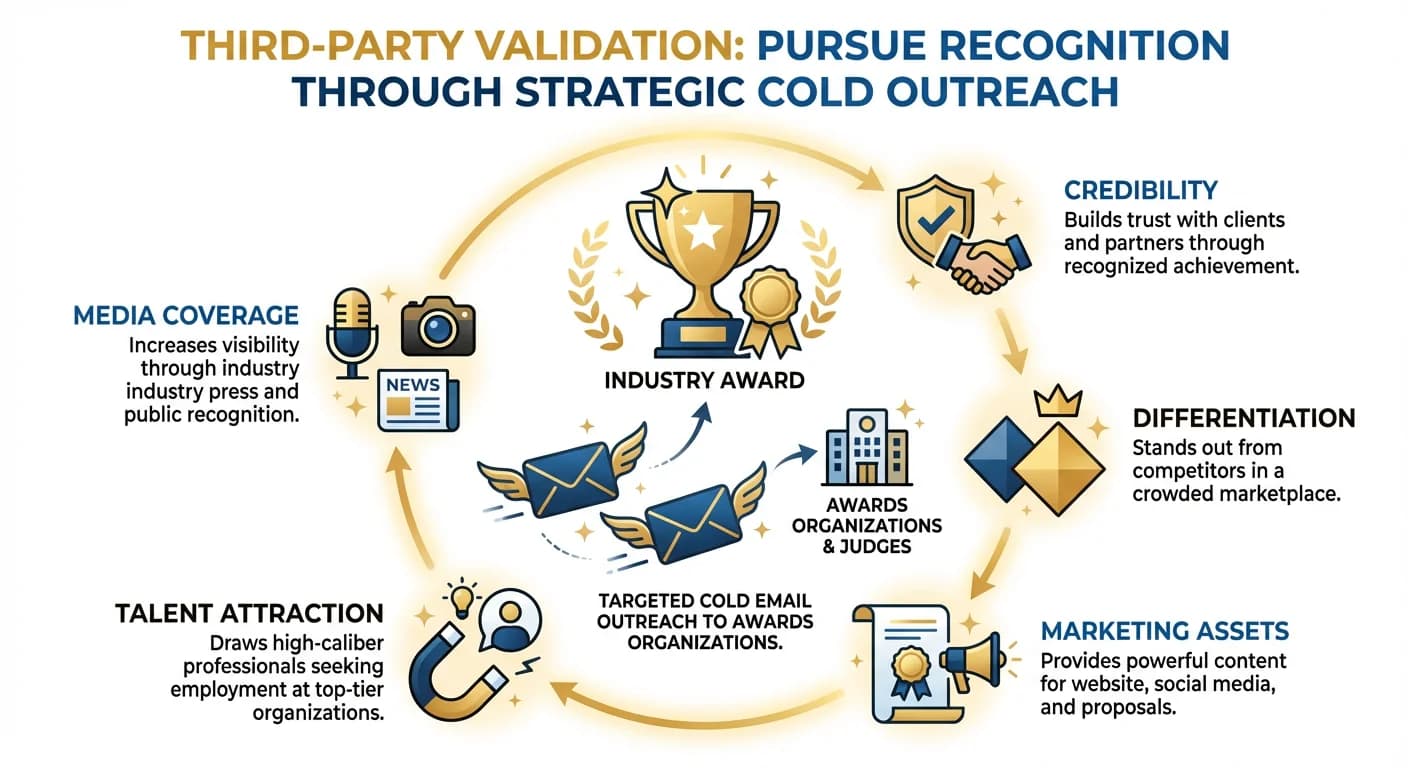
Cold email helps you pursue industry awards by connecting with awards organizations to clarify requirements, securing third-party nominations from partners or customers, learning application strategies from past winners, and building relationships with judges. Focus outreach on industry-specific awards that carry credibility with your target audience, then use personalized emails to request nominations, gather competitive intelligence, and understand selection criteria before applications close.
Key takeaways
- Awards provide third-party credibility, competitive differentiation, marketing assets, and talent attraction that marketing alone cannot replicate.
- Industry-specific awards from trade associations carry the highest credibility with your target audience compared to general business recognitions.
- Cold email serves four strategic purposes in awards pursuit: clarifying requirements with organizations, securing third-party nominations, learning from past winners, and building judge relationships.
- A structured awards calendar tracking application deadlines, requirements, past winners, and key contacts prevents missed opportunities and ensures adequate preparation time.
- The most valuable awards have credible selection processes, respected reputations in your industry, and usage rights that allow marketing leverage after winning.
Reviewed and updated September 15, 2026
Cold Email for Awards Nominations: Complete Strategy Guide
Industry awards provide third-party validation that marketing cannot replicate. Being recognized by respected organizations builds credibility with customers, investors, and talent while generating content you can leverage across marketing channels. The challenge is that most awards require proactive pursuit, and the most prestigious recognitions have competitive nomination and selection processes. Cold email provides a direct channel to awards organizations, nomination committees, and previous winners who can help position your company for success.
This guide covers everything you need to know about using cold email to pursue awards, from identifying the right opportunities to crafting nominations that stand out.
Why Industry Awards Matter
Awards provide benefits that extend well beyond the recognition event itself.
Third-party credibility. When independent organizations recognize your company, customers receive validation from a neutral source they can trust.
Competitive differentiation. Awards separate you from competitors who lack similar recognition, particularly in crowded markets.
Marketing assets. Award badges, coverage, and mentions provide content for your website, sales materials, and social media.
Talent attraction. Recognition signals success and desirability to potential employees evaluating your company.
Investor confidence. Awards demonstrate market validation that can strengthen fundraising conversations.
Media coverage. Many awards generate press coverage, expanding your visibility beyond your existing audience.
Team morale. Recognition motivates employees and validates their contributions.
Types of Awards to Pursue
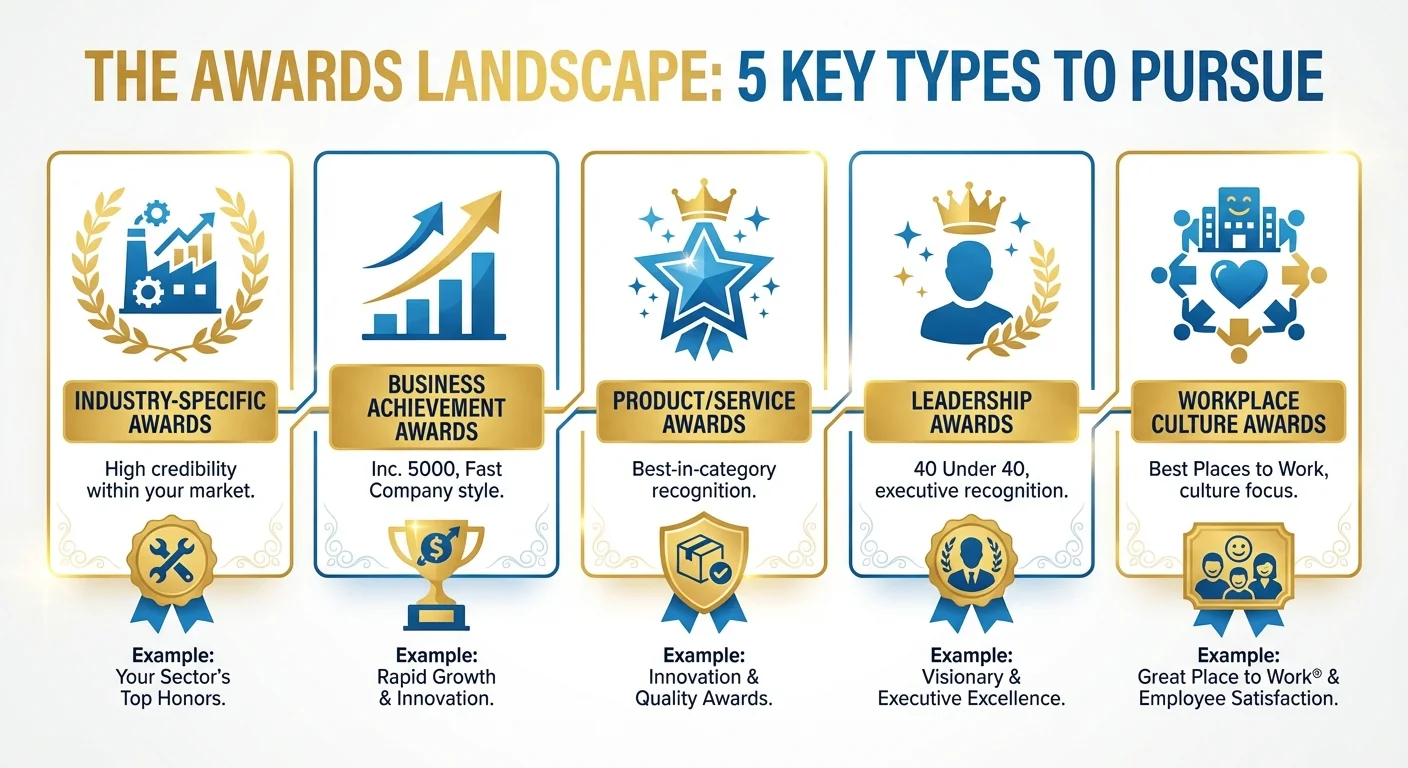
Not all awards carry equal value. Focus on opportunities that align with your goals and target audience.
Industry-Specific Awards
Industry associations and trade organizations recognize excellence within specific sectors. These awards carry weight with customers and partners in your market.
Value: High credibility within your industry; recognized by your target audience.
Examples: Technology awards from industry associations, vertical-specific recognitions, sector leadership awards.
Business Achievement Awards
Broader business awards recognize company growth, innovation, leadership, or workplace excellence.
Value: General business credibility; useful for talent and investor audiences.
Examples: Inc. 5000, Fast Company Most Innovative Companies, Great Place to Work certifications, regional business awards.
Product and Service Awards
These awards specifically recognize excellence in products, services, or solutions.
Value: Direct customer relevance; validates what you're selling.
Examples: Product of the year awards, best-in-category recognitions, user-voted awards.
Leadership and Individual Awards
Awards recognizing executives, founders, or individual contributors.
Value: Builds personal and company brand; attracts attention to the organization.
Examples: 40 Under 40 lists, industry leadership awards, entrepreneur recognitions.
Workplace and Culture Awards
Awards recognizing organizational culture, employee experience, or workplace practices.
Value: Talent attraction; validates company values.
Examples: Best Places to Work, diversity and inclusion awards, workplace culture recognitions.
Finding Award Opportunities
Systematic identification of award opportunities prevents missing valuable recognitions.
Research Methods
Industry association calendars. Industry groups typically announce awards on predictable schedules. Follow their communications and check websites regularly.
Competitor monitoring. Track what awards competitors have won. You may qualify for the same recognitions.
Trade publication awards. Many industry publications sponsor awards programs. Review publications in your space.
Google searches. Queries like "[your industry] awards [year]" or "best [product category] awards" surface opportunities.
Award databases. Services compile awards across industries. These can surface opportunities you might miss otherwise.
LinkedIn announcements. Pay attention when peers announce awards they've won. These may be relevant for your company.
Evaluating Award Value
Before investing time in an application:
Reputation: Is this award respected in your industry? Have reputable companies won it?
Reach: Who sees this award? Does the audience align with your goals?
Process: Is the selection process credible? Paid awards that require no vetting carry little value.
Effort: What's required to apply? Balance the investment against potential benefit.
Usage rights: Can you use the award in marketing? What are the terms for badge usage and promotion?
- Yes: Reputation: is this award respected in your industry, and have reputable companies won it?
- Yes: Reach: who sees this award, and does the audience align with your goals?
- Yes: Process: is the selection process credible? Paid awards that require no vetting carry little value.
- Yes: Effort: what is required to apply? Balance the investment against the potential benefit.
- Yes: Usage rights: can you use the award in marketing, and what are the terms for badge usage and promotion?
Building Your Awards Calendar
Create a structured calendar tracking:
- Award name and organization
- Application opening and closing dates
- Requirements and eligibility criteria
- Past winners (for competitive analysis)
- Materials needed for submission
- Key contacts at the organization
Planning ensures you have time to prepare strong applications and don't miss deadlines.
Using Cold Email in Awards Pursuit
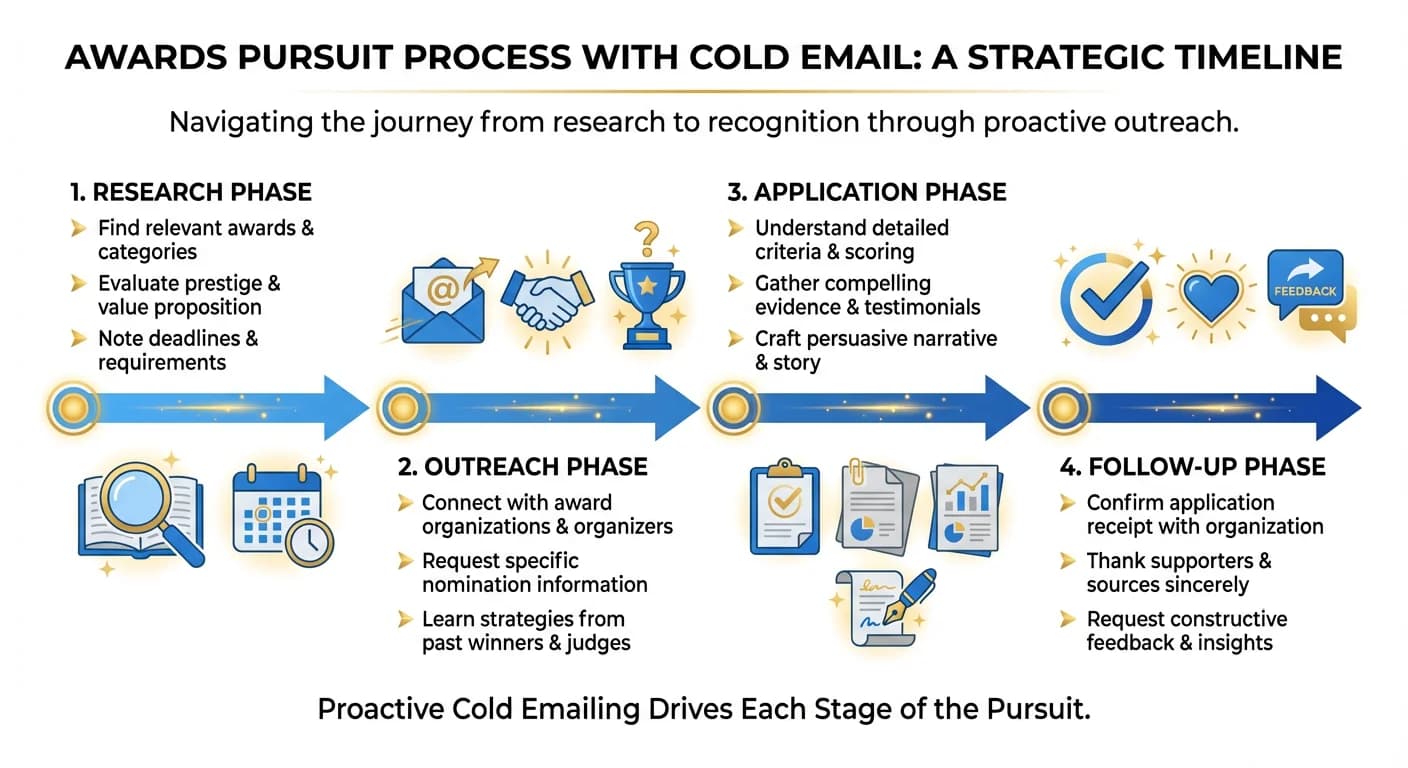
Cold email serves multiple purposes in the awards process.
Connecting with Awards Organizations
Reach out to awards programs to:
- Clarify eligibility requirements
- Understand selection criteria
- Ask questions about the process
- Express interest in future participation
- Build relationships for ongoing engagement
Securing Nominations
Some awards require third-party nominations. Cold email helps:
- Request nominations from clients or partners
- Connect with past winners who might nominate you
- Reach out to industry peers for support
- Engage judges or committee members (where appropriate)
Learning from Past Winners
Previous winners can provide valuable insights:
- What made their application successful
- What judges prioritize
- How to position your submission
- Common mistakes to avoid
Building Relationships with Judges
Where appropriate and ethical:
- Understand what judges look for
- Position yourself as a thought leader in their awareness
- Seek opportunities to engage (conferences, content, etc.)
- Build visibility before the selection process
Crafting Award-Related Outreach
Different award outreach scenarios require different approaches.
Reaching Out to Awards Organizations
Subject Lines:
- "Question about [Award Name] eligibility"
- "[Award Name] application inquiry"
- "Interested in [Award Name] for [Year]"
Email Structure:
Hi [Name],
I'm reaching out regarding [Award Name]. My company, [Company Name], [brief description] and I believe we may be a strong candidate for this recognition.
Before completing our application, I wanted to clarify [specific question about eligibility, criteria, or process].
Additionally, I'd appreciate any guidance on what makes applications stand out or common areas where candidates fall short.
Thank you for your time.
[Your Name] [Company]
Requesting Third-Party Nominations
Subject Lines:
- "Quick favor: [Award Name] nomination"
- "Would you nominate [Company] for [Award]?"
- "[Award] nomination request"
Email Structure:
Hi [Name],
I hope this finds you well. I'm reaching out with a request.
[Company Name] is pursuing [Award Name], and nominations from [clients/partners/industry peers] are part of the selection process. Given our [relationship/work together/collaboration], I wanted to ask if you'd be willing to submit a nomination on our behalf.
The nomination process involves [brief description of what's required]. I can provide any information that would be helpful.
I completely understand if you're not able to do this. Either way, I appreciate you considering it.
[Your Name]
Connecting with Past Winners
Subject Lines:
- "Congrats on [Award Name], quick question"
- "[Award Name] advice for future applicants?"
- "Your [Award Name] win inspired a question"
Email Structure:
Hi [Name],
Congratulations on your [Award Name] recognition. I saw the announcement and thought the recognition was well-deserved given [specific accomplishment or quality].
I'm pursuing [same or related award] for [Company Name] and was hoping you might share any insights about the application or selection process. Specifically, I'm curious about [specific question].
I understand you're busy, so even a brief response would be helpful.
Thank you, [Your Name]
Building Judge Relationships
Subject Lines:
- "Enjoyed your [talk/article/panel] on [topic]"
- "[Topic] question from an admirer of your work"
- "Your perspective on [topic]"
Email Structure:
Hi [Name],
I came across your [recent work/talk/article] on [topic] and found your point about [specific insight] particularly valuable. It directly applies to challenges we're navigating at [Company].
I'm [brief introduction and context]. I'd love to continue learning from your perspective on [topic].
Would you be open to connecting briefly? I'm also happy to share [something of value you could offer].
[Your Name]
Note: This outreach should be genuinely about learning, not transparently about influencing awards decisions. Building authentic relationships before any awards connection is key.
- Clarify eligibility requirements
- Understand selection criteria
- Ask questions about the process
- Express interest in future participation
- Ask what makes applications stand out and where candidates fall short
- Request nominations from clients or partners where the award requires them
- Connect with past winners who might nominate you
- Reach out to industry peers for support
- Offer to provide any information that would be helpful
- What made their application successful
- What judges prioritize
- How to position your submission
- Common mistakes to avoid
Creating Winning Award Applications
Most awards require formal applications. Strong applications significantly improve your chances.
Understanding Selection Criteria
Before writing, thoroughly understand:
- Official evaluation criteria and weighting
- What judges have said matters in past cycles
- Themes or focus areas for the current year
- How technical vs. narrative the application should be
Application Best Practices
Lead with impact. Open with your most compelling achievement or metric. Judges review many applications and make quick assessments.
Be specific. Vague claims like "industry leader" mean nothing. Specific metrics, outcomes, and examples demonstrate achievement.
Tell a story. Frame your application as a narrative: the challenge you faced, the approach you took, and the results you achieved.
Address criteria directly. Structure your application to clearly address each evaluation criterion. Don't make judges hunt for relevant information.
Provide evidence. Support claims with data, testimonials, media coverage, or other proof points.
Differentiate from competition. Explicitly address what makes your company, product, or achievement unique.
Follow instructions exactly. Word limits, format requirements, and submission guidelines exist for reasons. Ignoring them signals lack of attention to detail.
Supporting Materials
Many applications accept or require supporting materials:
Customer testimonials. Quotes from satisfied customers validate your claims.
Data visualizations. Charts and graphs make impact immediately visible.
Case studies. Detailed examples of successful implementations or outcomes.
Media coverage. Third-party recognition from publications supports credibility.
Product demonstrations. Videos or screenshots showcasing what you've built.
Financial metrics. Growth rates, revenue figures, or efficiency gains (if appropriate to share).
Follow-Up Strategy
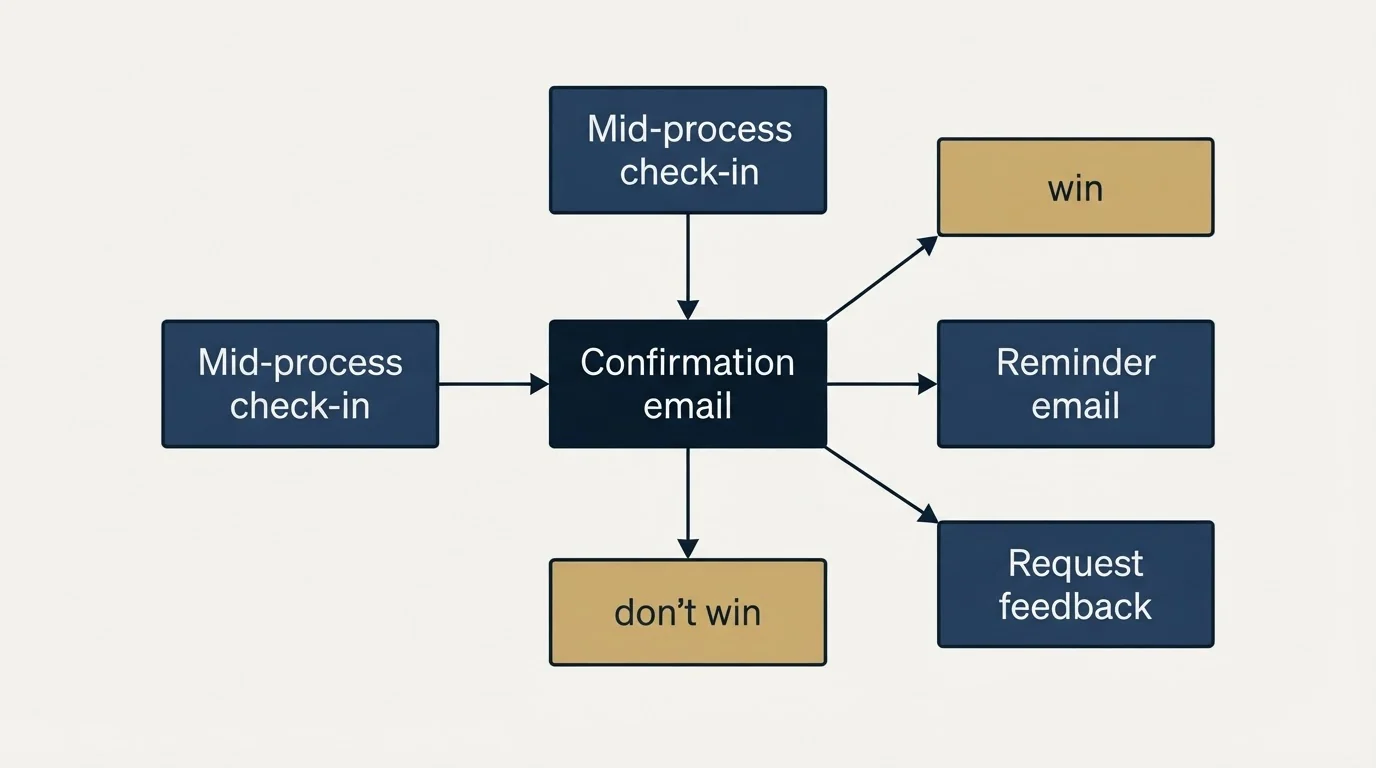
Awards processes benefit from thoughtful follow-up.
Post-Application Follow-Up
After submitting your application:
Confirmation email:
Hi [Name],
I wanted to confirm that our application for [Award Name] was received. Please let me know if you need any additional information or materials.
Thank you for the opportunity to be considered.
[Your Name]
Mid-process check-in (if timeline allows):
Hi [Name],
I hope the [Award Name] review process is going well. I wanted to check if there's any additional information about [Company Name] that would be helpful for the selection committee.
I'm happy to provide context, answer questions, or supply supplementary materials if useful.
[Your Name]
Following Up on Nominations
If you requested nominations from others:
Reminder email:
Hi [Name],
I wanted to follow up on my request for a [Award Name] nomination for [Company]. The deadline is [date], and I wanted to make sure you had enough time if you're still willing.
I'm happy to provide any information that would help with the nomination, or to handle any questions that come up.
Thank you again for considering this.
[Your Name]
After Results
If you win:
Send personalized thank-you notes to:
- Awards organization contacts
- Anyone who nominated you
- Supporters who provided materials or testimonials
- Anyone who advised you on the process
If you don't win:
Request feedback:
Hi [Name],
Thank you for the opportunity to be considered for [Award Name]. While we weren't selected this year, I wanted to ask if you're able to share any feedback on our application.
Understanding where we fell short would help us strengthen future submissions. I appreciate any insights you can offer.
[Your Name]
Common Mistakes to Avoid
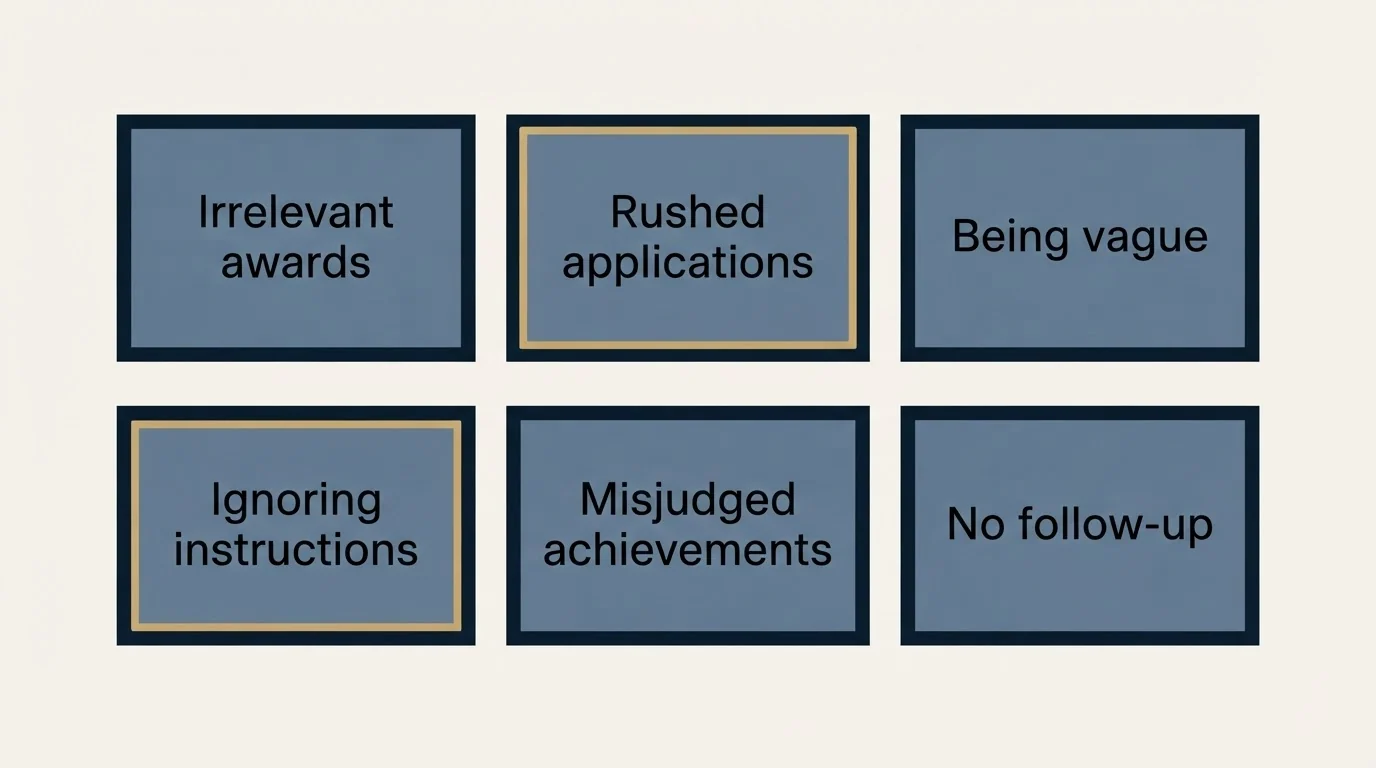
Applying for Irrelevant Awards
Pursuing awards that don't align with your audience or goals wastes time and dilutes your recognition portfolio.
Rushing Applications
Strong applications require time for research, writing, and review. Last-minute submissions rarely win.
Being Vague
Generic claims without specific evidence fail to impress judges who review hundreds of applications.
Ignoring Instructions
Word limits, format requirements, and submission deadlines exist for reasons. Violations suggest carelessness.
Underselling Achievements
False modesty in competitive applications costs you recognition. Present your accomplishments confidently with clear evidence.
Overselling Achievements
Exaggerated claims that judges can't verify damage credibility. Be ambitious but honest.
Not Following Up
Abandoning the process after submission misses opportunities to reinforce your candidacy or learn from the experience.
Ignoring Networking Opportunities
Awards events and communities offer valuable connections beyond the recognition itself.
Your Awards Outreach Checklist
Research Phase
- Identified relevant awards in your industry
- Evaluated award value (reputation, reach, effort)
- Noted deadlines and requirements
- Researched past winners
- Identified judges and selection committee
Outreach Phase
- Connected with awards organization for guidance
- Requested nominations (if required)
- Reached out to past winners for insights
- Built relationships with relevant judges (where appropriate)
Application Phase
- Understood selection criteria thoroughly
- Gathered supporting materials and evidence
- Crafted compelling narrative with specific metrics
- Addressed all criteria directly
- Followed all submission guidelines
- Had application reviewed before submission
Follow-Up Phase
- Confirmed application receipt
- Offered additional information during review
- Sent nomination reminders (if needed)
- Thanked supporters regardless of outcome
- Requested feedback if not selected
Building an Awards Program
Industry awards provide valuable recognition that builds credibility across audiences. Cold email supports the awards pursuit process by connecting you with awards organizations, past winners, potential nominators, and judges.
Success requires systematic identification of opportunities, thorough preparation, and strong applications that clearly demonstrate achievement. Treat awards as an ongoing program rather than ad-hoc efforts, building relationships and institutional knowledge over time.
If you're looking to systematize your awards outreach while maintaining personalization, RevenueFlow can help. Our done-for-you cold email campaigns apply these principles to build your awards recognition portfolio.
Get Your Free Campaign and see how targeted cold email can help you earn industry recognition.
Related Reading
Frequently asked questions.
Frequently asked questions- How do I use cold email to get award nominations?
- Cold email helps you request third-party nominations from customers, partners, or industry peers who can nominate your company for awards requiring external submissions. Reach out to awards organizations to clarify eligibility and selection criteria, contact past winners to learn their application strategies, and connect with judges to build relationships before applications. Focus on personalized outreach that explains why the award aligns with your achievements and makes nomination easy for the recipient.
- What types of awards should my company pursue?
- Prioritize industry-specific awards from trade associations and sector organizations because they carry the highest credibility with your target customers and partners. Also consider product and service awards that validate what you're selling, business achievement awards for growth and innovation, leadership awards to build executive visibility, and workplace culture awards to attract talent. Evaluate each opportunity based on reputation, audience reach, selection process credibility, and whether you can use the recognition in marketing.
- Why do industry awards matter for B2B companies?
- Awards provide third-party validation that your own marketing cannot replicate, building credibility with customers who trust independent recognition. They differentiate you from competitors in crowded markets, generate marketing assets like badges and press coverage, attract top talent who view awards as success signals, and strengthen investor confidence by demonstrating market validation. Awards also boost team morale by validating employee contributions and extending visibility beyond your existing audience through media coverage.
- How do I find relevant award opportunities?
- Monitor industry association calendars for annual awards programs, track which awards your competitors have won, review awards sponsored by trade publications in your space, and search Google for terms like your industry plus 'awards' and the current year. Also watch LinkedIn for peer announcements of awards they've received and consider award databases that compile opportunities across industries. Build a structured calendar tracking deadlines, requirements, past winners, and key contacts to avoid missing valuable opportunities.
About the author.

Ben Carden is CRO at RevenueFlow, which builds and operates outbound revenue engines for B2B companies. Previously at Gartner Enterprise. Studied at London School of Economics.
Ben Carden · CRO
Connect on LinkedIn →Explore more.
Ready to scale your outreach?
We build GTM engines that book real meetings. See the receipts.
Related articles.
Cold Email for PR: How to Pitch Journalists and Get Coverage
Learn how to craft cold emails that get journalists to open, read, and respond to your pitches. Includes real templates, timing strategies, and a complete PR outreach checklist.
Cold Email for Mentorship: Complete Strategy Guide
Learn how to use cold email to find and connect with mentors who can accelerate your career or business. Includes proven templates, personalization strategies, and best practices for building meaningful mentor relationships.
Cold Email for Conference Speaking: Complete Strategy Guide
Learn how to use cold email to secure speaking opportunities at industry conferences and events. Includes proven templates, pitch strategies, and best practices for speaker outreach.
Cold Email for Webinar Guest Recruitment: Strategy Guide
Learn how to use cold email to recruit expert guests for your webinars. Includes proven templates, personalization strategies, and best practices for building a roster of compelling webinar speakers.
Cold Email for Guest Blogging: Complete Strategy Guide
Learn how to use cold email to secure guest blogging opportunities on high-authority publications. Includes proven templates, pitch strategies, and best practices for building your content portfolio.
Cold Email for Interview Requests: Complete Strategy Guide
Learn how to use cold email to secure interviews with industry experts, thought leaders, and key stakeholders. Includes proven templates, timing strategies, and follow-up frameworks.