Cold Email for Interview Requests: Complete Strategy Guide
Learn how to use cold email to secure interviews with industry experts, thought leaders, and key stakeholders. Includes proven templates, timing strategies, and follow-up frameworks.
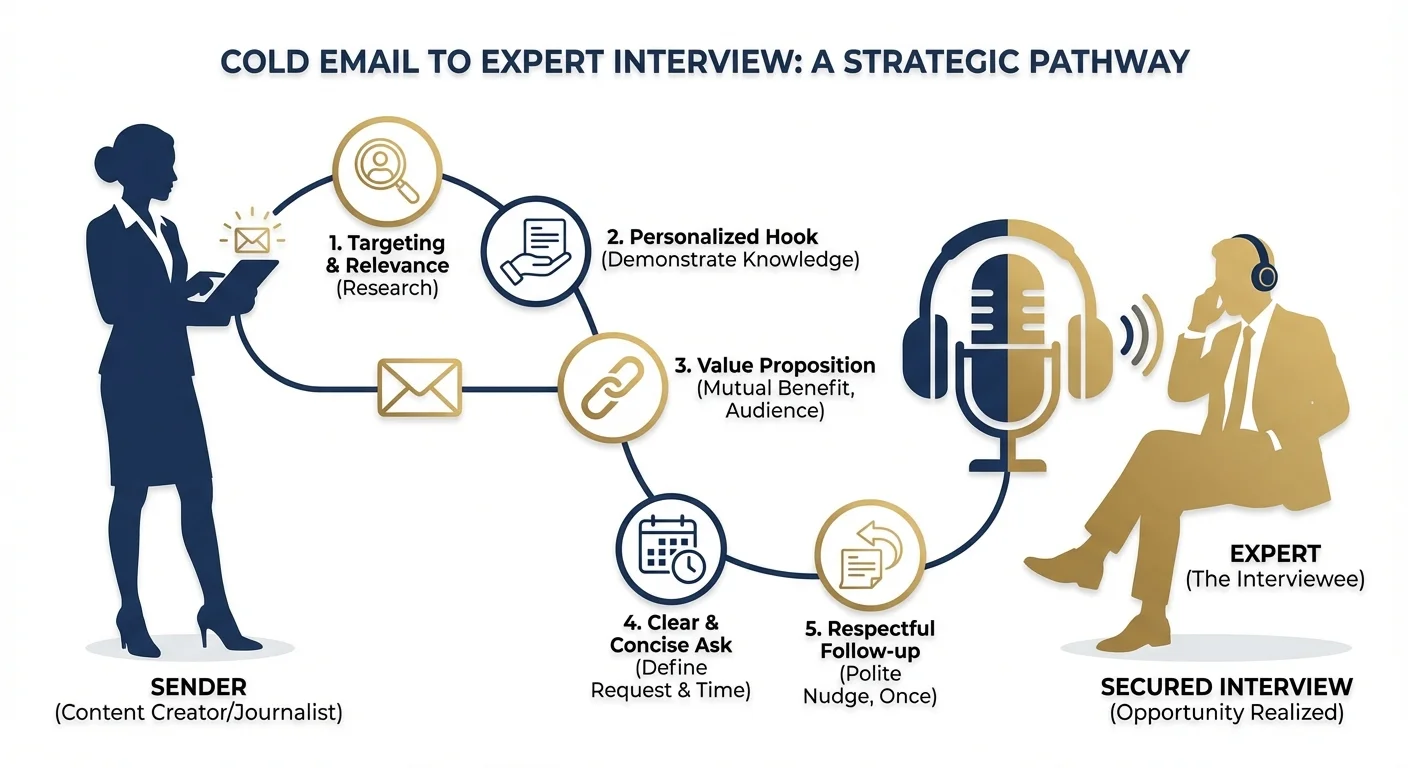
Cold email is the most effective method for securing interviews with industry experts because it provides direct access, allows thoughtful presentation of your request, scales efficiently across multiple prospects, creates documented context for busy professionals to review, and establishes immediate credibility. It bypasses limitations of social media, mutual connections, and event networking while enabling precision targeting of individuals whose perspectives match your specific content needs.
Key takeaways
- Cold email outperforms social media, mutual connections, and conference networking by providing direct access to professionals and allowing you to craft compelling, researched pitches that can be reviewed on the recipient's schedule.
- Successful interview prospecting requires defining five criteria: expertise relevance, audience value, accessibility likelihood, content compatibility, and network potential before initiating outreach.
- Ideal interview subjects can be systematically identified through seven channels: industry publications, conference speaker lists, podcast guest rosters, LinkedIn thought leaders, company executives, academic institutions, and professional associations.
- Each prospect entry should include full name, current title, organization, recent work, specific expertise areas, personalization hooks, and estimated response likelihood to maximize outreach effectiveness.
- Strategic targeting with clear criteria produces higher response rates and better interview quality than casting a wide net across unqualified prospects.
Reviewed and updated September 15, 2026
Cold Email for Interview Requests: Complete Strategy Guide
Securing interviews with industry experts, thought leaders, and successful professionals can transform your content, research, or journalism. These conversations provide unique insights that cannot be found in published materials, offering your audience genuine value while building your professional network. Cold email remains the most effective method for reaching busy professionals who would otherwise be inaccessible.
A technology journalist once spent three months trying to reach a prominent AI researcher through social media, mutual connections, and conference networking. A single well-crafted cold email accomplished what those months of effort could not, landing an exclusive interview that became the foundation for an award-winning series.
Why Cold Email Works for Interview Requests
Traditional networking approaches have significant limitations when seeking interviews. Social media messages get buried in crowded inboxes. Mutual connections may not have the relationship strength to make effective introductions. Event networking requires physical proximity and perfect timing. Cold email eliminates these barriers by providing direct access to virtually anyone with a professional email address.
The Strategic Advantage of Direct Outreach
Cold email for interview requests offers several distinct benefits over alternative approaches:
Precision targeting: You can identify and contact the exact individuals whose perspectives would be most valuable. No waiting for chance encounters or hoping mutual connections will make introductions.
A similar guide on cold email for case study participation explains how that same precision targeting helps you build a scalable pipeline of customer participants.
Thoughtful presentation: Unlike chance meetings or social media interactions, cold email allows you to craft a compelling pitch that demonstrates your research, articulates your value proposition, and makes responding easy.
Scalable efforts: You can reach multiple potential interviewees simultaneously, increasing your chances of securing conversations while maintaining personalized communication.
Documented context: Your email provides a reference that recipients can review, share with gatekeepers, or return to when their schedule permits. This persistence advantage matters when contacting busy professionals.
Professional framing: A well-structured email immediately establishes you as serious and credible, distinguishing your request from casual social media messages.
Finding the Right Interview Subjects
The success of your interview outreach depends entirely on targeting individuals whose insights genuinely match your content needs. Casting too wide a net wastes time and diminishes response rates. Strategic targeting maximizes both efficiency and outcome quality.
Defining Your Ideal Interview Subject
Before initiating any outreach, establish clear criteria for your ideal interview subjects:
Expertise relevance: Does the person possess direct knowledge or experience related to your topic? First-hand expertise produces richer content than theoretical understanding.
Audience value: Will your audience care about this person's perspective? Consider their recognition level, the uniqueness of their viewpoint, and their ability to articulate insights clearly.
Accessibility likelihood: Some individuals are inundated with interview requests while others rarely receive them. Balance ambition with pragmatism when building your target list.
Precision targeting matters just as much when seeking guidance, and the strategy guide for mentorship outreach shows how to frame a small, specific ask.
Content compatibility: Does this person's communication style and depth of knowledge match your format? A technical deep-dive requires different subjects than a quick-hit podcast episode.
Network potential: Beyond the immediate interview, could this relationship lead to additional opportunities, referrals, or ongoing collaboration?
Where to Find Interview Prospects
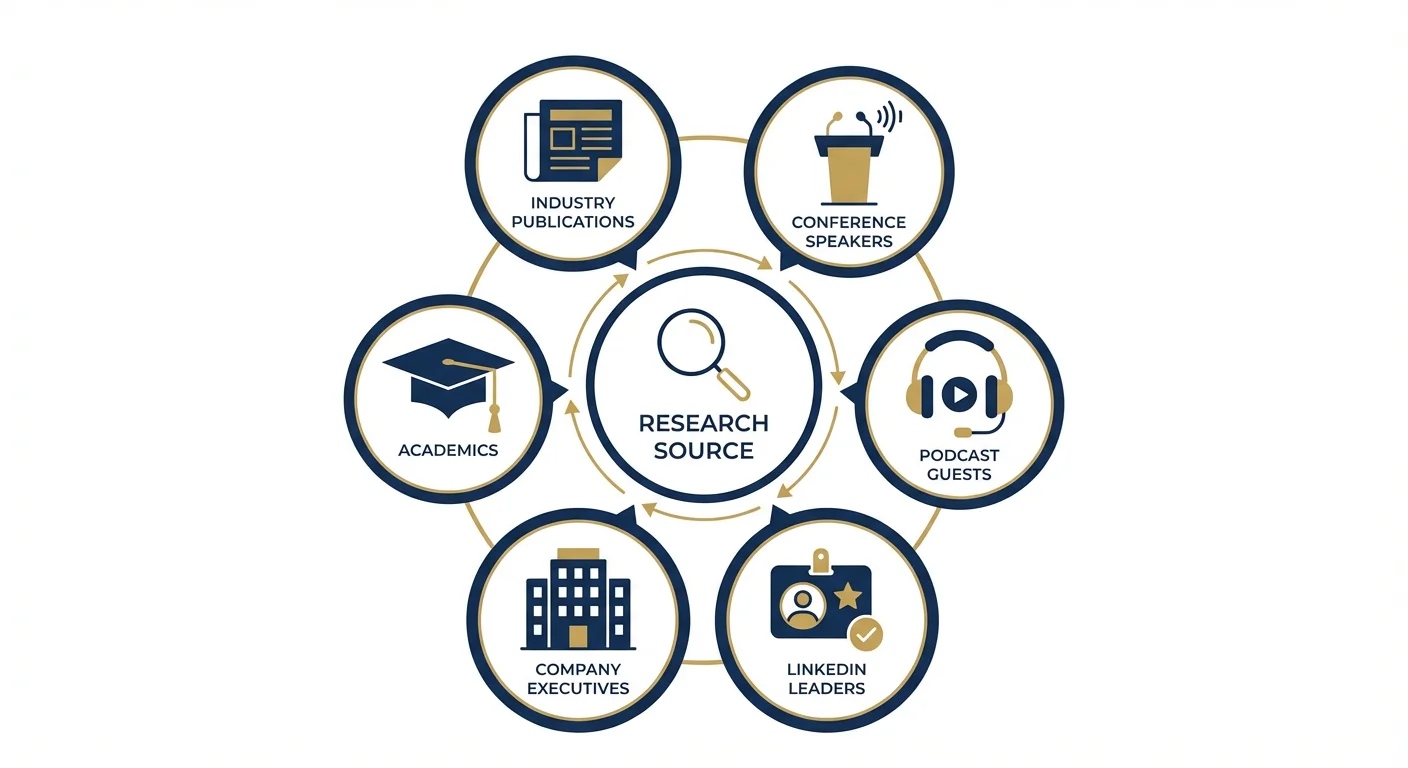
Identifying ideal interview subjects requires systematic research across multiple channels:
Industry publications: Authors of articles, research papers, and books in your subject area have demonstrated expertise and communication ability. Their published work also provides personalization opportunities.
Conference speakers: Event speaker lists curate qualified experts who have already proven willing to share knowledge publicly. Recent presentations indicate current activity and availability.
Podcast appearances: Individuals who have appeared on podcasts in your niche have demonstrated both expertise and media-friendliness. Their existing interviews also reveal communication style.
LinkedIn thought leadership: Active LinkedIn contributors with engaged followings have established expertise and demonstrated comfort with public discourse. Their content provides rich personalization material.
Company leadership: Executives and founders at relevant companies offer unique perspectives on industry trends, organizational challenges, and strategic decisions.
Academic institutions: Professors and researchers provide rigorous, evidence-based perspectives that complement practitioner viewpoints.
Professional associations: Association leaders and committee members often welcome opportunities to represent their industries and organizations.
Building Your Interview Prospect List
Compile comprehensive information for each potential interview subject:
- Full name and current title
- Organization and relevant background
- Email address (and backup contact methods)
- Recent work, publications, or public appearances
- Specific expertise areas relevant to your needs
- Potential personalization hooks
- Estimated likelihood of response (high, medium, low)
Aim for a diverse list that includes both aspirational targets and accessible alternatives. Having options prevents project delays when first-choice subjects are unavailable.
What to Offer Interview Subjects
Every interview request is implicitly asking for something valuable: the subject's time, expertise, and willingness to be quoted. Successful outreach demonstrates clear value exchange that makes participation worthwhile.
That same value exchange principle applies when reaching out to potential mentors, as explained in this guide to crafting effective mentorship outreach.
Value Propositions That Resonate
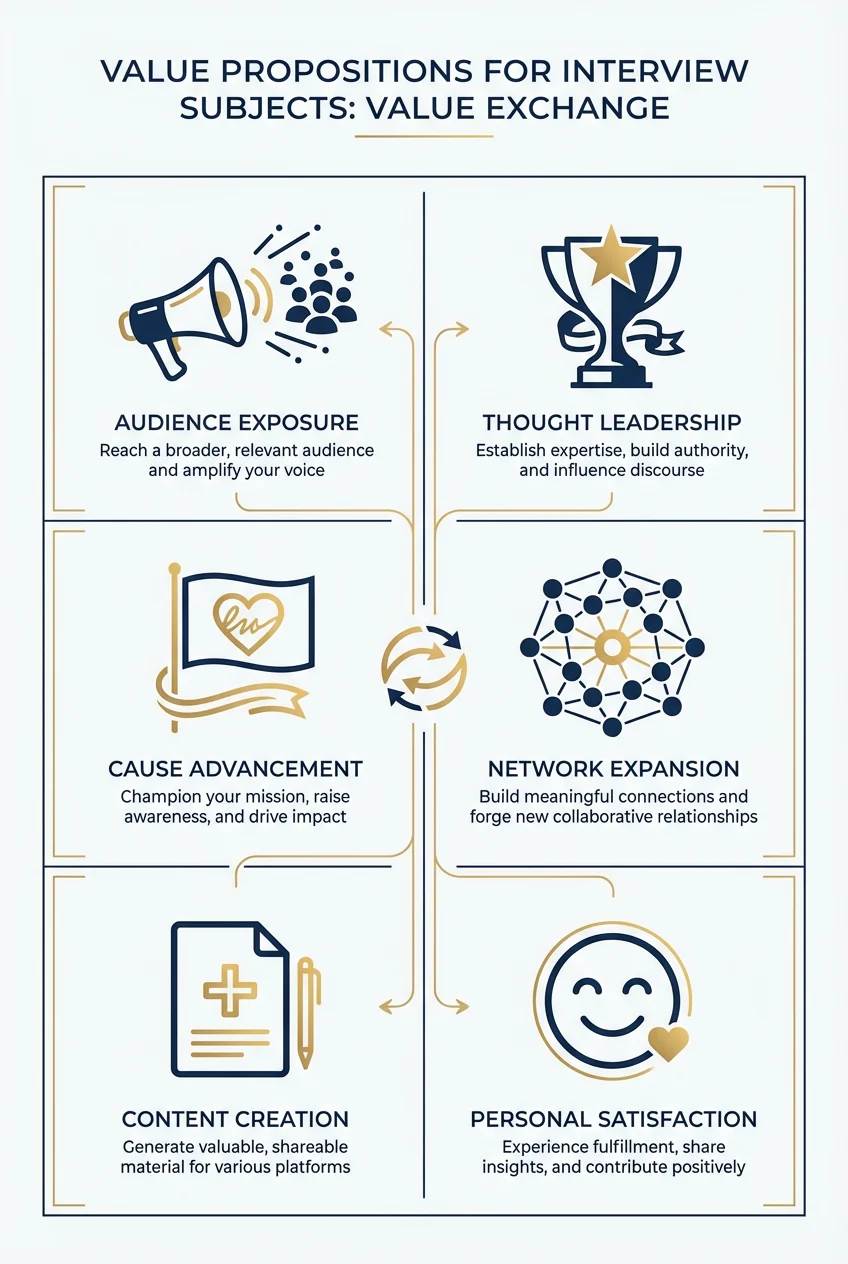
Different interview subjects respond to different incentives. Consider which appeals will resonate most strongly with your targets:
Audience exposure: Reaching your audience may benefit the subject's professional goals, book sales, company promotion, or personal brand. Quantify your reach when impressive.
Thought leadership positioning: Being quoted as an expert reinforces the subject's authority in their field. This appeals particularly to consultants, authors, and professionals building public profiles.
Thought leadership positioning also extends naturally to industry awards, where pursuing award nominations through outreach can further cement an expert's public authority.
Cause advancement: Subjects passionate about specific topics may welcome opportunities to spread their message. Align your interview focus with their advocacy priorities.
Network expansion: Connecting with you and potentially your audience members offers relationship value independent of the content itself.
Content creation value: The interview itself becomes content the subject can repurpose, reference in their own materials, or share with their networks.
Personal satisfaction: Many experts genuinely enjoy discussing their work and teaching others. The intrinsic reward of sharing knowledge motivates participation.
Structuring Your Interview Offer
Your outreach should clearly communicate:
- What the interview will cover (topics, angle, focus)
- How the content will be used (publication, podcast, research)
- What audience will see the finished product
- How much time the interview requires
- What format you prefer (call, video, written)
- Any preparation requirements
- When you need to conduct the interview
- What they receive in return (links, promotion, copies)
Clarity about expectations reduces friction and increases response rates. Ambiguity triggers hesitation and non-response.
What Works: Interview Request Email Best Practices
Effective interview request emails balance professionalism with genuine enthusiasm. Your message should demonstrate that you have done your homework while making participation feel easy and appealing.
Subject Line Principles
Your subject line determines whether busy professionals open your email. For interview requests:
- Reference their specific expertise or recent work
- Mention your platform or publication
- Create curiosity without appearing spammy
- Keep it under 50 characters when possible
Examples that perform well:
- "Interview request: [specific topic]"
- "Your insights on [topic] for [publication]"
- "Your [recent work] and a question for [publication]"
- "Quick interview for [publication]?"
Email Body Structure
Structure your interview request emails with these essential elements:
Credibility establishment: Open with context about who you are and why you are credible. Mention your publication, audience size, previous notable interviews, or relevant credentials.
Personalized connection: Reference something specific about the recipient. Their recent work, a particular viewpoint, or a shared connection demonstrates genuine interest beyond a mass request.
Clear purpose statement: Explain exactly what you want to discuss and why their perspective matters. Specificity signals preparation and respect for their expertise.
Value proposition: Articulate what they gain from participating. Exposure, positioning, satisfaction, or other benefits should be explicit.
Logistics transparency: Provide clear information about time commitment, format, timeline, and usage. Remove all ambiguity that might create friction.
Easy response path: Make saying yes simple. Offer scheduling links, suggest specific times, or ask a single yes/no question.
- Step 1Credibility establishment
Open with context about who you are and why you are credible.
- Step 2Personalized connection
Reference something specific about the recipient.
- Step 3Clear purpose statement
Explain exactly what you want to discuss and why their perspective matters.
- Step 4Value proposition
Articulate what they gain from participating.
- Step 5Logistics transparency
Provide clear information about time commitment, format, timeline, and usage.
- Step 6Easy response path
Make saying yes simple. Offer scheduling links, suggest specific times, or ask a single yes/no question.
Tone and Voice Guidelines
Interview request emails succeed when they feel like professional invitations from credible sources:
- Write with confidence without arrogance
- Demonstrate genuine enthusiasm for the topic
- Respect their time by being concise
- Avoid excessive flattery that feels insincere
- Maintain formality appropriate to your industry
- Express flexibility while showing you value their participation
Interview Request Email Templates
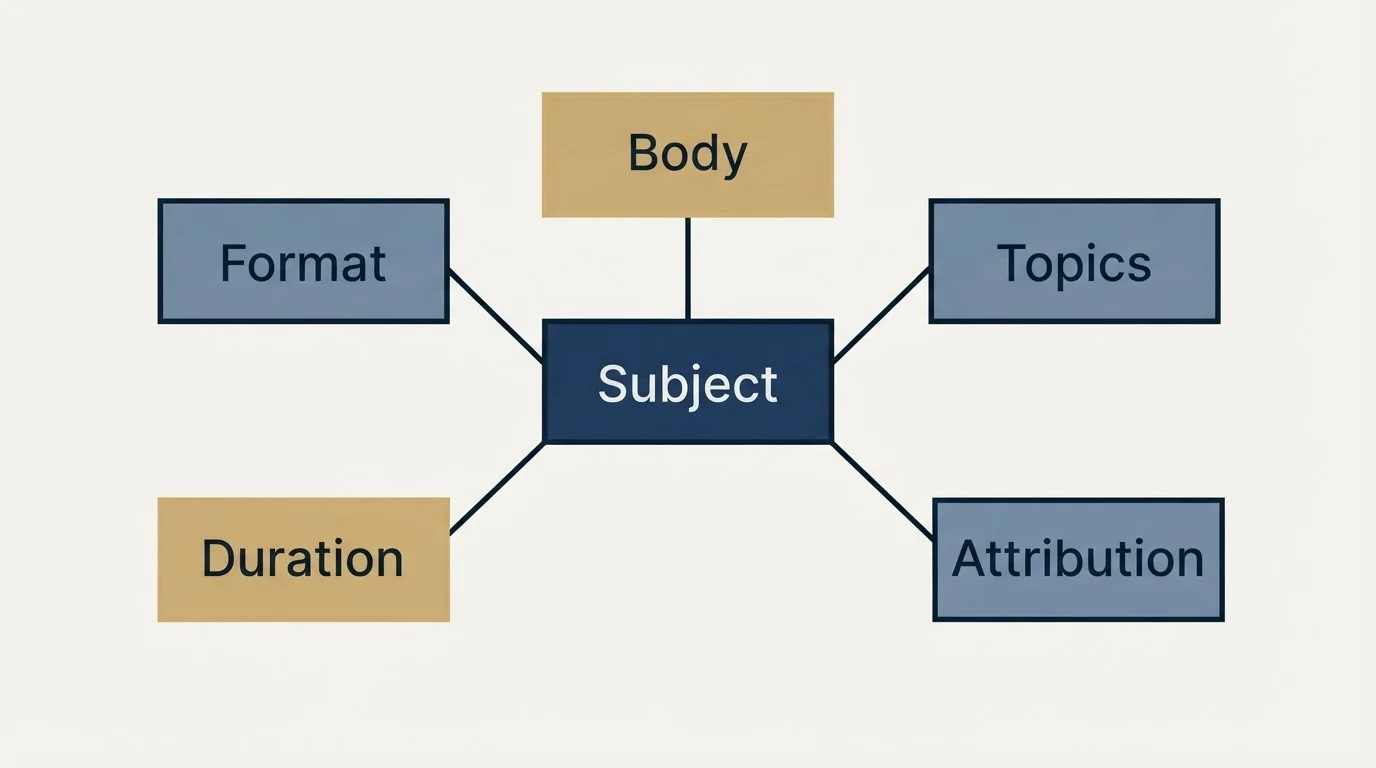
The following templates demonstrate effective approaches for different interview scenarios. Customize these frameworks with specific details about your publication and target subject.
Template 1: The Expert Authority Request
Subject: Interview request: [specific topic] for [publication]
Body:
Hi [First Name],
I am [Your Name], [your role] at [Publication/Company]. We reach [audience description and size] through our [content format].
Your work on [specific topic, paper, or project] caught my attention, particularly your perspective on [specific insight or finding]. That viewpoint would provide tremendous value to our audience as they navigate [relevant challenge or trend].
I would love to interview you for an upcoming piece on [broader topic]. The conversation would focus on:
- [Specific question or topic 1]
- [Specific question or topic 2]
- [Specific question or topic 3]
The interview would take approximately [time estimate] via [preferred format]. I am flexible on scheduling and happy to work around your calendar.
We would include your bio, links to your work, and any other information you would like to share with our readers.
Would you be available for a conversation in the next [timeframe]?
Best, [Your Name] [Title] [Publication] [Contact information]
Template 2: The Recent Work Hook
Subject: Your [article/talk/project] + quick interview?
Body:
Hi [First Name],
I recently [read/watched/attended] your [specific piece of content] on [topic]. Your point about [specific insight] really resonated with the research I have been doing on [related topic].
I am putting together a piece for [publication/audience description] that explores [topic angle]. Your perspective would add significant depth, particularly around [specific area of their expertise].
The format would be a [time estimate] [call/video chat/written Q&A] at your convenience. I have a handful of focused questions that build on the ideas you shared in [referenced content].
Our piece will reach [audience details] and we would prominently feature your insights with full attribution and links to your work.
Does this sound interesting? I am happy to share the questions in advance if helpful.
[Your Name]
Template 3: The Mutual Connection Introduction
Subject: [Connection Name] suggested I reach out
Body:
Hi [First Name],
[Mutual Connection] mentioned you would be the perfect person to speak with about [topic]. They spoke highly of your expertise in [specific area].
I am working on [content description] for [publication/company]. The piece explores [topic angle] and aims to provide [audience] with [intended value].
Based on your experience with [specific relevant experience], I believe you could offer insights our audience cannot find elsewhere. [Mutual Connection] confirmed you are generous with your knowledge when it serves a valuable purpose.
Would you have [time estimate] for a [format] conversation in the next few weeks? I would send questions in advance so you can determine if the topics align with what you would like to discuss.
Thank you for considering, [Your Name] [Brief credentials]
Template 4: The Exclusive Angle Request
Subject: Exclusive interview opportunity: [topic]
Body:
Hi [First Name],
[Publication] is preparing a major piece on [topic/trend] that will reach [audience size and description]. We are seeking one authoritative voice to anchor the piece, and your work on [specific expertise area] makes you our first choice.
The piece will explore:
- [Topic area 1]
- [Topic area 2]
- [Topic area 3]
Your insights would be featured prominently, with an extended quote section and full bio. We anticipate significant engagement based on the topic's timeliness and our audience's interest in [related area].
The interview would require approximately [time estimate] via [format]. We are working toward a publication date of [date], so I would hope to complete the conversation by [deadline].
If this opportunity interests you, I am happy to share more details about our approach and the specific questions we would cover.
[Your Name] [Title], [Publication]
Template 5: The Research Project Request
Subject: Research interview request: [academic/professional project]
Body:
Hi [First Name],
I am [Your Name], [role/credentials] at [institution/organization]. I am conducting research on [topic] for [purpose: thesis, report, book, etc.].
Your published work on [specific papers or projects] and practical experience in [relevant area] would provide essential perspective for this project. I am particularly interested in your insights on [specific questions or themes].
The interview would involve:
- Format: [call/video/written responses]
- Duration: Approximately [time estimate]
- Topics: [brief overview of discussion areas]
- Attribution: [how you would credit them]
I can share interview questions in advance and am flexible on scheduling. Participation would be acknowledged in [final product] and I would provide you with a copy of the completed work.
Would you be willing to contribute to this research? I am happy to discuss the project further if you have questions before committing.
Thank you for considering, [Your Name] [Institution] [Credentials]
When An Interview Request Goes Unanswered
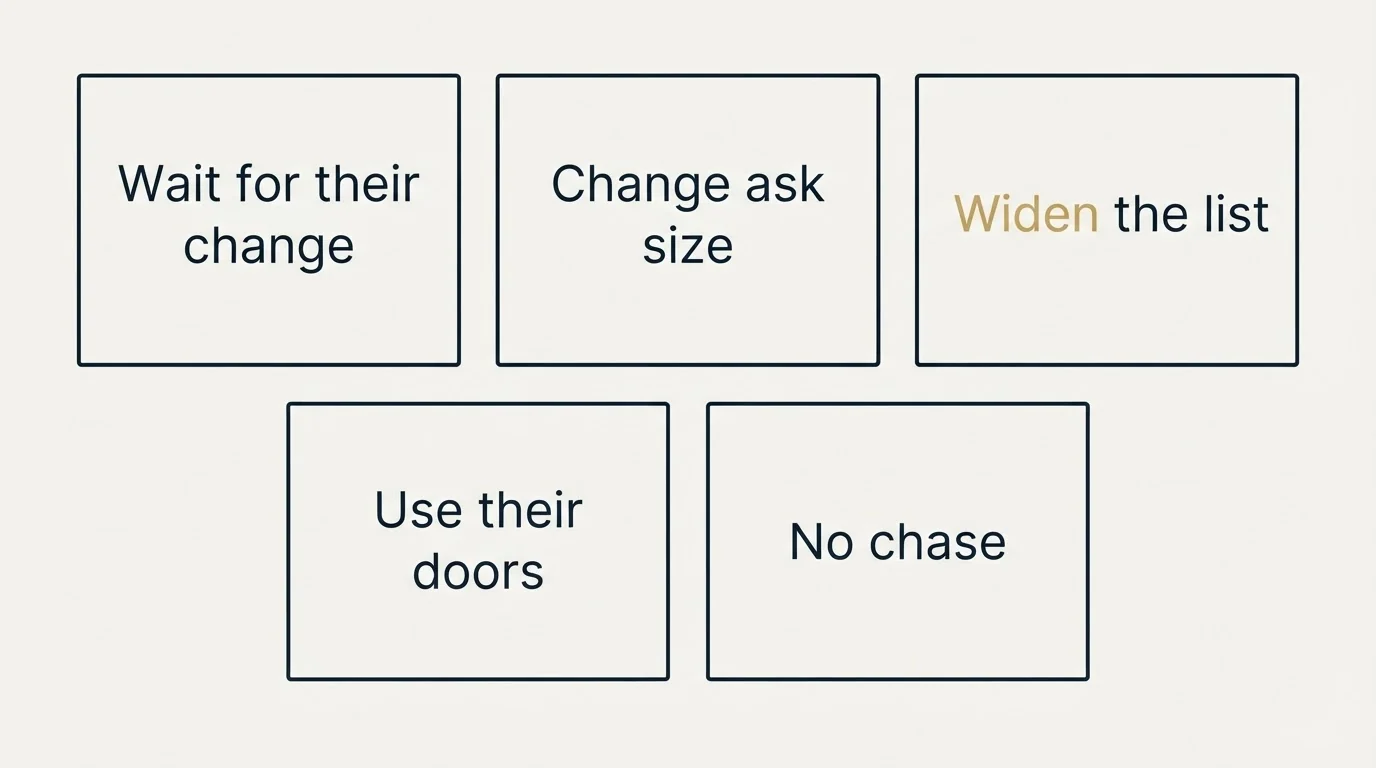
Busy professionals often intend to respond and lose the request in a crowded inbox, so silence is rarely a refusal. It usually means the ask arrived in the wrong month, the topic is not one they want to be quoted on right now, or the time you asked for was more than they had.
None of that is fixed by asking again in the same thread, which reads as a bump whatever the wording. The person you are approaching is someone you may want to interview repeatedly over the next decade, and a chase spends that relationship for nothing. Send one request per approach, and let the next approach have a genuinely new reason to exist.
What To Do Instead
Wait for something to change on their side. A new paper, a new book, a funding round, a product launch, a job move, a public argument they have just joined. Any of those is a reason to write that has nothing to do with your earlier email, and it is the approach most likely to land.
Change the size of the ask. A 45-minute recorded interview and three questions answered by email are different propositions. Coming back later with the smaller one is a new offer, not a reminder of the old one, and for genuinely busy experts it converts far better.
Widen the list. Most topics have more than one credible voice. Two additional experts approached once each will get you a usable interview faster than one expert approached three times, and the second-choice subject is often the more generous interviewee.
Use the doors they open. A press contact, an assistant, published office hours, a "get in touch" form on their lab page, or a reply saying to come back after their term ends. Those are invitations, and answering one is a conversation rather than a chase.
Re-Approach Example
A later approach is a new first message: its own subject line, its own reason, no reference to the request that went unanswered.
Subject: [Their new work] and a smaller ask
Hi [First Name],
Congratulations on [new paper, book, launch, or role]. The part about [specific finding or claim] is the piece of it our readers at [Publication] would most want explained in your own words.
Rather than a full interview, I would like to send you three questions by email, answerable in as much or as little detail as you have time for. We would publish your answers as written, with your bio and links to [their work].
If that is easier than a call, say the word and I will send the questions today.
[Your Name] [Title], [Publication]
Common Mistakes to Avoid
Interview request outreach fails for predictable reasons. Avoiding these common errors dramatically improves your success rate.
Failing to Research the Subject
Generic requests that could apply to anyone signal laziness and disrespect. Every interview request should reference specific work, demonstrate familiarity with the subject's expertise, and explain why their particular perspective matters.
Making the Request Too Vague
Unclear requests create uncertainty that triggers non-response. Be specific about topics, time commitments, formats, timelines, and outcomes. Ambiguity favors inertia.
Overcomplicating the Response Path
If responding requires multiple steps, calendar checking, or significant decision-making, responses decrease. Make saying yes require minimal effort.
Leading with Self-Interest
Requests that emphasize what you need without articulating value for the subject feel extractive. Balance your ask with clear benefits for the interviewee.
Inappropriate Familiarity
Unless you have an existing relationship, maintain professional formality. Excessive informality or assumed familiarity can undermine credibility.
Ignoring Their Current Focus
Requesting interviews on topics unrelated to the subject's current work or interests demonstrates poor research. Align your request with their active professional priorities.
Unrealistic Expectations
Expecting responses from extremely high-profile individuals to first-time outreach sets you up for disappointment. Build credibility through interviews with accessible experts before pursuing aspirational targets.
Your Interview Request Checklist
Before launching your interview outreach campaign, confirm completion of these steps:
Research and Targeting
- Identified specific individuals whose expertise matches your needs
- Researched each target's recent work and current focus areas
- Compiled contact information and personalization details
- Prioritized targets by relevance and accessibility
Content Preparation
- Clarified your interview topics and questions
- Defined your content format and audience
- Prepared credentials and background information to share
- Created value proposition relevant to each target type
Outreach Creation
- Written customized emails for each target or segment
- Set up tracking for opens and responses
- Prepared scheduling tools or calendar availability
Logistics Preparation
- Confirmed your interview availability windows
- Prepared recording or note-taking systems
- Created pre-interview question documents
- Planned post-interview thank you, quote approval and delivery of the published piece
Build Your Interview Pipeline
Securing interviews through cold email requires the same systematic approach as any professional outreach campaign. The strategies, templates, and frameworks in this guide provide everything needed to reach industry experts, thought leaders, and key stakeholders who would otherwise remain inaccessible.
Success comes from thorough research, compelling positioning, professional communication, and a list wide enough that no single unanswered request stalls the project. Each successful interview builds your credibility, expands your network, and improves response rates for future outreach.
Ready to secure interviews with hard-to-reach experts? Our team specializes in crafting outreach campaigns that get responses from busy professionals. Get your free interview outreach campaign and start landing the conversations that transform your content.
Frequently asked questions.
Frequently asked questions- Why is cold email better than LinkedIn for interview requests?
- Cold email allows thoughtful presentation of your request with full context that recipients can review and share with gatekeepers, while LinkedIn messages get buried in crowded inboxes. Email also immediately establishes professional credibility and provides documented reference material that busy professionals can return to when their schedule permits, giving your request persistence that social media messages lack.
- How do I find the right people to interview for my content?
- Start by defining five criteria: expertise relevance, audience value, accessibility likelihood, content compatibility, and network potential. Then systematically search industry publications for authors, conference speaker lists, podcast guest rosters, LinkedIn thought leaders, company executives, academic institutions, and professional associations. Compile comprehensive information including recent work and personalization hooks for each prospect.
- What information should I collect about interview prospects before reaching out?
- Build a list including full name, current title, organization, relevant background, email address with backup contact methods, recent work or public appearances, specific expertise areas relevant to your needs, potential personalization hooks, and estimated response likelihood rated as high, medium, or low. This comprehensive data enables personalized outreach and helps you prioritize prospects strategically.
- Does cold email actually work for getting interviews with busy experts?
- Yes, cold email provides direct access that bypasses the limitations of other methods. It allows precision targeting of exact individuals, enables scalable outreach to multiple prospects simultaneously while maintaining personalization, and lets you demonstrate research and credibility upfront. The documented format also helps busy professionals review requests on their schedule and share them with gatekeepers when needed.
About the author.

Ben Carden is CRO at RevenueFlow, which builds and operates outbound revenue engines for B2B companies. Previously at Gartner Enterprise. Studied at London School of Economics.
Ben Carden · CRO
Connect on LinkedIn →Explore more.
Ready to scale your outreach?
We build GTM engines that book real meetings. See the receipts.
Related articles.
Cold Email for Awards Nominations: Complete Strategy Guide
Learn how to use cold email to secure industry awards and recognitions. Includes proven templates, submission strategies, and best practices for awards outreach that gets results.
Cold Email for Mentorship: Complete Strategy Guide
Learn how to use cold email to find and connect with mentors who can accelerate your career or business. Includes proven templates, personalization strategies, and best practices for building meaningful mentor relationships.
Cold Email for Partnerships: Building Relationships
Learn how to use cold email to build strategic partnerships, from identifying the right partners to crafting compelling outreach that gets responses from business development leaders.
Cold Email for Conference Speaking: Complete Strategy Guide
Learn how to use cold email to secure speaking opportunities at industry conferences and events. Includes proven templates, pitch strategies, and best practices for speaker outreach.
Cold Email for Webinar Guest Recruitment: Strategy Guide
Learn how to use cold email to recruit expert guests for your webinars. Includes proven templates, personalization strategies, and best practices for building a roster of compelling webinar speakers.
Cold Email for Case Study Participation: Strategy Guide
Learn how to use cold email to recruit customers for case studies that demonstrate your product's value. Includes proven templates, incentive frameworks, and approval strategies.