Cold Email for Retail: The Complete Guide to B2B Outreach
Learn how to craft effective cold emails for retail decision makers, from store buyers to category managers, with proven templates and industry-specific strategies.
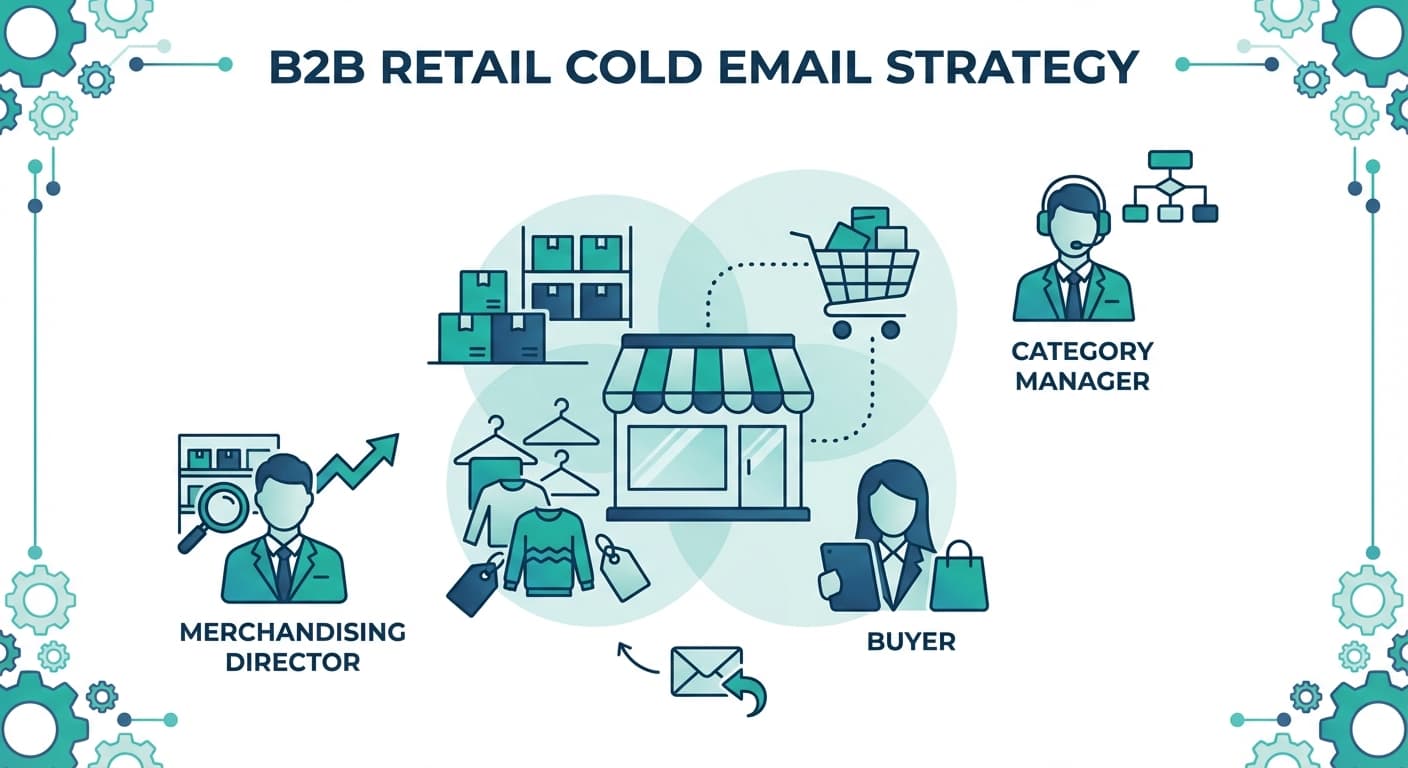
Cold email generates response rates of 8-15% in retail, significantly above the 1-5% cross-industry average, because 73% of retail executives prefer initial vendor contact via email. Retail buyers actively seek solutions through their inboxes due to constant innovation pressure, distributed decision-making requiring internal forwarding, and vendor fatigue with traditional channels. Success requires understanding specific decision-makers (category managers control $10M-$500M in purchases), addressing margin sensitivity and seasonal timing, and timing outreach to align with buying cycles that begin 9-12 months before major seasons.
Key takeaways
- Retail generates $7.4 trillion in annual U.S. sales and operates on decision-making processes ranging from 48 hours to 18 months depending on purchase complexity.
- B2B email marketing in retail produces an average ROI of $42 for every $1 spent according to Direct Marketing Association research.
- Category managers typically oversee $10 million to $500 million in annual purchases and control product assortment decisions within specific departments.
- Major retailers begin reviewing holiday merchandise 9 to 12 months in advance, creating predictable windows for vendor outreach.
- The retail vendor evaluation process progresses through five distinct phases from discovery (1-4 weeks) through final authorization and onboarding (4-16 weeks).
Reviewed and updated August 28, 2026
Cold Email for Retail: The Complete Guide to B2B Outreach
A regional grocery chain receives 47 vendor pitches every single week. The category manager has exactly 12 minutes between supplier meetings to scan her inbox. Your email lands at 2:43 PM on a Tuesday, right between a produce shortage alert and a planogram deadline reminder. You have roughly 3 seconds to prove your message deserves attention.
This is the reality of B2B cold email in retail. The industry that powers $7.4 trillion in annual U.S. sales (according to the National Retail Federation's 2024 State of Retail report) operates on razor-thin margins, seasonal pressures, and decision-making processes that can take anywhere from 48 hours to 18 months. Understanding these dynamics separates the vendors who get meetings from the thousands whose emails get deleted without a second glance.
Why Cold Email Works for Retail
Retail professionals live in their inboxes. A 2024 study by the Retail Industry Leaders Association found that 73% of retail executives prefer initial vendor contact via email over phone calls, trade show introductions, or LinkedIn messages. The reasoning is practical: email creates a paper trail, allows for internal forwarding, and can be reviewed during the brief windows between floor walks, inventory counts, and vendor negotiations.
Unlike retail buyers focused on margins, IoT decision-makers weigh security and integration concerns, a contrast explored in cold email strategies for IoT buyers.
The numbers support email as the preferred channel. According to research from the Direct Marketing Association, B2B email marketing in retail generates an average ROI of $42 for every $1 spent. Cold outreach specifically (when done correctly) sees response rates between 8% and 15% for retail-targeted campaigns, compared to the cross-industry average of 1% to 5%.
B2B email marketing in retail generates an average ROI
compared to the cross-industry average of 1% to 5%
Several factors make retail particularly receptive to cold email:
Constant pressure to innovate. Retail operates in a perpetual state of disruption. E-commerce growth, changing consumer preferences, supply chain volatility, and labor challenges mean buyers are actively seeking solutions. A well-timed email addressing a specific pain point can arrive exactly when a retailer is searching for answers.
Distributed decision-making. Unlike industries where a single executive controls purchasing, retail decisions often involve multiple stakeholders across merchandising, operations, finance, and store management. Email allows your pitch to be easily forwarded through these networks.
Seasonal buying cycles. Retail follows predictable purchasing patterns. Buyers for major retailers begin reviewing holiday merchandise 9 to 12 months in advance. Understanding these cycles allows you to time outreach when buyers are actively evaluating new vendors.
Vendor fatigue with traditional channels. Trade shows, sales calls, and in-store visits compete for attention with hundreds of other vendors using the same approaches. Email offers a way to stand out by delivering value directly to decision-makers without requiring immediate time investment.
The Retail Buyer: Who You're Really Emailing

Retail purchasing involves a complex ecosystem of decision-makers, influencers, and gatekeepers. Sending the same generic pitch to everyone wastes both your time and theirs.
Buyer segmentation matters just as much outside retail, and mapping buyer personas across mobile app teams shows how tailored messaging works for developers, agencies, and gaming studios.
Primary Decision-Makers
Category Managers control product assortment within specific departments. A grocery category manager for beverages decides which new drinks hit shelves, negotiates vendor terms, and manages planogram placement. These professionals typically manage $10M to $500M in annual purchases depending on retailer size.
Buyers and Purchasing Managers handle vendor relationships, negotiate contracts, and manage replenishment. In larger organizations, buyers may specialize in specific product categories. In smaller retailers, a single buyer might manage multiple departments.
Merchandising Directors/VPs oversee broader assortment strategy and vendor partnerships. While they rarely handle initial vendor evaluation, their approval is often required for significant new partnerships or category changes.
Store Owners/General Managers (for independent retailers) make all purchasing decisions personally. This consolidation of authority can accelerate decision timelines but also means your email competes with every other operational priority.
Influencers and Gatekeepers
Store Managers (in chain retail) influence category decisions based on customer feedback and local market conditions. While they rarely approve vendors directly, their input carries weight with corporate buyers.
Procurement/Sourcing Teams evaluate vendor qualifications, compliance requirements, and logistical capabilities. Your product might appeal to a buyer, but procurement holds veto power over vendors who cannot meet operational requirements.
Administrative Assistants often screen emails before they reach executives. Understanding their role helps you craft subject lines and opening lines that get forwarded rather than deleted.
The Retail Buying Process
Vendor evaluation in retail follows a structured but often unpredictable timeline:
Discovery (1-4 weeks): Buyers identify potential vendors through trade publications, competitor analysis, trade shows, and cold outreach. Your email enters consideration during this phase.
Initial Evaluation (2-8 weeks): Promising vendors receive requests for product samples, pricing sheets, and capability presentations. Speed and professionalism during this phase heavily influence advancement.
Business Review (4-12 weeks): Serious candidates participate in formal business reviews covering pricing, logistics, marketing support, and category fit. Large retailers may require vendor audits, insurance documentation, and compliance certifications.
Negotiation and Terms (2-6 weeks): Final vendors negotiate placement fees, promotional allowances, payment terms, and performance guarantees.
Authorization and Onboarding (4-16 weeks): Approved vendors complete system integration, logistics setup, and initial order placement.
- 1-4 weeksDiscovery
Buyers identify potential vendors through trade publications, competitor analysis, trade shows, and cold outreach.
- 2-8 weeksInitial Evaluation
Promising vendors receive requests for product samples, pricing sheets, and capability presentations.
- 4-12 weeksBusiness Review
Serious candidates participate in formal business reviews covering pricing, logistics, marketing support, and category fit.
- 2-6 weeksNegotiation and Terms
Final vendors negotiate placement fees, promotional allowances, payment terms, and performance guarantees.
- 4-16 weeksAuthorization and Onboarding
Approved vendors complete system integration, logistics setup, and initial order placement.
For major retailers, this process commonly spans 6 to 18 months from first contact to product on shelves. Regional chains and independent retailers can move significantly faster, sometimes completing the entire cycle in 30 to 90 days.
Retail-Specific Challenges (And How to Address Them)
Cold email for retail faces unique obstacles that require tailored solutions.
Challenge 1: Margin Sensitivity
Retail operates on notoriously thin margins. According to NYU Stern's analysis of retail industry data, the average net profit margin for grocery retailers is 1.6%, while general merchandise averages 4.2%. Every vendor pitch gets filtered through a simple question: will this improve our bottom line?
Solution: Lead with quantifiable financial impact. Replace vague value propositions with specific margin improvements, cost reductions, or revenue increases. If your product increased basket size by 8% in similar retailers, say exactly that. If you reduced shrinkage by $47,000 annually for a comparable store, include that number.
Challenge 2: Seasonal Timing Mismatches
Retail buying calendars operate 6 to 12 months ahead of consumer seasons. Pitching holiday merchandise in October means you are 11 months late. Many vendors fail simply because they approach buyers at the wrong time.
An ecommerce brand writing to those same retail buyers as a supplier, with its own store's sales data as proof, is the reader of outbound sales for ecommerce companies, which works the same review and show calendar from the seller's side.
Solution: Research and respect buying calendars. Major retailers publish vendor guidelines specifying submission windows for each season. For example, Target's vendor portal indicates that holiday merchandise submissions close in January of the same year. Structure your outreach calendar around these deadlines, not around when you think products should be on shelves.
Challenge 3: Buyer Turnover and Reorganization
Retail experiences significant organizational change. The Bureau of Labor Statistics reports that buyer and purchasing agent turnover rates exceed 15% annually. Organizational restructuring, category realignment, and corporate acquisitions further complicate contact accuracy.
Solution: Verify contact information before every campaign. Use multiple data sources and consider calling main switchboards to confirm current category responsibilities. Include soft language that acknowledges potential organizational changes: "If category responsibilities have shifted, I would appreciate being directed to the appropriate contact."
Challenge 4: Vendor Compliance Requirements
Large retailers maintain strict vendor qualification standards. Walmart's supplier requirements span over 200 pages. Target, Costco, and other major retailers maintain similarly detailed compliance programs covering everything from product testing to EDI integration to packaging specifications.
Solution: Acknowledge compliance readiness early in your outreach. If you have existing relationships with major retailers, mention them. If you hold relevant certifications (SQF, organic, fair trade), reference these credentials. Demonstrating awareness of compliance requirements signals vendor sophistication.
Challenge 5: Information Overload
Category managers at major retailers receive 30 to 100 vendor emails weekly. Most get deleted within seconds. Breaking through this noise requires more than a good product.
Solution: Deliver immediate, specific value. Instead of requesting a meeting to "discuss opportunities," provide concrete insights about their category performance, competitive positioning, or consumer trends. Buyers open emails that help them do their jobs better.
What Works: Retail Cold Email Best Practices
Subject Lines That Get Opened
Retail buyers scan subject lines for relevance, urgency, and credibility. Avoid generic pitches. Instead, demonstrate specific knowledge of their business.
Effective approaches:
- Reference specific categories: "Beverage category margin opportunity for [Store Name]"
- Mention recognizable retailers: "How we helped Kroger reduce out-of-stocks by 23%"
- Address known challenges: "[Retailer] private label expansion support"
- Use seasonal hooks: "Q4 holiday inventory solution for specialty retailers"
- Cite industry data: "NRF finding: 67% of retailers expanding [category] (relevant for [Store])"
Avoid:
- Generic product pitches: "Introducing our new product line"
- Salesy language: "Exclusive opportunity" or "Limited time offer"
- Overly casual: "Quick question" or "Touching base"
- Misleading: Subject lines that misrepresent email content
Email Copy That Converts
Retail buyers allocate minimal time to vendor emails. Effective cold emails follow a consistent structure:
Opening (1-2 sentences): Demonstrate immediate relevance. Reference their specific store, category, or recent company developments.
Value proposition (2-3 sentences): Clearly state what you offer and the quantifiable benefit. Include specific metrics from comparable retailers.
Credibility (1-2 sentences): Name recognizable retail clients, relevant certifications, or industry awards.
Call to action (1 sentence): Request a specific, low-commitment next step. Avoid asking for meetings without providing context on meeting length and agenda.
Total length: 75-150 words. Shorter emails consistently outperform longer ones in retail.
Timing and Frequency
Research from multiple email marketing platforms indicates optimal sending patterns for retail:
Best days: Tuesday, Wednesday, and Thursday. Monday inboxes overflow with weekend accumulation. Friday attention wanes as weekend priorities take precedence.
Best times: 7:00-9:00 AM (before the trading day intensifies) or 5:00-7:00 PM (after store hours for independent retailers). Avoid mid-day when buyers are typically in meetings or on the floor.
Re-approach timing: Send one message per campaign. If a buyer does not answer, wait for the next buying window (typically 60-90 days out) and approach them again with a campaign built on that season's own angle.
Compliance Considerations
Cold email in retail must navigate both general email regulations and industry-specific requirements.
CAN-SPAM Compliance
All commercial emails to U.S. recipients must comply with CAN-SPAM requirements:
- Include your physical business address
- Provide a clear unsubscribe mechanism
- Honor opt-out requests within 10 business days
- Use accurate header information and subject lines
- Identify the message as an advertisement if required
GDPR (For International Retail)
If targeting retailers in the European Union or UK, GDPR adds additional requirements including lawful basis for processing, enhanced consent requirements, and data subject rights. B2B cold email is generally permissible under "legitimate interest" provisions, but careful documentation is essential.
Food and Product Safety
Emails promoting food products, supplements, or health-related items must avoid unsubstantiated health claims. FDA regulations prohibit marketing foods as treatments for diseases without approved drug status. Stick to factual product descriptions and avoid medical or health claims that cannot be verified.
Retailer-Specific Requirements
Many retailers maintain vendor communication policies. Walmart, for instance, requires vendors to work through established channels rather than contacting store employees directly. Research target retailer policies before launching campaigns.
Real Retail Cold Email Examples
Example 1: Technology Solution for Multi-Location Retailers
Subject: Inventory accuracy improvement for [Retailer Name] stores
Body:
Hi [First Name],
[Retailer Name]'s expansion to 47 locations creates complexity in inventory management that I see affecting many growing specialty retailers.
Our inventory automation platform reduced out-of-stocks by 31% and shrinkage by $127,000 annually for a comparable 50-store specialty retailer in the Pacific Northwest.
We currently serve 340+ retail locations including [recognizable regional chain] and [second recognizable chain].
Would a 20-minute overview of our retail-specific capabilities be useful for your Q2 operations planning? I can share specific case studies from similar specialty formats.
Best, [Name] [Title] [Company] [Phone]
Example 2: Product Vendor to Grocery Buyer
Subject: Organic snack category gap at [Grocery Chain]
Body:
Hi [First Name],
I noticed [Grocery Chain] has expanded organic offerings significantly over the past 18 months, though the better-for-you snack section currently lacks options in the savory/protein segment.
Our organic chickpea snacks achieved 3.2x the category velocity in Sprouts and generated $94,000 incremental annual revenue per store in comparable natural grocers.
We are SQF Level 2 certified, EDI-ready, and currently distributed through KeHE.
If you are reviewing snack assortment for Q3 resets, I would welcome the opportunity to send samples and category data. What would be most helpful?
Best, [Name] [Title] [Company] [Phone]
Example 3: Service Provider to Independent Retailer
Subject: [Store Name] foot traffic observation
Body:
Hi [First Name],
I walked through [Store Name] on [specific street location] last week and noticed strong afternoon traffic but limited evening engagement. This pattern matches what we see in many independent retailers in urban locations.
Our extended hours staffing service helped [nearby independent retailer] increase evening revenue by 34% by providing trained retail staff for peak evening shifts without adding permanent headcount.
We serve 23 independent retailers in [city] including [recognizable local store] and [second local reference].
Would you be open to a brief conversation about your current staffing model? I can share specific economics from retailers in your area.
Best, [Name] [Title] [Company] [Phone]
Your Retail Cold Email Checklist
Before sending any cold email to retail prospects, verify the following:
Research and Targeting
- Confirmed the contact is the current decision-maker for relevant category/function
- Researched the retailer's recent news, expansions, or strategic priorities
- Identified specific pain points relevant to their retail format
- Verified seasonal timing aligns with their buying calendar
- Confirmed the retailer accepts unsolicited vendor outreach
Email Content
- Subject line references their specific retailer, category, or challenge
- Opening sentence demonstrates specific knowledge of their business
- Value proposition includes quantifiable metrics from comparable retailers
- Credibility section names recognizable retail clients or certifications
- Call to action requests a specific, low-commitment next step
- Total word count between 75-150 words
- No unsubstantiated claims about product benefits
Compliance
- Physical business address included
- Unsubscribe link functional and visible
- Subject line accurately reflects email content
- No misleading header information
- Checked retailer-specific vendor communication policies
Technical Setup
- Email authenticated with SPF, DKIM, and DMARC
- Sending domain has established reputation
- Reply-to address monitored and responsive
- Mobile rendering verified
Follow-Up Plan
- One message per campaign, with the next campaign timed to the next buying window
- Each campaign leads with new information rather than referring back to the last
- Tracking in place for opens, clicks, and replies
- Response templates ready for common buyer questions
Getting Started With Retail Cold Email

Cold email in retail works when it respects the realities of how buyers operate: limited time, margin pressure, compliance requirements, and an overwhelming volume of vendor pitches competing for attention.
The retailers who respond are looking for vendors who understand their business, communicate efficiently, and deliver quantifiable value. Every element of your email should demonstrate these qualities.
Starting with a targeted, well-researched campaign of 50-100 prospects typically generates enough data to refine messaging and scale successful approaches. Begin with retailers where you have the strongest case studies or most relevant experience, then expand based on results.
For teams without dedicated cold email infrastructure, building the required technical setup (domain warming, authentication, deliverability monitoring) can delay campaigns by 4-8 weeks. Working with specialists who maintain established sending infrastructure can accelerate time to first meetings.
Related Reading
- Cold Email for SaaS Companies: The Complete Guide to B2B Outreach
- Cold Email for Training and Development Companies: The Complete Guide
- Cold Email for Staffing Agencies: The Complete Guide
Ready to reach retail buyers with cold email that converts? Our team builds and runs complete cold email campaigns for B2B companies selling into retail. We handle targeting, messaging, technical infrastructure, and campaign optimization while you focus on closing deals.
Get Your Free Campaign Strategy to see how cold email can open doors with the retailers you want to reach.
Frequently asked questions.
Frequently asked questions- Why do retail buyers prefer cold email over other outreach methods?
- Retail buyers prefer email because it creates a paper trail for vendor evaluation, allows easy forwarding to internal stakeholders across merchandising, operations, and finance, and can be reviewed during brief windows between operational demands. Unlike phone calls or in-person meetings, email doesn't require immediate time investment and fits naturally into the distributed decision-making structure of retail organizations where multiple departments must weigh in on vendor selections.
- Who are the primary decision-makers I should target with retail cold emails?
- Target category managers who control product assortment and manage $10M-$500M in annual purchases, buyers and purchasing managers who handle vendor relationships and contracts, and store owners or general managers for independent retailers who consolidate all purchasing authority. For larger initiatives, merchandising directors or VPs provide final approval. Also consider influencers like procurement teams who hold veto power over vendor compliance, and store managers whose customer feedback influences corporate buying decisions.
- What response rates can I expect from cold email campaigns targeting retail?
- Well-executed retail cold email campaigns generate response rates between 8% and 15%, significantly higher than the cross-industry B2B average of 1% to 5%. This elevated performance reflects retail's receptivity to email contact, with 73% of retail executives preferring initial vendor contact via email. The strong performance stems from constant innovation pressure, distributed decision-making that favors forwardable communication, and predictable seasonal buying cycles that create windows when buyers actively seek new vendors.
- How long does the retail buying process take from first contact to approval?
- The complete retail vendor evaluation process spans 13 to 46 weeks across five phases: discovery (1-4 weeks), initial evaluation with samples and pricing (2-8 weeks), business review covering logistics and compliance (4-12 weeks), negotiation of terms and fees (2-6 weeks), and final authorization with system integration (4-16 weeks). Timeline varies dramatically based on retailer size, product category complexity, and whether the vendor replaces an existing supplier or enters a new category.
- When should I send cold emails to align with retail buying cycles?
- Time outreach to match retail's seasonal purchasing patterns, particularly the fact that buyers for major retailers begin reviewing holiday merchandise 9 to 12 months in advance. This predictable cycle creates strategic windows when category managers actively evaluate new vendors. Understanding these timelines prevents your email from arriving when buyers have already finalized assortments or are focused on execution rather than planning, dramatically improving your chances of serious consideration.
About the author.

Fernando Cao is CEO at RevenueFlow, which builds and operates outbound revenue engines for B2B companies. Previously at Accenture Strategy. Studied at University of Bath.
Fernando Cao · CEO
Connect on LinkedIn →Explore more.
Ready to scale your outreach?
We build GTM engines that book real meetings. See the receipts.
Related articles.
Cold Email for Telecom: Reaching Carriers and MSPs
Telecom companies face rapid technology changes and competitive pressures. Here's how to approach cold email outreach to carriers, MSPs, and UCaaS providers.
Cold Email for Architecture Firms: 2026 Strategy Guide
Architecture firms buy on project phases rather than fiscal quarters. How to build a list, time the spec window, and write cold emails principals answer.
Cold Email for Trucking and Fleet Companies: 2026 Guide
How to reach carriers, fleet operators, and safety buyers with cold email: FMCSA-driven list building, trigger timing, four templates, and compliance.
Cold Email for Cannabis Companies: 2026 Strategy Guide
The April 2026 rescheduling order split cannabis buyers into two tax realities. Here is how to segment, list-build, and write cold email for each.
Cold Email for Private Equity Firms: 2026 Strategy Guide
How to run cold email into private equity: mapping fund-level and portfolio-level buyers, list sources, four templates, and PE-specific deliverability rules.
Cold Email for Wealth Management Firms: 2026 Strategy Guide
RIAs are 16,500+ mostly small firms with public Form ADV data, small buying committees, and a compliance gate. How to run cold email into wealth management.