Cold Email Timing Benchmarks: 2026 Performance Data
The weekday barely moves cold email replies; the weekend does. Send-timing data from Woodpecker, Instantly, MailerLite and Brevo, and what each measured.

Published cold email data shows the weekday barely matters: Woodpecker's medians put Monday to Friday at a 1.17% to 1.19% reply rate, while weekend replies run about 38% lower. Hour-of-day data exists only for marketing email, where MailerLite finds opens peaking between 8 and 11 AM local time. Send weekday mornings in the recipient's time zone.
Key takeaways
- Woodpecker's cold email data puts all five weekdays at a 32% median open rate and a 1.17% to 1.19% median reply rate.
- Weekend replies run about 38% lower than weekday replies in Woodpecker's data, the one timing gap the cold email data shows clearly.
- The sources disagree on the best weekday: Instantly names Wednesday, MailerLite Friday, and Brevo Monday and Tuesday.
- Hour-of-day data is published for marketing email only; MailerLite finds opens peaking between 8 and 11 AM local time on most weekdays.
Reviewed and updated September 21, 2026
The day of the week barely moves cold email replies. In Woodpecker's platform data, Monday to Friday all sit at a 32% median open rate and a median reply rate between 1.17% and 1.19%, and the only real drop comes at the weekend, where replies run about 38% lower. That is a far flatter picture than most send-time advice paints.
This report collects the send day of week performance data that platforms have actually published, says what each one measured, and draws out what holds for cold outbound. An earlier version of this page carried day, hour, month, industry and seniority indexes with no source behind them. Those tables are gone, and every figure below names the platform that measured it.
A wording note, since the question often arrives as the best days to send an email blast. A blast is one broadcast to a list that opted in; the Woodpecker and Instantly figures below are cold outbound, and the MailerLite and Brevo figures are opt-in email marketing. The day-of-week and time-of-day shape transfers between the two. The volume assumptions do not, because a blast sends once to everybody and outbound spreads the same list across mailboxes and days.
The same note covers the best time for sending email marketing, which is the phrasing the question usually arrives in. Permission-based email marketing sends to people who asked to hear from you, and the day-of-week and time-of-day shape below transfers to it directly, because both are competing for the same working attention in the same inbox. What does not transfer is everything downstream of consent: sending volume per mailbox, list construction and the reputation model each motion runs under.
About This Data
The short answer to the best time to send a cold email is any weekday, in the recipient's own working morning. Which weekday matters far less than the usual advice suggests; whether it is a weekday matters a great deal.
The best day to send a cold email, read off the cold email data below, is Monday to Friday with no clear winner among them. Instantly names Wednesday, and Woodpecker's medians put the five weekdays within 0.02 percentage points of each other.
Four datasets are used, and they measure different things:
- Woodpecker's cold email benchmarks: platform data from cold campaigns sent through Woodpecker over the last 90 days, reported as medians. The day-of-week table counts mailboxes that sent at least 1,000 emails in that window.
- Instantly's Cold Email Benchmark Report 2026: "billions of cold email interactions across thousands of active workspaces" on the Instantly platform.
- MailerLite's send-time study: 2,138,817 email marketing campaigns sent from the US, UK, Australia and Canada over twelve months. These are newsletters to subscribers, not cold email.
- Brevo's 2026 Marketing Orchestration Benchmark: "aggregated, anonymized messaging data from over 175,000 active Brevo customers", as unweighted averages. Also opt-in marketing.
Each describes one platform's customers rather than the whole market, the same limit that applies to any benchmark drawn from sales engagement platforms, so read the figures as directional and test them against your own replies.
Send day of week performance data
Woodpecker publishes the only per-day cold email table of the four, with the sample behind every row.
Open rates are flat across the working week at 32%, and only 29% to 30% on Saturday and Sunday. Replies are flat too, from 1.19% on Monday and Tuesday to 1.17% on Friday. The weekend is where the difference sits: 0.71% on Saturday and 0.75% on Sunday, which Woodpecker puts at about 38% lower than weekday replies. Only "a quarter to a third of companies send on the weekend", and each weekday row rests on 4 to 5.5 million emails from around 1,900 companies, so the flat weekday result is not a small-sample effect.
Where the sources disagree
Instantly's report says "Tuesday-Wednesday see peak reply rates, Wednesday is highest", without publishing the per-day figures in the report, and that Friday "sees the highest volume of auto-replies as prospects set out-of-office messages". The marketing datasets disagree with both. MailerLite finds that "Friday generates the highest average open rate (49.72%)" and the highest average click rate, 8.09%, with open rates "surprisingly consistent across the entire week, generally hovering between 46.5% and 47.5%". Brevo finds that "Monday and Tuesday consistently show the highest open and click-through rates".
Woodpecker, cold email
- No weekday ahead: replies 1.17% to 1.19%
- Weekend replies about 38% lower
Instantly, cold email
- Wednesday highest reply rate
- Per-day figures not published in the report
MailerLite, newsletters
- Friday highest average open (49.72%)
- Friday highest average click (8.09%)
Brevo, marketing email
- Monday and Tuesday highest open rates
- Monday and Tuesday highest click-through rates
Four datasets, four different best days. What they share is that the gap between weekdays is small, which is why the day is the smaller half of the decision.
What about Monday?
Monday is where the old advice and the data part most clearly. The usual claim is that Monday inboxes are buried under the weekend's backlog. In Woodpecker's data Monday ties Tuesday for the highest median reply rate, 1.19%, and Instantly calls Monday its launch day, with its highest send volume of the week. MailerLite's best Monday hour, 10 AM at a 49.4% average open rate, is the second highest peak of its week.
Time of Day Benchmarks
Neither cold email dataset breaks replies down by hour: Woodpecker's benchmark page and Instantly's 2026 report, as read for this update, give no hour-of-day figure. The published hour data comes from email marketing, and MailerLite's is the largest. Across its campaigns, "the highest open rates fall between 8 AM and 11 AM local time" on most weekdays, while "the highest click rates fall much later, between 8 PM and 9 PM".
| Day | Peak open hour | Open rate at peak |
|---|---|---|
| Monday | 10 AM | 49.4% |
| Tuesday | 10 AM | 48.7% |
| Wednesday | 11 AM | 48.5% |
| Thursday | 9 AM | 49.2% |
| Friday | 6 PM | 49.7% |
| Saturday | 9 AM | 48.9% |
| Sunday | 9 AM | 48.9% |
For cold email the morning pattern is the part worth carrying over, because a cold email needs a reply during working attention rather than an evening click. Send inside the recipient's working morning, in their own time zone, and spread the sends through it. Instantly's report warns that "erratic volume kills deliverability" and advises "predictable daily volumes that email providers learn to trust".
Time Zone Considerations
A morning window only helps in the recipient's own morning, and its UTC equivalent moves when the clocks change.
| Region | Local window | UTC, standard time | UTC, summer time |
|---|---|---|---|
| US East Coast | 8 to 10 AM | 13:00 to 15:00 | 12:00 to 14:00 |
| US West Coast | 8 to 10 AM | 16:00 to 18:00 | 15:00 to 17:00 |
| UK | 9 to 11 AM | 09:00 to 11:00 | 08:00 to 10:00 |
| Central Europe | 9 to 11 AM | 08:00 to 10:00 | 07:00 to 09:00 |
| Sydney | 9 to 11 AM | 23:00 to 01:00 | 22:00 to 00:00 |
Region moves the baseline more than the hour does. Brevo's 2026 benchmark puts North American marketing email at a 17.32% open rate against 22.83% for Europe, or 32.49% and 36.90% with Apple Mail Privacy Protection opens included, so a US benchmark and a European one are not the same yardstick.
Timing Optimization Strategies
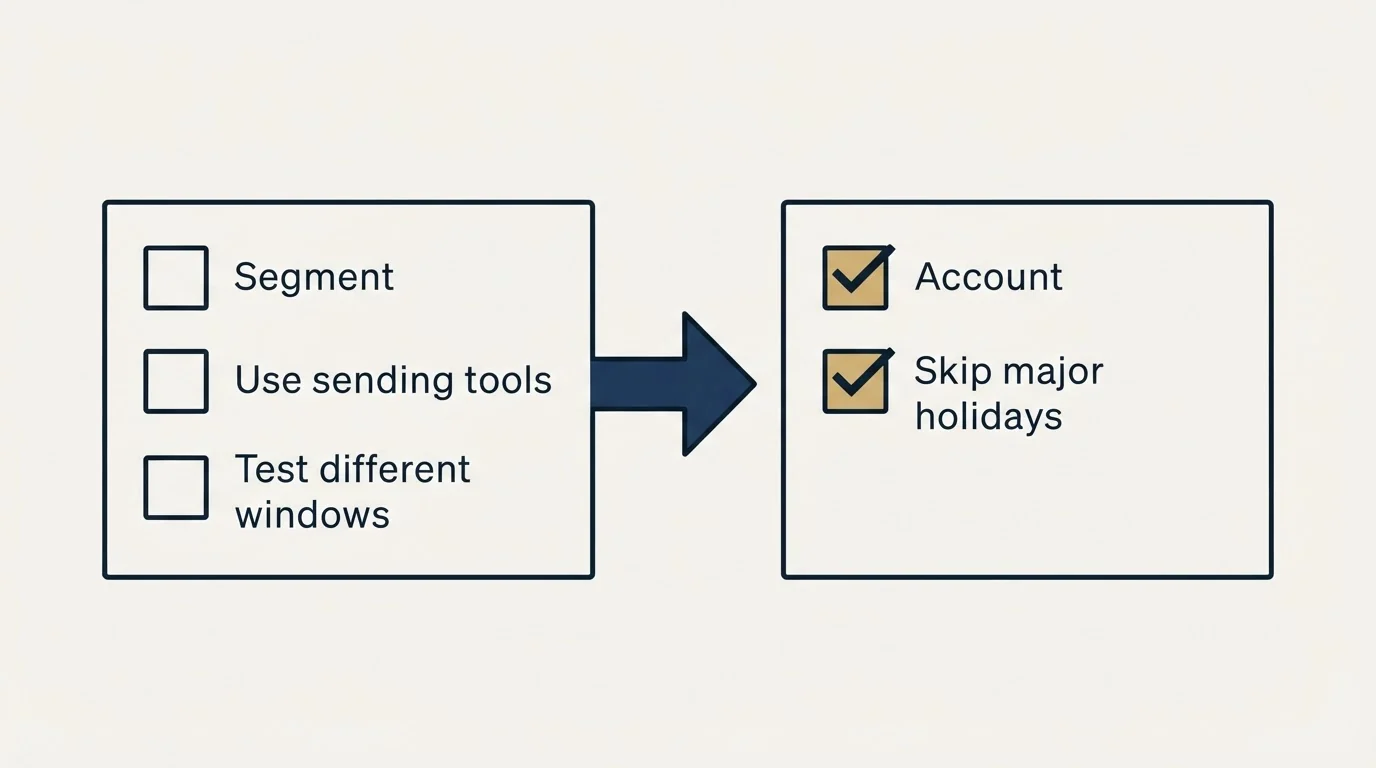
Implementing Timezone-Based Sending
-
Segment by geography. Group prospects by timezone for optimized send times.
-
Use sending tools with timezone features. Most sales engagement platforms support timezone-aware scheduling.
-
Test different windows. A/B test morning vs. afternoon for your specific audience.
-
Account for daylight saving. Adjust schedules when clocks change.
Avoiding Bad Timing
-
Skip major holidays. Pause campaigns during holiday weeks, when fewer people are working through their inbox.
-
Avoid month-end for finance targets. Finance professionals are swamped during close periods.
-
Skip product launch weeks. Tech companies are distracted during major releases.
-
Mind earnings seasons. Public company executives are less responsive around quarterly reports.
Measuring Timing Impact
Key Metrics to Track
Woodpecker's own caveat applies to any timing test: "Open rate is the noisier of the two, because tracking pixels get blocked or auto-loaded (e.g. Apple Mail Privacy Protection), so treat reply rate as the number that matters."
| Metric | How to Measure | What it tells you |
|---|---|---|
| Reply rate by send day and hour | Segment replies by send timestamp | The number that matters |
| Open rate by send time | Segment by hour/day | Noisy: pixels are blocked or auto-loaded |
| Time-to-reply | Track reply timestamps | When replies need someone to answer them |
| Weekend share of sends | Count sends by day | Weekend replies run about 38% lower |
A/B Testing Timing
To find your optimal timing:
-
Test one variable. Day OR time, not both simultaneously.
-
Use enough volume. At Woodpecker's weekday median reply rate of about 1.2%, 100 sends per variation produce roughly one reply each, which cannot separate two send times. Size each arm for replies, not sends.
-
Run for multiple weeks. Account for weekly variations.
-
Track reply rate, not just opens. Opens alone can be misleading.
Setting Timing Standards
Based on the published data, these are the standards worth holding:
| Element | Standard | Basis |
|---|---|---|
| Send days | Monday to Friday | Weekday replies 1.17% to 1.19% (Woodpecker) |
| Weekends | Avoid | Replies about 38% lower (Woodpecker) |
| Send window | Recipient's working morning, local time | Opens peak 8 to 11 AM (MailerLite, marketing email) |
| Daily volume | Steady, spread through the window | "Erratic volume kills deliverability" (Instantly) |
| What to measure | Replies, not opens | Open rate is the noisier number (Woodpecker) |
Optimizing Your Send Timing
Timing is one of the easier variables to get right, and the published data makes it simpler than the usual advice: send on a weekday, in the recipient's morning, at a steady volume, and judge the result on replies. The weekday you pick is unlikely to be what separates a good campaign from a bad one; the list and the message are.
If you want to optimize your campaign timing or need help implementing timezone-based sending strategies, our team specializes in building high-performance cold email programs for B2B companies.
Get a free campaign audit and see how your current send timing compares to the published benchmarks. We will identify specific opportunities to improve your timing for better reply rates.
Related Reading
Frequently asked questions.
Frequently asked questions- What is the best day to send a cold email?
- Any weekday. Woodpecker's cold email data puts Monday to Friday at a 32% median open rate and a reply rate between 1.17% and 1.19%, a spread of 0.02 percentage points. Instantly's report names Wednesday as its peak. The clear gap is the weekend, where Woodpecker measures replies about 38% lower than on weekdays.
- What time of day should I send cold emails?
- In the recipient's working morning, in their own time zone. Neither Woodpecker nor Instantly publishes cold email replies by hour, so the hour data comes from marketing email: MailerLite's 2,138,817 campaigns show opens peaking between 8 and 11 AM local time on most weekdays, with clicks peaking between 8 and 9 PM.
- What about Monday?
- Monday performs as well as any weekday in the cold email data. Woodpecker's median reply rate for Monday is 1.19%, tied with Tuesday for the highest, and Instantly reports its highest send volume of the week on Monday. The claim that Monday inboxes bury cold email is not visible in either dataset.
- Do US email marketing benchmarks differ by region?
- Yes, more than by hour. Brevo's 2026 benchmark puts North American marketing email at a 17.32% open rate against 22.83% for Europe, or 32.49% and 36.90% with Apple Mail Privacy Protection opens included. Within a region, sending in each recipient's local morning matters more than any single send hour in UTC.
About the author.

Hosun Chung is COO at RevenueFlow, which builds and operates outbound revenue engines for B2B companies. Previously at Gleacher Shacklock LLP. Studied at London School of Economics.
Hosun Chung · COO
Connect on LinkedIn →Explore more.
Ready to scale your outreach?
We build GTM engines that book real meetings. See the receipts.
Related articles.
Cold Email Spam Rate Benchmarks: 2026 Performance Data
Industry standards require keeping spam complaint rates below 0.1% to maintain sender reputation. Learn the benchmarks and strategies to protect your cold email deliverability.
Cold Email Follow-Up Benchmarks: 2026 Performance Data
The follow-up benchmarks kept intact and read against their own definitions, plus why RevenueFlow sends one message per campaign instead.
Cold Email Bounce Rate Benchmarks: 2026 Performance Data
A 3.04% platform bounce rate held 1.27% true hard bounces, 2.38% with blocks included, and 12.6% delay notices. What low bounce email data is made of.
Cold Email Subject Line Benchmarks: 2026 Performance Data
Industry data reveals that subject lines determine 35-50% of open rate variation. Discover the benchmarks for length, personalization, and format that drive the highest engagement.
Cold Email Personalization Benchmarks: 2026 Performance Data
LeadMagic, Cognism, Explorium and others sell funding and competitor signals. What published data ties to higher reply rates, and how to turn a signal into a line.
Cold Email Sequence Benchmarks: 2026 Performance Data
Every industry sequence figure, kept intact and read honestly: the opening message produces 30-40% of replies, and here is what the rest of them cost.