7 Principles for Writing Cold Emails That Actually Get Replies
Your cold emails are too long. I spent 20 minutes editing a single email from 6 sentences to 4, and the reply rate jumped 20-30%. Here's how to write ruthlessly concise cold emails that convert.
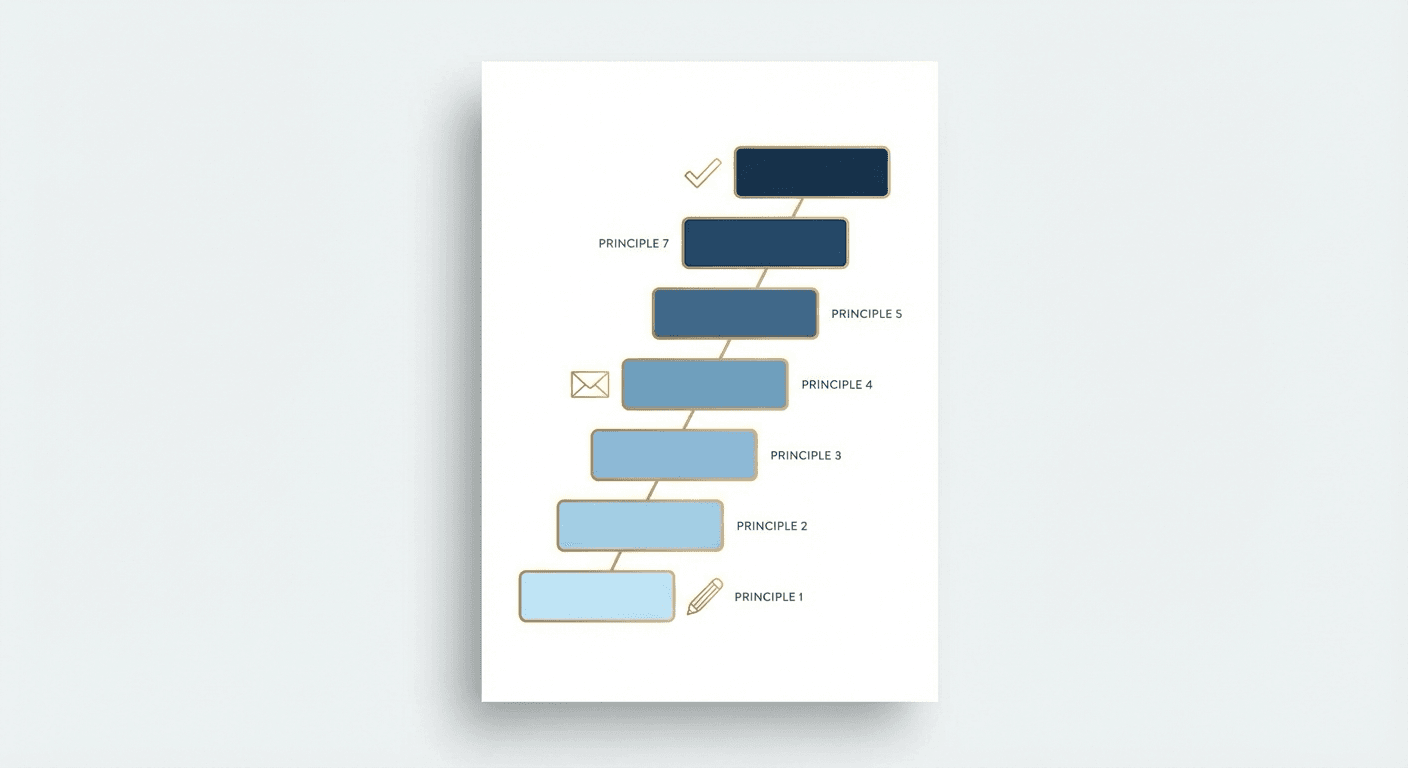
Shorter cold emails consistently outperform longer ones by 20-30% in reply rates. Cut every unnecessary word, stack 2-3 concrete proof points with specific outcomes, add time-bounded CTAs like "this week," avoid jargon, and put your effort into the single message you send rather than into what would follow it.
Key takeaways
- Editing a cold email from 6 sentences to 4 increased reply rates by 20-30%.
- Stacking three proof points with specific outcomes builds significantly more credibility than citing a single case study.
- Repeatedly contacting people who did not answer is what trains mailbox providers to distrust a sending domain, which is why we send one message per campaign and no bumps.
- Time-bounded CTAs like "Worth a quick chat this week?" create gentle urgency and make prospects more likely to respond.
- 80% of optimization effort should go into the message itself, because on a single-message campaign it is the whole campaign.
Reviewed and updated September 15, 2026
7 Principles for Writing Cold Emails That Actually Get Replies
Your cold emails are too long.
I recently spent 20 minutes editing a single cold email down from 6 sentences to 4. The result? The reply rate jumped 20-30%.
This isn't an isolated case. It's a pattern I've seen across many campaigns: shorter emails consistently outperform longer ones.
Cold email copywriting is mostly deletion: the principles below are the edits that survive when a message has to work on its own.
The Problem with Most Cold Emails
Most people write cold emails like they're drafting formal business correspondence. They're not.
Cold emails need to be ruthlessly concise. Every extra word is friction. Every unnecessary sentence is a reason for your prospect to move on.
Think about your own inbox. When you see a wall of text from someone you don't know, what do you do? You skip it. Your prospects do the same thing.
The difference between a 0.5% and 3% reply rate often comes down to removing 10-15 unnecessary words and tightening your proof points.
Cold email is a game of inches. Here's how to win it.
Principle 1: Make Every Word Earn Its Place

This is the foundation of effective cold email writing. If a word doesn't add value, cut it.
Replace Complex Words with Simple Ones
- Bad: "complimentary" → Good: "free"
- Bad: "conversation" → Good: "chat"
- Bad: "strategy session" → Good: "call" (when appropriate)
- Bad: "opportunity" → Good: "chance"
Cut Wordy Phrases Ruthlessly
Before:
"Would you be interested in a complimentary strategy session where I share..."
After:
"Interested in a free strategy session? I'll share..."
You just cut 3 words and made it more direct. That's the game.
Eliminate Unnecessary Qualifiers
Before:
"Company A (with a combined value of $500M)"
After:
"Company A ($500M)"
The value speaks for itself. You don't need to explain it.
Why This Matters
Every word your prospect has to read is cognitive load. The more load you add, the less likely they'll finish reading. And if they don't finish reading, they can't reply.
Action Items:
- Write your email
- Go through every sentence and ask: "What would happen if I deleted this?"
- If the answer is "nothing," delete it
- Repeat until you can't cut anymore
Principle 2: Credibility Needs Multiple Proof Points
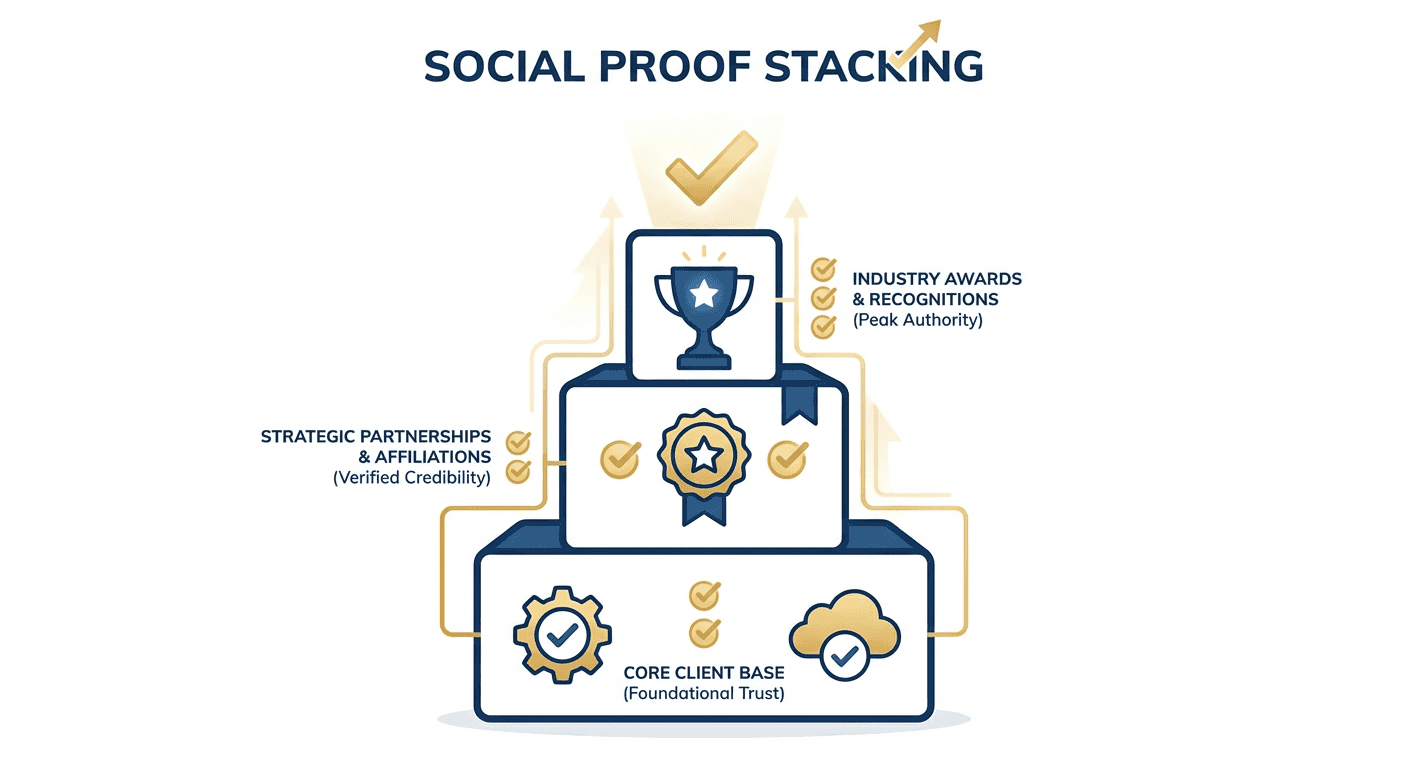
One case study is okay. Three is better.
The Power of Social Proof Stacking
When you list one client, prospects think: "Okay, you helped one company."
When you list three clients with specific outcomes, prospects think: "This person has a proven track record."
Weak:
"I've worked with Company A (sold for $200M)"
Strong:
"I've helped exit Company A ($200M), Company B (acquired by Industry Leader), and Company C ($1B)"
You went from one vague reference to three specific, impressive outcomes. The effort was minimal. The impact is massive.
How to Structure Multiple Proof Points
The key is to pack more proof into fewer words:
- Use parentheses for outcomes: "(acquired by Google)"
- Use dollar amounts when impressive: "($500M exit)"
- Use recognizable company names when possible
- Use industry-specific metrics they'll care about
Example for SaaS:
"Helped scale Company A (0→$10M ARR), Company B (acquired by Salesforce), Company C ($50M Series B)"
Example for Agencies:
"Ran campaigns for Company A (500% ROAS), Company B (Forbes 500), Company C ($2M month one)"
When You Don't Have Multiple Case Studies Yet
If you're just starting out, you can still build credibility:
- Reference your previous role: "Former VP of Sales at [Company]"
- Use your personal metrics: "Generated $5M in pipeline in 6 months"
- Reference specific methodologies: "Using the same playbook that helped..."
But as soon as you have multiple clients, use them. Multiple proof points signal expertise better than anything else.
Principle 3: Add Urgency to Your CTA
Most cold emails end with a weak CTA that lacks any reason to act now.
Time-Bounded CTAs Perform Better
Weak:
"Worth a quick chat to see if this could help?"
Strong:
"Worth a quick chat this week to see if this could help?"
The difference? One word: "this week."
Why Time-Bounded CTAs Work
Most prospects who want to take a call want to do it soon. They're not thinking "I'll schedule something in three months." They're thinking "If this is relevant, I want to explore it now."
By suggesting "this week," you:
- Create gentle urgency
- Make it easy for them to act
- Signal that you respect their time (you're not asking for someday, you're asking for soon)
Other Effective Time-Bounded CTAs
- "Worth a 15-minute call this week?"
- "Available for a quick chat Tuesday or Wednesday?"
- "Want to explore this next week?"
- "Have 10 minutes this week to discuss?"
When NOT to Use Urgency
Don't manufacture fake urgency. Don't say things like:
- "This offer expires Friday" (unless it actually does)
- "Only 3 spots left" (unless true)
- "Act now or miss out"
Real urgency works. Fake urgency kills trust.
Principle 4: Avoid Jargon and Long-Winded Phrases
Clear beats clever. Every. Single. Time.
The Jargon Problem
When you use industry jargon or try to sound sophisticated, you create friction. Your prospect has to decode what you're saying instead of immediately understanding it.
Bad:
"As they navigated critical growth inflection points..."
What does this even mean? It sounds impressive, but it's empty.
Good:
"Same playbook I used with [specific clients]"
This is clear, concrete, and credible.
Common Jargon to Avoid
- "Leverage" → Use "use"
- "Synergize" → Don't use this at all
- "Value-add" → Use "valuable" or "helpful"
- "Ecosystem" → Use "network" or be more specific
- "Holistic approach" → Explain what you actually do
- "Best-in-class" → Use specific metrics instead
Write Like You Talk
Read your email out loud. If it sounds like something you'd never actually say in conversation, rewrite it.
Before:
"We facilitate enterprise-level solutions that optimize go-to-market strategies through data-driven methodologies."
After:
"We help B2B companies grow faster by fixing their sales process."
Which would you rather receive?
The Clarity Test
After writing your email, ask:
- Could a 12-year-old understand this?
- Would I say this in a normal conversation?
- Are there any words I'm using to sound smart?
If you fail any of these tests, simplify.
Where we differ from standard practice
Much of the advice on this page reflects how outbound is commonly run. We run it differently, and since this page sits on our site it is worth saying where the difference is and what it costs us.
- A sequence of messages to each prospect over several weeks
- Later messages often land in the same email thread
- Every contact is reached more than once, so a distracted reader gets another chance
- The later messages go only to people who did not answer the first
- Reputation cost accrues on the sending domain across everything else it sends
- One message, then that campaign is finished for that contact
- No thread replies and no bumps
- A non-responding audience becomes a new campaign with a genuinely different premise, not a reminder
- More of the work moves into targeting and into the one message
- We reach each contact less often, and that is the cost we accept
The reasoning is mechanical rather than moral. A follow-up arrives underneath a message the recipient has already seen and chosen not to answer, so it is delivered to the population most likely to mark it as spam, and the reputation cost of that lands on the sending domain across every campaign running on it. We set that cost against the replies a sequence recovers and decided the trade was not worth it. The full argument, with the numbers from our own campaigns, is in why we stopped using follow-ups.
Principle 5: Only Use 2-Message Sequences
Not 3. Not 4. Two messages maximum.
The Deliverability Issue
More follow-ups increase spam risk, which kills your inbox reputation. Once your domain gets flagged, all your emails suffer, even to people who opted in.
The Data:
- Most replies come from message 1 (~70-80%)
- Some come from message 2 (~15-20%)
- Almost none from message 3+ (~5%)
For that extra 5%, you're risking your entire domain reputation. It's not worth it.
The Exception: LinkedIn
LinkedIn is different because deliverability isn't a concern there. On LinkedIn, you can send 3-4 follow-ups without hurting anything.
But for email? Stick to 2.
What Your 2-Message Sequence Should Look Like
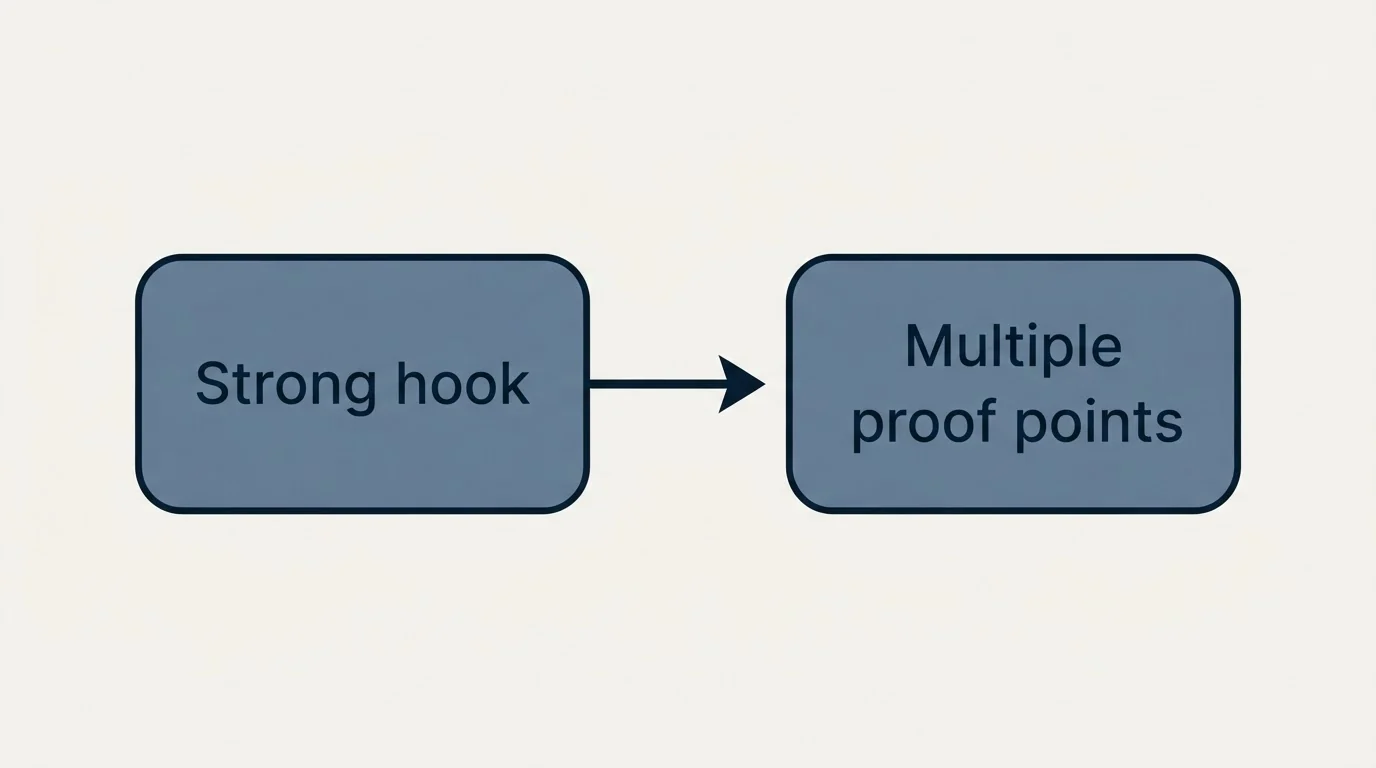
Message 1: The Opener
- Strong hook
- Multiple proof points
- Clear value proposition
- Time-bounded CTA
Message 2: The Follow-Up
- Reference the first email briefly
- Add ONE new piece of value or proof
- Different CTA angle
- Make it easy to say yes
Example Follow-Up:
"Hey [Name] - following up on my email from Tuesday about [topic].
Quick add: just helped [Company D] achieve [specific result] using the same approach.
Worth a quick chat this week?"
Short, adds value, easy to respond to.
When to Send Message 2
Wait 3-5 business days. Not 2 days (too soon), not 7 days (too long). 3-5 is the sweet spot.
Principle 6: Edit AI Outputs Relentlessly
Claude and ChatGPT give you a starting point, not a finished product.
The AI Writing Problem
AI tools are incredible for:
- Getting past blank page syndrome
- Generating structure
- Offering word choice alternatives
- Creating variations quickly
But they're terrible at:
- Being concise (they overwrite by default)
- Understanding your specific voice
- Knowing what will resonate with your ICP
- Making strategic trade-offs
How to Use AI Effectively
Step 1: Generate Use AI to create a first draft. Give it context:
- Your ICP
- Your value proposition
- Your proof points
- Your desired tone
Step 2: Edit Ruthlessly Go back and forth with the AI:
- Make it tighter
- Make it punchier
- Remove the bloat
- Cut corporate speak
Step 3: Add Your Voice This is the part AI can't do. Add:
- Specific anecdotes
- Your personality
- Unique insights
- Authentic language
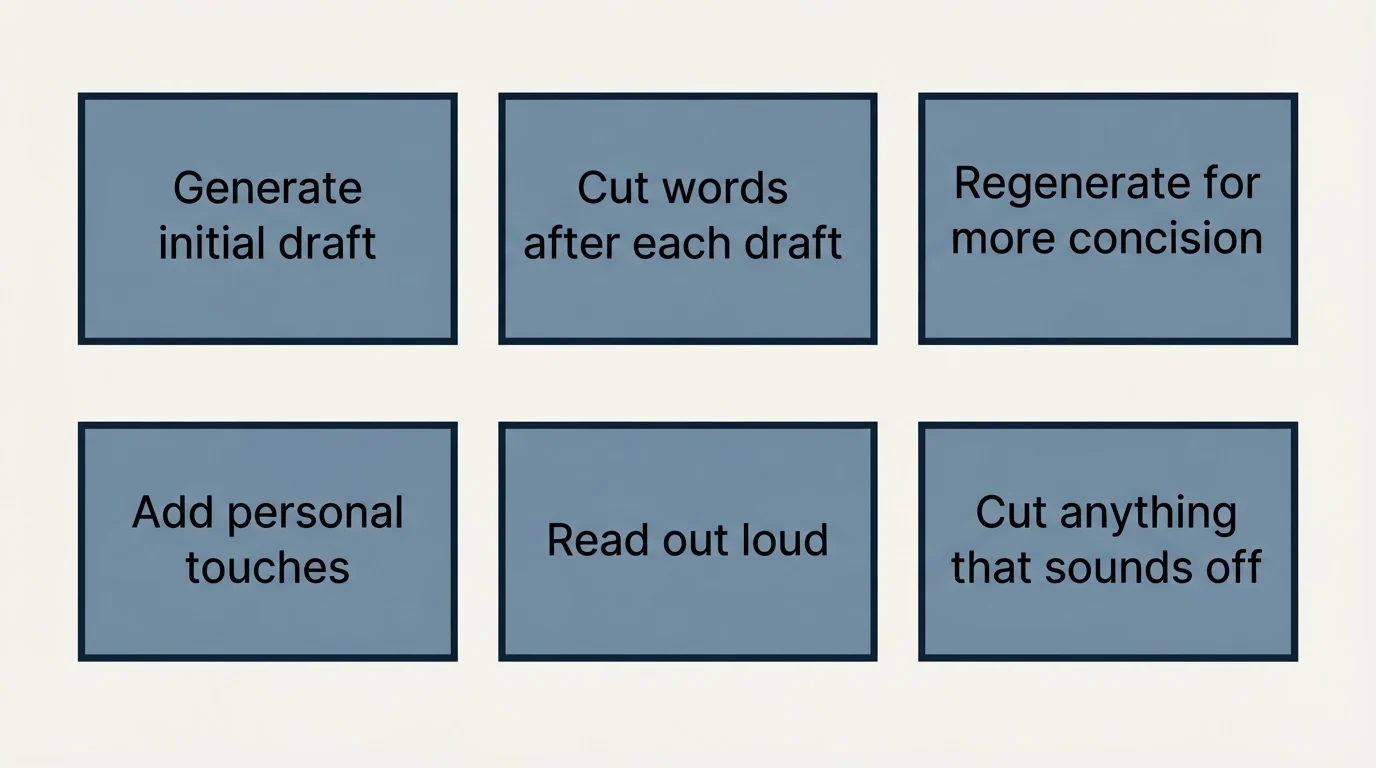
The Iteration Process
Don't accept the first AI output. My process:
- Generate initial draft
- Cut 30% of the words
- Regenerate with "make it more concise"
- Cut another 20%
- Add personal touches
- Read out loud
- Cut anything that sounds off
By the end, the email is 50% shorter and 3x more effective.
AI Prompt Template for Cold Emails
Write a cold email to [ICP] about [offer].

Key details:
- My proof: [specific results with clients]
- Their pain: [specific problem]
- The ask: [specific CTA]

Style:
- Extremely concise (under 100 words)
- Conversational tone
- No jargon
- Make it punchy

After you generate it, make it 30% shorter.
This prompt will get you 80% of the way there. You do the final 20%.
Principle 7: Put 80% of Effort into Message 1
Your first email does the heavy lifting. That's where reply rates are won or lost.
The Effort Allocation Mistake
Most people spend equal time on all their messages:
- 1 hour on message 1
- 1 hour on message 2
- 1 hour on message 3
This is backwards. The correct allocation:
- 4 hours on message 1
- 1 hour on message 2
- 0 hours on message 3 (don't send it)
Why Message 1 Matters So Much
The math:
- If 1,000 people see message 1
- Maybe 200 see message 2 (the ones who didn't reply)
- Maybe 50 see message 3
Your effort should match the leverage. Message 1 reaches 5x more people than message 3.
What to Optimize in Message 1
1. Subject Line This determines if they open. Test:
- Question vs statement
- Specific vs general
- Short vs long
- Personalized vs generic
2. Opening Hook First sentence determines if they keep reading. Test:
- Question
- Specific observation
- Proof point
- Relevant reference
3. Value Proposition Why should they care? Test:
- Different angles
- Different proof points
- Different framings
4. CTA What do you want them to do? Test:
- Question vs statement
- Specific vs open-ended
- Time-bounded vs open
The Testing Process
Week 1: Send 100 emails with version A Week 2: Send 100 emails with version B (change ONE variable) Week 3: Send 100 emails with the winner + one new variable
Don't test everything at once. Change one thing at a time so you know what works.
Putting It All Together: Before and After
Let me show you how these principles transform a real cold email.
Before (118 words):
Hi [Name],
I hope this email finds you well. I wanted to reach out because I noticed that [Company] is in a growth phase, and I believe I might be able to provide some value.
I specialize in helping B2B companies optimize their go-to-market strategies through data-driven cold email campaigns. In my previous role, I worked with a company that was able to increase their reply rates by implementing some of the strategies that I would be happy to discuss with you.
Would you be interested in having a complimentary consultation call where we could discuss how these strategies might be applicable to your situation? I'm confident that I could provide some insights that would be valuable for your team.
Looking forward to hearing from you.
Problems:
- Way too long (118 words)
- Generic opening ("hope this finds you well")
- Vague value prop ("provide some value")
- Jargon ("optimize," "data-driven")
- Weak proof (one unnamed company)
- No urgency in CTA
- Sounds like everyone else
After (64 words):
Hey [Name],
Helped scale email programs at [Company A] ($200M exit), [Company B] (3M+ pipeline), and [Company C] (acquired by Salesforce).
Same playbook could work for [Company]. Noticed you're [specific observation].
Worth a quick chat this week? I'll share what worked for [similar company in their industry].
Best, [Your name]
Why it's better:
- 54 fewer words (46% reduction)
- Multiple specific proof points
- Clear, jargon-free language
- Relevant observation shows research
- Time-bounded CTA
- Unique voice
Expected impact: 2-3x higher reply rate.
The Implementation Checklist
Before sending your next cold email campaign, run through this checklist:
Conciseness:
- Under 100 words?
- Every word necessary?
- No wordy phrases?
- Simple word choices?
Credibility:
- Multiple proof points?
- Specific outcomes?
- Relevant to their situation?
CTA:
- Time-bounded?
- Clear and specific?
- Easy to say yes?
Clarity:
- No jargon?
- Would I say this in person?
- Could anyone understand it?
Structure:
- Only 2 messages?
- 80% effort on message 1?
- AI output heavily edited?
Voice:
- Sounds like me?
- Different from others?
- Authentic?
If you can check all these boxes, you're in the top 10% of cold emailers.
The Bottom Line
Cold email success isn't about perfect targeting or revolutionary tactics. It's about doing the simple things well:
- Write shorter
- Prove more
- Be clearer
- Sound human
Most people won't do this because editing is hard work. It's easier to send a 150-word email you wrote in 5 minutes than a 75-word email you refined for 20 minutes.
But the 75-word email will outperform the 150-word email 3x over.
The choice is yours: spray and pray with long emails, or cut ruthlessly and win.
Start with your next email. Cut 30% of the words. Watch what happens.
Related Reading
- Why Short Cold Emails Get More Replies Than Perfectly Personalized Ones
- Nobody Knows What You're Selling: Why Clear Value Propositions Win
If you would rather have this run for you, RevenueFlow books qualified meetings on a pay-per-meeting basis and publishes client results.
Frequently asked questions.
Frequently asked questions- How many messages should a cold email campaign send to one prospect?
- One. We send a single message per campaign and no bumps, on email or on LinkedIn. Repeatedly contacting people who did not answer is what trains mailbox providers to distrust a sending domain, and on LinkedIn a second message lands in the same thread the prospect already chose to ignore. If an audience is worth approaching again, the instrument is a new campaign built on a genuinely different premise, not another message on the old one.
- What should I do if I don't have multiple case studies for my cold emails?
- Reference your previous role or title, use your personal metrics like "Generated $5M in pipeline in 6 months," or cite specific methodologies you've used successfully. As soon as you acquire multiple clients, switch to stacking 2-3 proof points with specific outcomes in parentheses like "Company A ($200M exit), Company B (acquired by Salesforce)" to signal proven expertise.
- Why do time-bounded CTAs improve cold email response rates?
- Time-bounded CTAs like "Worth a quick chat this week?" work because prospects interested in your offer want to explore it immediately, not months later. Adding "this week" creates gentle urgency, makes it easy to act now, and signals respect for their time. Avoid fake urgency like "offer expires Friday" unless genuinely true, as manufactured scarcity destroys trust.
- How should I use AI to write cold emails?
- Use AI to generate initial drafts, then edit relentlessly. AI-generated emails often include fluffy language, unnecessary qualifiers, and formal phrasing that reduces reply rates. Write your first draft manually or with AI, then iterate 3-5 times cutting words, simplifying language, and removing jargon. The iteration process is where effective cold emails are actually created.
About the author.

Tim Carden is CMO / CTO at RevenueFlow, which builds and operates outbound revenue engines for B2B companies. Studied at McGill University.
Tim Carden · CMO / CTO
Connect on LinkedIn →Explore more.
Ready to scale your outreach?
We build GTM engines that book real meetings. See the receipts.
Related articles.
Cold Email Frameworks: Which One Fits Your Offer
AIDA, PAS and Before-After-Bridge arrange the same four elements in different orders. What each one assumes about the reader, and what none of them fix.
Can Buyers Tell an Email Was Written by AI?
Buyers are not running a classifier on your cold email. What they react to is a message containing nothing only somebody who looked could have written.
CAN-SPAM Act Compliance for B2B Cold Email: The Rules
The CAN-SPAM Act makes no exception for business-to-business email. Here are the seven requirements, the opt-out clocks, and where liability lands when an agency sends.
How to Write a New Year Outreach Email, Line by Line
A new year outreach email works only where January is a fact about the account. Who that is, the structure line by line, and two worked examples.
How to Write a Third Follow Up Email, Line by Line
A third follow up email belongs only in a thread where the person replied or agreed to something. When to send one, and how to write it line by line.
BASHO Email: Four Sentences Built on One Insight
A BASHO email is four or five sentences built on one researched insight about a specific person. The format is documented, and it cannot be produced at volume.