12 Curiosity-Driven Email Templates That Get Replies
Spark interest with emails that make prospects want to learn more. These curiosity-driven templates use strategic intrigue to generate opens, clicks, and responses.
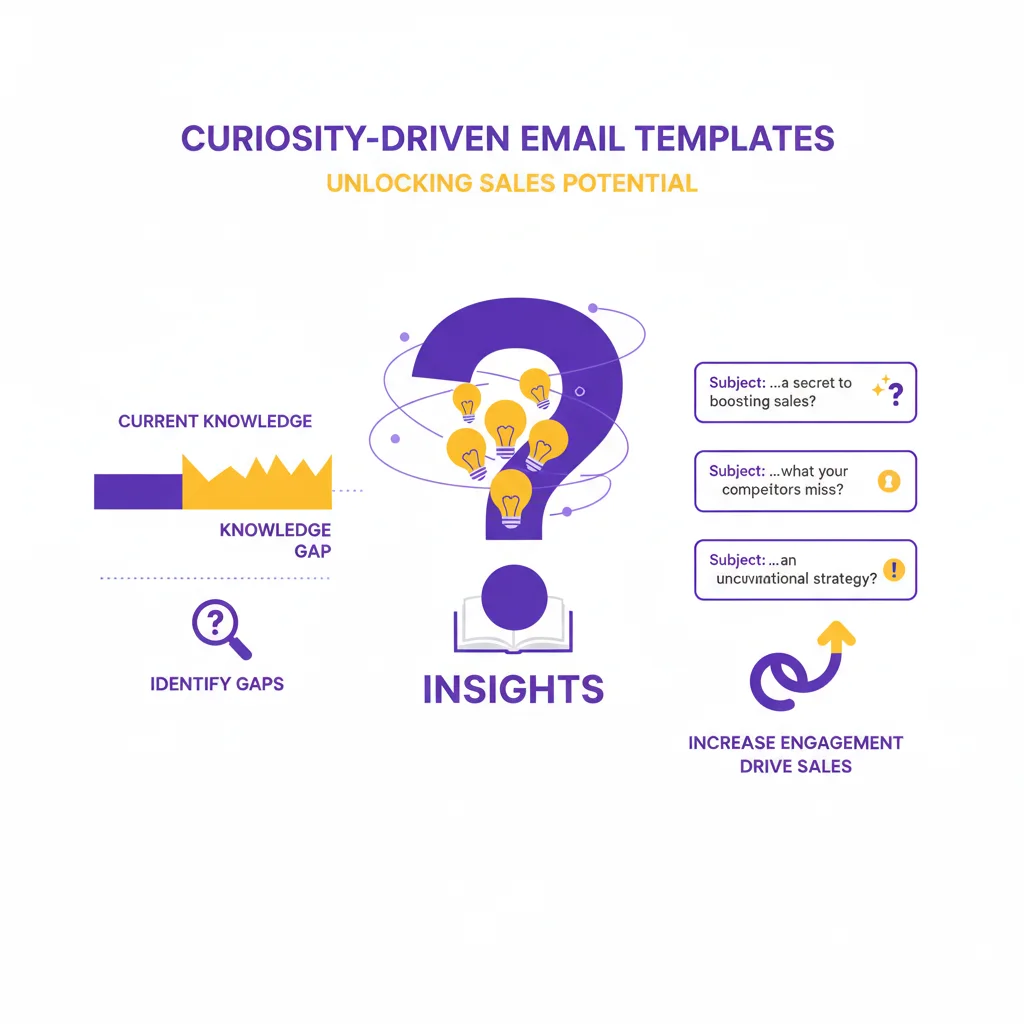
Curiosity-driven emails create psychological tension by establishing knowledge gaps through counterintuitive questions, surprising observations, or incomplete information that prospects feel compelled to resolve. The approach uses 12 templates across four categories: question-based (challenging assumptions with unexpected questions), observation-based (sharing industry patterns or shifts), teaser-based (hinting at valuable insights without full disclosure), and question loop templates (prompting self-assessment). Success requires balancing intrigue with clarity, delivering on promised information, and using genuine insights rather than empty manipulation.
Key takeaways
- Curiosity-driven emails leverage psychological tension created when prospects become aware of gaps between what they know and what they want to know.
- The 12 templates fall into four categories: question-based curiosity, observation-based curiosity, teaser-based curiosity, and question loop curiosity templates.
- Effective curiosity emails must balance mystery with clarity: too little intrigue leads to being ignored, while too much feels manipulative.
- Common mistakes include empty teases with no substance, obvious setups that insult intelligence, and bait-and-switch tactics that destroy trust.
- Curiosity templates work best when they use verifiable statistics, reference specific company initiatives, or share genuine patterns observed across similar companies.
Reviewed and updated September 1, 2026
12 Curiosity-Driven Email Templates That Get Prospects to Open and Reply
Curiosity is one of the most powerful drivers of human behavior. When something captures our interest, we need to know more. Effective cold emails leverage this by creating knowledge gaps that prospects want to fill.
Curiosity-driven emails don't give everything away upfront. They hint at valuable information, ask thought-provoking questions, or share unexpected observations that make prospects want to continue the conversation.
This guide provides 12 curiosity-driven email templates that spark interest and generate responses.
The Psychology of Curiosity
Curiosity arises when we become aware of a gap between what we know and what we want to know. This gap creates psychological tension that we're motivated to resolve.
In cold email, you can create this gap by:
- Teasing information: Hinting at something valuable without revealing all
- Asking unexpected questions: Questions they haven't considered
- Sharing surprising observations: Information that challenges assumptions
- Creating open loops: Starting stories or ideas that need completion
The key is balance. Too little intrigue and they ignore you. Too much and they feel manipulated.
Section 1: Question-Based Curiosity Templates
These templates use thought-provoking questions to create engagement.
Template 1: The Counterintuitive Question
When to use: When you can challenge a common assumption.
Subject: Why does [counterintuitive thing happen]?
Email:
Hi [Name],
Here's something that doesn't make sense on the surface: [counterintuitive observation about their industry or function].
Most teams assume [common assumption]. But companies like [Similar Company] found that [surprising insight].
Curious whether this matches what you're seeing at [Company]?
Best, [Your name]
Customization tips:
- Use genuinely counterintuitive observations from your experience
- Make the observation relevant to their specific situation
- Be prepared to explain the insight if they ask
Template 2: The "Did You Know" Approach
When to use: When you have surprising data or statistics.
Subject: [Surprising statistic about their industry]
Email:
Hi [Name],
Did you know that [surprising statistic relevant to their industry]?
When I first saw this data, I assumed it was an outlier. Turns out it's a pattern across [type of companies].
The implications for [Company] could be significant. Worth a quick discussion?
Best, [Your name]
Customization tips:
- Use verifiable statistics from credible sources
- Choose statistics that relate to problems you solve
- Be ready to share the source if asked
Template 3: The Insider Question
When to use: When you can reference something specific about their company.
Subject: Quick question about [specific initiative or announcement]
Email:
Hi [Name],
I saw [specific thing about their company, like an announcement, job posting, or news].
I'm curious: does this mean [Company] is [specific inference about their priorities]?
If so, I have some thoughts that might be useful. If I'm reading it wrong, I'd be interested to know what's actually driving [the initiative].
Either way, would a brief conversation be worthwhile?
Best, [Your name]
Customization tips:
- Reference specific, recent information about their company
- Make a reasonable inference that shows you understand their business
- Invite correction if your inference is wrong
Section 2: Observation-Based Curiosity Templates

These templates share observations that prompt prospects to learn more.
Template 4: The Pattern Recognition
When to use: When you've noticed a pattern across companies like theirs.
Subject: Something I've noticed about [industry/company type]
Email:
Hi [Name],
I've worked with [X] companies in [industry] over the past year. A pattern keeps emerging: [brief description of pattern].
Some teams are ahead of it. Others are discovering it the hard way.
I'm curious where [Company] falls on that spectrum. Worth a quick conversation to compare notes?
Best, [Your name]
Customization tips:
- Describe a genuine pattern you've observed
- Make the pattern relevant to challenges you solve
- Position yourself as sharing observations, not selling
Template 5: The Industry Shift
When to use: When you've observed changes affecting their market.
Subject: A shift happening in [industry]
Email:
Hi [Name],
There's a shift happening in [industry] that isn't obvious yet. The companies recognizing it are [doing something specific]. The ones missing it are [facing specific consequence].
I've been tracking this for [timeframe] and have some thoughts on where it's heading.
If [Company] is thinking about [relevant area], this might be worth discussing. Interested?
Best, [Your name]
Customization tips:
- Reference genuine industry shifts you can speak to
- Be specific about what companies are doing differently
- Offer to share your perspective without requiring commitment
Template 6: The Unexpected Finding
When to use: When you can share something surprising from your work.
Subject: We found something unexpected
Email:
Hi [Name],
Working with [Similar Company], we discovered something we didn't expect: [surprising finding].
It challenged some assumptions we had about [topic]. I'm curious whether [Company] would see something similar.
Worth a brief conversation to explore?
Best, [Your name]
Customization tips:
- Share genuinely unexpected findings
- Connect the finding to something relevant to them
- Be prepared to discuss details if they're interested
- A counterintuitive observation, a surprising statistic, or an inference drawn from something they announced
- The gap opens by asking something they have not considered
- Be ready to explain the insight, share the source, or accept correction if the inference is wrong
- A pattern across companies like theirs, a shift in their industry, or an unexpected finding from your own work
- The gap opens with information that challenges an assumption
- The pattern, the shift and the finding all have to be genuine and yours to speak to
- An incomplete story, an approach most people in the role miss, or a result stated as a number
- The gap opens by holding back the turning point
- Avoid being too vague or mysterious, and offer to show the specifics rather than claim them
Section 3: Teaser-Based Curiosity Templates
These templates hint at valuable information without giving everything away.
Template 7: The Incomplete Story
When to use: When you have a compelling case study to share.
Subject: How [Similar Company] went from [before] to [after]
Email:
Hi [Name],
[Similar Company] was stuck at [before state]. [X] months later, they hit [after state].
The turning point wasn't what you'd expect.
If you're curious about what changed, I'd be happy to walk through their story. It might spark some ideas for [Company].
Worth 15 minutes?
Best, [Your name]
Customization tips:
- Use a compelling before/after story
- Hint at the "unexpected" turning point without revealing it
- Make the story relevant to their likely situation
Template 8: The Secret Sauce Tease
When to use: When you have a unique approach or methodology.
Subject: The approach most [role] miss
Email:
Hi [Name],
Most [role] approach [challenge] by [common approach]. It works, but it misses something important.
There's an approach that [top companies/performers] use that produces [better result]. It's counterintuitive, which is why most people don't try it.
If you're open to challenging the conventional wisdom, I'd be happy to walk through it.
Interested?
Best, [Your name]
Customization tips:
- Reference a genuine alternative approach
- Be prepared to explain the approach in detail
- Avoid being too vague or mysterious
Template 9: The Results Preview
When to use: When you have impressive results to reference.
Subject: [X]% improvement in [metric]
Email:
Hi [Name],
What if [Company] could improve [key metric] by [X]%?
That's the average result for companies like yours after implementing [brief description of approach].
I realize that sounds like marketing speak. I'd rather show you the specifics and let you judge whether it's realistic for your situation.
Worth a look?
Best, [Your name]
Customization tips:
- Use results you can actually demonstrate
- Acknowledge skepticism and address it
- Offer to show specifics rather than just claiming results
Section 4: Question Loop Curiosity Templates
These templates create ongoing engagement through questions.
Template 10: The Self-Assessment Prompt
When to use: When you can offer a framework for self-evaluation.
Subject: Where does [Company] stand on [dimension]?
Email:
Hi [Name],
Companies in [industry] generally fall into three categories on [dimension]:
- [Category 1]: [Brief description]
- [Category 2]: [Brief description]
- [Category 3]: [Brief description]
I'm curious where [Company] falls. Each position has different implications for [relevant outcome].
Worth a quick conversation to compare notes?
Best, [Your name]
Customization tips:
- Create a genuine, useful framework
- Make the categories distinct and recognizable
- Be prepared to discuss implications of each category
Template 11: The Priority Question
When to use: When you want to understand their current focus.
Subject: What's the bigger priority right now?
Email:
Hi [Name],
For teams like yours, the choice often comes down to [Priority A] vs [Priority B].
Both matter. But the answer affects which approach makes sense.
I'm curious which is more pressing for [Company] right now. The answer shapes what I'd recommend.
Worth a quick reply?
Best, [Your name]
Customization tips:
- Present two genuine priorities they likely face
- Show that you understand the trade-offs involved
- Use their answer to customize your follow-up
Template 12: The Future State Question
When to use: When you want to understand their vision.
Subject: Where is [Company] headed?
Email:
Hi [Name],
If everything goes well for [Company] over the next [timeframe], what does [specific area] look like?
I ask because companies with different visions need different approaches to get there.
Understanding your direction would help me know whether I can be useful or if we're solving for different problems.
Worth a quick reply?
Best, [Your name]
Customization tips:
- Ask about a timeframe relevant to their planning
- Show that you'll customize your approach based on their answer
- Be genuinely curious about their vision
Best Practices for Curiosity-Driven Emails
Deliver on the Curiosity
If you create curiosity, you must satisfy it. Prospects who feel tricked by clickbait become hostile. Make sure you can deliver valuable information when they engage.
Balance Mystery and Clarity
Too much mystery feels manipulative. Too much clarity removes intrigue. Find the balance where prospects understand enough to be interested but want to learn more.
Use Genuine Insights
The best curiosity triggers come from real observations and data. Manufactured intrigue feels hollow. Base your curiosity hooks on actual experience and knowledge.
Match Curiosity to Audience
Different audiences respond to different types of curiosity:
- Executives: Strategic and competitive insights
- Technical buyers: Novel approaches and data
- Operators: Efficiency gains and shortcuts
- Financial buyers: ROI and cost implications
Don't Overuse
Curiosity-driven emails lose power when overused. Mix them with other approaches. If every email tries to create intrigue, prospects learn to ignore the pattern.
Follow Up With Substance
When a curiosity email generates a response, follow up with substantial information. Don't make them ask multiple times to get the insight you teased.
Common Curiosity Mistakes

The Empty Tease
Creating curiosity without having substance to back it up. If they engage and you have nothing interesting to share, you've damaged trust.
The Obvious Setup
When the curiosity hook is so transparent that prospects see the manipulation. Phrases like "You won't believe..." or "The secret no one tells you..." often fall into this trap.
The Irrelevant Hook
Creating curiosity about something they don't actually care about. The curiosity must connect to their real priorities and challenges.
The Never-Ending Mystery
Dragging out the mystery too long. If they have to book a meeting just to learn what you're talking about, most will give up.
The Bait and Switch
Using curiosity to get opens, then delivering standard sales content. This trains prospects to ignore your future emails.
- No: A tease with no substance behind it, so there is nothing to share when they engage
- No: A hook transparent enough that the manipulation shows, such as you won't believe or the secret no one tells you
- No: Curiosity about something they do not actually care about
- No: A mystery dragged out until they have to book a meeting to learn what you are talking about
- No: Curiosity used to win the open, followed by standard sales content
- Yes: Enough clarity to understand why it matters, with enough held back to be worth answering
- Yes: Hooks built on real observations, data and experience you can stand behind
Measuring Curiosity Email Performance
Track these metrics to optimize curiosity-driven approaches:
- Open rate: Are your subject lines generating curiosity?
- Reply rate: Are prospects engaging with the content?
- Click rate: If including links, are people clicking?
- Meeting conversion: Do curiosity-driven conversations lead to meetings?
- Feedback quality: What do responses say about how the email landed?
Compare these metrics against your non-curiosity emails to measure the impact.
Combining Curiosity With Other Approaches

Curiosity works well when combined with other template types:
- Curiosity + social proof: "Here's what surprised us about [Similar Company]'s results"
- Curiosity + pain points: "The hidden cost most [industry] companies miss"
- Curiosity + value proposition: "What if [metric] could improve [X]%?"
- Curiosity + trigger events: "I noticed [event] and have a thought about what it means"
The curiosity element drives engagement while other elements provide context and relevance.
Related Reading
- 15 Pain Point Email Templates That Get Prospects to Respond
- 14 Trigger Event Email Templates That Catch Prospects at the Right Moment
- 13 Value Proposition Email Templates That Communicate Your Worth
Getting Help With Curiosity-Driven Campaigns
Developing effective curiosity hooks requires understanding your market, having genuine insights to share, and testing what resonates. If you're looking to build curiosity-driven campaigns:
Schedule a free strategy call to discuss:
- What types of curiosity resonate with your audience
- How to develop genuine insights worth teasing
- Campaign sequences that build interest over time
- Testing approaches to optimize curiosity hooks
Schedule your free strategy call here.
We'll help you develop curiosity-driven messaging that generates engagement and conversations.
Frequently asked questions.
Frequently asked questions- How do curiosity-driven emails work psychologically?
- Curiosity-driven emails create psychological tension by making prospects aware of a gap between what they currently know and what they want to know. This gap motivates them to resolve the tension by learning more. The emails achieve this through teasing valuable information, asking unexpected questions, sharing surprising observations, or creating open loops that need completion. The key is balancing intrigue with clarity to avoid being ignored or appearing manipulative.
- What are the four main types of curiosity email templates?
- The four categories are question-based curiosity templates (using counterintuitive questions and surprising statistics), observation-based curiosity templates (sharing patterns recognized across companies or industry shifts), teaser-based curiosity templates (hinting at valuable information through incomplete stories or results previews), and question loop curiosity templates (prompting self-assessment or priority questions). Each category creates curiosity through a different psychological mechanism but all aim to make prospects want to continue the conversation.
- What mistakes should I avoid when writing curiosity-driven emails?
- Avoid the empty tease where subject lines promise value but emails deliver nothing substantive. Don't use obvious setups that insult prospect intelligence or irrelevant hooks disconnected from their actual needs. The never-ending mystery that refuses to provide clarity frustrates prospects, while bait-and-switch tactics that promise one thing but deliver another destroy trust. Instead, use genuine insights, deliver on the curiosity you create, and ensure the intrigue connects to problems you actually solve.
- When should I use a counterintuitive question template?
- Use the counterintuitive question template when you can legitimately challenge a common assumption in the prospect's industry or function. The template works by presenting an observation that doesn't make sense on the surface, then hinting at a surprising insight that companies like theirs have discovered. You must use genuinely counterintuitive observations from your experience, make them relevant to the prospect's specific situation, and be prepared to explain the insight when they respond.
- How do I balance mystery and clarity in curiosity emails?
- Balance mystery and clarity by providing enough information to establish credibility and relevance while withholding details that make continuing the conversation valuable. The email should clearly indicate you have something worth knowing without giving away everything upfront. Use specific references, verifiable data points, or concrete observations to demonstrate substance, but position the full insight as something best discussed in conversation. The curiosity should feel like a genuine invitation to exchange valuable information, not a manipulation tactic.
About the author.

Ben Carden is CRO at RevenueFlow, which builds and operates outbound revenue engines for B2B companies. Previously at Gartner Enterprise. Studied at London School of Economics.
Ben Carden · CRO
Connect on LinkedIn →Explore more.
Ready to scale your outreach?
We build GTM engines that book real meetings. See the receipts.
Related articles.
10 B2B Cold Email Templates for One-Message Sends
Ten B2B cold email templates written for a single send, with the four slot structure underneath them and the test that separates a good example from a bad one.
Cold Email Templates for Customer Success Managers
Eleven cold email templates for customer success managers, covering champion change, expansion, renewal rescue, and win-back, with subject lines and timing.
14 Renewal Email Templates That Retain Customers
Master subscription and contract renewals with 14 proven email templates. Reduce churn, lock in renewals early, and maintain customer relationships.
Follow-Up Call Scripts: Nine Calls Into a Live Conversation
Nine follow-up call scripts, each tied to the event that earns the call, from a demo to a renewal, plus the four moves they share and how each call should end.
13 Case Study Request Email Templates That Get Results
Get proven email templates for requesting case studies, video testimonials, and written reviews from your happiest customers. Includes templates for every stage from initial ask to final approval.
Email Subject Line Capitalization: What the Guides Say
What the style authorities actually rule on subject line case, what the published tests measured, and the default for a one to one sales email.