The Hidden Cost of Investor Outreach Is Reputation
You're getting meetings. But you're destroying your reputation in the process. Here's why the traditional outreach model is burning the only asset that matters.
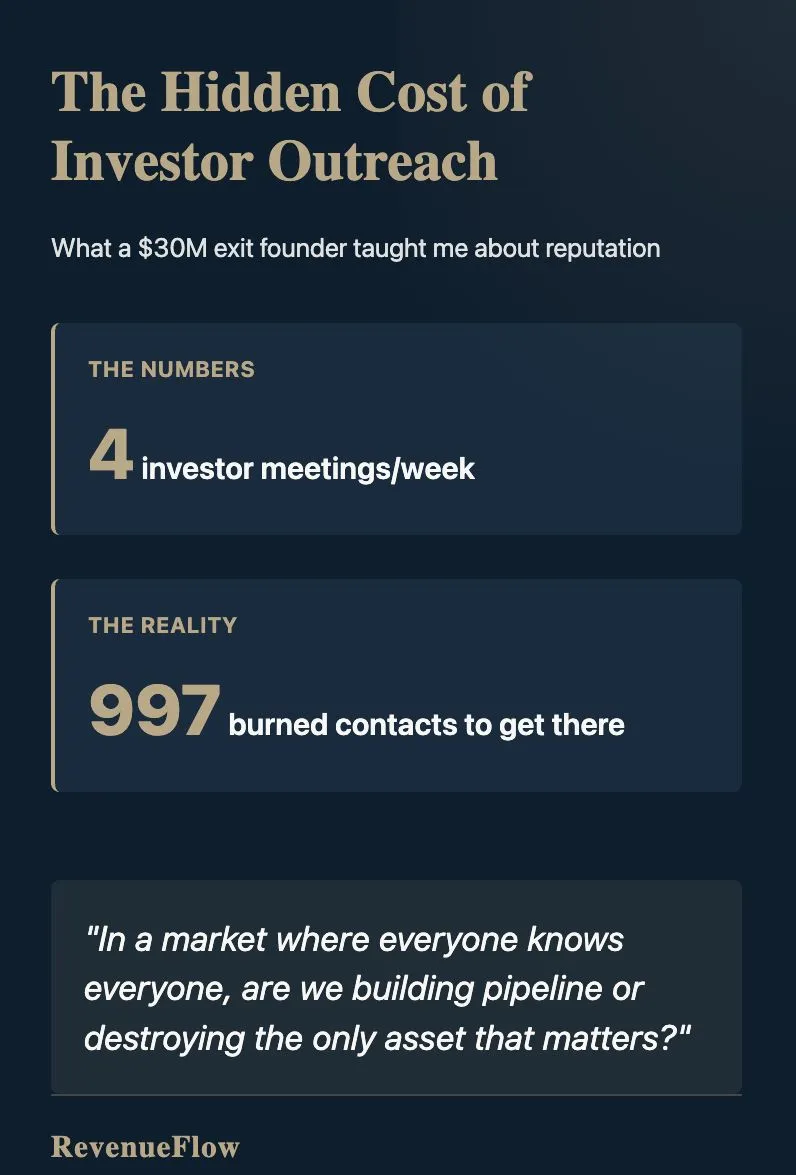
Traditional investor outreach destroys your reputation by treating a finite market like an infinite one. Messaging 1,000+ investors to book 4 meetings burns 997 contacts in a market where the same players operate for decades and remember every interaction. A value-first model (nurturing warm contacts with proprietary research and insights) generates 5x more meetings (4% vs 0.4%) while building rather than destroying the reputation compound effect that makes future raises possible.
Key takeaways
- Traditional outreach yields 4 meetings from 1,000 messages (0.4% conversion) while burning 997 contacts in a finite market where reputation is the only asset that matters.
- Capital markets contain thousands of relevant investors who operate for decades with long memories, unlike B2B SaaS markets with millions of prospects and high turnover.
- A value-first model achieves 20 quality meetings from 500 warm contacts (4% conversion rate, 10x better than spray-and-pray) with zero reputation damage and high repeatability.
- Reputation compounds in both directions: one burned investor talks to 50 others and sits on 5 LPACs, multiplying the damage beyond the initial contact.
- Leading with proprietary research, exclusive insights, and investment data transforms qualification from generic outreach into reputation-building relationships.
Reviewed and updated September 1, 2026
The Hidden Cost of Investor Outreach
What a $30M exit founder taught me about reputation.
Just spoke with a founder who exited for $30M and is now raising a credit fund. The conversation made me realize something that most capital raisers completely miss.
They're getting meetings. But they're terrified they're destroying their reputation in the process.
The Numbers vs. The Reality
Here's what the traditional investor outreach model looks like:
- Getting 3-4 investor meetings a week from LinkedIn outreach
- But messaging 1,000+ accredited investors to get there
- In a market where everyone knows everyone
- And reputation is the only thing that actually matters
The math: 4 meetings. 997 burned contacts.
Let that sink in.
Why Traditional Outreach Destroys Capital Raisers
Here's what most capital raisers don't realize:
The traditional outreach model treats your market like it's infinite.
Blast 1,000 messages. Get 50 replies. Book 4 meetings. Close 1 investor.
That works if you're selling software to mid-market companies. There are 300,000+ mid-market companies in the US. Burn 1,000? Who cares. There's always more.
Mid-market SaaS teams relying on volume outreach often turn to platforms like those compared in Klenty versus Outreach for cold email execution to manage that scale.
Beyond volume outreach platforms, comparing data enrichment with sales engagement tools clarifies how sourcing leads differs from executing sequences.
It destroys you if you're raising capital in a finite market.
Think about it:
You're not selling to anonymous prospects. You're asking sophisticated investors to trust you with their money.
And every generic message you send to "grow your network" or "explore opportunities" is a vote that you don't actually understand their world.
The Problem With "Spray and Pray"

When you cold blast your entire TAM with generic outreach, here's what actually happens:
In a market where everyone knows everyone
You're forgettable. Maybe slightly annoying.
You look like a hustler who got lucky.
997 burned contacts
To the 4 who take meetings: You look like a hustler who got lucky.
To the 50 who reply but don't book: You're forgettable. Maybe slightly annoying.
To the 946 who don't reply: You've just demonstrated that you don't understand how investor relationships work. You've shown them you're willing to spam their inbox to hit your activity metrics.
And here's the killer: they remember.
The capital raiser I spoke with literally said:
"I hadn't really thought about what happens to the 997 people who don't reply. We're burning through our entire addressable market."
In a world where your next raise depends on reputation, you're systematically destroying it to book meetings today.
The Finite Market Problem
Capital markets aren't like B2B SaaS markets. They're finite.
B2B SaaS:
- Millions of potential customers
- High turnover (new companies, new decision-makers)
- Short memories
- Transaction-focused relationships
Capital Markets:
- Thousands of relevant investors (not millions)
- Same players for decades
- Long memories
- Relationship-focused
When you cold blast in B2B SaaS, you're fishing in the ocean. When you cold blast in capital markets, you're poisoning your own pond.
Beyond the strategy question, the tools themselves differ sharply, as this comparison of cold email and sales engagement platforms shows.
The New Model: Quality Over Spray-and-Pray

Instead of cold blasting your entire TAM, here's what actually works:
1. Start With Your Warm Network
You already have people paying attention. Use them.
- Your LinkedIn followers (you might have 27K+ already watching)
- Your newsletter subscribers
- People who've engaged with your content
- Past investors and their networks
These aren't cold leads. They've already opted in to your worldview.
2. Lead With Value, Not Asks
Use actual value as the entry point:
- Proprietary research they can't get elsewhere
- Exclusive Q&As with people they want access to
- Investment insights from your unique position
- Pattern recognition from your deal flow
When you lead with value, the ask becomes natural. When you lead with the ask, you're just another inbox annoyance.
Choosing the right tooling matters too, so see this comparison of CRM versus sales engagement platforms before automating any outreach sequence.
3. Let Your Team Handle Qualification
Your SDR team should handle qualification, not generic outreach.
Generic outreach: "Hi [Name], I see you invest in [space]. Would love to connect about our fund."
Qualification: "You've engaged with 3 of our research pieces on [trend]. Here's an exclusive update with our latest data."
One burns reputation. The other builds it.
4. Reserve Personal Time for Relationships
Your personal time should go to actual investor relationships, not cold prospecting.
The people who will write you checks want to know you. They want to see you at dinners, hear you on podcasts, read your thinking over time.
They don't want to be prospect #847 in your automated sequence.
What This Looks Like in Practice
Here's the difference in outcomes:
Traditional Model:
- 1,000 people messaged
- 50 replies (5%)
- 4 meetings (0.4%)
- 997 burned contacts
- Reputation damage: high
- Repeat-ability: low (you've burned your list)
Value-First Model:
- 500 warm contacts nurtured
- 100 engaged regularly (20%)
- 20 quality meetings (4%)
- 0 burned contacts
- Reputation damage: none
- Repeat-ability: high (relationships compound)
The value-first model gets you more high-quality meetings without destroying the very asset that makes future raises possible.
The Reputation Compound Effect

Here's what the spray-and-pray crowd doesn't understand:
Reputation compounds.
That investor you burned today? They talk to 50 other investors. They sit on 5 LPACs. They have lunch with the exact people you're trying to reach next quarter.
One bad impression doesn't just cost you one investor. It costs you the network effect of that investor's relationships.
Meanwhile, reputation built through value compounds in the opposite direction.
That investor who loves your research? They share it with their network. They introduce you to colleagues. They become a reference for your next conversation.
The Bottom Line
Your reputation in a small market is worth more than a full calendar of unqualified meetings.
If you're doing investor outreach in 2025 and you're still cold blasting LinkedIn, you're not building pipeline.
You're burning the only asset that matters.
The question isn't "how do I get more meetings?"
The question is: "In a market where everyone knows everyone, are we building pipeline or destroying the only asset that matters?"
Related Reading
- How We Generated $110M in Pipeline in 6 Days (Case Study)
- Cold Email for Investor Outreach: How Founders Connect with VCs
- Fractional Sales Leadership: Ninety Days of Deliverables and a Written Exit
Looking to build intelligent investor outreach without burning your reputation? See how we help capital raisers and advisory firms turn their existing credibility into pipeline, without the spray-and-pray approach that destroys what you've spent years building.
Frequently asked questions.
Frequently asked questions- Why does cold emailing investors damage my reputation?
- Cold blasting investors treats a finite market like an infinite one. When you message 1,000 investors to get 4 meetings, you've shown 997 people that you don't understand how investor relationships work. Capital markets are small: the same players operate for decades, they know each other, and they remember. That investor you burned talks to 50 others and sits on multiple LPACs, multiplying the reputation damage far beyond the initial contact.
- How is raising capital different from B2B SaaS sales?
- Capital markets are finite with thousands of relevant investors, not millions. The same players operate for decades with long memories and relationship-focused dynamics. B2B SaaS has millions of potential customers, high turnover with new decision-makers constantly emerging, short memories, and transaction-focused relationships. Cold blasting works in B2B SaaS because you're fishing in an ocean; in capital markets, you're poisoning your own pond.
- What is the value-first model for investor outreach?
- The value-first model nurtures warm contacts (LinkedIn followers, newsletter subscribers, content engagers) with proprietary research, exclusive Q&As, investment insights, and pattern recognition from your deal flow. This approach generates 20 meetings from 500 contacts (4% conversion) versus 4 meetings from 1,000 cold messages (0.4% conversion). It builds zero burned contacts, creates repeatability as relationships compound, and establishes you as a valuable resource before making any ask.
- What should my SDR team focus on instead of generic outreach?
- Your SDR team should handle qualification, not generic cold outreach. Instead of 'I see you invest in this space, let's connect,' they should identify investors who've engaged with your content multiple times and offer exclusive updates with new data. This transforms outreach from reputation-burning spam into relationship-building qualification. Reserve your personal time for actual investor relationships (dinners, podcasts, and long-term thought leadership), not cold prospecting.
About the author.

Ben Carden is CRO at RevenueFlow, which builds and operates outbound revenue engines for B2B companies. Previously at Gartner Enterprise. Studied at London School of Economics.
Ben Carden · CRO
Connect on LinkedIn →Explore more.
Ready to scale your outreach?
We build GTM engines that book real meetings. See the receipts.
Related articles.
LinkedIn Outreach for Banks: A Regulated Message
How a bank's relationship managers use LinkedIn to reach business owners: what the FFIEC guidance, FINRA's notices and LinkedIn's own rules require, and where to stop.
LinkedIn Outreach for Utilities: Selling to the Sector
How a vendor selling to utilities uses LinkedIn next to a published sourcing process: the three ownership models, the registration gate and what a message may ask.
LinkedIn Outreach for Marketing Agencies
How a marketing agency wins its own clients on LinkedIn: the published agency search process, the platform rules aimed at how agencies work, and the expert buyer.
Sales Kickoff Agendas: Five Published, Session by Session
Five publishers print a sales kickoff agenda. They agree on four blocks and disagree on session length, rehearsal and where the agenda comes from.
Win Rate Benchmarks: Which Figures State a Population
A catalogue of the published average sales win rates, sorted by whether the page names the population behind its own number. Most do not.
Sales Cycle Length Benchmarks: What Each Figure Counts
The published B2B sales cycle benchmarks, sorted by what each page says it counted. The same number means two different things in two of them.