12 Networking Email Templates for Professional Outreach
Building professional relationships by email takes a different approach than sales. Templates for networking, informational interviews and relationship building.

When you already have someone's email address, the best practices for professional networking outreach are simple: send one short message that could only be for them, say why you chose them, make one small ask with a time limit, offer something back, stay under 100 words, and follow up twice at most, 7 to 10 days apart.
Key takeaways
- A networking email asks for time, attention or advice rather than money, so urgency, scarcity and aggressive follow-ups damage the relationship you are trying to start.
- Specific beats flattering: name something the person has done, written or said, and the exact insight or connection you are hoping for.
- Make the ask small and easy to grant, such as a 15-minute call or one focused question, and keep the whole message under 100 words.
- Follow up at most twice, 7 to 10 days apart, adding something new each time, then stop emailing and engage with their content or find a mutual connection.
Reviewed and updated September 18, 2026
Networking emails serve a different purpose than sales emails. You are not trying to close a deal or book a demo. You are trying to start a relationship, gain insight, or make a connection that pays off for both sides over time.
That changes the tactics. Urgency, scarcity and aggressive follow-ups damage your reputation with someone you want in your professional network. When you already have a person's email address, professional networking outreach comes down to a handful of best practices and one well-chosen template. This page gives you both: the practices first, then 12 templates.
Professional networking outreach best practices when you have their email address
When you already have someone's email address, the best practice is a single short message that could only have been written to them. Say why you chose this person, make one small ask with a time limit, offer something in return, keep it under 100 words, and follow up at most twice, 7 to 10 days apart, adding something new each time.
To: [Name] · Subject: Quick question about your path to [role/company]
"Your work at [Company] caught my attention, specifically [something specific you admire or find interesting]." 1
"Would you be open to a 15-minute call sometime in the next few weeks?" 2
"I know your time is valuable and would be grateful for any insight you could offer." 3
- 1Why this person and nobody else. A detail from their own work is what separates the message from a mail merge.
- 2One small ask with a time limit. Fifteen minutes on a call is easier to grant than a coffee or an open request for advice.
- 3It acknowledges the imposition and applies no pressure, because there is no transaction to hurry along.
Five practices sit behind every template.
Be specific about why you are writing. "I would love to pick your brain" tells the recipient nothing about what you want or why they should be the one to help. Name something they have done, written or said, and the exact insight or connection you are after.
Make it easy to say yes. A 15-minute call is easier to accept than a coffee meeting, and one focused question is easier to answer than a vague request for advice.
Lead with what you can offer. A perspective, access to a community, expertise in something they care about. Even small value turns a request into an opportunity.
Keep it short. Busy professionals receive dozens of networking requests. Stay under 100 words where you can.
Respect the difference from sales. There is no transaction, and people detect insincerity instantly. The first email plants a seed.
Template 1: Informational Interview Request
Use this when: You want to learn about someone's role, company, or industry to inform your own career decisions. A coffee chat request is this same template under its more casual name, and the same specificity rule decides whether it gets answered.
Subject: "Quick question about your path to [role/company]"
Body:
"Hi [Name],"
"I am currently [your relevant situation] and exploring [career path or industry]. Your work at [Company] caught my attention, specifically [something specific you admire or find interesting]."
"Would you be open to a 15-minute call sometime in the next few weeks? I would love to hear how you got into [their field] and any advice you would share with someone at my stage."
"I know your time is valuable and would be grateful for any insight you could offer."
"[Your name]"
Template 2: LinkedIn Connection Follow-Up
Use this when: Someone accepted your LinkedIn connection request and you want to turn that into a real relationship.
Subject: "Thanks for connecting on LinkedIn"
Body:
"Hi [Name],"
"Thanks for connecting on LinkedIn. I noticed you work in [their field/role] and wanted to reach out directly."
"I am currently [your relevant situation] and have been following your work on [specific topic or project]. Your [post/article/project] about [topic] particularly resonated with me because [brief reason]."
"I would love to hear more about [specific aspect of their work]. Would you be open to a brief conversation sometime?"
"[Your name]"
Template 3: Event Follow-Up (Conference, Meetup, Webinar)
Use this when: You met someone at an event and want to continue the conversation.
Subject: "Great meeting you at [Event Name]"
Body:
"Hi [Name],"
"It was great meeting you at [Event Name] on [day]. I really enjoyed our conversation about [specific topic you discussed]."
"I have been thinking about what you said regarding [specific point they made], and I would love to continue that discussion. [Optional: share a thought or resource related to that topic.]"
"Would you be open to grabbing coffee or a quick call in the next couple weeks?"
"[Your name]"
Template 4: Industry Expert Outreach
Use this when: You want to connect with someone whose expertise you admire but have no prior relationship with.
Subject: "Your work on [topic] has been invaluable"
Body:
"Hi [Name],"
"I have been following your work on [specific topic] for [timeframe], and your [article/talk/book/podcast] on [specific piece] shaped how I think about [relevant area]."
"I am [your relevant background] and currently working on [relevant project or challenge]. I have a specific question about [focused topic] that I think you would have unique insight on."
"Would you be open to a 10-minute call, or if easier, I could send my question via email?"
"[Your name]"
Template 5: Mentor Request
Use this when: You want to establish an ongoing mentorship relationship with someone more senior.
Subject: "Would you consider mentoring me?"
Body:
"Hi [Name],"
"I have admired your career trajectory from [early role] to [current role] and have learned a great deal from [specific ways you have encountered their work]."
"I am currently [your situation] and navigating [specific challenge or transition]. Your experience with [relevant aspect of their background] makes you uniquely qualified to offer guidance."
"I am not asking for a huge time commitment. Even a 30-minute call once a month would be incredibly valuable. I come prepared with specific questions and respect your time."
"Would you be open to exploring a mentorship arrangement?"
"[Your name]"
Template 6: Alumni Network Outreach
Use this when: You share an educational background with someone you want to connect with.
Subject: "Fellow [School Name] grad looking for advice"
Body:
"Hi [Name],"
"I am a [year] graduate of [School/Program] and came across your profile through the alumni network. Your path from [School] to [current role/company] is exactly the trajectory I am hoping to follow."
"I am currently [your situation] and trying to break into [field/role/company]. I would love to hear how you navigated that transition and any advice you would offer to someone a few years behind you."
"Would you have 15 minutes for a quick call sometime?"
"Go [mascot/school cheer if appropriate],"
"[Your name]"
Template 7: Cold Outreach for Industry Insight
Use this when: You want to understand an industry better and have identified someone with relevant experience.
Subject: "Learning about [industry/field] from someone who knows it"
Body:
"Hi [Name],"
"I am researching [industry/field] as part of [your context: job search, business idea, investment thesis, etc.] and your experience at [Company] makes you someone I would really like to learn from."
"I have done my homework and read [specific source: their articles, company press, industry reports]. I have a few specific questions about [focused topic] that I have not been able to answer through research alone."
"Would you be willing to spend 15 minutes sharing your perspective?"
"[Your name]"
Template 8: Reconnecting After Time Apart
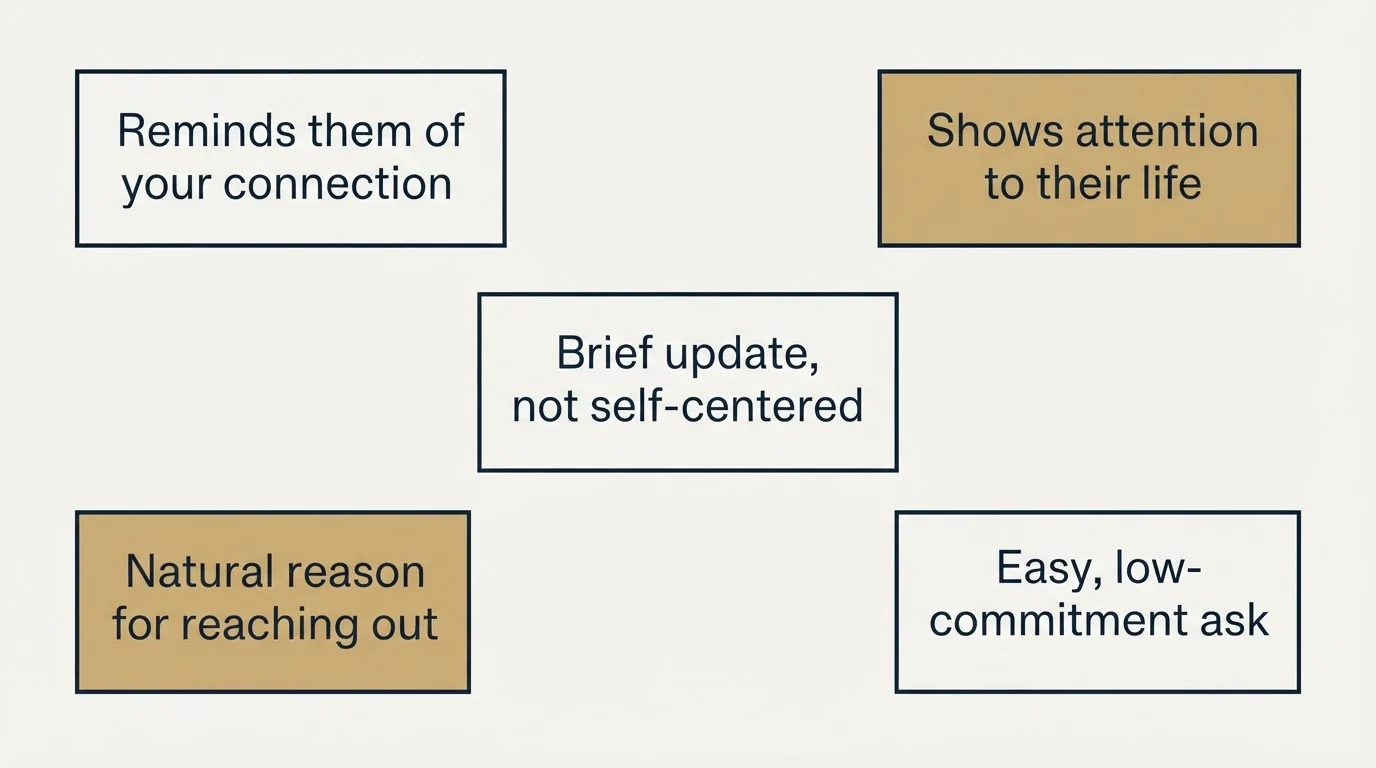
Use this when: You want to re-establish a connection with someone you have not spoken to in a while.
Subject: "Catching up after [timeframe]"
Body:
"Hi [Name],"
"It has been [timeframe] since we last connected when we [context of last interaction]. I hope things are going well with [something you know about their situation]."
"I have been [brief update on your situation] and recently thought of you when [specific trigger: saw their content, encountered relevant situation, etc.]."
"Would love to catch up and hear what you have been working on. Any interest in grabbing coffee or a quick call?"
"[Your name]"
Template 9: Peer Networking (Same Level, Different Company)
Use this when: You want to connect with someone in a similar role at another company to share experiences.
Subject: "Fellow [role] at [their company type] looking to connect"
Body:
"Hi [Name],"
"I am [your role] at [Your Company], and I came across your profile while researching how other [role type] approach [specific challenge or topic]."
"I am currently working on [relevant project or challenge] and would love to compare notes with someone facing similar situations at a different organization. I think we could both benefit from sharing what is working and what is not."
"Would you be open to a peer conversation?"
"[Your name]"
Template 10: Requesting an Introduction
Use this when: You want someone in your network to introduce you to someone in theirs.
Subject: "Could you introduce me to [Target Name]?"
Body:
"Hi [Name],"
"I hope you are doing well. I noticed you are connected with [Target Name] on LinkedIn, and I was wondering if you might be willing to make an introduction."
"I am reaching out to [Target Name] because [specific reason related to their work, role, or expertise]. I think [brief explanation of why the connection would be valuable]."
"I have drafted a short introduction that you could forward if you are comfortable. No pressure at all if you would prefer not to or do not know them well enough."
"[Your name]"
"P.S. Here is a draft intro you could use:"
"Hi [Target Name], I wanted to introduce you to [Your Name]. [They are/work on] [brief relevant description]. [Your Name] was hoping to connect with you about [specific topic]. I will let you two take it from here."
Template 11: Reaching Out to a Speaker or Author
Use this when: You want to connect with someone whose public work (book, talk, article) resonated with you.
Subject: "Your [book/talk] changed my approach to [topic]"
Body:
"Hi [Name],"
"I just finished your [book/talk/article] on [topic], and I wanted to reach out to say thank you. Your point about [specific insight] particularly resonated with me and has already changed how I approach [relevant situation in your life]."
"I am [brief relevant background] and am currently [applying their ideas/facing related challenges]. I have one question that came up as I was implementing your framework: [specific, focused question]."
"No expectation of a response given how busy you must be, but I wanted you to know the impact your work is having."
"[Your name]"
Template 12: Networking Within Your Own Company
Use this when: You want to build relationships with people in other departments or at higher levels within your organization.
Subject: "Learning more about the [their department] team"
Body:
"Hi [Name],"
"I am [your role] on the [your team] team, and I have been wanting to learn more about how [their department] approaches [specific topic or function]."
"I have heard great things about your work on [specific project] and would love to understand more about [specific aspect]. As someone who [your connection to their work: depends on their output, works on related problems, etc.], I think having a better understanding would help me [specific benefit]."
"Would you have 20 minutes for a coffee or virtual chat?"
"[Your name]"
Why each template works
The reasons repeat, which is the point.
| Template | Why it works |
|---|---|
| 1. Informational Interview Request | Explains your situation and why you are reaching out. References something specific about their work. Asks for a specific, limited time commitment. Acknowledges the imposition respectfully. Professional tone without being stiff. |
| 2. LinkedIn Connection Follow-Up | Explains why you connected. Shows you have actually looked at their work. References something specific they created. Clear but low-pressure ask. Opens the door without demanding anything. |
| 3. Event Follow-Up (Conference, Meetup, Webinar) | Reminds them of the context immediately. References specific conversation details. Shows you were actually listening. Offers something of value (a continued interesting conversation). Natural next step suggestion. |
| 4. Industry Expert Outreach | Genuine appreciation based on specific work. Establishes your credibility briefly. Asks one focused question, not vague advice. Offers two response options (call or email). Respects their time with the 10-minute limit. |
| 5. Mentor Request | Explains specifically why you chose them. Shows you understand their background. Clear about your current situation and needs. Sets expectations about time commitment. Promises to be prepared and respectful. |
| 6. Alumni Network Outreach | Immediate common ground with shared alma mater. Explains your specific interest in their path. Clear about what stage you are at. Specific time request. Light touch with the school reference at the end. |
| 7. Cold Outreach for Industry Insight | Clear about why you are researching. Shows you have done preliminary work. Demonstrates you value their specific experience. Focused questions, not vague conversation. Modest time request. |
| 8. Reconnecting After Time Apart | Reminds them of your connection immediately. Shows you have been paying attention to their life. Brief update without being self-centered. Natural reason for reaching out now. Easy, low-commitment ask. |
| 9. Peer Networking (Same Level, Different Company) | Establishes common ground immediately. Clear mutual benefit proposition. Specific topic to discuss. Framed as peer exchange, not information extraction. Simple, open-ended ask. |
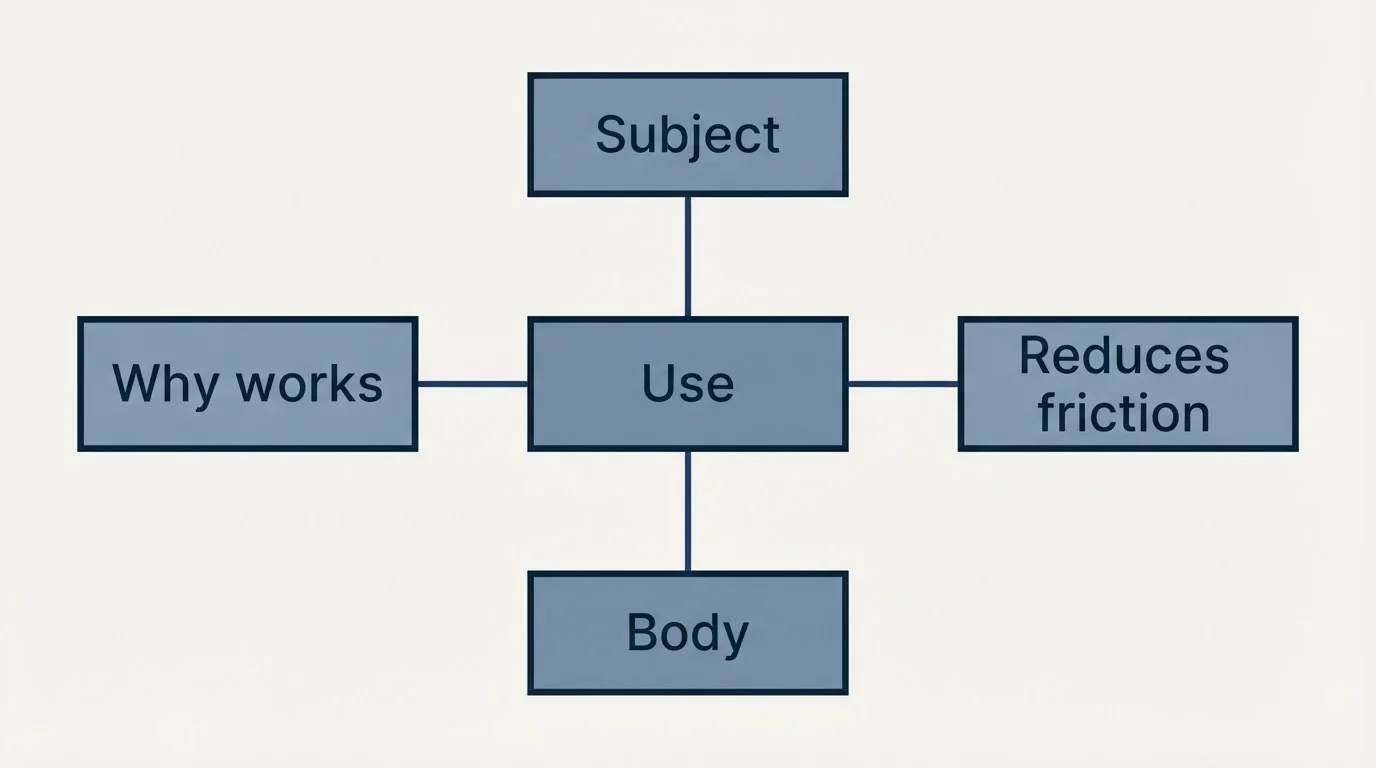
| 10. Requesting an Introduction | Explains why you want the introduction specifically. Reduces friction by providing a draft. Gives them an easy out if uncomfortable. Respectful of their relationship with the target. Clear and actionable. |
| 11. Reaching Out to a Speaker or Author | Genuine appreciation with specific examples. Shows you actually consumed and applied their work. One focused question, not a generic request. No pressure with "no expectation" language. Leaves the door open for future connection. |
| 12. Networking Within Your Own Company | Internal connection is easier to establish. Clear reason for wanting to connect. Specific topic, not vague networking. Explains mutual benefit. Casual but professional request. |
Where we differ from standard practice
Much of the advice on this page reflects how outbound is commonly run. We run it differently, and since this page sits on our site it is worth saying where the difference is and what it costs us.
The reasoning is mechanical rather than moral. A follow-up arrives underneath a message the recipient has already seen and chosen not to answer, so it is delivered to the population most likely to mark it as spam, and the reputation cost of that lands on the sending domain across every campaign running on it. We set that cost against the replies a sequence recovers and decided the trade was not worth it. The full argument, with the numbers from our own campaigns, is in why we stopped using follow-ups.
Follow-Up Strategy for Networking Emails
Networking follow-ups need more patience than sales follow-ups. Wait at least 7-10 days before the first one, because these are not urgent requests and a quick chaser reads as desperate. Make each follow-up add something: an article relevant to your first note, a reference to something they recently published, or the reason you are writing now.
Follow-up example:
"Hi [Name],"
"Following up on my note from last week. I just saw your recent [post/article/announcement] about [topic] and it reinforced why I was hoping to connect."
"[Optional: One sentence of genuine reaction to their content.]"
"Still hoping to find 15 minutes to chat if you have availability."
"[Your name]"
Two follow-ups is the maximum. If you hear nothing after two, assume they are too busy or not interested, because continuing to email damages your reputation. Engage with their content on social media or find a mutual connection who could make an introduction.
Common Mistakes in Networking Emails
- Generic flattery. "I am a huge fan of your work" means nothing without specifics, and it signals that the same email went to 50 people.
- Asking for too much. An hour with a stranger, or career guidance in a first email, is presumptuous. Start small and build.
- Making it all about you. Even when you are the one asking, think about what you bring to the conversation.
- Forgetting to follow through. If someone agrees to help, send your availability promptly, come prepared, and always send a thank you.
- Never giving back. If you only write when you need something, people stop responding.
Building a Long-Term Networking Practice
The professionals with the strongest networks invest in relationships consistently, not only when they need a job. Reach out to one or two people a week even when you need nothing, share articles, make introductions and congratulate people. The relationships compound over years.
Getting Started with Networking Outreach
Identify 10-15 people you genuinely want to connect with and research each one: their background, their content, their recent work. Then use these templates as starting points, not scripts. The best networking emails feel like they could only have been written to that specific person.
If you are building outreach programs for your business, we help B2B companies create systematic approaches to cold email.
Schedule your free strategy call here.
Related Reading
Frequently asked questions.
Frequently asked questions- What are the best practices for professional networking outreach when you have their email address?
- Send one short message that could only have been written to that person. Say specifically why you chose them, make one small ask with a time limit such as a 15-minute call, offer something in return, and keep it under 100 words. Follow up at most twice, 7 to 10 days apart, adding something new each time.
- How long should a networking email be?
- Under 100 words where possible. Busy professionals receive dozens of networking requests, and a short message respects their time. It needs three things only: why you are writing to this person specifically, one small and specific ask, and an easy way to decline. Anything beyond that can wait for the conversation itself.
- How many times should you follow up on a networking email?
- Twice at most. Wait at least 7 to 10 days before the first follow-up, because these are not urgent requests, and make each one add something new, such as a reaction to something they recently published. After two attempts with no answer, stop emailing and engage with their content or look for a mutual connection.
- What is the difference between a networking email and a sales email?
- A sales email asks someone to exchange money for value. A networking email asks for something less tangible, such as time, attention, advice or a connection, so there is no immediate transaction. Reciprocity and sincerity matter more, the relationship develops over months and years, and sales tactics like urgency and scarcity backfire.
About the author.

Ben Carden is CRO at RevenueFlow, which builds and operates outbound revenue engines for B2B companies. Previously at Gartner Enterprise. Studied at London School of Economics.
Ben Carden · CRO
Connect on LinkedIn →Explore more.
Ready to scale your outreach?
We build GTM engines that book real meetings. See the receipts.
Related articles.
10 B2B Cold Email Templates for One-Message Sends
Ten B2B cold email templates written for a single send, with the four slot structure underneath them and the test that separates a good example from a bad one.
Cold Email Templates for Customer Success Managers
Eleven cold email templates for customer success managers, covering champion change, expansion, renewal rescue, and win-back, with subject lines and timing.
14 Renewal Email Templates That Retain Customers
Master subscription and contract renewals with 14 proven email templates. Reduce churn, lock in renewals early, and maintain customer relationships.
13 Case Study Request Email Templates That Get Results
Get proven email templates for requesting case studies, video testimonials, and written reviews from your happiest customers. Includes templates for every stage from initial ask to final approval.
13 Demo Follow-Up Email Templates to Close More Deals
Proven demo follow-up email templates for every scenario, from same-day recaps to re-engaging stalled prospects and handling competitive evaluations.
Email Subject Line Capitalization: What the Guides Say
What the style authorities actually rule on subject line case, what the published tests measured, and the default for a one to one sales email.