15 Win-Back Email Templates That Recover Lost Customers
Learn how to win back churned customers with 15 proven email templates. Re-engage lost accounts, address departure reasons, and recover valuable customer relationships.

Win-back emails recover lost customers by addressing their specific departure reasons with targeted timing. Send immediate follow-ups within days for problem resolution, product update notifications at 1-6 months when features are added, and comprehensive change announcements after 6+ months. Segment campaigns by why customers left (price, product gaps, poor experience, changed needs, or competitive switches), and provide concrete evidence of improvement rather than generic appeals.
Key takeaways
- Former customers convert at significantly higher rates than cold prospects because they already understand your value proposition and have made a purchasing decision once.
- Win-back campaigns should be timed strategically: 0-30 days for immediate follow-ups, 1-6 months for product updates, and 6+ months for comprehensive change announcements.
- Effective win-back emails segment by five primary departure reasons: price/budget constraints, product limitations, poor experience, changed needs, and competitive switches.
- The immediate follow-up template works by requesting feedback rather than pushing for return, which feels respectful and catches customers while experience is fresh.
- Problem resolution emails demonstrate that customer feedback led to concrete actions and reduce return risk through specific incentives like discounted rates or extended trials.
Reviewed and updated September 15, 2026
15 Win-Back Email Templates That Recover Lost Customers
Lost customers represent one of the most underutilized revenue opportunities in B2B. They already know your product. They've already made a purchasing decision once. They understand your value proposition. Compared to cold prospects, former customers are significantly more likely to convert when approached with the right message at the right time.
Yet most companies treat churned customers as permanently lost. They move on to new prospects and never look back. This is a mistake. Customer circumstances change. Product issues get resolved. Competitor alternatives disappoint. The reasons someone left six months ago may no longer apply.
This guide provides 15 email templates for winning back lost customers, organized by departure reason and timing.
Understanding Why Customers Leave
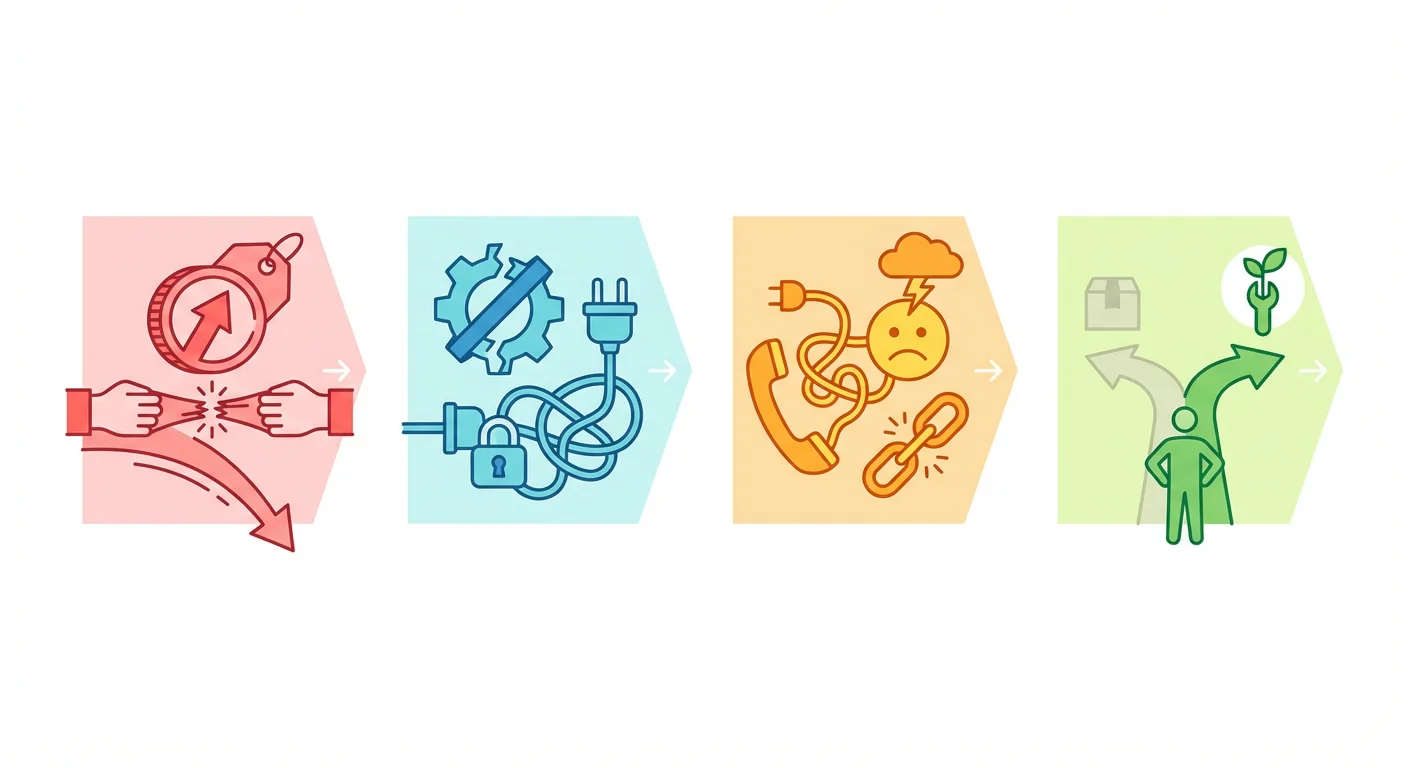
Effective win-back campaigns address specific departure reasons. Understanding why customers left determines which approach will resonate.
Price and Budget
Customers who left due to cost are candidates for win-back when budgets improve, when you offer better pricing, or when they realize alternatives cost more in hidden ways.
Product Limitations
Customers who left due to missing features are candidates when you've added those capabilities or when they discover alternatives have their own limitations.
Poor Experience
Customers who left due to service issues are candidates after you've made improvements and can demonstrate changed behavior.
Changed Needs
Customers whose needs evolved may return when needs shift again or when you've expanded your offering to meet their new requirements.
Competitive Switch
Customers who left for competitors may return after experiencing competitor shortcomings or when you've improved relative positioning.
Recent Departure Templates (0-30 Days)
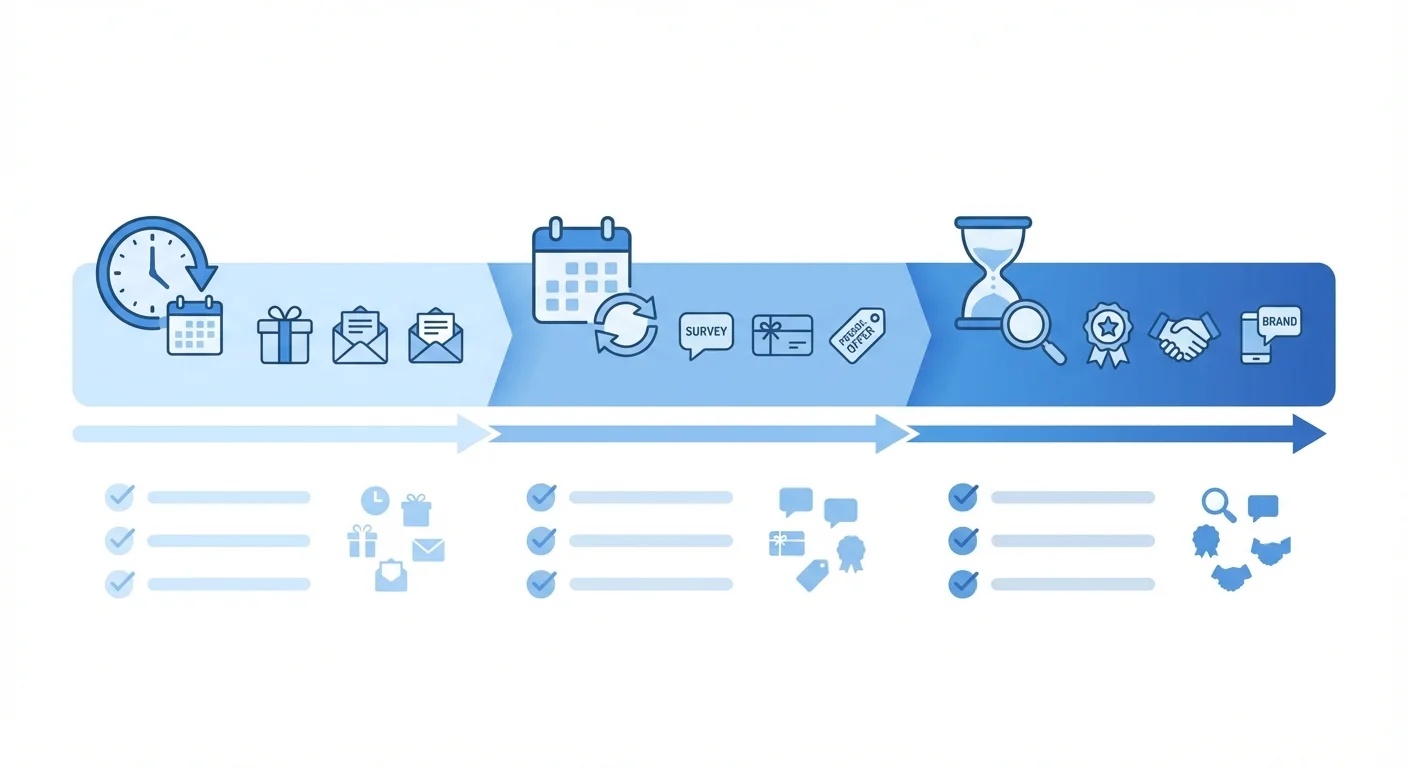
These templates reach out shortly after a customer churns, while the relationship is still fresh.
Template 1: The Immediate Follow-Up
Best for: Reaching out within days of cancellation.
Subject line: Sorry to see you go, [First Name]
Email:
Hi [First Name],
I saw that [Company Name] canceled your [Product] subscription. While I respect your decision, I wanted to reach out personally.
First, thank you for being a customer. Your business meant something to us.
Second, I'm curious: What led to the decision to leave?
Understanding your reasons helps us improve. And if there's anything unresolved that contributed to your decision, I'd like a chance to address it.
If you're open to it, I'd appreciate a brief conversation. Not to sell you on coming back, but to understand what we could have done better.
Either way, I wish you and [Company Name] well.
[Your Name]
Why it works: Immediate follow-up catches customers while the experience is fresh. Requesting feedback rather than pushing return feels respectful.
Template 2: The Problem Resolution Offer
Best for: Customers who left due to specific issues you can address.
Subject line: We want to make this right
Email:
Hi [First Name],
I understand [Company Name] left because of [specific issue they mentioned]. I want you to know we've taken this seriously.
Here's what we've done:
- [Action taken 1]
- [Action taken 2]
- [Action taken 3]
I'm not asking you to come back immediately. But I wanted you to know that your feedback led to real changes.
If you'd be willing to give us another chance, I can offer:
- [Incentive 1, such as discounted rate]
- [Incentive 2, such as extended trial]
- [Incentive 3, such as dedicated support]
If you're not ready to return, that's completely understandable. But the door is open, and the issues that drove your departure have been addressed.
[Your Name]
Why it works: Demonstrating that their feedback led to changes shows respect for their experience. Incentives reduce the risk of returning.
Template 3: The Grace Period Extension
Best for: Customers who may have left due to temporary circumstances.
Subject line: Extended grace period for [Company Name]
Email:
Hi [First Name],
Your [Product] subscription recently ended, but your account and data are still preserved.
Before anything is permanently deleted, I wanted to offer an extended grace period. Here's what this means:
What's preserved:
- All your data and configurations
- Your account settings
- Your history and records
Grace period extended until: [Date]
To reactivate: [Link or instructions]
If you left due to temporary circumstances (budget timing, team changes, project completion), this gives you flexibility to return when ready.
No pressure. Just wanted you to know the option exists.
[Your Name]
Why it works: Extended grace periods address circumstantial departures. Preserving data reduces the friction of returning.
Medium-Term Win-Back Templates (1-6 Months)
These templates reach out to customers who left recently but not immediately.
Template 4: The Product Update Notification
Best for: Customers who left due to missing features or capabilities.
Subject line: [Feature they wanted] is here
Email:
Hi [First Name],
When [Company Name] left [Product], you mentioned that [missing feature/capability] was a factor.
I wanted to let you know: we've built it.
[Feature Name]:
- [What it does]
- [How it addresses their need]
- [Additional capabilities]
Here's a quick overview: [Link to demo video or product page]
If this was a significant factor in your decision to leave, it might be worth another look. If other factors were more important, I completely understand.
Either way, I wanted you to know we listened and acted on your feedback.
Would you be interested in seeing the new feature in action?
[Your Name]
Why it works: Feature-specific win-back addresses the exact reason for departure. Showing you listened to feedback demonstrates respect.
Template 5: The Check-In Email
Best for: General check-in after a few months of departure.
Subject line: How are things going, [First Name]?
Email:
Hi [First Name],
It's been [X] months since [Company Name] left [Product]. I wanted to check in and see how things are going.
A few questions I'm curious about:
- Did you find a solution that's working better for your needs?
- Are there things about [Product] that you miss?
- Have your needs or circumstances changed since you left?
This isn't a disguised sales pitch. I'm genuinely interested in understanding how things have evolved.
If you've found something that works great, I'm happy to hear that. If you've discovered the grass isn't always greener, let's talk about what coming back might look like.
Either way, I'd appreciate your perspective.
[Your Name]
Why it works: Genuine check-ins feel caring rather than sales-focused. Open questions invite honest dialogue about their current situation.
Template 6: The Competitive Experience Question
Best for: Customers who left for a competitor.
Subject line: How's [Competitor] working out?
Email:
Hi [First Name],
When [Company Name] left, I believe you moved to [Competitor]. I'm curious: how has that experience been?
I'm asking because:
- I genuinely want to understand what they do better than us
- I want to know if our perception of their strengths and weaknesses is accurate
- If there are things you miss about [Product], I'd love to know
No hidden agenda here. Honest competitive feedback helps us improve.
That said, if [Competitor] hasn't lived up to expectations, or if you're missing things about [Product], I'd be happy to discuss what coming back might look like.
What's your honest assessment?
[Your Name]
Why it works: Asking about competitor experience invites honest comparison. Competitors often disappoint, and this catches those moments.
Template 7: The Industry Change Alert
Best for: Alerting former customers to relevant industry developments.
Subject line: [Industry development] and what it means for you
Email:
Hi [First Name],
I wanted to share something relevant to [Company Name], even though you're no longer a customer.
[Brief description of industry development, regulatory change, market shift, or trend]
Why this matters for [Company Name]:
- [Impact 1]
- [Impact 2]
- [Impact 3]
How [Product] helps companies navigate this:
- [Capability 1]
- [Capability 2]
- [Capability 3]
I'm not suggesting you need to return to [Product]. But if this development affects your business and you're looking for solutions, we might be able to help.
Worth a conversation?
[Your Name]
Why it works: Industry alerts provide genuine value regardless of customer status. If the development creates urgency, you're positioned to help.
Long-Term Win-Back Templates (6+ Months)
These templates reach out to customers who left a significant time ago.
Template 8: The "A Lot Has Changed" Email
Best for: Customers who left long enough ago that significant improvements have been made.
Subject line: [Product] has changed a lot since you left
Email:
Hi [First Name],
It's been [timeframe] since [Company Name] used [Product]. A lot has changed since then.
Major updates since you left:
- [New feature/improvement 1]
- [New feature/improvement 2]
- [New feature/improvement 3]
- [New feature/improvement 4]
What customers are saying: "[Recent customer quote about improvements]" - [Customer Name, Company]
Recognition:
- [Award or recognition]
- [Analyst mention]
- [Growth metric]
If you evaluated [Product] today, you'd find a significantly better product than what you experienced.
I'm not assuming things didn't work out with whatever solution you moved to. But if you're ever considering options again, [Product] deserves a fresh look.
Want to see what's new?
[Your Name]
Why it works: Significant time gaps justify comprehensive update summaries. Third-party validation (quotes, awards) adds credibility.
Template 9: The Anniversary Outreach
Best for: Reaching out on the anniversary of their departure or original sign-up.
Subject line: One year since we parted ways
Email:
Hi [First Name],
A year ago, [Company Name] ended your relationship with [Product]. I wanted to mark the occasion with a quick note.
Over the past year, we've:
- [Accomplishment 1]
- [Accomplishment 2]
- [Accomplishment 3]
More importantly, we've learned from customers like you who gave us feedback about what we could do better.
I don't know what your situation looks like today. Maybe you've found a perfect solution. Maybe you're still looking. Maybe your needs have evolved entirely.
If there's ever an opportunity to work together again, we'd welcome it. And if there's anything I can ever help with, professionally, don't hesitate to reach out.
Wishing you and [Company Name] continued success.
[Your Name]
Why it works: Anniversary timing creates a natural reason to reach out. The professional relationship offer extends goodwill beyond sales.
Template 10: The "We've Missed You" Email
Best for: Warm, relationship-focused outreach after extended absence.
Subject line: We've missed you, [First Name]
Email:
Hi [First Name],
I was looking through our customer records and came across [Company Name]. It reminded me of [specific positive memory from their time as a customer].
We've genuinely missed having you as part of our community.
I know circumstances change and decisions are made for good reasons. But I wanted to reach out and let you know:
- The door is always open
- We've continued improving [Product]
- We'd love to earn your business again if the opportunity ever arises
If your situation has changed, or if you're ever curious about what we're doing now, I'd be happy to reconnect.
No pressure. Just wanted you to know you're remembered and valued.
[Your Name]
Why it works: Warm, personal outreach stands out from transactional win-back attempts. Specific memories demonstrate genuine relationship investment.
Incentive-Based Win-Back Templates
These templates offer specific incentives to encourage return.
Template 11: The Special Offer Email
Best for: Offering discounts or special terms to encourage return.
Subject line: Special offer for returning customers
Email:
Hi [First Name],
I have an offer reserved for former customers like [Company Name].
Come back and get:
- [X]% off your first [term period] back
- [Bonus, such as free onboarding or extra features]
- [Benefit, such as locked-in pricing]
The details:
- Offer valid through [Date]
- Applies to [Plan types]
- [Any conditions]
We don't offer this to new customers. This is specifically for customers we'd love to have back.
If you've been considering [Product] again, this is the best time to return.
Interested? Reply to this email and I'll set everything up.
[Your Name]
Why it works: Exclusive returning customer offers create privilege and urgency. Clear terms make the decision straightforward.
Template 12: The Free Trial Re-Offer
Best for: Letting former customers try the improved product risk-free.
Subject line: Try [Product] again, on us
Email:
Hi [First Name],
Rather than ask you to commit to [Product] again, I'd like to offer a different approach.
Come back for a free [X]-day trial.
No credit card. No commitment. Just access to see how [Product] has evolved since you left.
What's changed:
- [Improvement 1]
- [Improvement 2]
- [Improvement 3]
What you'll get during the trial:
- Full feature access
- [Support level]
- [Any additional trial benefits]
If the trial convinces you that [Product] has improved, we can discuss renewal terms. If it doesn't, you've lost nothing but a bit of time.
Start your trial: [Link]
Worth another look?
[Your Name]
Why it works: Risk-free trials remove the barrier of commitment. Former customers can validate improvements without risk.
- A discount or terms kept for former customers only
- A stated end date, so the decision has an edge to it
- Or a free trial again, with no credit card and no commitment
- What has changed since they left, listed plainly
- What the primary reason for leaving was
- What, if anything, would have changed the decision
- 5 minutes to reply, or 15 minutes for a call
- Feeds product and service decisions even when the answer is no
Feedback-Focused Win-Back Templates
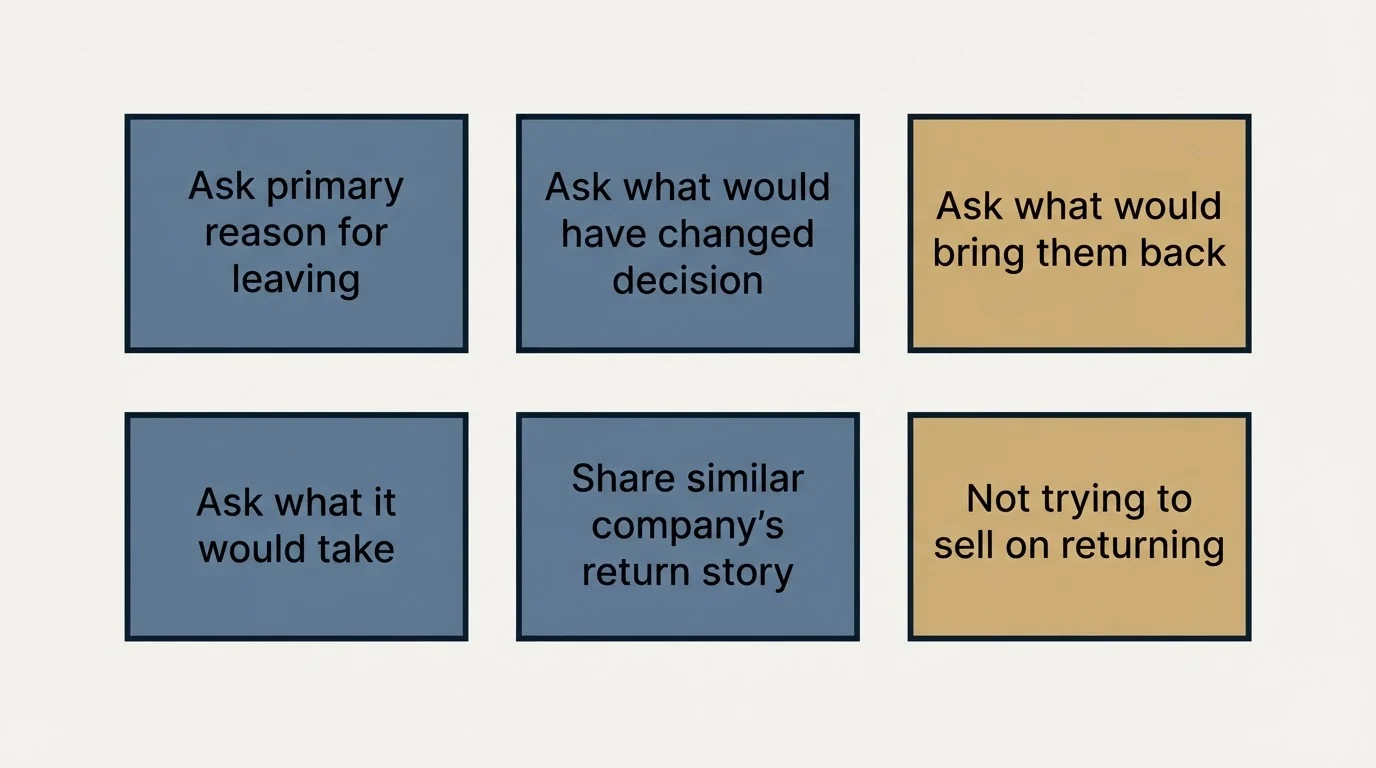
These templates prioritize learning over immediate return.
Template 13: The Exit Interview Request
Best for: Gathering feedback to inform both win-back efforts and product improvement.
Subject line: Can I ask why you left?
Email:
Hi [First Name],
I'm reaching out to former customers to better understand why they left [Product]. Your honest feedback would be incredibly valuable.
I have three questions:
- What was the primary reason [Company Name] left?
- What, if anything, would have changed your decision?
- Is there anything that would bring you back?
I'm not trying to sell you on returning. I genuinely want to understand what we could have done differently.
If you have 5 minutes to reply or 15 minutes for a call, I'd appreciate your candor. Your feedback directly informs our product and service decisions.
[Your Name]
Why it works: Feedback requests feel respectful rather than pushy. Understanding departure reasons enables better win-back attempts and product improvement.
Template 14: The "What Would It Take" Email
Best for: Direct exploration of win-back conditions.
Subject line: What would it take?
Email:
Hi [First Name],
I'll be direct: I'd love to have [Company Name] back as a customer.
But rather than pitch you on returning, I want to ask: What would it take?
- A specific feature we don't have?
- Better pricing?
- Improved support?
- Something else entirely?
I might be able to address what you name. Or I might have to acknowledge we can't. Either way, I'd rather understand the gap than guess at it.
If returning to [Product] is completely off the table regardless of what we do, that's useful to know too. It helps me focus on customers where there's actually an opportunity.
What would it take?
[Your Name]
Why it works: Direct questions cut through back-and-forth. Understanding specific conditions enables targeted solutions.
Template 15: The Success Story Share
Best for: Showing former customers what current customers achieve.
Subject line: What [Similar Company] achieved after coming back
Email:
Hi [First Name],
I wanted to share a story that might be relevant for [Company Name].
[Similar Company], a company similar to yours, left [Product] [timeframe] ago for similar reasons you did. They came back [timeframe] later.
Since returning, they've achieved:
- [Result 1]
- [Result 2]
- [Result 3]
[Quote from customer]: "[Quote about their return experience]" - [Name, Title]
Full story: [Link to case study if available]
I share this not to pressure you, but to show that coming back is something other companies have done successfully.
If you're ever curious about what returning might look like for [Company Name], I'm here to discuss.
[Your Name]
Why it works: Social proof from similar companies who returned demonstrates that returning is viable. Success stories create positive associations.
Best Practices for Win-Back Campaigns
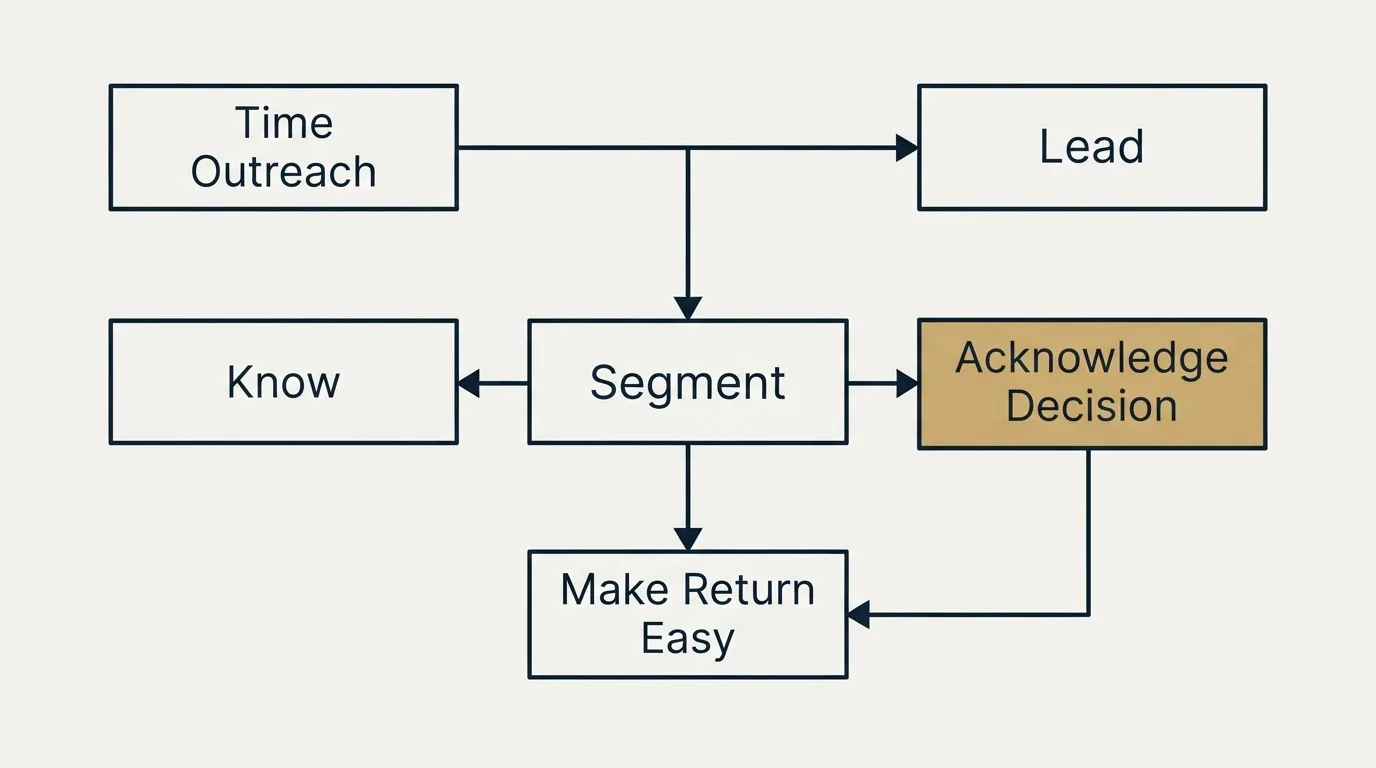
Segment by Departure Reason
Customers who left due to price need different messages than those who left due to product issues.
Time Your Outreach
Different timing works for different situations. Recent departures need different approaches than long-term churned customers.
Lead with Value, Not Desperation
Win-back emails should feel valuable to receive, not desperate pleas to return.
Acknowledge Their Decision
Respect that they made a choice to leave. Don't dismiss their reasons or minimize their experience.
Make Return Easy
Remove friction from the return process. Preserved data, streamlined onboarding, and clear terms all help.
Know When to Stop
Persistent follow-up crosses into annoyance. Know when to let go and revisit later.
Common Mistakes to Avoid
Ignoring Departure Reasons: Win-back emails that don't address why someone left feel tone-deaf.
Being Pushy: Aggressive win-back attempts damage remaining goodwill.
One-Size-Fits-All Messaging: Different departure reasons require different approaches.
Forgetting to Update Records: Track win-back attempts to avoid redundant outreach.
Over-Promising: Win-back offers you can't sustain create negative experiences the second time around.
- Yes: Segment by departure reason, since price and product issues need different messages
- Yes: Write something that feels valuable to receive
- Yes: Respect that they made a choice, and do not minimize their reasons
- Yes: Make returning easy: preserved data, streamlined onboarding, clear terms
- Yes: Keep records of win-back attempts so the same ground is not covered twice
- No: Messages that never address why the customer left
- No: Aggressive attempts that spend the goodwill still left
- No: One message written for every departure reason at once
- No: Offers you cannot sustain if they do come back
Recover Your Lost Relationships
Former customers represent warm leads with existing knowledge of your product. By approaching win-back thoughtfully, addressing their specific departure reasons, and offering genuine value for returning, you can recover relationships that seemed lost.
Not every churned customer will return. But many will, given the right approach at the right time. Use these templates as starting points, customize them for your specific situations, and measure what works.
Ready to win back lost customers? Start your free cold email campaign and turn churned accounts into renewed relationships.
Related Reading
Frequently asked questions.
Frequently asked questions- When should I send a win-back email after a customer cancels?
- Send your first win-back email within days of cancellation for immediate follow-up. Use 1-6 month timing when you've added features they requested or made product improvements. Reserve 6+ month outreach for comprehensive changes or anniversary-based reconnection. Different timing addresses different departure scenarios: immediate outreach works for problem resolution, while longer gaps suit product evolution announcements.
- What should I include in a win-back email to make it effective?
- Address the specific reason they left rather than sending generic appeals. Acknowledge their decision respectfully without appearing desperate. Provide concrete evidence of changes or improvements if relevant to their departure. Make returning easy by preserving their data and offering reduced-friction reactivation. Lead with value for them rather than your need to recover revenue.
- How do I write a win-back email for customers who left due to product limitations?
- Lead with the specific feature they wanted that you've now built. Explain what it does and how it addresses their original need. Include a link to a demo video or product page showing the new capability. Reference their previous feedback directly to show you listened and acted on it. Offer to demonstrate the new feature in action rather than pushing immediate return.
- Should I offer discounts in win-back emails?
- Use incentives strategically for customers who left due to specific problems you've resolved, not as the primary win-back mechanism. Offer discounted rates, extended trials, or dedicated support to reduce the risk of returning after a negative experience. Incentive-based templates work best when combined with evidence of concrete improvements. Avoid leading with discounts, which can signal desperation rather than genuine change.
About the author.

Ben Carden is CRO at RevenueFlow, which builds and operates outbound revenue engines for B2B companies. Previously at Gartner Enterprise. Studied at London School of Economics.
Ben Carden · CRO
Connect on LinkedIn →Explore more.
Ready to scale your outreach?
We build GTM engines that book real meetings. See the receipts.
Related articles.
10 B2B Cold Email Templates for One-Message Sends
Ten B2B cold email templates written for a single send, with the four slot structure underneath them and the test that separates a good example from a bad one.
14 Renewal Email Templates That Retain Customers
Master subscription and contract renewals with 14 proven email templates. Reduce churn, lock in renewals early, and maintain customer relationships.
Follow-Up Call Scripts: Nine Calls Into a Live Conversation
Nine follow-up call scripts, each tied to the event that earns the call, from a demo to a renewal, plus the four moves they share and how each call should end.
Cold Email Templates for Customer Success Managers
Eleven cold email templates for customer success managers, covering champion change, expansion, renewal rescue, and win-back, with subject lines and timing.
13 Case Study Request Email Templates That Get Results
Get proven email templates for requesting case studies, video testimonials, and written reviews from your happiest customers. Includes templates for every stage from initial ask to final approval.
Email Subject Line Capitalization: What the Guides Say
What the style authorities actually rule on subject line case, what the published tests measured, and the default for a one to one sales email.