AI Collapsed the Learning Curve. Here's What That Means.
Our CRO builds lead gen systems in Clay. Our cofounders set up automations. I find leads using multi-stage Cursor workflows. None of us are 'technical.' All of us are shipping.
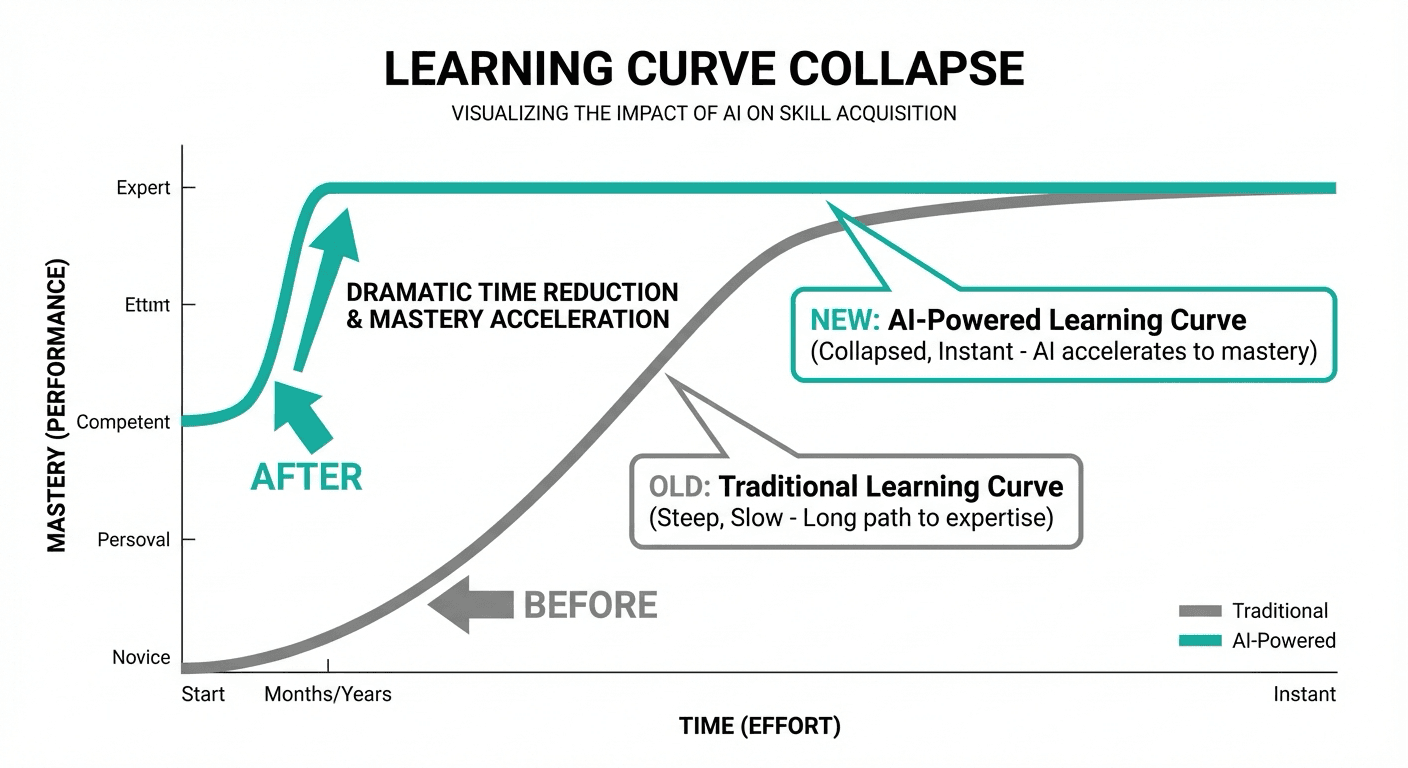
AI tools have eliminated traditional technical barriers, allowing non-technical professionals to build systems, automations, and workflows without coding expertise. The shift transforms work from specialized execution to cross-functional orchestration, where one person can now own entire workflows that previously required multiple specialists. Success depends on clarity of intent, quality detection, and speed of iteration rather than deep technical knowledge.
Key takeaways
- The most expensive part of building is the handoff between teams, not the work itself: each transfer loses context and adds friction.
- AI enables small teams to produce massive output by letting each person do work that previously required multiple specialists.
- The new competitive advantages are clarity of intent, quality detection, cross-functional fluency, and speed of iteration.
- Specialists who cannot communicate across functions become increasingly obsolete as generalists use AI to execute in multiple domains.
- Teams using AI can compress iteration cycles from weeks to hours, moving from idea to tested implementation in a single day.
Reviewed and updated September 5, 2026
AI Collapsed the Learning Curve. Here's What That Means.
Something strange is happening at our company.
Our CRO is building lead gen systems in Clay. Our cofounders are setting up automations. I'm finding leads using multi-stage Cursor workflows.
None of us are "technical", yet all of us are shipping.
Not because we suddenly learned to code. Because AI collapsed the learning curve.
The Old Model Is Dead
Full stack used to mean frontend and backend.
Now it means code, copy, design, and go-to-market, all in one person.
The most expensive part of building anything isn't the work itself. It's the handoff between different teams and functions. Each transfer loses context. Each adds lag. Each creates friction.
When one person can bridge those gaps using AI, you trade 10% perfection for 100% velocity.
From Specialist to Orchestrator
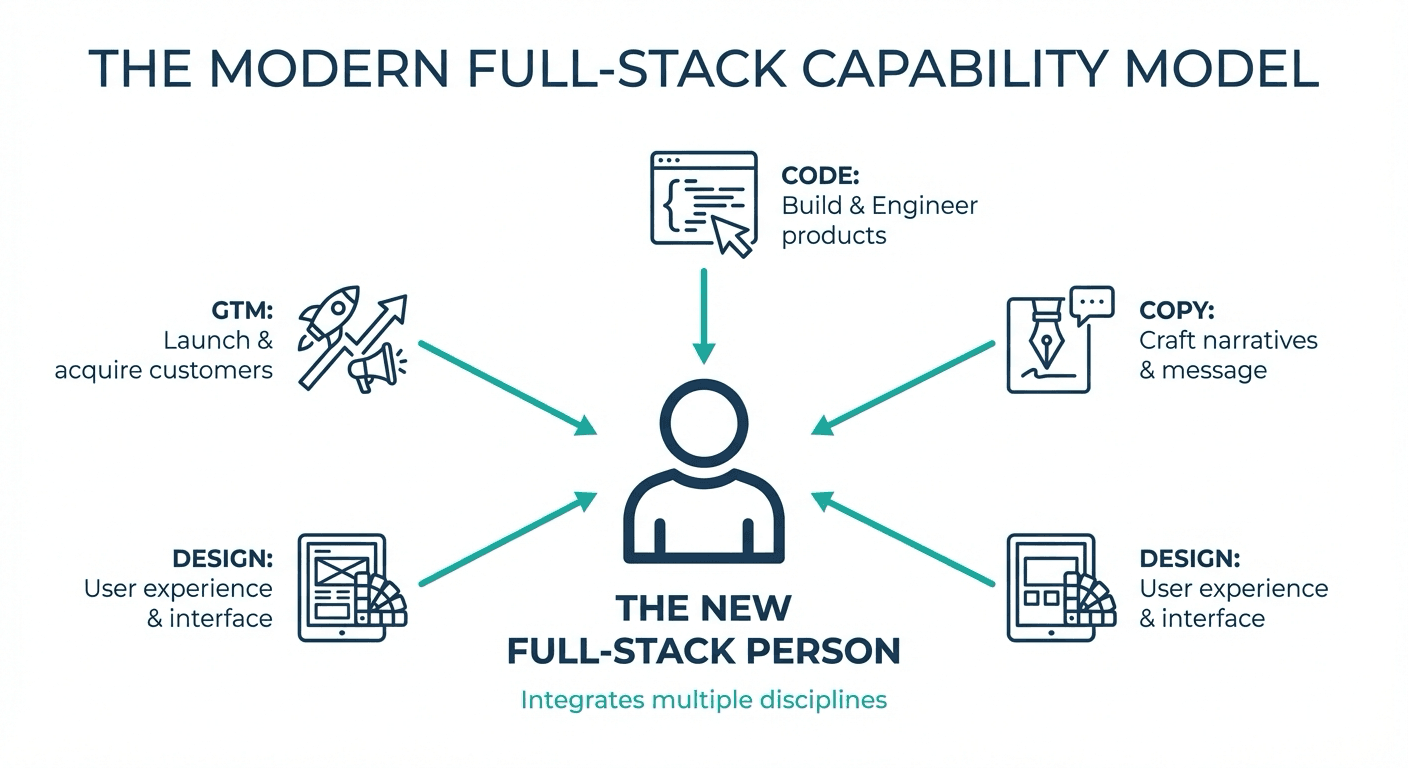
We're not becoming experts. We're becoming orchestrators.
The distinction matters.
An expert does the work. An orchestrator understands what needs to happen and guides AI to execute. They know the what and why well enough to direct the how.
This doesn't mean expertise is worthless. Deep domain knowledge becomes more valuable because it's rarer. But the implementation layer (the actual building) is increasingly commoditized.
The New Skill Stack
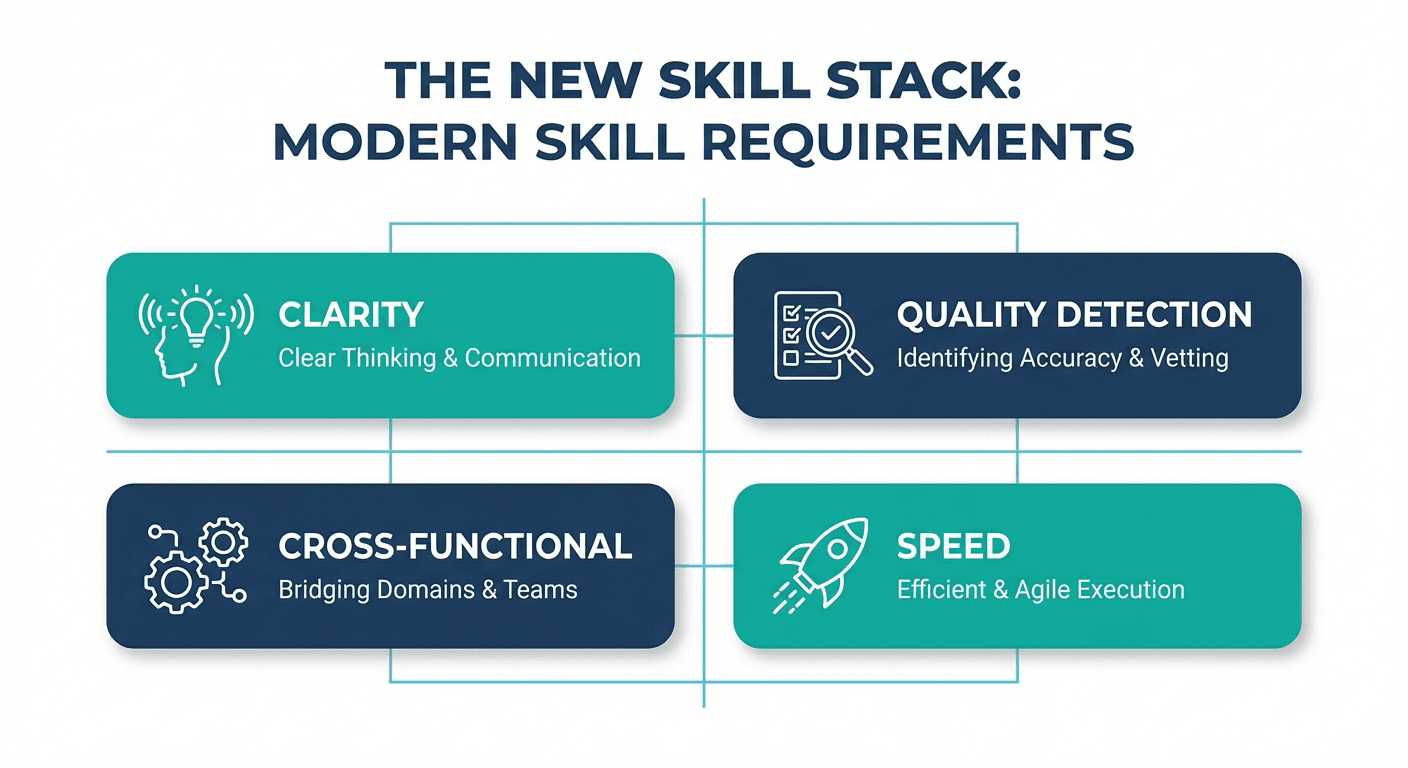
What matters now:
Clarity of intent. If you can describe precisely what you want, AI can build it. The blocker isn't technical skill. It's knowing what to ask for.
Quality detection. AI output varies. Being able to recognize good output from bad output (having taste) is the new competitive advantage.
Cross-functional fluency. Understanding multiple domains lets you connect capabilities that specialists keep siloed. The generalist who can prompt across the value chain has leverage specialists don't.
Speed of iteration. When building is fast, iteration cycles compress. The person who runs more experiments per week wins.
What This Breaks
- The specialist who can't communicate across functions? Increasingly obsolete.
- Companies structured around hand-offs between siloed teams suddenly look bloated.
- Job descriptions become meaningless faster.
- Small teams with massive output.
- AI lets each person do work that used to require specialists.
- Someone has an idea at 9am. By noon, they've mocked it up. By end of day, it's built and tested.
The specialist who can't communicate across functions? Increasingly obsolete.
If you only know one thing deeply but can't connect it to adjacent domains, AI makes you replaceable. Someone who understands both areas, even less deeply, can now execute in both.
Companies structured around hand-offs between siloed teams suddenly look bloated. Why have ten people pass work between them when one person can own the whole flow?
Job descriptions become meaningless faster. The work evolves before the specs can be rewritten.
What This Enables
Small teams with massive output.
We run a substantial business with a fraction of the headcount you'd expect. Not because we're working harder. Because AI lets each person do work that used to require specialists.
Someone has an idea at 9am. By noon, they've mocked it up. By end of day, it's built and tested. No tickets. No sprints. No waiting for someone else's calendar.
The Compounding Effect
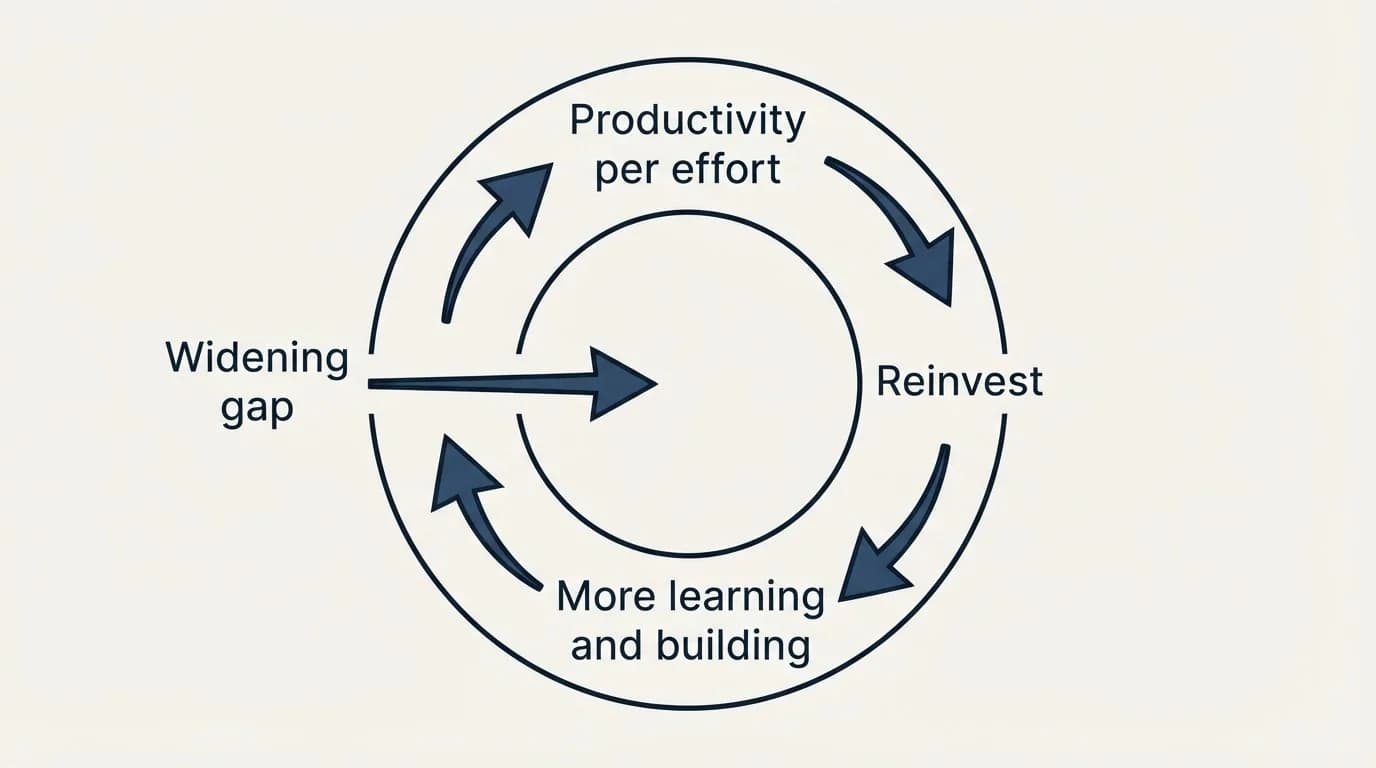
Those who figure this out now will have compounded so far ahead in 12 months that catching up won't be an option.
This isn't hyperbole. It's basic math.
If you're 10x more productive per unit of effort, and you reinvest that productivity into more learning and building, the gap widens every day.
We're betting our entire company on this shift. Within six months, it won't be optional.
How to Start
Pick one task you've been delegating because it's "technical." Learn to do it yourself with AI assistance.
Not to replace your specialist. To understand what's possible. To remove bottlenecks. To move faster.
Start with something small:
- Build a simple automation
- Create a landing page
- Set up a basic workflow
The goal isn't to become a developer. It's to collapse the distance between idea and execution.
The Point
We're moving from an era of specialized silos to an era of high-agency generalists.
The leverage is with people who can prompt, review, and integrate across the entire value chain.
The question isn't whether AI can do the technical work. It can.
The question is whether you'll learn to direct it.
Related Reading
- Claude Code Has 50+ Features Most People Never Discover
- The Gap Between a Chat App and an Engineer: 5 B2B Marketing Workflows
- Most Outbound Teams Need 3 Ops People to Hold Their Stack Together. You Need 22 APIs.
Want to see how we use AI-powered workflows for lead generation? Book a call to learn about our approach.
Frequently asked questions.
Frequently asked questions- What does it mean to be an orchestrator instead of a specialist?
- An orchestrator understands what needs to happen and guides AI to execute, knowing the what and why well enough to direct the how. Unlike specialists who perform the work themselves, orchestrators focus on clarity of intent and quality detection across multiple domains. Deep domain knowledge remains valuable, but the implementation layer becomes commoditized through AI assistance.
- Why are small teams now able to produce as much as large teams?
- AI allows each person to do work that previously required multiple specialists, eliminating costly handoffs between siloed teams. When one person can own an entire workflow using AI assistance, companies avoid the context loss and lag created by transferring work between functions. This means substantial output with a fraction of traditional headcount, as individuals can move from idea to tested implementation in a single day.
- What skills matter most when working with AI tools?
- Four skills dominate: clarity of intent (describing precisely what you want), quality detection (recognizing good output from bad), cross-functional fluency (understanding multiple domains to connect capabilities), and speed of iteration (running more experiments per week). Technical implementation skill matters less than the ability to prompt, review, and integrate across the entire value chain.
- How do I start using AI to build things I used to delegate?
- Pick one task you've been delegating because it's technical and learn to do it yourself with AI assistance. Start small with a simple automation, landing page, or basic workflow. The goal isn't becoming a developer: it's understanding what's possible, removing bottlenecks, and collapsing the distance between idea and execution to move faster.
About the author.

Hosun Chung is COO at RevenueFlow, which builds and operates outbound revenue engines for B2B companies. Previously at Gleacher Shacklock LLP. Studied at London School of Economics.
Hosun Chung · COO
Connect on LinkedIn →Explore more.
Ready to scale your outreach?
We build GTM engines that book real meetings. See the receipts.
Related articles.
Claude Code Has 50+ Features Most People Never Discover
The commands, configuration layers, and one workflow habit that changes everything. Written for people using it 8 hours a day who suspect they are using 10% of it.
Claude Code Is the Best GTM Tool of 2026
Your GTM stack is fine. The problem is that you are the integration layer holding it together. Here is what changes when an agent with API access takes that job instead.
AI Sales Agents: 6 Jobs They Do Well and 4 They Fail At
Agents plan and act, copilots suggest, workflows follow a fixed path. Here are the six sales jobs agents handle today, the four they fail, and the buying test.
AI SDR: What It Replaces, What It Doesn't and What It Costs
AI SDRs handle research, list building, sending and reply triage well. Discovery, objections and relationships do not transfer. Capability matrix and real pricing.
AI Appointment Setters vs Human Setters: Cost per Meeting
2026 pricing for voice AI setters, AI SDR platforms, human setters and agencies, with a cost-per-meeting table that adds back oversight and no-shows.
Chat App or Engineer: 5 B2B Marketing Workflows
Competitor teardowns, campaign reports, a versioned brand voice file, SEO refresh, and ABM briefs. Five workflows that read real files, run real scripts, and write finished artifacts to disk.