Best Clay Alternatives in 2026
Looking for alternatives to Clay? Compare the top data enrichment tools by pricing, features, and integrations, read from each vendor's own pages.
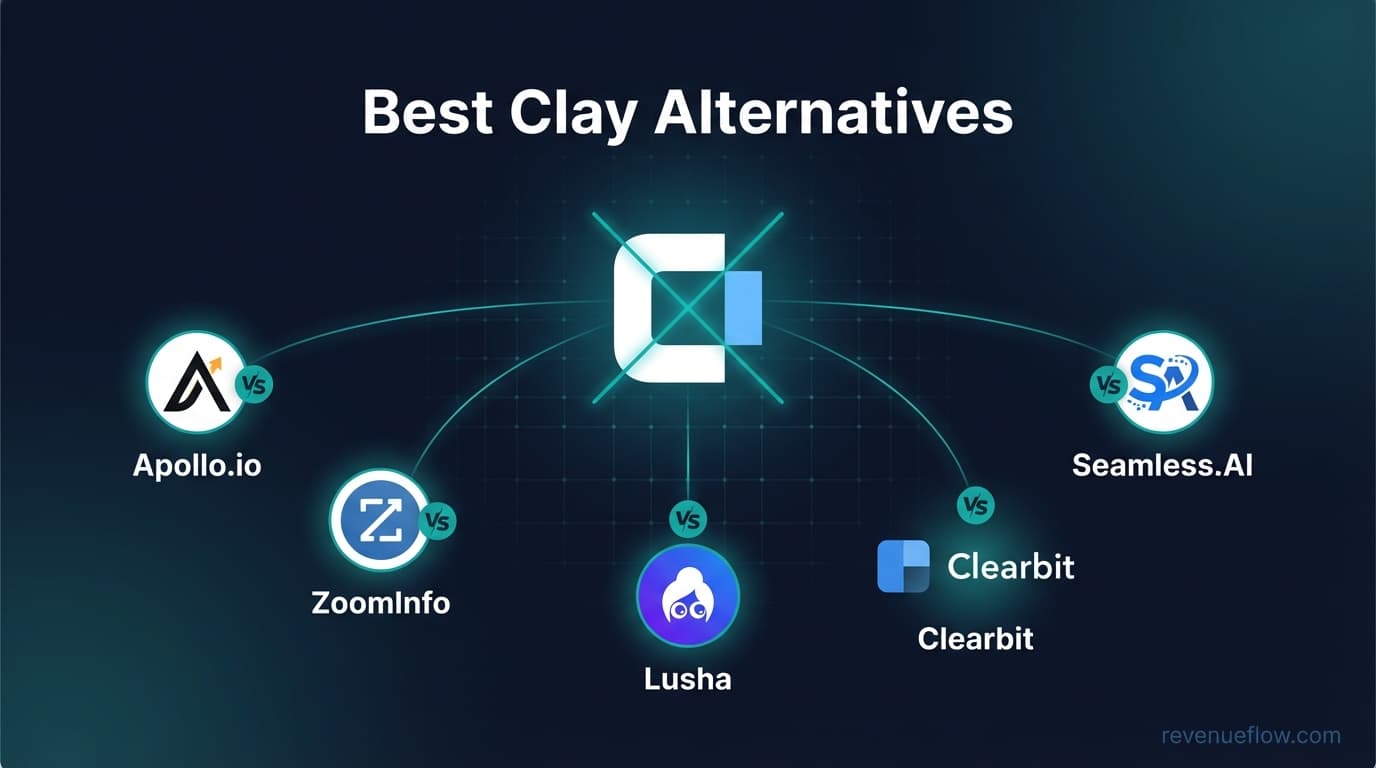
The best Clay alternative depends on the job: Apollo is the closest all-in-one, with waterfall enrichment and AI research from $49 per seat a month billed annually. Lusha, UpLead and Seamless.AI sell contact data with less setup, and Clearbit, now part of HubSpot, covers CRM enrichment. Clay itself lists Launch at $185 a month.
Key takeaways
- Clay's pricing page builds its price from actions and data credits, lists Launch at $185 a month and Growth at $495, and gives every plan unlimited seats.
- Apollo is the closest all-in-one Clay alternative: its paid plans list waterfall enrichment and AI research, from $49 per seat a month billed annually.
- For contact data alone, Lusha, UpLead and Seamless.AI all offer a free plan or trial, but their seat rules differ: bundled seats, single user plans, or per-user pricing.
- Clay's own pricing page says bringing your own API keys skips data credits, so a team unhappy with the data bill may not need to switch at all.
Reviewed and updated September 18, 2026
Clay's pricing page lists its Launch plan at $185 a month and explains that the price is two meters added together: actions for the platform work, and data credits for the data it buys from 150+ partners. That split is the most useful starting point for anyone looking for a Clay alternative, because it shows which of Clay's two jobs a replacement has to do. Some teams want the contact data without the workflow builder. Others want the enrichment without a second bill for data. The alternatives below are sorted by that job, and every price comes from the vendor's own pricing page.
What is the best Clay alternative?
It depends on which Clay job you want replaced. For Clay's mix of data, waterfall enrichment, AI research and sequences in one place, Apollo is the closest match: its paid plans list waterfall enrichment and AI research, priced per seat. For contact data with less setup, Lusha, UpLead and Seamless.AI sell it directly. For enrichment inside a CRM, Clearbit is now part of HubSpot.
What Clay charges, and what a replacement has to cover
Clay's pricing page lists four plans. Free includes 100 data credits and 500 actions a month. Launch is $185 a month, or $167 billed annually, with 2,500 data credits and 15,000 actions, and adds phone number enrichment, job change signals and email campaigns. Growth is $495, or $446 billed annually, with 6,000 data credits and 40,000 actions, and adds CRM auto-sync, HTTP API integrations and webhooks. Enterprise is custom, with an annual commitment.
Three details on the same page decide whether switching saves money. Every Clay plan, Free included, lists unlimited seats, so a per-seat alternative can cost more for a large team even when its entry price is lower. Bringing your own API key for a data provider skips data credits entirely and leaves only actions to pay. And an enrichment that returns no result costs neither. A team whose complaint is the data bill may be better served by its own provider keys than by a new tool.
The alternatives, grouped by the job they do
The all-in-one: Apollo
Apollo is the closest like-for-like Clay alternative on paper. Its pricing page lists waterfall enrichment, AI research and AI lead scoring, unlimited sequences and CRM integrations on its paid plans, plus Prospecting, Gmail and Salesforce extensions. The Free plan is $0 with 900 credits per seat per year. Basic is $49 per seat per month billed annually with 30,000 credits per seat per year, Professional is $79, and Organization is $119 with a minimum of 3 seats. The unit is the seat, the opposite of Clay's model, and the Apollo and Clay comparison works through what that means for a team.
Contact databases with a free way in
Lusha. Free gives 40 credits a month, where an email costs 1 credit and a phone number 5. Starter is $37.45 a month billed yearly or $49.90 monthly with 1 seat; Pro lists 2 free seats and Premium 5. The Clay and Lusha comparison sets the two side by side.
UpLead. A Test Drive gives 5 credits over 7 days, and Essentials is $99 a month for 170 credits, one contact per credit with email and mobile direct dial. Free, Essentials and Plus are single user accounts, and the homepage says emails are verified anytime you export.
Seamless.AI. Free is 1 user and 50 credits. Pro and Enterprise go through sales, and the FAQ says Pro plans start at 10,000 annual credits.
LeadIQ. Free is 1 user and 50 credits. Credits price the data: an email is 1 credit, a phone number 10, both together 11. Pro includes 5 users, and its price moves with a credits slider.
ContactOut. Free allows 5 emails, 5 phones and 5 exports a day through a browser extension and search portal. The Email plan is $49 a month billed annually for 300 exports a month, and each self-serve plan carries a limit of 1 user per company.
SignalHire. Free gives 5 credits a month, or 10 with its browser extension installed. The Emails plan is $69 a month billed monthly for 1,000 credits.
Adapt.io. Free gives 25 email credits and 25 enrichment credits a month. Starter is $49 a month for 500 email credits, and basic is $99 for 1,000 email credits and 100 phone credits.
Lead411. A Pilot Light trial gives 50 exports over 7 days, and Spark is $49 a month for 1,000 exports. The unit is the whole record, so a direct dial costs nothing extra.
Quoted, or not readable here
Cognism. Its pricing page names no price. Standard and Pro each include 5 seats, one credit reveals one contact, and the FAQ says pricing is tailored to the product, the team setup and how the platform will be used.
Since data enrichment and CRM tools solve different problems, see how the two categories complement each other in this enrichment versus CRM breakdown.
ZoomInfo and Datanyze. Both sites answered a plain request with HTTP 403 and a headless browser with a bot challenge, so neither price is stated here. Datanyze's Chrome Web Store listing names ZoomInfo Technologies as its publisher. The Clay and ZoomInfo comparison covers the enterprise side.
RocketReach. Its pricing page served prices in pounds to this comparison, from £20 a month billed annually for Essentials, and says plans for larger organisations start at $6K annually. The US-dollar ladder was not readable here.
Enrichment inside a CRM: Clearbit
Clearbit's pricing page now opens with "Clearbit has joined HubSpot" and carries no price. What it still describes is the enrichment job: data for leads, contacts and accounts, scoring and routing in real time, IP intelligence that turns anonymous website traffic into intent signals, and form shortening. For a team whose Clay use is mostly enriching inbound records, that is the relevant comparison, and the Clay and Clearbit comparison covers it.
clearbit.com/pricing
"Clearbit has joined HubSpot!" 1
"Data for leads, contacts, and accounts" 2
"Turn your anonymous website traffic into real buying intent signals" 3
- 1The page leads with the acquisition and carries no plan or price.
- 2The job it still describes is enriching CRM records, which is one of the jobs Clay does.
- 3IP intelligence for website visitors sits beside enrichment, scoring and routing, and form shortening.
Every alternative on one table
| Alternative | What its pricing page shows |
|---|---|
| Apollo, all-in-one | Free: 900 credits per seat a year. Basic $49 per seat a month, billed annually |
| Lusha, contact database | Free: 40 credits a month. Starter $37.45 a month billed yearly |
| UpLead, contact database | Test Drive: 5 credits. Essentials $99 a month, one user |
| Seamless.AI, contact database | Free: 1 user, 50 credits. Pro through sales |
| LeadIQ, contact database | Free: 1 user, 50 credits. Pro includes 5 users |
| ContactOut, contact database | Free: 5 emails a day. Email $49 a month billed annually |
| SignalHire, contact database | Free: 5 or 10 credits a month. Emails $69 a month |
| Adapt.io, contact database | Free: 25 email credits. Starter $49 a month |
| Lead411, contact database | Pilot Light: 50 exports. Spark $49 a month |
| Cognism, quoted | No price; 5 seats included per package |
| RocketReach, quoted in pounds here | Essentials £20 a month billed annually |
| ZoomInfo and Datanyze, unreadable | Refused plain and headless requests |
| Clearbit, CRM enrichment | Joined HubSpot; no price on the page |
How seats change the bill
Seat rules differ more than prices in this category. Clay lists unlimited seats on every plan. Apollo prices per seat and Seamless.AI's Pro plan per user. Lusha, LeadIQ and Cognism bundle seats into a plan: Lusha 1, 2 or 5, LeadIQ Pro 5 users, Cognism 5 seats per package. UpLead's Free, Essentials and Plus, and ContactOut's self-serve plans, are for one user. A five-person team comparing entry prices without the seat rule is comparing the wrong numbers.
A worked example: five people
The arithmetic here is illustrative. The team is invented, the prices are list prices on annual billing, and the credit units differ between vendors, so only the headcount effect is being compared.
Five people on Clay's Launch plan cost $167 a month, because the plan has no seat count. The same five on Apollo Basic cost 5 times $49, or $245 a month. On Lusha, five users means Premium, which lists 5 free seats at $299.95 a month billed yearly. On UpLead, five users rules out every self-serve plan, since only Professional is a team account, and Professional is quoted. The cheapest entry price in the table above is not the cheapest bill for this team.
Moving off Clay without losing work
Plan the move around what does not travel. Clay's actions reset every billing cycle, so there is nothing to run down on that side. Unused data credits roll over on Launch and Growth, up to twice the monthly amount, and they are spent inside Clay, so use them on the last enrichment runs before cancelling rather than after. Waterfall orders, Claygent prompts and scoring columns are configuration: write them down before leaving, because the replacement has to be told the same things in its own terms.
Then re-verify anything carried across. A record enriched months ago is not verified today, and a migration is exactly when stale data gets loaded in bulk.
How to Choose the Right Alternative

Name the job first. Contact data, enrichment workflows and CRM enrichment are three purchases, and the alternatives above each do one of them well.
Count seats before comparing prices. A per-seat price multiplied by the team is the real entry price, and single user plans do not stretch to a team at all.
Price the unit you actually use. A phone number costs 5 credits on Lusha and 10 on LeadIQ, while UpLead and Lead411 count the whole contact as the unit.
Once your enrichment stack is settled, it helps to see how a CRM and a sales engagement platform divide the workflow, as explored in this CRM versus sales engagement comparison.
Trial before the contract. Most of the list offers a free plan or a trial. Cognism, RocketReach's larger plans and the two unreadable sites need a sales conversation first.
Final Recommendation

Keep Clay if the complaint is the data bill and your team already pays providers, because its own pricing page says your own API keys skip data credits. Move to Apollo if you want one per-seat tool that enriches, researches and sends. Move to Lusha, UpLead or Seamless.AI if the job was always contact data. Look at Clearbit inside HubSpot if the job is enriching CRM records. Whichever it is, run the free plan or trial on your own list before committing.
Related Reading
- Apollo vs Clay: Choosing the Right Data Enrichment Tool for B2B Sales
- Clay vs ZoomInfo: Data Enrichment Tool Comparison
- Clay vs Lusha: Which B2B Data Enrichment Tool Should You Use?
- Clay vs Clearbit: Which B2B Data Enrichment Tool Fits Your Stack?
If you would rather have this run for you, RevenueFlow books qualified meetings on a pay-per-meeting basis and publishes client results.
Pricing and features are taken from the vendors' own pages. Verify current terms with the vendor before relying on them.
Frequently asked questions.
Frequently asked questions- What is a good alternative to Clay?
- It depends on what Clay does for you. Apollo is the closest all-in-one, with waterfall enrichment, AI research and sequences on its paid plans from $49 per seat a month billed annually. For contact data with less setup, Lusha, UpLead and Seamless.AI each offer a free plan or trial. For enriching CRM records, Clearbit is now part of HubSpot.
- Is Apollo cheaper than Clay?
- Per seat, usually, and per team, not always. Apollo's Basic plan is $49 per seat a month billed annually, while Clay's Launch plan is $185 a month, or $167 billed annually, with unlimited seats. For one or two people Apollo costs less; for a larger team, Apollo's per-seat price multiplies while Clay's plan price does not.
- What happened to Clearbit?
- Clearbit's pricing page now opens with the line Clearbit has joined HubSpot and shows no price. It still describes enrichment for leads, contacts and accounts, real-time scoring and routing, IP intelligence for website visitors, and form shortening. A team comparing it with Clay for CRM enrichment should look at it through HubSpot.
- Can I lower my Clay bill without switching?
- Often, yes. Clay's pricing page says that if you bring your own API keys for a data provider, you skip data credits and pay only actions, and that an enrichment returning no result costs neither. Unused data credits also roll over on Launch and Growth, up to twice the monthly amount, so uneven months waste less than a plain credit plan.
About the author.

Tim Carden is CMO / CTO at RevenueFlow, which builds and operates outbound revenue engines for B2B companies. Studied at McGill University.
Tim Carden · CMO / CTO
Connect on LinkedIn →Explore more.
Ready to scale your outreach?
We build GTM engines that book real meetings. See the receipts.
Related articles.
Best PhantomBuster Alternatives in 2026
Looking for alternatives to PhantomBuster? Compare the top data enrichment tools by pricing, features, and integrations.
Apollo.io vs Proofy: Data Enrichment Tool Comparison
Compare Apollo.io and Proofy side by side. See pricing, features, and integrations to choose the right data enrichment tool for your needs.
Apollo.io vs Bouncer: Data Enrichment Tool Comparison
Compare Apollo.io and Bouncer side by side. See pricing, features, and integrations to choose the right data enrichment tool for your needs.
Emailable vs UpLead: Data Enrichment Tool Comparison
Compare Emailable and UpLead side by side. See pricing, features, and integrations to choose the right data enrichment tool for your needs.
Apollo.io vs Bookyourdata: Data Enrichment Tool Comparison
Compare Apollo.io and Bookyourdata side by side. See pricing, features, and integrations to choose the right data enrichment tool for your needs.
Apollo.io vs Ocean.io: Data Enrichment Tool Comparison
Compare Apollo.io and Ocean.io side by side. See pricing, features, and integrations to choose the right data enrichment tool for your needs.