Apollo.io vs Ocean.io: Data Enrichment Tool Comparison
Compare Apollo.io and Ocean.io side by side. See pricing, features, and integrations to choose the right data enrichment tool for your needs.
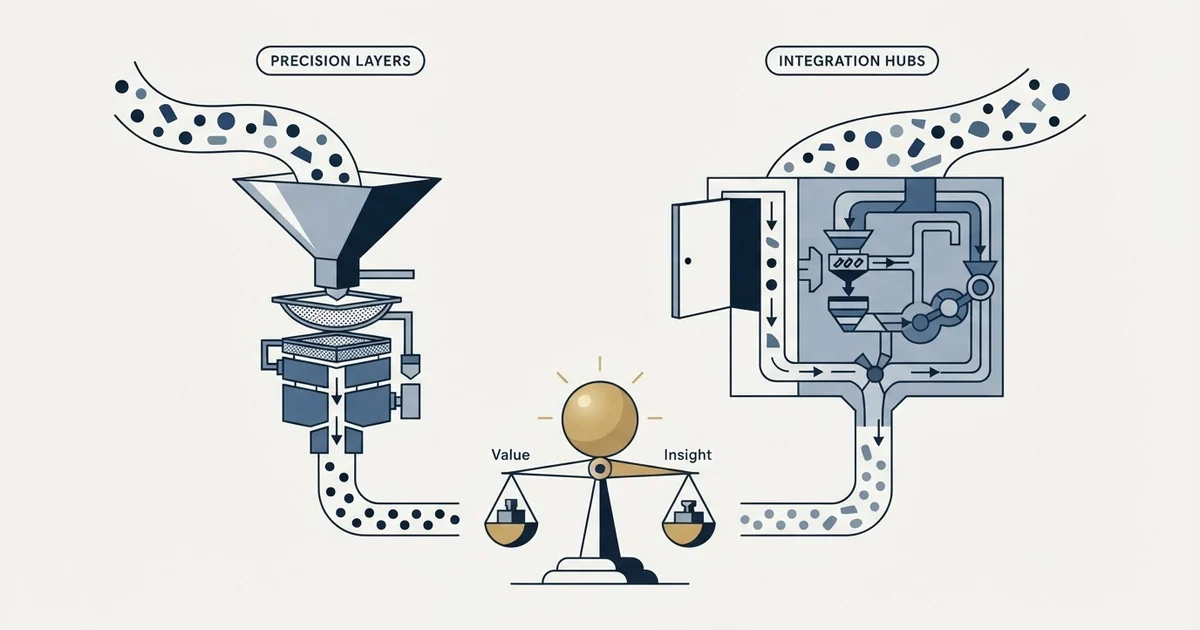
Ocean.io is a lookalike prospecting platform that learns your ideal customer profile from closed-won deals and ranks every company in your market against it. Apollo.io is a contact database with sequences and a dialer, free at $0 and from $49 per seat per month billed annually. Ocean.io prices per result in credits.
Key takeaways
- Ocean.io's homepage says it learns your ideal customer profile from the deals you already won and ranks every company in your market against it, with the reason shown.
- Ocean.io's API documentation charges from one credit pool: 1 credit per email found, 10 per phone found, 0.2 per search result and 0.1 per enrichment.
- Apollo's pricing page lists a free plan at $0 and paid seats at $49, $79 and $119 per seat per month billed annually, with sequences and a dialer in the same seat.
- Ocean.io's pricing page refused automated reads for this update, so its plan sizes are carried unverified; its per-result credit costs come from its API documentation.
Reviewed and updated September 21, 2026
Ocean.io's homepage describes a different starting point from Apollo's. It says Ocean.io "learns your ICP from the deals you already won, then ranks every company in your market against it." Apollo starts from a database its site sizes at 240M contacts and 30M companies, and from a free plan. So Apollo.io vs Ocean.io is a choice between searching a large contact database and asking a lookalike engine which companies resemble the ones you already closed.
What Is Ocean.io?
Ocean.io is a lookalike prospecting platform. Its homepage says it learns your ideal customer profile from closed-won deals, ranks every company in your market against it, and then shows who to call. Its API documentation lists lookalike company and people search, enrichment, lookup and reveal endpoints, all drawing on one credit pool, with a found email at 1 credit and a found phone at 10.
The homepage walks through the loop with a worked example. You connect your CRM, Ocean.io clusters your closed-won deals and shows which segments convert, ranked by win rate, deal size and close time. You pick a segment to seed the search, and Ocean.io scores every match against it so that only companies that fit make the list, with accounts ranked on fit and the reason shown. It can also ask one question about every company on the list and answer it from the company's own website, and it flags events such as funding raised in the last 90 days or new leadership hired, with the line "Reach out because something happened, not because it is Tuesday."
The output goes where the team already works. The homepage names a direct push to Salesforce, HubSpot and Clay, and the API documentation lists 20 endpoints across 6 groups plus an MCP server that connects an AI assistant directly to the API. On security, the homepage says it is built with GDPR in mind and independently audited for SOC 2 Type II.
How Apollo Pitches Itself
Apollo's pricing page leads with "The all-in-one platform to grow your business" and promises to "unify your tech stack with an AI-powered platform". The story is breadth: one seat that searches the database, reveals contacts, enriches the CRM, runs sequences and dials. The affordability part of the message is the ladder itself, which opens at a free plan at $0 and puts paid seats at $49, $79 and $119 per seat per month billed annually. The page also labels the whole ladder introductory pricing that may change.
That positioning matters for this comparison because Ocean.io does not claim to send anything. Its homepage ends at a ranked list pushed into another system, so an Ocean.io buyer still needs a sequencer, and an Apollo buyer already has one.
Ocean.io Pricing: What the Credits Buy
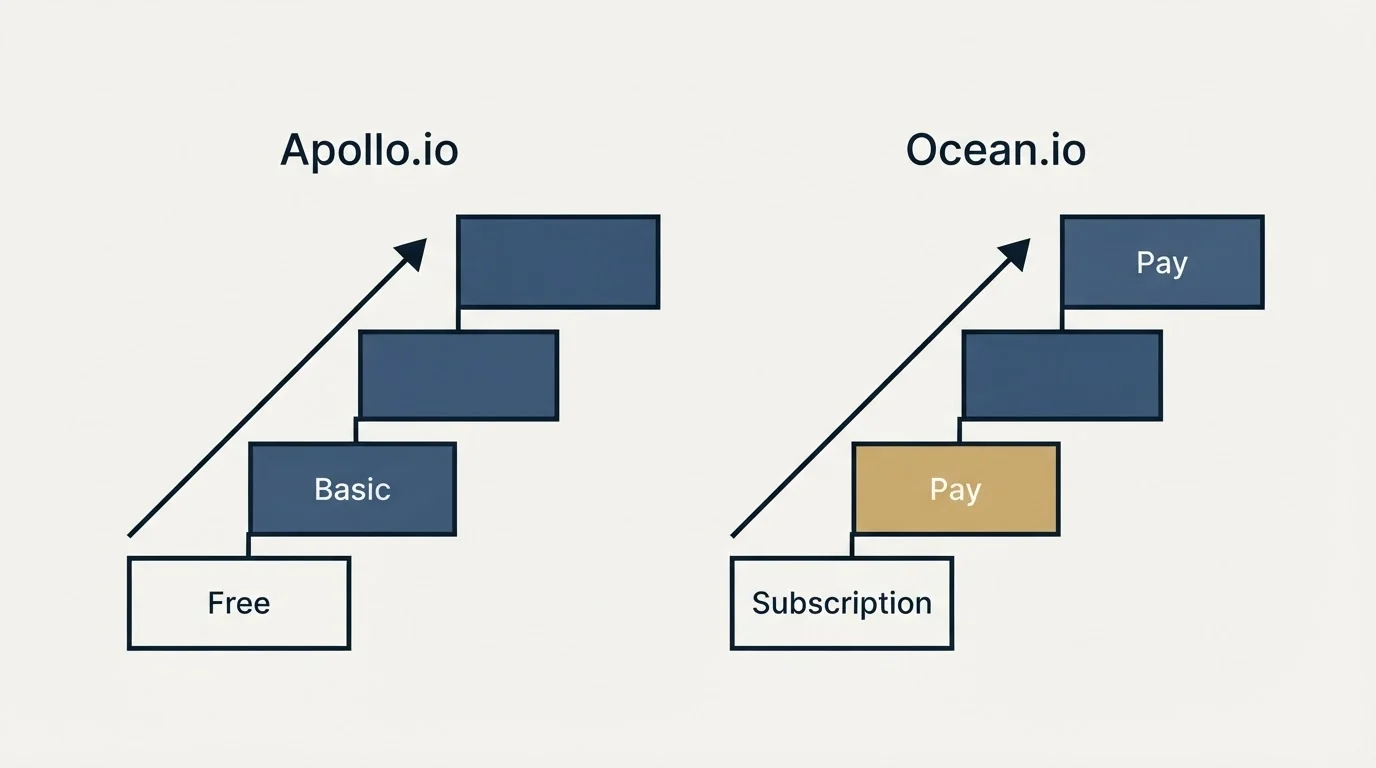
Ocean.io charges in credits from one pool shared by every endpoint. Its API documentation prices a found email at 1 credit, a found phone at 10, a search result at 0.2 and an enrichment at 0.1, with lookups at 0.05. Its pricing page, which lists the plan sizes, refused automated reads for this update, so the plan figures below are carried unverified.
The documentation's cost table is precise. Searching companies or people costs 0.2 credits per result, enriching a company or a person costs 0.1 per result, one at a time or in batch, and looking up companies or people costs 0.05. Autocomplete costs 0.1 per call. Revealing an email costs 1 credit per email found and revealing a phone costs 10 credits per phone found, so a miss costs nothing. Checking the credit balance, reading the data fields and warming up companies are free. If the balance runs out, the API returns a 402 and the request is not processed, so no credits are deducted.
The plan sizes are the part this update could not read. Ocean.io's pricing page answered a plain request with a 403 and rendered the app's sign-up screen in a browser. The table below is what this page carried before the refresh, kept for reference and not re-checked against a live page, so confirm it with Ocean.io before relying on it.
| Plan | Price | Credits (carried, unverified) |
|---|---|---|
| Subscription (Yearly) | Usage-based | Minimum 9,000 credits, maximum 60,000; credits valid for 12 months |
| Subscription (Monthly) | Usage-based | Minimum 750 credits, maximum 5,000; credits valid for 6 months |
| Pay as you go | Usage-based | Minimum 1,000 credits, maximum 20,000; credits valid for 3 months |
| Custom plan | Contact Sales | Volume pricing for larger teams with flexible credit allocation |
Source: Ocean.io API documentation, Credits; plan table carried from this page's earlier version.
A Worked Credit Example
The documentation prices common jobs itself. Searching 500 people is 100 credits. Revealing emails for 200 people at the roughly 79% find rate it assumes is 158 credits. Searching 500 people and revealing emails for 300 is 400 credits. The same job revealing phones for those 300 instead is 3,100 credits by the same arithmetic, which is the number that decides most budgets: on Ocean.io a phone costs ten emails.
| Operation | Calculation | Credits |
|---|---|---|
| Search 500 people | 500 x 0.2 | 100 |
| Reveal emails for 200 people, about 79% found | 158 x 1 | 158 |
| Search 500 people, reveal emails for 300 | (500 x 0.2) + (300 x 1) | 400 |
| The same, revealing phones for 300 | (500 x 0.2) + (300 x 10) | 3,100 |
Apollo.io Pricing
| Plan | Per seat, billed annually | Per seat, billed monthly | Credits per seat |
|---|---|---|---|
| Free | $0 | $0 | 900 a year, granted monthly |
| Basic | $49 | $65 | 30,000 a year upfront, or 2,500 a month |
| Professional | $79 | $99 | 48,000 a year upfront, or 4,000 a month |
| Organization | $119, minimum 3 seats | Annual only | 72,000 a year upfront |
Apollo's pricing page says credits give you access to emails, phone numbers and enriched data, and it marks annual billing as a 24% saving. It does not print a per-reveal credit rate on the plan cards, so the fair comparison with Ocean.io is pool against pool: how many of your own lookups a seat's yearly credits cover, tested on a sample of your list, rather than a price per email copied from either page.
Source: Apollo.io Pricing
Who Should Pick Which
Pick Apollo.io when one seat should search, sequence and dial. Its plan cards list unlimited sequences and a US dialer on paid plans, a free plan at $0 with 900 credits a seat a year lets a team test before paying, and the search works on filters, so an ideal customer profile you can already write down is enough to start.
Pick Ocean.io when you have a won-deal history for it to learn from and you already own a sending tool. Its homepage builds the search from your closed-won deals, ranks accounts on fit with the reason shown, and pushes them to Salesforce, HubSpot or Clay, and its API meters every call per result. If Ocean.io is the tool you are moving away from, the ocean.io alternative roundup covers the wider field, and a credit-priced rival sits in LeadMagic vs Ocean.io.
Apollo.io fits when
- You want search, sequences and a dialer in one seat
- You want to start free, at $0 with 900 credits a year
- Your ideal customer profile can be written as filters
Ocean.io fits when
- Your CRM holds enough closed-won deals to learn from
- You want accounts ranked on fit, with the reason shown
- You already own a sequencer and want per-result API pricing
For the Apollo side of the decision in more depth, Apollo.io pricing walks through the credit ladder seat by seat, and Apollo vs Clearbit covers how its database compares with an enrichment layer.
Can You Use Both?
Yes, and they meet at the CRM. Ocean.io pushes ranked accounts into Salesforce or HubSpot, and Apollo connects to the same two CRMs, so a team can let Ocean.io decide which companies are worth working and let Apollo find and message the people there. The rule that keeps that stack clean is ownership. Decide which tool may create account records and which may only enrich them, and keep the paid reveals in one of the two, because paying both vendors to find the same email address is the waste to design out before the first export.
Integration Ecosystem
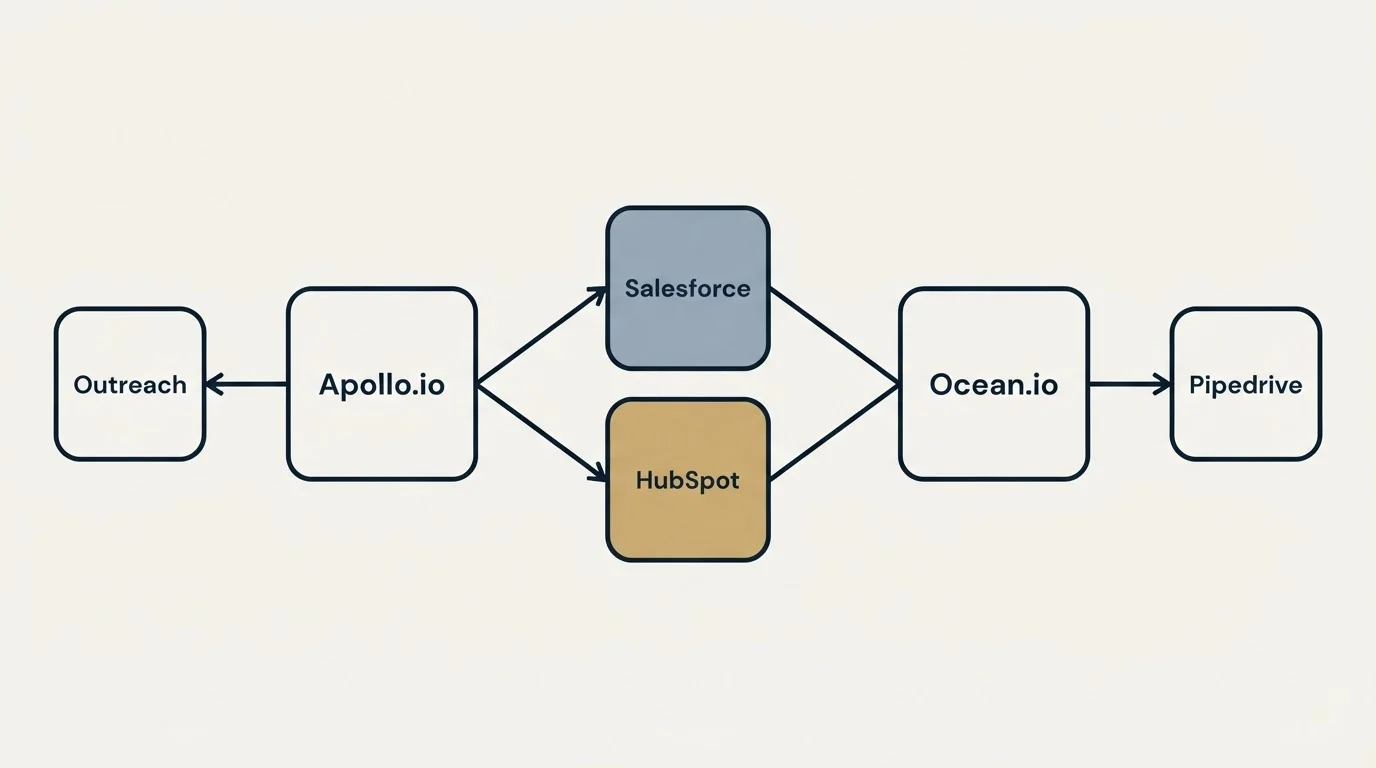
Apollo's pricing page answers the integration question in its FAQ: it integrates with Salesforce, HubSpot, Outreach, SalesLoft, Marketo, SendGrid, LinkedIn and all email providers. Its plan comparison adds Pipedrive among the CRM integrations and Mailgun beside SendGrid.
Ocean.io's integrations page lists Salesforce, HubSpot, Pipedrive and Clay, plus a custom webhook that works with Zapier, Make, n8n or your own endpoint. It lists Attio and Zoho CRM as coming soon, and it says field mapping is automatic.
Three CRMs appear on both lists: Salesforce, HubSpot and Pipedrive. Everything else appears on one vendor's page only, which is a statement about the pages rather than proof that the other product cannot connect.
Getting Started Checklist
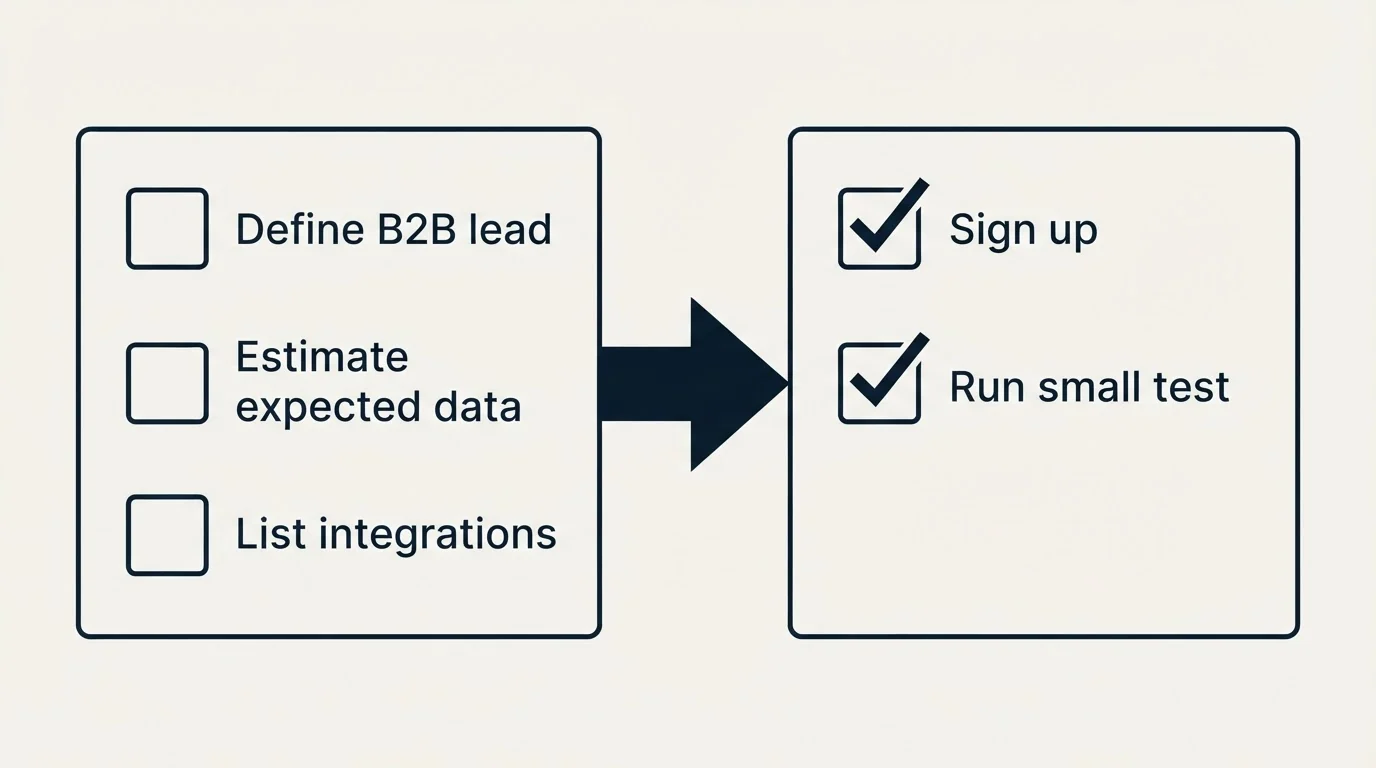
- Decide whether the search should start from filters or from your won deals.
- Count the emails and phones you expect to reveal each month, because a phone costs ten emails on Ocean.io.
- List the CRM and sending tools the records must reach, and check them against both integration lists.
- Start on Apollo's free plan, and on Ocean.io's free start or its search with no signup.
- Run the same account sample through both and compare the found contacts, not the list sizes.
Final Thoughts
Apollo.io and Ocean.io both end in contact data, but they start in different places. Apollo is a database and a sending tool in one seat, free to start and priced per seat. Ocean.io is a lookalike engine fed by your own won deals, priced per result in credits, and it hands its ranked accounts to a tool you already own.
If the list is not the bottleneck and the conversations are, RevenueFlow can build a first campaign on your market.
Pricing and features are taken from the vendors' own pages. Verify current terms with the vendor before relying on them.
Frequently asked questions.
Frequently asked questions- What is Ocean.io?
- Ocean.io is a lookalike prospecting platform. Its homepage says it learns your ideal customer profile from closed-won deals in your CRM, ranks every company in your market against it with the reason shown, and pushes the ranked accounts to Salesforce, HubSpot or Clay. Its API adds lookalike company and people search, enrichment and contact reveals on one credit pool.
- How much does Ocean.io cost?
- Ocean.io's API documentation prices each result in credits: 1 credit per email found, 10 per phone found, 0.2 per search result, 0.1 per enrichment and 0.05 per lookup, with misses free. Its plan sizes sit on a pricing page that refused automated reads for this update, so confirm the credit bundle and price with Ocean.io directly.
- Are Apollo and Ocean.io free?
- Apollo has a free plan at $0 with 900 credits per seat per year, granted monthly, before paid seats from $49 per seat per month billed annually. Ocean.io's homepage offers a free start and a lookalike search with no signup; its paid plan sizes are on its pricing page, which could not be read for this update.
- Which is better for finding lookalike companies, Apollo or Ocean.io?
- Ocean.io, because lookalike search is the product: its homepage builds the search from your closed-won deals and ranks every company in your market against that segment. Apollo searches its database by filters you write yourself. If you can describe the ideal customer profile precisely, Apollo is enough; if you would rather learn it from wins, Ocean.io fits.
About the author.

Tim Carden is CMO / CTO at RevenueFlow, which builds and operates outbound revenue engines for B2B companies. Studied at McGill University.
Tim Carden · CMO / CTO
Connect on LinkedIn →Explore more.
Ready to scale your outreach?
We build GTM engines that book real meetings. See the receipts.
Related articles.
Apollo.io vs Proofy: Data Enrichment Tool Comparison
Compare Apollo.io and Proofy side by side. See pricing, features, and integrations to choose the right data enrichment tool for your needs.
Apollo.io vs Bouncer: Data Enrichment Tool Comparison
Compare Apollo.io and Bouncer side by side. See pricing, features, and integrations to choose the right data enrichment tool for your needs.
Apollo.io vs Bookyourdata: Data Enrichment Tool Comparison
Compare Apollo.io and Bookyourdata side by side. See pricing, features, and integrations to choose the right data enrichment tool for your needs.
AroundDeal vs Leadspicker: Data Enrichment Tool vs Sales Engagement Platform Comparison
Compare AroundDeal (data enrichment tool) and Leadspicker (sales engagement platform) side by side. See pricing, features, and integrations to decide which one, or both, your stack needs.
AroundDeal vs Salesflare: Data Enrichment Tool vs CRM Platform Comparison
Compare AroundDeal (data enrichment tool) and Salesflare (CRM platform) side by side. See pricing, features, and integrations to decide which one, or both, your stack needs.
Gong vs NeverBounce: Sales Engagement Platform vs Data Enrichment Tool Comparison
Gong vs NeverBounce: what Gong's own pages say about enrichment, what NeverBounce's API returns about an address, and how each vendor prices.