Apollo.io Pricing: Plans, Credit Limits and Real Cost
Apollo's published plan prices, the per-endpoint credit costs underneath them, the Unlimited fair-use formula, and the export credits most cost models leave out.
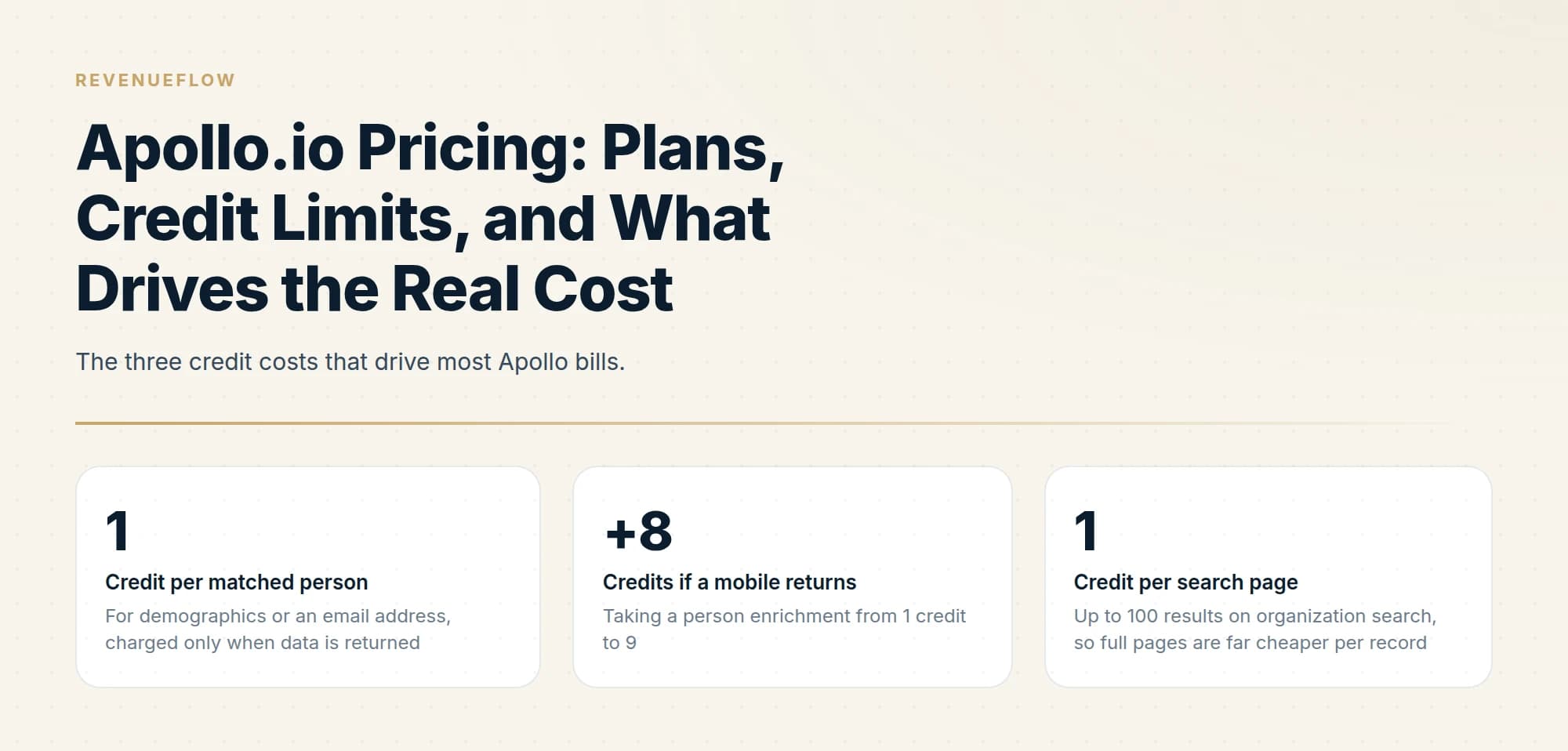
Apollo publishes four annual-billing tiers at US$0, US$49, US$79 and US$119 per seat per month, with credits granted per seat per year. Credits drive the real cost: charged per matched record or per search page, surcharged 8 credits for mobile numbers, and consumed again whenever a contact leaves Apollo.
Key takeaways
- Annual-billing plans are US$0, US$49, US$79 and US$119 per seat per month, granting 900, 30,000, 48,000 and 72,000 credits per seat per year.
- The Unlimited fair-use formula prices a credit at US$0.025, capping paid accounts at amount paid divided by that figure or 1 million credits a year.
- Export credits are consumed on CSV export, CRM sync and API enrichment synced outside Apollo, so verification-elsewhere architectures run that meter constantly.
- Downgrading plan or seat count takes effect immediately with no mid-term refund, while add-on downgrades wait until the end of the billing cycle.
Reviewed and updated September 5, 2026
Apollo's plan prices are the smaller half of what you will pay. Seats run from free to US$119 a month, and the number that actually determines your bill is credit consumption, which is metered per endpoint, surcharged for phone numbers, charged again when data leaves the platform, and capped by a fair-use formula on the plans described as unlimited.
All of it is documented. Here is the full picture, verified against Apollo's own pricing page and developer documentation on 11 August 2026.
The published plans
Apollo's pricing page opens on annual billing, and these are the figures it shows in that view. Every price is per seat per month, billed annually, and every credit allowance is per seat per year.
| Plan | Price per seat, per month | Credits per seat, per year |
|---|---|---|
| Free | US$0 | 900, granted monthly |
| Basic | US$49 | 30,000, granted upfront |
| Professional | US$79 | 48,000, granted upfront |
| Organization | US$119, minimum 3 seats | 72,000, granted upfront |
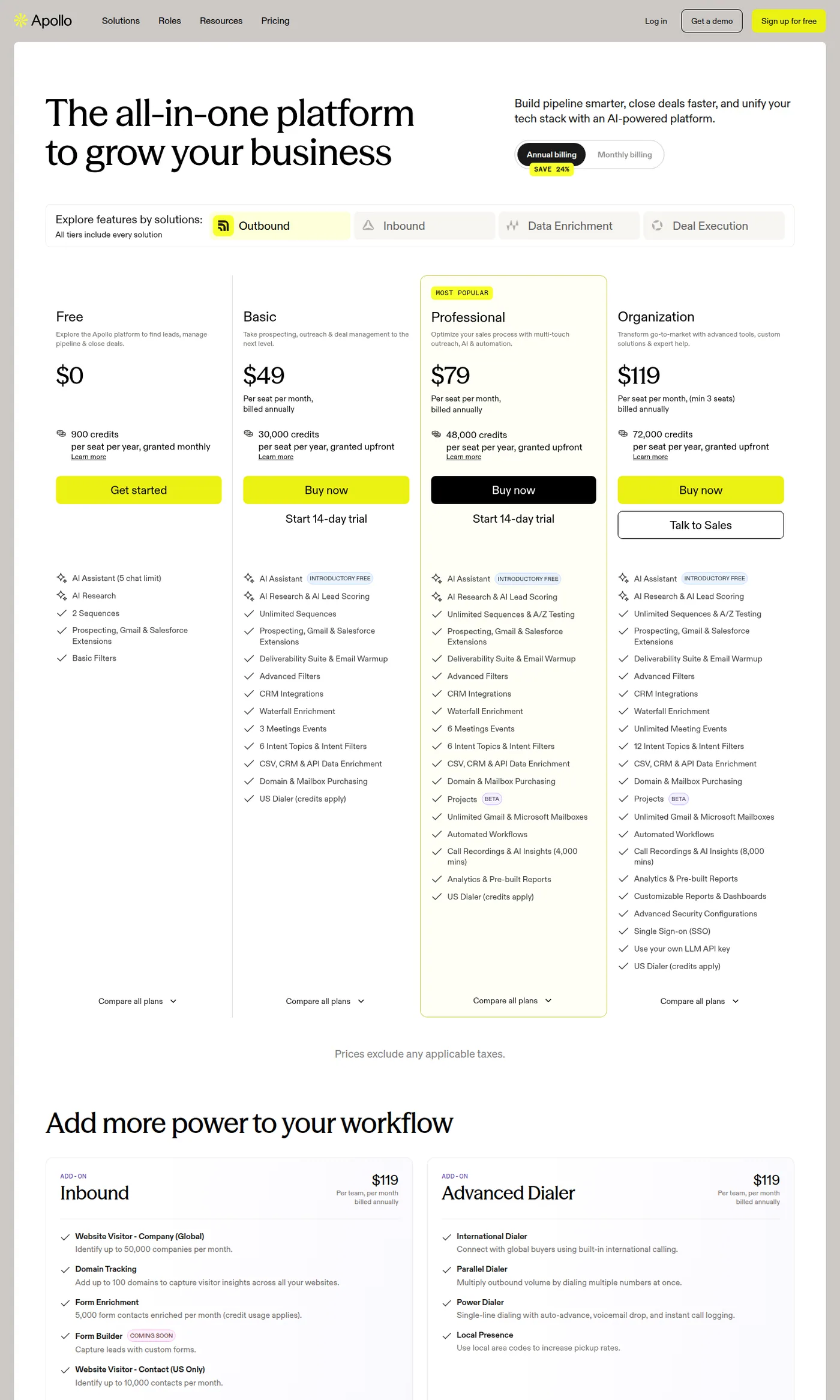
Two qualifications on that table, both of which matter when you compare Apollo to anything else.
These are annual-billing prices. The page carries a Monthly billing toggle and advertises annual as saving 24%, so paying monthly costs meaningfully more per seat. The monthly figures are only rendered after switching the toggle and are not stated here, because we did not capture that view.
Organization has a three-seat minimum. At US$119 per seat that is a floor of US$357 a month before anyone has enriched a single record, which makes the step from Professional considerably larger than the per-seat difference suggests.
A warning about secondary sources, including automated ones. The structured pricing data embedded in Apollo's own page markup is stale relative to what the page renders: it still describes a US$99 Professional tier and a contact-for-pricing top tier, neither of which matches the live page. If you are scraping Apollo's pricing rather than reading it, you will get the wrong numbers, and so will any roundup built that way.
Trials include 50 credits and 5 mobile credits, with almost all the features of the plan selected. At the end you can convert to a paying plan or drop to the Starter plan, which Apollo describes as free forever.
Credits are the real meter
Every endpoint that returns data has a published price, and endpoints that create, update, list or manage records cost nothing at all.
For demographics or an email address, charged only when data is returned
Taking a person enrichment from 1 credit to 9
Up to 100 results on organization search, so full pages are far cheaper per record
The rest of the documented table: organization enrichment costs 1 credit per company, get complete person info costs 1 credit, organization job postings cost 1 credit per page of up to 10,000 results, and news article search costs 1 credit per page of up to 25. Conversation endpoints cost 1 credit only when the conversation carries AI insights, and nothing otherwise.
Two structural points follow. Charging happens on results, not requests, so a miss on a plain enrichment call is free. And page-billed endpoints reward maximum page sizes, because a page of 3 results costs exactly what a page of 100 does.
Waterfall enrichment breaks the predictability
Waterfall is the one place where Apollo cannot give you a fixed number, and it says so.
Email waterfall enrichment typically uses 1 to 4 credits, though some vendor configurations or successful higher-cost matches may result in 20 or more. Phone waterfall typically uses 8 to 25 credits, with some configurations exceeding 45.
Teams running high volume email outreach through Apollo, especially at law firms, should also weigh how warmup tools suited to legal services keep sender reputation intact.
The exception to "charging happens on results" lives here too. Apollo documents that some waterfall vendors consume credits per lookup even when no data is found. On a waterfall-enabled job, your spend tracks attempts rather than successes, which makes list quality a direct cost input rather than only a performance one.
What "unlimited" means in the fine print
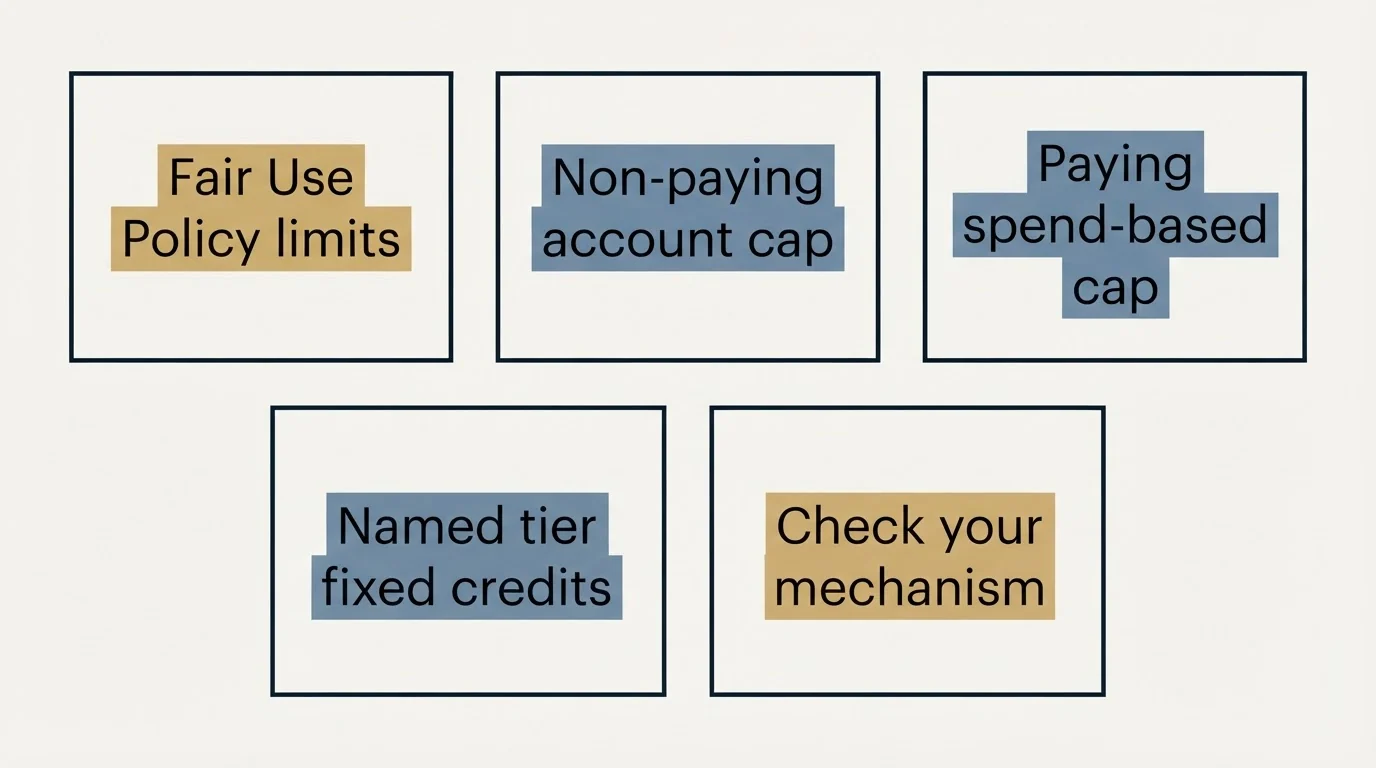
Apollo's Unlimited plans are governed by a published Fair Use Policy, and the numbers are specific.
For non-paying accounts on an Unlimited plan, the limit is 10,000 credits per account per month. For paying accounts, it is the lesser of the amount paid divided by US$0.025, or 1 million credits per account per year.
That second formula quietly prices a credit at two and a half cents, which is the most useful number on the whole page. It converts any spend into a fair-use allowance: US$100 a month buys 4,000 credits of it, US$500 buys 20,000, and the million-credit annual ceiling only binds at spend well beyond either. Apollo will discuss custom allocations above that.
Worth reading against the per-seat allowances in the table, because they are different mechanisms. The named tiers grant a fixed number of credits per seat per year. The Fair Use Policy governs the plans Apollo describes as Unlimited. Check which of the two your quote actually puts you on before modelling anything, since they behave nothing alike at the margin.
This is more transparent than most uses of the word "unlimited", and it is still a cap. Budget against the formula rather than the label.
Export credits, the line most models miss
Apollo consumes export credits whenever a contact leaves the platform. Its pricing page names the cases explicitly: CSV export, CRM sync, and Person API enrichment synced to any system outside Apollo, giving Outreach and Salesloft as examples.
Since exported contacts often feed straight into outbound campaigns, recruiters weighing which platform to route them through can compare options in this roundup of email tools built for recruiting teams.
This matters disproportionately if your architecture is sound. The reliable outbound setup verifies addresses independently before sending and sends from infrastructure separate from the data vendor, which means contacts leave Apollo continuously by design. A cost model comparing plan prices alone will understate that architecture's real cost, while the everything-in-one-tool approach avoids the meter and pays for it in domain risk instead. The domain-safe workflow covers that trade in full.
How this pricing model differs from a seat-priced tool
Worth understanding structurally, because it changes which questions matter when you compare Apollo against anything else.
A seat-priced tool has a cost you can predict on the day you sign. Ten users at a fixed monthly rate is ten times that rate, forever, regardless of how hard anyone works. The risk is paying for seats nobody uses.
A credit-metered tool has a cost that tracks activity. Two teams on identical Apollo plans can produce very different invoices, and the one doing more prospecting pays more, which is arguably correct. The risk is different: you cannot know the number until you have run the workload, and the failure mode is a surprise rather than waste.
Apollo is both at once, which is the part that catches people. You pay per seat for access and per credit for use, so the model inherits both risks. A team that buys seats for occasional users and then runs heavy enrichment through one of them pays twice over.
Credit driven pricing aside, teams still weighing whether Apollo overlaps with a dedicated enrichment tool can see how it stacks up in this comparison with LeadIQ on data enrichment.
- Ten users at a fixed monthly rate is ten times that rate, forever
- Cost does not move with how hard anyone works
- The risk is paying for seats nobody uses
- Two teams on identical plans can produce very different invoices
- The team doing more prospecting pays more, which is arguably correct
- You cannot know the number until you have run the workload
- The risk is a surprise rather than waste
- Per seat for access, per credit for use
- Inherits both risks
- A team buying seats for occasional users and running heavy enrichment through one of them pays twice over
Two practical consequences. Buy seats for people who will use the interface, and run programmatic work through the API rather than through additional seats. And model a heavy month rather than an average one, because the metered half of the bill is driven by your busiest campaign, not your typical week.
Billing behaviour worth knowing before you commit
Three rules from Apollo's own billing FAQ, each of which has caught someone out.
Upgrades take effect immediately, for both plan changes and seat count.
Downgrades of plan or seat count also take effect immediately, with access updating straight away and no refund processed for the mid-term change. Your reduced price starts from the next billing cycle. So downgrading mid-cycle costs you the access without recovering the money.
Add-on credit downgrades work differently, taking effect at the end of the billing cycle. Add-on credits bought mid-cycle stay available until the end of the current billing period even if you downgrade before then.
Additional credits can be purchased at any time once you are signed up, which is the release valve when a job runs long.
The free tier and the trial
Both exist and they answer different questions.
Trials include 50 credits and 5 mobile credits, with almost all the features of the plan you selected. At the end you convert to a paying plan or drop to the Starter plan, which Apollo describes as free forever.
Fifty credits sounds thin until you map it against the credit table. Skipping mobile numbers, that is roughly fifty enriched contacts, which is enough to draw a sample from your actual ICP and check the addresses against an independent verifier. Spending the trial on that single test tells you more than any published accuracy claim, because it measures your market rather than someone else's.
What the trial cannot tell you is what a heavy month costs. Fifty credits will not surface the waterfall behaviour, the export-credit accumulation, or the pagination multiplier, and those are the three things that make real invoices larger than expected. Model those from the documented rates rather than from trial experience.
Modelling your actual cost
- Yes: Plan price multiplied by seat count, on the billing cycle you will actually use
- Yes: Enrichment credits: matched records per month, times 1, or times 9 if you need mobiles
- Yes: Search credits: pages pulled per month at maximum page size
- Yes: Export credits for every contact that leaves for verification or sending
- Yes: Waterfall spend budgeted on attempts rather than on successes
- No: Comparing plan prices alone against another vendor's plan prices
- Depends: Whether an Unlimited plan's fair-use formula clears your expected volume
Apollo's own recommended approach before a large job is the right one: identify whether the endpoint consumes credits, check the charging unit, run a small test request, review the credit usage in settings, then scale. A test run costs a handful of credits and is the only reliable way to find out what your specific workflow burns.
One practical warning on measurement. Meter a job by its own consumption rather than by the account-wide counter, because on a shared workspace the account total includes everyone else's activity and a budget check reading it will either halt a job that has spent nothing or miss one that is running away.
For the plan-level rate limits that sit alongside these credit costs, the API guide has the full tables. For where the product fits overall, the review covers the all-in-one question, and Apollo versus ZoomInfo covers the head-to-head.
We run sourcing and outbound for clients on a pay-per-qualified-meeting basis, which means credit budgets and tool contracts sit on our side of the line. You can see what a campaign would look like for your market.
Plan prices and credit allowances are read from Apollo's pricing page as rendered on its default annual-billing view, captured 11 August 2026; monthly-billing prices are higher and were not captured. Trial terms, Fair Use credit limits, export-credit rules and billing behaviour are from the same page, and per-endpoint credit consumption is per Apollo's API pricing documentation last updated 18 July 2026. Note that the structured pricing data embedded in that page's markup is stale and disagrees with the rendered figures. Prices exclude tax and Apollo revises them; verify current pricing on Apollo's own page before purchasing.
Sources: Apollo.io pricing, Apollo API pricing and credits, Apollo API rate limits
Frequently asked questions.
Frequently asked questions- What are Apollo.io's plans and prices?
- Four named tiers, priced per seat per month on annual billing: Free at zero, Basic at US$49, Professional at US$79, and Organization at US$119 with a three-seat minimum. Credit allowances are 900, 30,000, 48,000 and 72,000 per seat per year. Monthly billing costs more, with the page advertising annual as a 24% saving.
- What are Apollo export credits?
- Credits consumed whenever a contact leaves Apollo. Apollo names CSV export, CRM sync, and Person API enrichment synced to an outside system such as Outreach or Salesloft. If you verify addresses independently and send from separate infrastructure, contacts leave constantly, so export credits are an ongoing cost rather than an occasional one.
- Can I buy more Apollo credits mid-month?
- Yes. Apollo allows purchasing additional credits at any time once you are signed up. Add-on credits bought mid-cycle remain available until the end of the current billing period even if you downgrade before then, though downgrades of the add-on itself only take effect at the end of the cycle.
- What happens if I downgrade my Apollo plan mid-cycle?
- Plan and seat-count downgrades take effect immediately, so access updates straight away, and no refund is processed for the mid-term change. The lower price applies from your next billing cycle. In practice that means a mid-cycle downgrade costs you the access without recovering any of the money already paid.
About the author.

B2B cold email experts helping companies generate qualified leads through done-for-you outreach campaigns.
RevenueFlow Team
Explore more.
Ready to scale your outreach?
We build GTM engines that book real meetings. See the receipts.
Related articles.
Sales Engagement Platform Pricing in 2026: What 61 Tools Charge and Which Hide It
Sales engagement platforms start at a median of $75 a month, 70.5% carry a quote-only tier, and AI SDR platforms start at $204.50. Data from 61 verified tools.
Salesgear Pricing: Two Ladders Under One Plan Title
Salesgear's page is titled as one plan and carries a Data ladder and an Outreach ladder. Both at both billing states, what each meters, and the two vendor-side conflicts.
Bookyourdata Pricing: 25 Packs, Priced Per Contact
Bookyourdata sells credits in twenty-five packs with no subscription. The dated ladder, the per-contact rates rendered in the browser, the guarantee rule and BeSpoke.
Zeliq Pricing: One Seat Rate and a Credit Meter
Zeliq prices one self-serve seat in dollars with a credit meter that never expires. Both billing states, the three credit rates, the top-up ladder and the Custom floor.
Autobound Pricing: One-Time Credit Packs, Not Seats
Autobound's pricing page sells one-time credit packs for a signal data API, not seats. The six packs, the per-endpoint meter, and what a company costs.
Twain Pricing: Credits per Lead, Three Research Modes
Twain sells credits, not seats, and a lead costs 1 to 14 of them depending on the research mode. The two ladders, the four expiry clocks and the cap.