Twain Pricing: Credits per Lead, Three Research Modes
Twain sells credits, not seats, and a lead costs 1 to 14 of them depending on the research mode. The two ladders, the four expiry clocks and the cap.
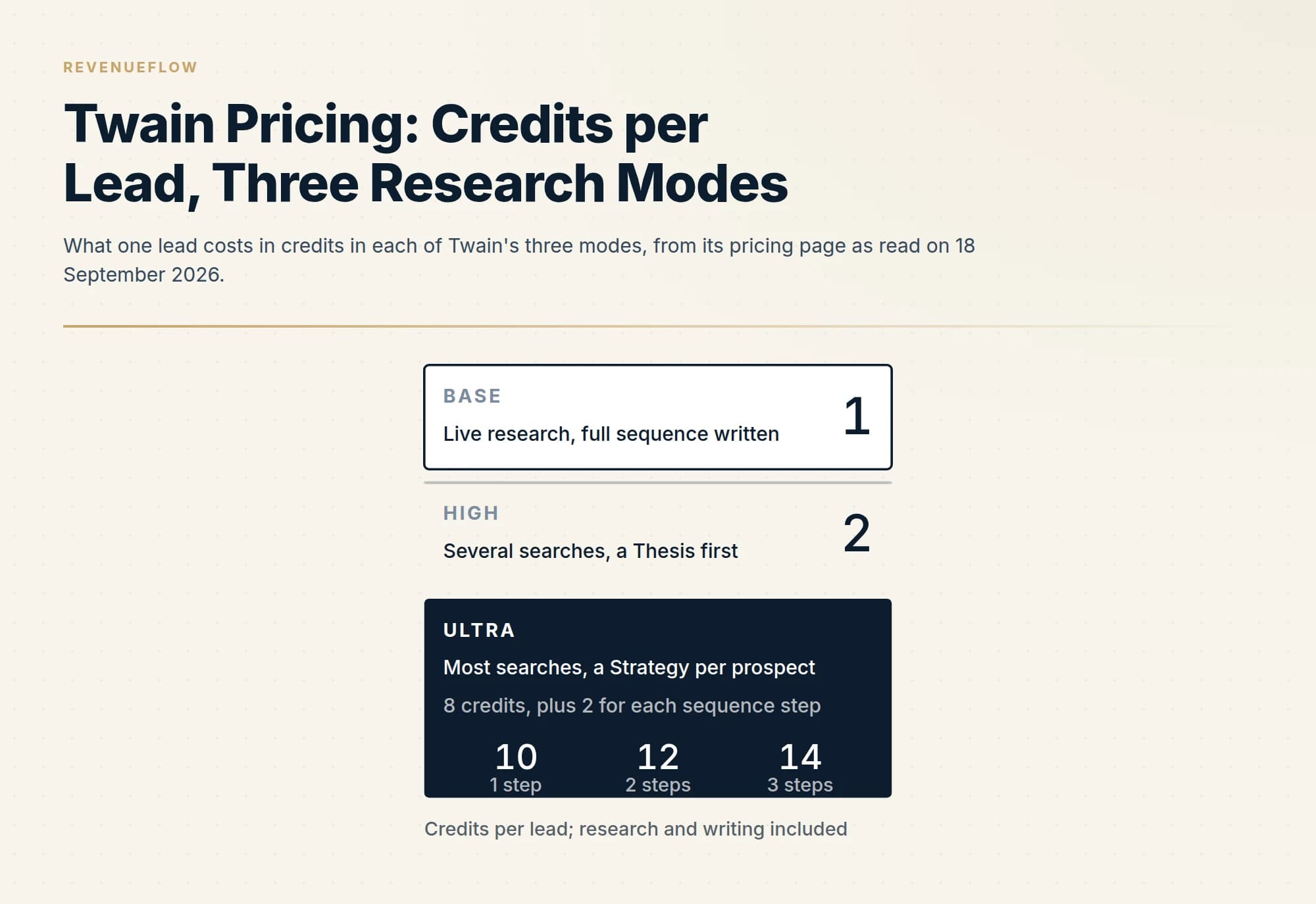
As published on Twain's pricing page on 18 September 2026, credits are sold by subscription from $99 a month for 1,000 or in one-time packs from $29.70 for 200. No per-seat charge applies. A lead costs 1 credit in Base, 2 in High and 8 plus 2 per step in Ultra, so 1,000 credits covers about 71 to 1,000 leads.
Key takeaways
- Twain's pricing page on 18 September 2026 sells credits two ways: monthly subscriptions from $99 for 1,000 credits and one-time packs from $29.70 for 200, with no per-seat charge.
- A lead costs 1 credit in Base, 2 in High and 8 plus 2 per sequence step in Ultra, so the same 1,000 credits covers 1,000 leads or about 71.
- Subscription credits roll over but the balance is capped at three times the monthly allowance at renewal; pack credits last 60 days and any new pack extends them all.
- Regenerating is free except for several leads in Ultra, and moving a lead to a deeper mode costs the full price of the new mode, so pick the mode before the first run.
Reviewed and updated September 18, 2026
Twain does not charge per seat. Its pricing page says so in as many words, and older directory listings that show per-user plans describe a ladder the vendor's page no longer carries. What Twain sells is credits, and the price of a lead depends on a choice the buyer makes for every list: how hard the tool should research before it writes.
That choice runs from one credit per lead to fourteen, so the same monthly plan can cover a thousand leads or about seventy. Everything below comes from twain.ai as fetched on 18 September 2026, with each figure attributed to the pricing page it appears on. Twain here means the outreach research and copywriting tool at twain.ai, published by Twain Technology GmbH. It has nothing to do with the scanner driver standard of the same name, which shares the search results for this query.
Two ways to buy the same credit
The page puts the choice at the top: "Subscriptions cost less per credit and add credits each month. One-time packs let you buy credits without subscribing." A note under the tables adds: "Prices are in USD. Taxes are added where applicable." There is no annual option and no billing toggle; the subscription is monthly.
As published on Twain's pricing page on 18 September 2026, the monthly subscription ladder has six published levels: 1,000 credits for $99 a month, 2,000 for $198, 4,000 for $396, 10,000 for $900, 14,000 for $1,260 and 18,000 for $1,600, with a custom level above that routed to sales. The table's last column, headed per lead, reads $0.10 on the first three levels and $0.09 on the top three.
As published on the same page on 18 September 2026, one-time packs have seven levels: 200 credits for $29.70, 500 for $74.25, 1,000 for $148.50, 1,500 for $202.50, 2,000 for $270, 4,000 for $480 and 10,000 for $1,150. The per-lead column reads $0.15 on the first three, $0.14 on the next two and $0.12 on the last two. The summary card at the top of the page rounds the entry pack to "From $30"; the table is the precise figure.
Compared at equal size, which is this article's arithmetic on the two published tables, 1,000 credits cost $99 on subscription and $148.50 as a pack, so the pack carries a premium of half again. That premium buys the right not to subscribe, and for a team running one campaign a quarter it can still be the cheaper route.
New accounts start with a free grant. The page lists a free account with 500 credits and no credit card required, and adds a constraint worth knowing before a trial: "Twain runs on desktop."
The mode decides what a lead costs
The per-lead column in both tables assumes the cheapest mode. Twain has three, and the page explains them in one line: "Base is for high-volume lists. High is the standard mode for multi-channel campaigns." Ultra is described as the highest-quality mode because it runs the most searches and builds a strategy for each prospect.
As published on the pricing page on 18 September 2026, Base costs 1 credit per lead: Twain researches the account and contact live and writes the full sequence from your instructions. High costs 2 credits per lead, runs several searches, qualifies the lead and builds what the page calls a Thesis before writing; among its listed behaviours is one that matters for accuracy: "Records absent signals, so the sequence does not rely on unverified assumptions". Ultra is priced by formula, "8 credits + 2 per sequence step", and the page works it through: one step is 10 credits, two steps 12, three steps 14.
The page is clear that the mode price is all-in. In its words: "Twain does not charge separately for research or writing."
What a thousand credits covers
The consequence is that a credit balance is only a lead count in Base mode. Dividing the entry subscription's 1,000 credits by each mode's published cost, which is this article's arithmetic, gives 1,000 leads in Base, 500 in High, 100 in Ultra with one step, about 83 with two steps and about 71 with three.
The cost per lead moves the same way. At the entry subscription's published rate, a lead is about $0.10 in Base, about $0.20 in High and about $1.39 in Ultra with three steps; on a one-time pack at the entry rate the same three work out to about $0.15, $0.30 and $2.08. Those are derivations from the vendor's tables and not figures it prints, and they are the numbers to carry into a comparison with a copywriter's hour or another tool's seat.
The step count is where a sender's own practice changes the bill. Twain writes sequences, and Ultra charges for each step in one. RevenueFlow's documented practice for cold outbound is one message per campaign, with no bumps and no thread replies, for the reasons set out in email sequence software. A team that works that way buys Ultra at its one-step price of 10 credits, and the three-step figure never applies to it. A team that runs multi-step sequences should budget on the step count it actually sends.
Four clocks on four kinds of credit
Twain's credits do not all expire the same way, and the page gives each kind its own rule under a heading about how credits roll over and expire.
Free credits last 30 days: 500 of them, added when the account is created. Subscription credits roll over while you subscribe, with a cap, in the page's words: "Credits are added each month and remain available while you subscribe. At renewal, your balance is capped at three times your monthly allowance." One-time credits run on a 60-day clock that resets for the whole balance with each purchase: "Credits are valid for 60 days. Buying another pack extends the expiry date of your remaining balance." And after cancelling a subscription the FAQ gives a short grace period: "You can use your remaining credits until five days after your paid period ends."
The cap is the rule with teeth. On the 1,000-credit plan the balance can never exceed 3,000 at renewal, so a subscriber who pauses campaigns for a quarter stops accumulating after the third month and pays for credits that are clipped on arrival. The 60-day rule on packs cuts the other way: a small top-up pack bought on day 59 extends every credit already in the account.
What regeneration costs
Drafts get rewritten, and the page prices rewriting separately from first generation. Editing the instructions and regenerating one lead in its current mode is free, Ultra included. Bulk regeneration is where the modes part ways: "Regenerating several leads in Base or High is free." For Ultra, the FAQ says Twain charges 2 credits per sequence step for each lead that needs regeneration, and adds: "The cost preview shows the total before you continue."
Moving a lead up a mode is charged in full. The FAQ explains why: "Moving that lead to a deeper mode costs the full price of the new mode" because Twain reruns the deeper research as well as the sequence. So the cheap way to use the tool is to decide the mode before the first run. Generating in Base and upgrading the promising leads to Ultra costs the Base credit and then the full Ultra price on top.
Seats, sharing and what comes with every account
For a team, the line on the page that matters most is this one: "Add teammates without paying per seat. Share one credit balance and use the API or MCP." The FAQ repeats it: teammates can be added without a per-seat charge, and everyone draws on the same shared balance. API and MCP access are listed as part of every account, with no tier gate.
A shared balance with free seats has a management consequence. Nothing stops one enthusiastic user running a large list in Ultra and spending the month's credits in an afternoon. The cost preview is the control the page offers, and it is worth agreeing internally which mode each kind of list gets before the first run.
Where it fits
Twain's own pages address go-to-market teams writing outbound: the pricing page frames the trial as a way to test accuracy, recency and outreach messaging quality for GTM copywriting, and the testimonials on its home page come from demand generation, sales and founding GTM roles. Those testimonials include reply-rate claims, which are the vendor's customers speaking on the vendor's site and are not repeated here as findings.
What a research-and-write tool can and cannot know about a recipient is the subject of AI email copywriters, and the High mode's habit of recording absent signals is a direct answer to the failure that article describes, a confident sentence built on a fact nobody verified. Where a copy tool sits relative to data, sending infrastructure and orchestration is mapped in the 7-layer GTM AI stack, which names Twain in the copy layer. For the difference between a tool that drafts and an agent that sends, see AI SDR, and for a per-seat vendor in the neighbouring category with its seat minimums published, see Regie.ai's pricing.
The short version
As published on Twain's pricing page on 18 September 2026, credits are sold two ways: a monthly subscription from $99 for 1,000 credits up to $1,600 for 18,000, and one-time packs from $29.70 for 200 credits up to $1,150 for 10,000. There is no annual plan and no per-seat charge, and new accounts receive 500 free credits for 30 days.
A lead costs 1 credit in Base, 2 in High and 8 plus 2 per sequence step in Ultra, so 1,000 credits covers anywhere from 1,000 leads to about 71. Subscription credits roll over up to three times the monthly allowance, pack credits last 60 days and are extended by any new pack, and a cancelled account keeps its credits for five days after the paid period.
Choose the mode before the first run, because moving a lead deeper costs the full price of the new mode. If the constraint is the number of qualified conversations and not the quality of each draft, you can see what a first campaign produces first.
Ladders, mode costs, expiry rules and FAQ answers above were read from Twain's own pricing page on 18 September 2026. The leads per 1,000 credits, the cost per lead by mode and the pack premium are this article's arithmetic on those published figures. Verify current terms with the vendor before relying on them.
Sources: Twain pricing, Twain home page
Frequently asked questions.
Frequently asked questions- How much does Twain cost?
- As published on Twain's pricing page on 18 September 2026, monthly subscriptions run from $99 for 1,000 credits to $1,600 for 18,000, and one-time packs run from $29.70 for 200 credits to $1,150 for 10,000. Prices are in US dollars with taxes added where applicable. New accounts receive 500 free credits for 30 days with no credit card.
- Does Twain charge per seat?
- No. The pricing page read on 18 September 2026 says teammates can be added without paying per seat and that everyone shares one credit balance, with API and MCP access included in every account. The cost scales with how many leads are generated and in which research mode, not with how many people use the tool.
- How many credits does Twain use per lead?
- It depends on the mode. As published on 18 September 2026, Base costs 1 credit per lead, High costs 2, and Ultra costs 8 credits plus 2 per sequence step, which the page works through as 10, 12 and 14 credits for one, two and three steps. The price covers research and writing together.
- Do Twain credits expire?
- Each kind has its own rule. Free credits last 30 days. Subscription credits roll over while you subscribe, capped at three times the monthly allowance at renewal. One-time pack credits last 60 days, and buying another pack extends the whole remaining balance. After cancelling, remaining credits can be used until five days after the paid period ends.
About the author.

B2B cold email experts helping companies generate qualified leads through done-for-you outreach campaigns.
RevenueFlow Team
Explore more.
Ready to scale your outreach?
We build GTM engines that book real meetings. See the receipts.
Related articles.
Lavender Pricing: Two Products, No Pricing Page
Lavender has no pricing page. The Email Coach ladder per seat at both billing states, the free routes, and the separate per-agent price for Ora.
Salesgear Pricing: Two Ladders Under One Plan Title
Salesgear's page is titled as one plan and carries a Data ladder and an Outreach ladder. Both at both billing states, what each meters, and the two vendor-side conflicts.
Zeliq Pricing: One Seat Rate and a Credit Meter
Zeliq prices one self-serve seat in dollars with a credit meter that never expires. Both billing states, the three credit rates, the top-up ladder and the Custom floor.
Overloop Pricing: Two Seat Rates and No Annual Toggle
Overloop publishes Starter and Growth per user with a credit allowance and no annual rate on the page. What each seat carries, and what the page leaves out.
PersistIQ Pricing: A Demo Form Where the Ladder Was
PersistIQ's pricing address serves a demo form and no platform price. What the site does publish, the Luka add-on ladder at both billing states, and how to read a quote.
Gong Engage vs Salesloft Cadence: How They Differ
Gong Engage and Salesloft Cadence compared from each vendor's own pages: where each starts, six jobs side by side, and what the pricing pages disclose.