Airscale Pricing: Three Plans, One Credit, Four Rates
Airscale prints a different credit cost on every plan, and its advertised per-email price belongs to the custom one. The dated ladder and the rollover rules.
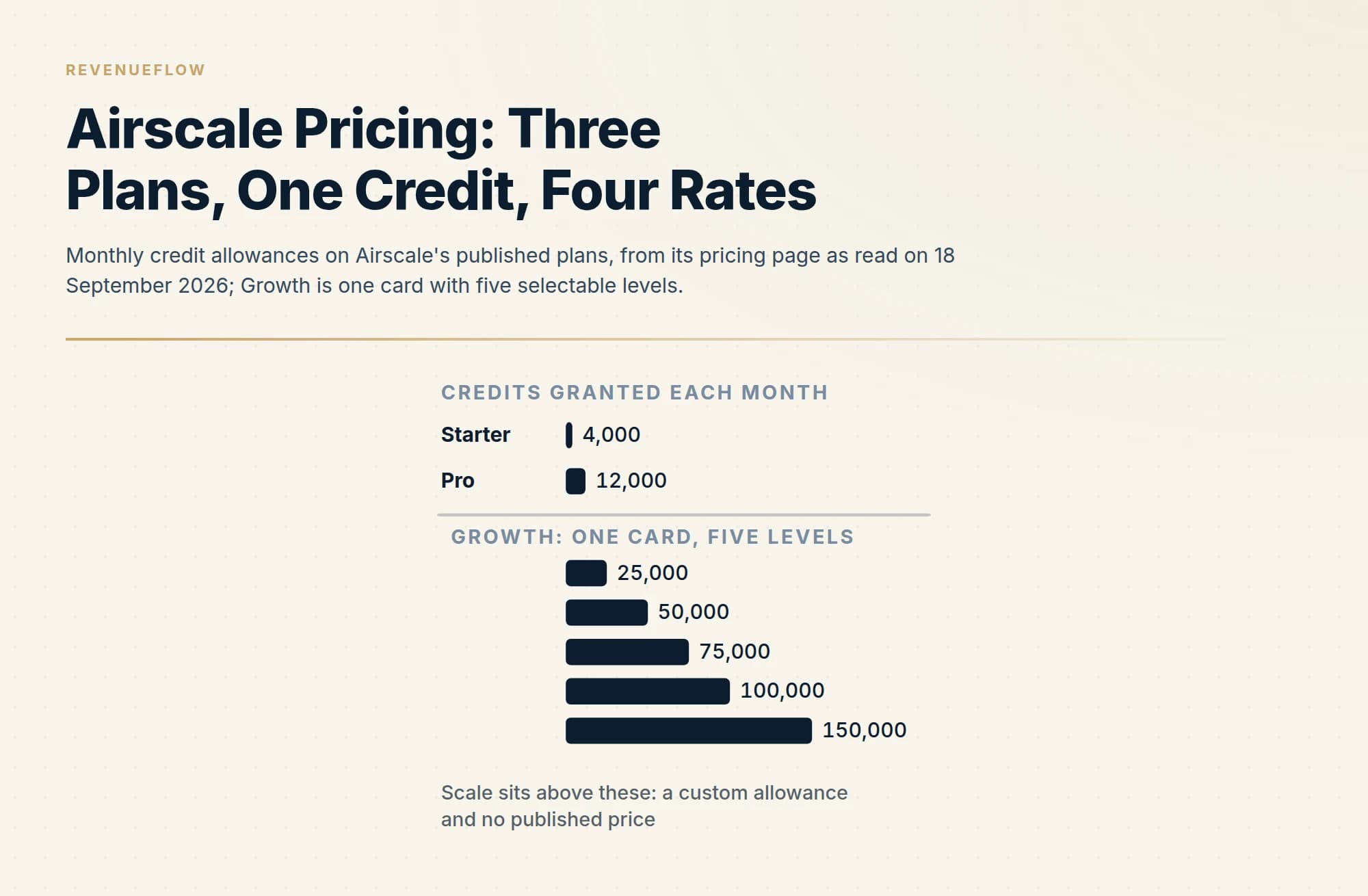
As published on Airscale's pricing page on 18 September 2026, Starter is $49 a month for 4,000 credits, Pro is $99 for 12,000 and Growth runs from $189 for 25,000 credits to $1,049 for 150,000. Yearly billing costs ten times the monthly figure. A verified email costs 2 credits on every plan, and unused credits roll over while you subscribe.
Key takeaways
- Airscale publishes three self-serve plans on 18 September 2026 at $49, $99 and from $189 a month, plus a custom Scale plan with no published price.
- Each plan card prints its own credit cost, from $0.01225 on Starter to $0.00699 at the top Growth level, so one enrichment has a different price on every plan.
- The per-email and per-mobile dollar prices on the enrichments page are, in the vendor's words, based on the custom plan, which no self-serve customer pays.
- Credits roll over while a subscription is active, a lookup that finds nothing is not charged, and running out is solved by resubscribing, which resets the billing cycle.
Reviewed and updated September 18, 2026
Airscale sells one unit, the credit, and prints what a credit costs on each plan card. As published on Airscale's pricing page on 18 September 2026, that printed credit cost is $0.01225 on Starter, $0.00825 on Pro and $0.00756 on the entry Growth level. A fourth rate, the one behind the per-email and per-mobile prices advertised across the site, belongs to a plan with no published price at all.
That is the thing to understand before comparing this ladder with anything. The same enrichment costs a different amount on every plan, and the dollar prices on the vendor's own enrichment list are quoted at the cheapest rate, the one you have to ask for. Everything below comes from airscale.io as fetched on 18 September 2026: the pricing page in both billing states, the enrichments page and the terms of service. Airscale here means the lead sourcing and enrichment product at airscale.io, which is unrelated to the telecoms hardware that shares the name.
The three published plans, month to month
The pricing page describes itself as a "Flexible credit-based system to source and enrich your leads" and opens on a Monthly tab. As published on Airscale's pricing page on 18 September 2026, in that monthly state, Starter is $49 a month for 4,000 credits a month, Pro is $99 a month for 12,000 credits a month, and Growth starts at $189 a month for 25,000 credits a month. A fourth card, Scale, prints its price as custom and routes to a contact form.
Growth is five plans behind one card. A selector on the card steps the monthly credit allowance through 25,000, 50,000, 75,000, 100,000 and 150,000, and the price moves with it. Rendered in a browser on 18 September 2026 in the monthly state, those five levels read $189, $375, $549, $729 and $1,049 a month, with the printed credit cost falling from $0.00756 at the first level to $0.00750, $0.00732, $0.00729 and $0.00699 at the last.
Every plan carries the same feature list. The page prints it once beneath the cards rather than per plan: unlimited users, credits that roll over, waterfall enrichments, access to more than 30 data providers, exports to CRMs and email sequencers, custom onboarding, dedicated Slack support, API access, and the option to use your own API keys. Nothing on the page gates a feature by tier, so the plans differ on two numbers only: how many credits arrive each month, and what each one costs.
The yearly state is ten months of the monthly one
The billing control has two tabs, Monthly and Yearly, and the yearly figures do not exist in the HTML a plain fetch receives. They appear only after the tab is clicked in a browser. Rendered that way on 18 September 2026, Starter reads $490 a year, Pro $990 a year, and the five Growth levels $1,890, $3,750, $5,490, $7,290 and $10,490 a year.
Each of those is exactly ten times the monthly figure for the same level, which is this article's arithmetic on the two published states: two months free, or a little under 17 percent. The page prints no savings label on the tab, so that percentage is a derivation here and not the vendor's claim. The credit line on each card still reads per month in the yearly state, and the printed credit cost falls accordingly, to $0.01021 on Starter, $0.00688 on Pro and $0.00630 on the first Growth level, down to $0.00583 at 150,000 credits.
The page does not say whether a yearly subscriber receives twelve months of credits upfront or month by month. The cards keep the monthly wording, so the conservative reading is a monthly grant on a yearly invoice, and it is worth confirming in writing because it decides whether a large one-off list can be run in the first week.
One enrichment, four prices
The pricing FAQ defines the unit: credits are the currency used to buy data points and actions, a typical action is either free or costs one to two credits according to that FAQ, and "it costs 2 credits to find a verified professional email". The enrichments page turns that into a full menu. As published there on 18 September 2026, finding and verifying a professional email is listed at 2 credits, finding a phone number at 40 credits, verifying an email at 0.5 or 0.25 credits depending on the verifier chosen, and business intent topics at 3 credits, with several lookups listed as free.
Beside each credit count the enrichments page prints a dollar price: $0.008 for the verified email, $0.15 for the phone number. Above the list sits the sentence that governs all of them: "Prices shown are based on our custom plan". Those dollar figures match the two rates printed on the Scale card of the pricing page, the plan with no published price.
So the dollar column describes a rate that no self-serve customer pays. Multiplying the published credit counts by the credit cost printed on each plan card, which is this article's arithmetic on Airscale's published numbers, a verified professional email at 2 credits works out to about $0.0245 on Starter, $0.0165 on Pro and $0.0151 on the first Growth level in the monthly state, against the $0.008 the enrichments page shows. A phone number at 40 credits works out to about $0.49 on Starter and $0.33 on Pro, against the advertised $0.15. The vendor publishes every input to that calculation. It simply prints the answer for one plan only, and it is the plan you cannot buy from the page.
What a miss costs, and why the waterfall matters to the bill
Airscale holds no data of its own. The pricing FAQ says so directly, describing the product as a central, credit-based marketplace through which you pull data from external enrichment tools into your workflows. Its waterfall feature queries several of those tools in order for one field, and the FAQ says you "only pay once a result is found". On email specifically it adds: "You are not charged when no email is found."
That rule changes what the credit count means. On a list where a third of rows return nothing, a pay-per-attempt tool bills the whole list and a pay-on-result tool bills two thirds of it. The share is invented here to show the shape, and the rule is the vendor's. It also means the effective cost per usable record on Airscale is the credit count for that field, not a multiple of it, which is the comparison to run against any provider inside a waterfall enrichment sequence.
Rollover, and the rule for running out
The pricing page leads with a promise: "Risk free: credits never expire and are reported to the next month if unused." The FAQ qualifies it. Unused credits never expire, it says, as long as you are subscribed to one of the plans. Rollover is a property of an active subscription, and the page says nothing about what happens to a balance after cancellation.
Running out works in an unusual way. There is no top-up pack on the page. The FAQ answer to running out of credits is that you can cancel your subscription and subscribe to the same plan again, and it describes the result: "The credits will be added directly to your account and the action will reset your billing cycle." Downgrading or upgrading does the same, and the FAQ sums up: "All of these actions would act the same as Pay-as-you-go options."
In practice that makes each plan a credit pack you can rebuy early. A Starter subscriber who burns 4,000 credits in ten days can buy another 4,000 at the same rate on day eleven, and the next renewal moves to that date. Nothing about that is hidden, but it does mean a heavy month costs two plan fees, and the cheaper credit rate one plan up may have been the better purchase. Compare the two before the second rebuy, because the credits roll over either way.
The terms that sit behind the cards
Airscale's terms of service, marked as last updated on 1 November 2025, set the contract rules the pricing page leaves out. Subscriptions renew automatically for an equivalent period at the then-current price unless cancelled before the renewal date. A cancelled subscription can be used to the end of its term with no prorated refund, and the general rule is stated flatly: "All fees are non-refundable, except as explicitly stated in the Agreement." The same section reserves the right to change prices and to charge for services that were previously free, with effect on posting.
The trial is the low-risk way in. The pricing FAQ says paid plans start at $49 a month and that the product is free for 14 days on the trial, and every plan card carries a button to get started for free.
Where it sits beside other credit ladders
Credit-priced data is a crowded shelf, and the unit is never the same twice. Explorium's credit packages sell prepaid credits that expire after twelve months where Airscale's roll over while you subscribe. Clay's pricing charges per action with the cost varying by which provider answers, which is the closest structural neighbour. FullEnrich publishes a single per-credit rate rather than one per plan. Whichever you weigh it against, compare on cost per usable record at your own hit rate, and keep email verification in the same budget line, because an address that resolves is not yet an address that delivers. The wider field is mapped in data enrichment tools for SDR teams.
Airscale's own pages address go-to-market teams building lead lists, enriching contacts and drafting personalised outreach with AI, and its home page says it is trusted by more than 1,000 startups and enterprises, which is the vendor's claim about itself.
The short version
As published on Airscale's pricing page on 18 September 2026, Starter is $49 a month for 4,000 credits, Pro is $99 for 12,000, and Growth runs from $189 for 25,000 credits to $1,049 for 150,000, with a custom Scale plan above. The yearly tab, visible only in a browser, prices each level at ten times its monthly figure. Every plan has the same features and unlimited users.
The number to model is the credit cost printed on your plan card, because a verified email is 2 credits and a phone number 40 on every plan, and the dollar prices on the enrichments page are, in the vendor's words, based on the custom plan. Credits roll over while you subscribe, a miss is not charged, and running out is solved by resubscribing, which resets the billing cycle.
If the list is not the constraint and the conversations are, you can see what a first campaign produces before adding another data line.
Plans, figures, credit counts and terms above were read from Airscale's own pricing page, enrichments page and terms of service on 18 September 2026; the yearly figures and the Growth levels were read in a rendered browser session that day. The per-enrichment dollar amounts by plan and the yearly saving are this article's arithmetic on those published numbers. Verify current terms with the vendor before relying on them.
Sources: Airscale pricing, Airscale enrichments, Airscale terms of service
Frequently asked questions.
Frequently asked questions- How much does Airscale cost?
- As published on Airscale's pricing page on 18 September 2026, Starter is $49 a month for 4,000 credits, Pro is $99 a month for 12,000 credits, and Growth starts at $189 a month for 25,000 credits and rises to $1,049 for 150,000. The Scale plan is custom. Yearly billing prices each level at ten times its monthly figure.
- Do Airscale credits expire or roll over?
- The pricing page read on 18 September 2026 says credits never expire and are carried to the next month if unused, and its FAQ adds the condition that this holds as long as you are subscribed to one of the plans. The page does not say what happens to a balance after cancellation, so ask before you cancel with credits left.
- How many Airscale credits does a verified email cost?
- Two. The pricing FAQ and the enrichments page both list a verified professional email at 2 credits, and the FAQ says you are not charged when no email is found. A phone number is listed at 40 credits. The dollar cost depends on the credit cost printed on your plan card, which differs on every plan.
- What happens when you run out of Airscale credits?
- There is no top-up pack on the pricing page. The FAQ read on 18 September 2026 says you can cancel and subscribe to the same plan again, that the credits are added directly to your account, and that the action resets your billing cycle. Upgrading or downgrading works the same way, which the vendor compares to pay as you go.
About the author.

B2B cold email experts helping companies generate qualified leads through done-for-you outreach campaigns.
RevenueFlow Team
Explore more.
Ready to scale your outreach?
We build GTM engines that book real meetings. See the receipts.
Related articles.
Snitcher Pricing: The $49 Table Is the Annual Rate
Snitcher's visible price table is the annual-billing ladder. The ten bands at both billing states, the unique-company meter, and the rules on a help page.
Autobound Pricing: One-Time Credit Packs, Not Seats
Autobound's pricing page sells one-time credit packs for a signal data API, not seats. The six packs, the per-endpoint meter, and what a company costs.
TexAu Pricing: Four Tiers, Billed Only on a Match
TexAu charges credits only when a lookup succeeds. The four tiers at both billing states, the rollover cap, and three places the page disagrees with itself.
LeadGibbon Pricing: Three Monthly Plans, No Annual Tab
LeadGibbon publishes three monthly plans and no annual rate. The dated ladder, the verified-emails-only meter, the rollover rule, and what the page does not publish.
Bookyourdata Pricing: 25 Packs, Priced Per Contact
Bookyourdata sells credits in twenty-five packs with no subscription. The dated ladder, the per-contact rates rendered in the browser, the guarantee rule and BeSpoke.
SalesQL Pricing: Four Plans, Priced Per Credit
SalesQL publishes four plans on a monthly-first pricing page. Here is the dated ladder, the per-profile credit meter, the seat limits, and what the page leaves out.