Snitcher Pricing: The $49 Table Is the Annual Rate
Snitcher's visible price table is the annual-billing ladder. The ten bands at both billing states, the unique-company meter, and the rules on a help page.
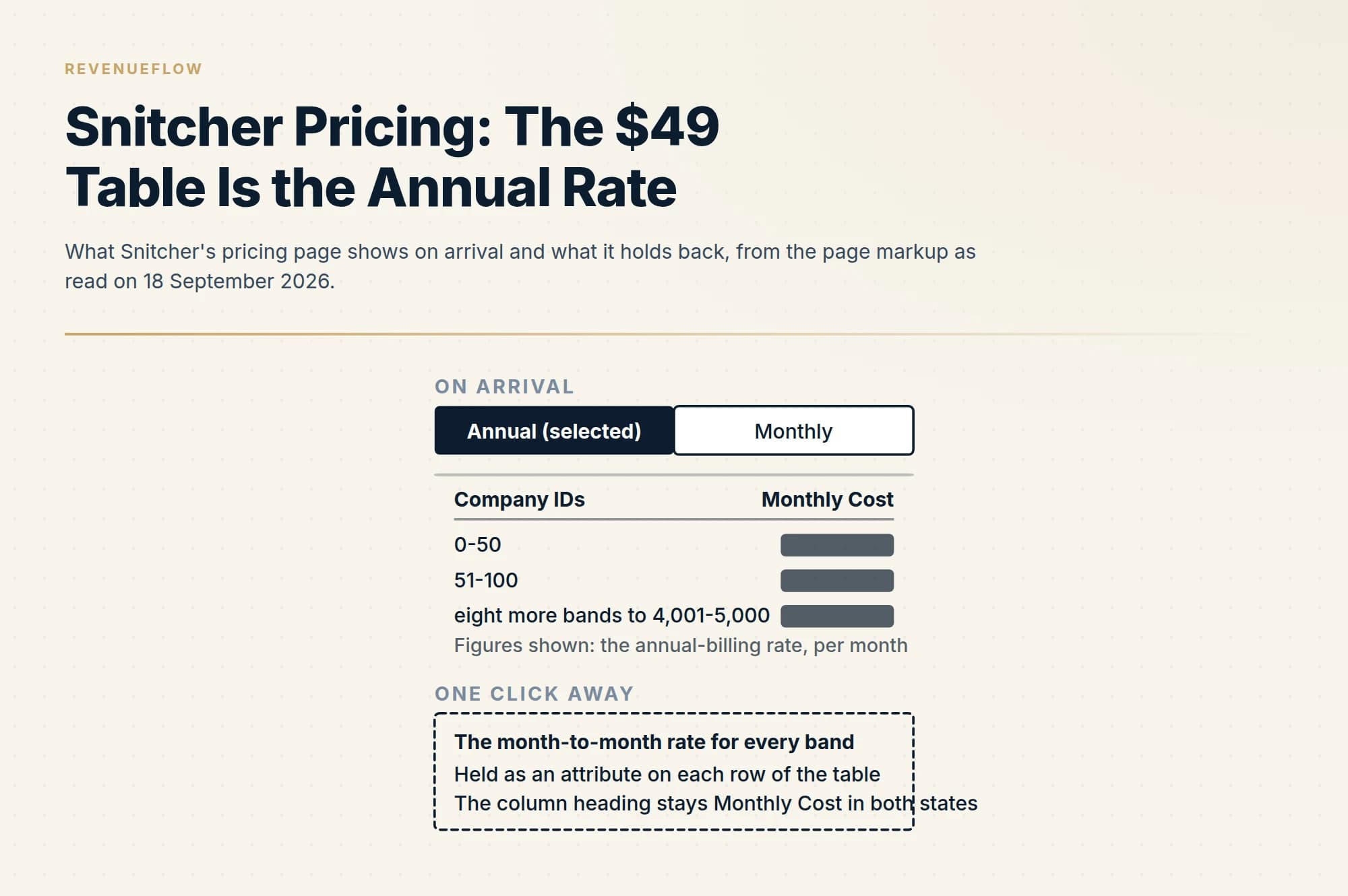
As published on Snitcher's pricing page on 18 September 2026, ten bands run from $49 a month for up to 50 identified companies to $529 for 4,001 to 5,000 on annual billing, the tab the page opens on. Month to month the same bands run $79 to $779. Seats and features are included; each extra website is a separate subscription.
Key takeaways
- The figures visible on Snitcher's pricing page on 18 September 2026, $49 to $529, are annual-billing rates, because the page opens on its Annual tab.
- The month-to-month rates for the same ten bands run $79 to $779 and sit in the page markup until the Monthly tab is selected.
- The meter is unique companies identified per billing period, counted once however often they return; seats, features and integrations do not change the rate.
- Snitcher's help centre says each website needs its own subscription, and that the annual plan is invoiced in full upfront with no refund on early cancellation.
Reviewed and updated September 18, 2026
Snitcher's pricing page prints one table with a column headed Monthly Cost, and the first figure in it is $49. That figure is the annual-billing rate. The page opens with its Annual tab selected, the month-to-month figure for the same band is $79, and the only place the second number exists before you click anything is an attribute in the page markup.
This matters because the $49 ladder is the one that gets copied. Comparison posts and review pages reproduce the visible column and describe annual billing as a discount on top of it, which reads the table backwards. Everything below comes from snitcher.com and help.snitcher.com as fetched on 18 September 2026, each figure attributed to the surface it appears on. Snitcher here means the website visitor identification vendor at snitcher.com and nothing else that shares the word.
The table, read with its toggle
As published on Snitcher's pricing page on 18 September 2026, the billing control above the table has two tabs, Annual and Monthly. The Annual tab is the one marked as selected in the markup and carries a label reading "~ 30% off". So the ten figures a visitor sees on arrival are annual-billing rates expressed per month.
The table has two columns, Company IDs and Monthly Cost, and ten bands. On the annual tab, as published on that page on 18 September 2026, the bands run 0 to 50 companies at $49, 51 to 100 at $69, 101 to 250 at $99, 251 to 500 at $139, 501 to 750 at $179, 751 to 1,000 at $229, 1,001 to 2,000 at $279, 2,001 to 3,000 at $349, 3,001 to 4,000 at $439 and 4,001 to 5,000 at $529.
Each of those cells carries a second value in the same page. The markup holds a yearly price and a monthly price as attributes on every row, and the page script swaps one for the other when the tab changes. On the Monthly tab, as read from those attributes and confirmed in a rendered browser session on 18 September 2026, the same ten bands run $79, $109, $149, $199, $269, $339, $419, $529, $649 and $779.
Above 5,000 companies there is no published rate. The page lists a Custom tier for platforms and developers, described as building on Snitcher infrastructure with white-label visitor tracking and IP-to-company lookups, and routes it to sales.
The Annual tab label and the published numerals disagree
The Annual tab is labelled "~ 30% off", and the page's own FAQ says annual billing will "save 30% compared to monthly billing". The published numerals give a wider range than that.
Dividing each annual-tab figure by its monthly-tab figure, which is arithmetic performed here on Snitcher's own published numbers rather than anything the vendor states, the saving is about 38 percent on the first band, about 37 percent on the second, and between about 30 and 34 percent on the other eight. The smallest gap, on this article's division of Snitcher's published figures, is on the 251 to 500 band, where $139 against $199 is a fraction over 30 percent. The label is accurate as a floor and understates the two lowest bands.
That asymmetry is worth knowing because the lowest bands are where a small site lands. A team identifying fewer than 100 companies a month gives up proportionally more by staying month to month than a team in the thousands does.
What a unique identification is
The meter is stated on the pricing page in one sentence: "Our plans are based on the number of unique companies we ID each month." The FAQ on the same page defines the unit as a company identified for the first time within your billing period, and says return visits from the same company are not counted again.
Snitcher's help centre adds the mechanics. Its pricing article, dated 13 March 2026 on the page, says the cost is calculated on the total number of unique domains identified each month, "counting each company only once per month, regardless of visit frequency". It also publishes the formula: "Monthly usage is determined by calculating the average daily identifications during the billing period, and then multiplying that average by 30.43."
Two vendor pages describe the tier change differently
The pricing page FAQ answers the overage question this way: if you exceed your monthly identification limit, "you can upgrade to a higher tier for more volume", and an in-app warning appears as the limit approaches. That reads as a choice the customer makes.
The help-centre pricing article describes the same event from the other side. Under a heading about how tiers work, it says your pricing tier is determined by the number of unique domains identified each month and adds: "It is automatically adjusted based on your usage."
Those two sentences sit on two Snitcher surfaces on the same day, and they are not the same promise. One has you choosing to move up; the other has the tier following your traffic. Neither page publishes a per-identification overage rate, so there is no metered charge to model, but a site whose traffic is growing should ask which behaviour applies to its account before the month it crosses a band. A campaign that doubles traffic for three weeks is exactly the case where the answer changes the invoice.
What the annual plan changes beyond the rate
The annual plan is more than a lower figure. Snitcher's help-centre pricing article says an annual subscriber receives a year of identifications upfront, and gives the rule: multiply the monthly identifications by 12. Its own worked example is a monthly limit of 1,000 identifications becoming an annual limit of 12,000.
That converts a monthly ceiling into a yearly pool, which suits seasonal traffic. A site that identifies 1,600 companies in a launch month and 600 in a quiet one stays inside a 12,000 pool where it would have crossed the monthly band. Those two monthly counts are invented here to show the shape, and the pool rule is the vendor's.
The cancellation article on the same help centre sets the other side of the trade. It says subscribers are invoiced for the total annual amount at the start, by card or by a one-off invoice paid by bank transfer, that the annual plan renews automatically unless cancelled before the renewal date, and that "we do not provide refunds for cancellations made before the end of your term". Downgrading to a lower tier is described as an option for subscribers on the monthly plan. On the first band, twelve months at the annual-tab figure of $49 is $588 paid at once, which is this article's multiplication of the published figure.
| Rule | Monthly plan | Annual plan |
|---|---|---|
| Identification allowance | The band, each month | The band times 12, granted upfront |
| Invoiced | Each month | The total annual amount at the start |
| Downgrade to a lower tier | Described as available | Not described |
| Cancel | Any time, access to period end | Any time, access to period end |
| Refund on early cancellation | No | No |
| Renewal | Monthly cycle | Automatic unless cancelled first |
What does not move the price, and the one thing that multiplies it
Seats do not. The pricing page FAQ says "All plans include unlimited team members." Features do not either: the platform card says "Full access to all features included." and lists company identification, user identification through what it calls the Identity Layer, intent signal detection, Slack and email alerts, CRM sync for HubSpot, Salesforce and Pipedrive, REST API access and GDPR compliance tools. The FAQ lists the integrations as included in all plans with no per-integration fees.
Websites do. The help-centre article on adding multiple websites says "Each website will have its own separate subscription", with its own tracking code and its own 14 day free trial. A company running a product site, a regional site and a separate marketing domain is buying the ladder three times, each at the band that site reaches on its own. For a multi-brand team that is the largest multiplier anywhere in Snitcher's pricing, and it appears on a help page rather than on the pricing page.
Does not change the rate
- Team members, stated as unlimited
- Features, all included on every band
- Integrations, no per-integration fee
- Return visits from a company already counted
Changes what you pay
- Unique companies identified in the period
- The billing tab, Annual or Monthly
- Each extra website, a separate subscription
- Volume past the top band, quoted by sales
The currency symbol moves and the numerals do not
One more property of the page is easy to miss. The HTML Snitcher served to a plain fetch on 18 September 2026 prints every figure with a dollar sign. The same page rendered in a browser on a United Kingdom connection that day displayed a pound sign in front of identical numerals, on both tabs. The page script formats prices through a currency helper that reads the visitor's region and falls back to a dollar sign when that helper is not ready.
Nothing on the page announces this. The practical reading is that the numerals are the published fact and the symbol depends on where the page is loaded, so a figure quoted from a screenshot should carry the location it was taken in. Confirm the currency of your own quote at checkout rather than from a shared screenshot.
A related piece of page state: the first fetch on 18 September 2026 also carried a banner offering a referred visitor a discount on a first purchase, with the wording "enjoy 15% off your first purchase". That is a referral promotion attached to the visit, and the ladder above is the rate without it.
Where the trial and the fine print sit
The pricing page offers a 14-day free trial with no credit card required, and its FAQ says the trial has full access to all features. The help-centre pricing article recommends the trial for a specific reason: to get an accurate estimate of how many unique companies Snitcher identifies on your site before you choose a band. That is the right use of it. The number that sets the bill is one only your own traffic can produce.
The FAQ adds that you can cancel at any time and that "There are no long-term contracts or cancellation fees." It also says Snitcher considers discounts for startups, non-profits and educational institutions through its sales team, with no figure published.
How it sits beside the rest of the category
Snitcher is one of the few visitor identification vendors that prints its whole volume ladder, which is why it anchors comparisons. Leadfeeder alternatives compared on data and price sets its table beside vendors that publish only a floor, and Lead Forensics alternatives does the same against Lead Forensics, whose pricing page carried no figure when that comparison was written. For a European vendor that prices the subscription and the contact data as two separate lines, the Albacross review is the closest neighbour, and Leadfeeder's own ladder shows the banded model in euros.
Identification is company level by default. The pricing FAQ says Snitcher matches visitor IP addresses to corporate data and surfaces individual contact details only when the customer chooses to reveal them. A vendor's lawful basis for that matching does not transfer to the sender who then emails someone at the identified company, which is the distinction set out in GDPR for B2B outbound.
The short version
As published on Snitcher's pricing page on 18 September 2026, ten bands run from 0 to 50 companies to 4,001 to 5,000. The figures visible on arrival, $49 to $529, are the annual-billing rates, because the page opens on its Annual tab. The month-to-month rates for the same bands, $79 to $779, sit in the markup and appear when the Monthly tab is selected. The label says about 30 percent off and the published numerals work out to between about 30 and 38 percent by band.
The unit is a unique company identified in the billing period, counted once however often it returns. Seats, features and integrations do not change the rate. A second website does, because each site is its own subscription. The annual plan grants twelve months of identifications upfront, is invoiced in full at the start, renews automatically and is not refunded on early cancellation.
Run the trial on your own traffic, read the band at both billing states, and ask whether the tier follows your usage automatically before a traffic spike decides it for you. If the identified accounts are not turning into conversations, the constraint is downstream of the tool, and you can see what a first campaign produces against your own list.
Bands, figures, billing rules and FAQ answers above were read from Snitcher's own pricing page and help centre on 18 September 2026. The percentage savings and the twelve-month total are this article's arithmetic on those published figures. Verify current terms with the vendor before relying on them.
Sources: Snitcher pricing, Snitcher help centre: plans and pricing, Snitcher help centre: plans and billing collection, Snitcher help centre: multiple websites
Frequently asked questions.
Frequently asked questions- How much does Snitcher cost per month?
- As published on Snitcher's pricing page on 18 September 2026, the annual-billing ladder runs from $49 a month for up to 50 identified companies to $529 for 4,001 to 5,000. On month-to-month billing the same ten bands run from $79 to $779. Above 5,000 companies there is no published rate and the page routes to sales.
- Does Snitcher charge per user or per seat?
- No. The pricing page FAQ read on 18 September 2026 states that all plans include unlimited team members, and the platform card says full access to all features is included. The price follows one meter only, the number of unique companies identified in the billing period, plus a separate subscription for each additional website.
- What counts as an identification on Snitcher?
- The pricing page FAQ defines it as a company identified on your website for the first time within your billing period, and says return visits from the same company are not counted again. The help centre adds that monthly usage is calculated from average daily identifications in the billing period multiplied by 30.43.
- Can you cancel a Snitcher annual plan and get a refund?
- You can cancel, and access continues to the end of the paid period, but the help-centre cancellation article read on 18 September 2026 says refunds are not provided for cancellations made before the end of the term. The annual plan is invoiced for the total annual amount at the start and renews automatically unless cancelled before the renewal date.
About the author.

B2B cold email experts helping companies generate qualified leads through done-for-you outreach campaigns.
RevenueFlow Team
Explore more.
Ready to scale your outreach?
We build GTM engines that book real meetings. See the receipts.
Related articles.
Airscale Pricing: Three Plans, One Credit, Four Rates
Airscale prints a different credit cost on every plan, and its advertised per-email price belongs to the custom one. The dated ladder and the rollover rules.
Autobound Pricing: One-Time Credit Packs, Not Seats
Autobound's pricing page sells one-time credit packs for a signal data API, not seats. The six packs, the per-endpoint meter, and what a company costs.
TexAu Pricing: Four Tiers, Billed Only on a Match
TexAu charges credits only when a lookup succeeds. The four tiers at both billing states, the rollover cap, and three places the page disagrees with itself.
LeadGibbon Pricing: Three Monthly Plans, No Annual Tab
LeadGibbon publishes three monthly plans and no annual rate. The dated ladder, the verified-emails-only meter, the rollover rule, and what the page does not publish.
Bookyourdata Pricing: 25 Packs, Priced Per Contact
Bookyourdata sells credits in twenty-five packs with no subscription. The dated ladder, the per-contact rates rendered in the browser, the guarantee rule and BeSpoke.
SalesQL Pricing: Four Plans, Priced Per Credit
SalesQL publishes four plans on a monthly-first pricing page. Here is the dated ladder, the per-profile credit meter, the seat limits, and what the page leaves out.