Autobound Pricing: One-Time Credit Packs, Not Seats
Autobound's pricing page sells one-time credit packs for a signal data API, not seats. The six packs, the per-endpoint meter, and what a company costs.
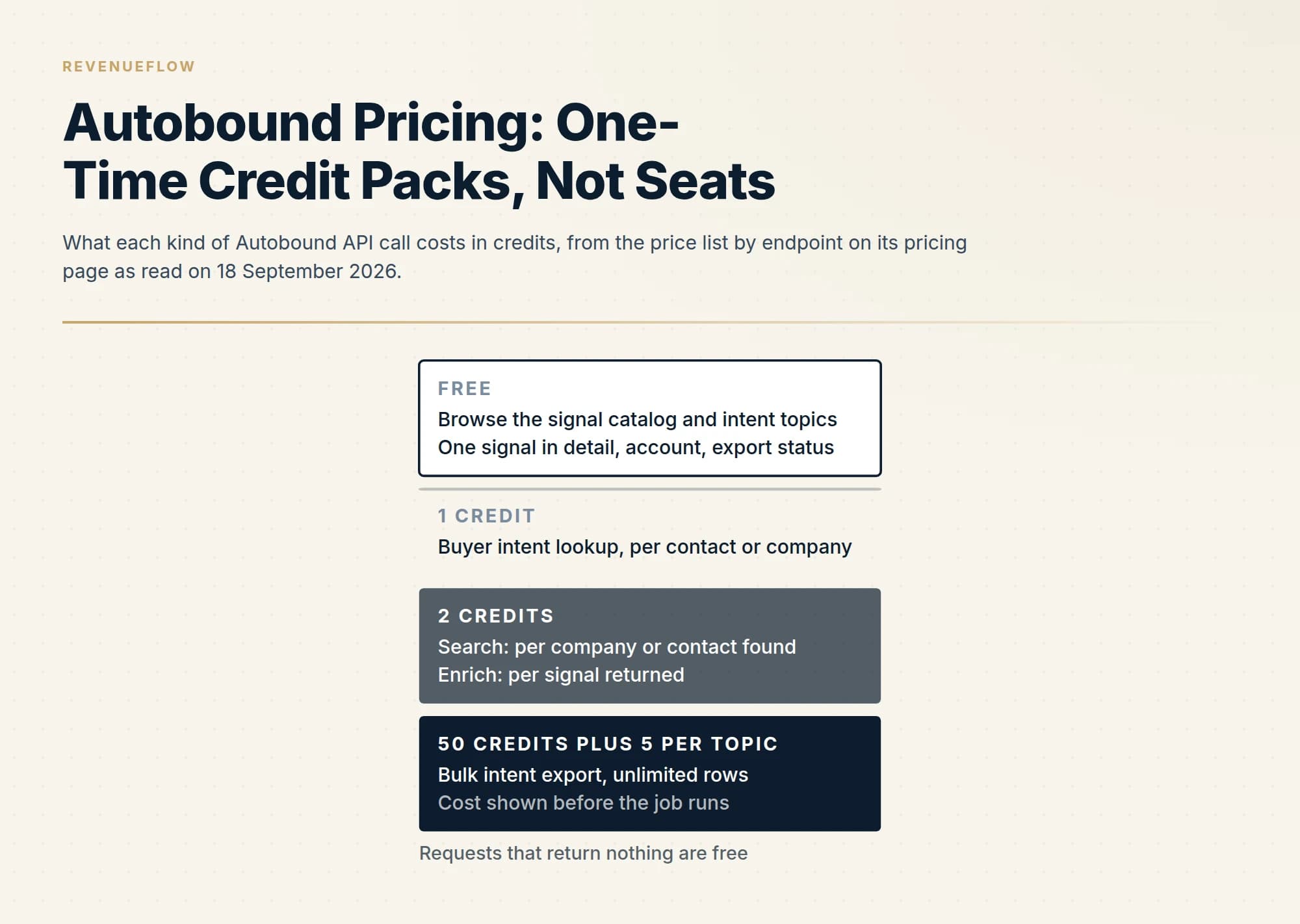
As published on Autobound's pricing page on 18 September 2026, credits are sold in six one-time packs from $19 for 2,000 credits to $4,999 for 1,249,750, with no subscription and no seats. Search costs 2 credits per result, enrich 2 credits per signal and buyer intent 1 credit per contact. Credits never expire and new accounts receive 1,000 free.
Key takeaways
- Autobound's pricing page on 18 September 2026 sells one-time credit packs for a signal data API, from $19 for 2,000 credits to $4,999 for 1,249,750, with no seat-based plan.
- The meter is per endpoint: 2 credits per search result, 2 per signal on enrich, 1 per buyer intent lookup, and 50 credits plus 5 per topic for a bulk export.
- On the vendor's own average of about 8 signals per company, one company enrichment costs about 16 credits, so divide a pack by 16 before comparing prices.
- Credits never expire, packs pool, and zero-result requests are free, while one of the vendor's own comparison pages still describes paid plans that scale with team size.
Reviewed and updated September 18, 2026
Most write-ups of Autobound's pricing describe an AI email writer sold by the seat. Autobound's own pricing page, as fetched on 18 September 2026, sells something else: one-time packs of credits for a signal data API, with no subscription, no seat count and no billing toggle anywhere on the page.
The gap between those two descriptions is the useful thing to know before budgeting, because a buyer who arrives expecting a per-user plan will not find one to buy. Everything below comes from autobound.ai as fetched on 18 September 2026: the pricing page, its expandable price list by endpoint, the home and about pages, and one of the vendor's own comparison pages. Each figure is attributed to the surface it appears on.
What the pricing page sells
The page is titled around signal data plans and credits, and its headline reads "Autobound pricing, simple and transparent". Under the plan heading it states the model in three short sentences: "One-time purchases. Buy a pack, draw it down, top up whenever." A line above the packs adds: "Every plan unlocks the full platform."
As published on Autobound's pricing page on 18 September 2026, there are six packs. Starter is $19 for 2,000 credits, printed as $0.0095 per credit. Growth is $49 for 5,444 credits at $0.009 per credit. Scale is $149 for 19,867 credits at $0.0075. Pro is $499 for 83,167 credits at $0.006. Business is $1,299 for 288,667 credits at $0.0045. Enterprise is $4,999 for 1,249,750 credits at $0.004. Each pack above Starter carries a savings label measured against the Starter rate, running from 5% on Growth to 58% on Enterprise.
The same page's FAQ describes a tier above those. Enterprise credit packs, it says, run from $10,000 for 2.6 million credits up to $40,000 for 11.5 million, and beyond that the route is a sales conversation. It also offers Flat File Delivery as a separate contract: bulk data licensing refreshed weekly into the buyer's own infrastructure, with no published price.
Three terms apply to every pack, and the page lists them together: credits never expire, zero-result requests are free, and all of the 35-plus signal sources are included. The FAQ adds that packs stack: "You can purchase multiple credit packages and they pool into your account." New accounts start with a grant, in the FAQ's words: "Everyone gets 1,000 free credits on signup to try it out."
The meter is per endpoint, and the browsing endpoints are free
The page summarises the meter in one line: "Fair pricing: search costs 2 credits per result, enrich costs 2 credits per signal." An expandable section headed Pricing by endpoint then lists every API route with its cost, under the sentence "Free endpoints never touch your balance."
As read from that list on 18 September 2026, enriching a company or a contact you already know costs 2 credits per signal returned. Searching for new companies or contacts by signal costs 2 credits per company or contact. A buyer intent lookup costs 1 credit per contact or per company. Bulk exports of buyer intent are priced differently from everything else, at 50 credits plus 5 credits per topic with unlimited rows, which the page illustrates with the phrase "pull 1 row or 10 million for the same price". It adds that the cost is shown before the job runs and that "failed jobs are never charged".
The free routes are the browsing ones: the signal catalog and its history, the full detail of a single signal, the list of intent topics and filters, one company's intent timeline, export status and downloads, and the account, credit, log and health endpoints.
Enrich is billed per signal, so a company is not one credit
The enrich meter is the one that surprises people, because its unit is the signal returned and not the record requested. The pricing FAQ does the conversion itself: "Each company enrich returns ~8 signals on average at 2 credits/signal = ~16 credits per company." On that average it says 1,000 companies is about 16,000 credits, that the Growth pack covers about 340 companies and that Scale covers about 1,240.
Those two coverage figures check out against the pack sizes, and the same division can be run on the other four packs. Dividing each pack's credits by the vendor's own average of about 16 credits per company, which is arithmetic performed here and not a figure Autobound prints, Starter covers about 125 companies, Pro about 5,200, Business about 18,000 and Enterprise about 78,000. The average is the vendor's and will move with the accounts you enrich: a company with a quiet quarter returns fewer signals and costs less, and a busy one costs more.
| Pack | Credits | Companies enriched | Source of the figure |
|---|---|---|---|
| Starter | 2,000 | about 125 | Derived here |
| Growth | 5,444 | about 340 | Vendor FAQ |
| Scale | 19,867 | about 1,240 | Vendor FAQ |
| Pro | 83,167 | about 5,200 | Derived here |
| Business | 288,667 | about 18,000 | Derived here |
| Enterprise | 1,249,750 | about 78,000 | Derived here |
Why a one-time pack changes the buying decision
A subscription forces a forecast: you pick a monthly allowance and lose what you do not use. A pack that never expires removes that pressure, and the FAQ leans on it: "No. Credits never expire. Buy when you need them, use them whenever." The consequence is that the only forecasting error available is buying a small pack at a worse rate than the large one you end up needing.
The rate curve is steep enough for that to matter. On the page's own per-credit figures, Scale costs about a fifth less per credit than Starter and Enterprise less than half, and the enterprise packs described in the FAQ work out lower still, at roughly $0.0038 and $0.0035 per credit on this article's division of the published prices by the published credits. Because packs pool and nothing expires, the rational pattern is to measure consumption on the free grant and a Starter pack, then buy once at the size a quarter of real use implies.
The page also draws the line where the API stops being the right purchase. Its own decision table puts the API at under 50,000 enrichments a month with real-time responses and the flat file at 50,000 or more with batch processing and a weekly refresh, and the FAQ says that at 100,000 or more records enriched or searched regularly the flat file is usually cheaper and simpler.
The vendor's own pages describe two different products
The pricing page, the home page and the about page agree with each other. The home page headline is "The signal layer for enterprise GTM" and the about page opens with the sentence "Autobound builds B2B signal intelligence infrastructure." Both describe data delivered by API, file push or OEM licensing to GTM teams and to other platforms, and neither mentions an email writer.
Other Autobound pages, still live and still ranking for the vendor's name, describe the older shape. A comparison page against Lavender says Autobound "generates signal-grounded emails from scratch", and its feature table compares the two products on items such as a Chrome extension and inbox integration. On price that page says: "Free tier available. Paid plans scale with team size." Nothing on the pricing page scales with team size. There is no seat count on it at all.
The honest reading is that the site is mid-transition and the pricing page is the current one, since it is the only surface carrying figures. A team that wants the email generation product the comparison page describes should ask sales directly how it is sold today, and should not assume a published per-seat rate exists. The live guide to building an outbound engine from scratch still lists Autobound among tools that write first lines from enriched data, which is that older shape.
Where signal data fits, and what it does not fix
Signal data is a timing input. It tells you that a company hired an executive, raised money, changed its stack or started reading about a topic, and the value decays at different speeds for each. The connection shapes and decay rules are set out in intent signal APIs for outbound, and the difference between a verified business event and a publisher co-op's topic surge is the subject of the B2B intent data guide. For a vendor that prices the same kind of input per topic and by annual contract, see the Bombora review; for another credit-priced data source where a record costs several credits, see Explorium's credit packages.
A signal is also only an input to a message. Whether a generated line built on that signal is true is a separate check, covered in AI email copywriters. Autobound's own home page quotes reply rates for signal-timed sends; those are the vendor's marketing claims and are not repeated here as findings.
The short version
As published on Autobound's pricing page on 18 September 2026, credits are sold in one-time packs from $19 for 2,000 credits to $4,999 for 1,249,750, with larger enterprise packs from $10,000 described in the FAQ. Credits never expire, packs pool, zero-result requests are free, and new accounts receive 1,000 free credits.
The meter is per endpoint: 2 credits per search result, 2 credits per signal on enrich, 1 credit per buyer intent lookup, and a flat 50 credits plus 5 per topic for a bulk export. On the vendor's own average a company enrichment costs about 16 credits, so divide any pack by 16 before comparing it with a per-record price elsewhere.
No seat-based plan is published, even though one of the vendor's own comparison pages still describes one. If the signal is not the constraint and the conversations are, you can see what a first campaign produces first.
Packs, figures, endpoint costs and FAQ answers above were read from Autobound's own pricing page on 18 September 2026, with the endpoint list read in a rendered browser session that day; the positioning statements come from its home, about and comparison pages fetched the same day. Coverage figures for four of the six packs and the enterprise per-credit rates are this article's arithmetic on those published numbers. Verify current terms with the vendor before relying on them.
Sources: Autobound pricing, Autobound home page, Autobound about page, Autobound vs Lavender
Frequently asked questions.
Frequently asked questions- How much does Autobound cost?
- As published on Autobound's pricing page on 18 September 2026, six one-time packs run from Starter at $19 for 2,000 credits to Enterprise at $4,999 for 1,249,750 credits, with Growth at $49, Scale at $149, Pro at $499 and Business at $1,299 between them. The FAQ describes larger enterprise packs from $10,000, and new accounts receive 1,000 free credits.
- Does Autobound charge per user?
- Not on its pricing page. As read on 18 September 2026 that page sells one-time credit packs with no seat count, no subscription and no billing toggle. One of the vendor's own comparison pages still says paid plans scale with team size, so a buyer who wants the email generation product should ask sales how it is sold today.
- Do Autobound credits expire?
- No. The pricing page states that credits never expire, and its FAQ repeats the point and adds that multiple packs can be purchased and pool into one account balance. The page also states that zero-result requests are free and that failed export jobs are never charged, so a balance is only drawn down by calls that return data.
- How many Autobound credits does it take to enrich a company?
- About 16 on the vendor's own average. The pricing FAQ read on 18 September 2026 says each company enrich returns about 8 signals at 2 credits per signal, and that 1,000 companies is about 16,000 credits. It puts the Growth pack at about 340 companies and the Scale pack at about 1,240 on that basis.
About the author.

B2B cold email experts helping companies generate qualified leads through done-for-you outreach campaigns.
RevenueFlow Team
Explore more.
Ready to scale your outreach?
We build GTM engines that book real meetings. See the receipts.
Related articles.
Snitcher Pricing: The $49 Table Is the Annual Rate
Snitcher's visible price table is the annual-billing ladder. The ten bands at both billing states, the unique-company meter, and the rules on a help page.
Airscale Pricing: Three Plans, One Credit, Four Rates
Airscale prints a different credit cost on every plan, and its advertised per-email price belongs to the custom one. The dated ladder and the rollover rules.
TexAu Pricing: Four Tiers, Billed Only on a Match
TexAu charges credits only when a lookup succeeds. The four tiers at both billing states, the rollover cap, and three places the page disagrees with itself.
LeadGibbon Pricing: Three Monthly Plans, No Annual Tab
LeadGibbon publishes three monthly plans and no annual rate. The dated ladder, the verified-emails-only meter, the rollover rule, and what the page does not publish.
Bookyourdata Pricing: 25 Packs, Priced Per Contact
Bookyourdata sells credits in twenty-five packs with no subscription. The dated ladder, the per-contact rates rendered in the browser, the guarantee rule and BeSpoke.
SalesQL Pricing: Four Plans, Priced Per Credit
SalesQL publishes four plans on a monthly-first pricing page. Here is the dated ladder, the per-profile credit meter, the seat limits, and what the page leaves out.