27 Intent Signal APIs, Grouped by How You Connect Them
Twenty-seven intent signal providers, grouped by how you actually connect them: MCP servers, REST APIs, webhooks, and orchestration. Plus what each one is for.
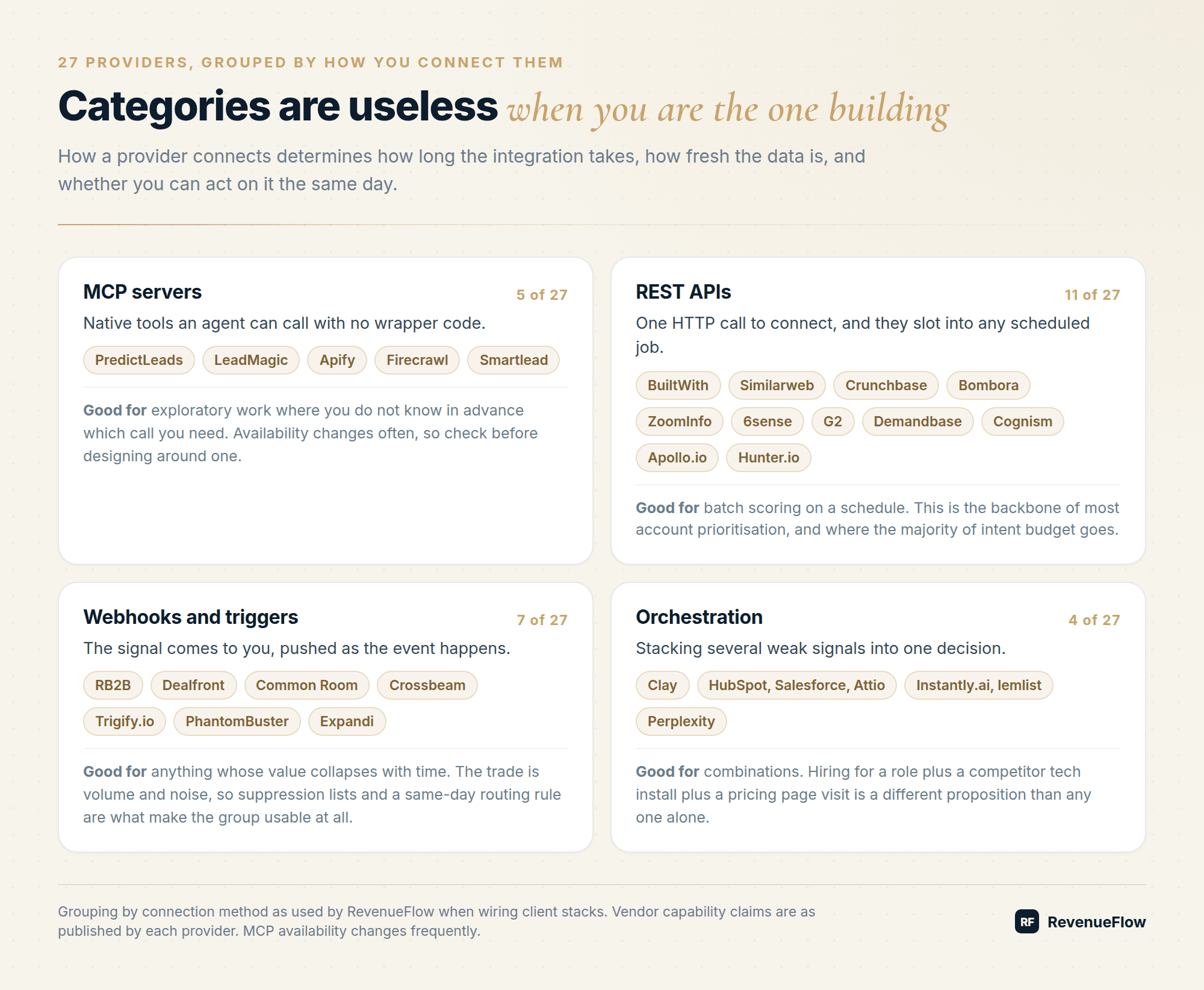
Intent signal providers divide into four groups by connection method: MCP servers an agent calls natively, REST APIs pulled on a schedule, webhooks that push events in real time, and orchestration layers that stack several signals into one score. Match the group to how fast the signal decays.
Key takeaways
- The 27 providers split into four connection groups: 5 MCP servers, 11 REST APIs, 7 webhook and trigger sources, and 4 orchestration layers.
- A nightly REST pull is by definition up to a day stale, which is fine for funding and hiring signals and too slow for a pricing page visit.
- Webhook sources such as RB2B, Dealfront and Trigify fire on every match including your own team and bots, so suppression lists are mandatory rather than optional.
- MCP-native tools including PredictLeads, LeadMagic, Apify, Firecrawl and Smartlead need no wrapper code, but server availability changes often and should be verified.
- Buy the intent API after the play exists: a signal you cannot act on within its useful window is a subscription to interesting information.
Reviewed and updated September 5, 2026
27 Intent Signal APIs, Grouped by How You Actually Connect Them
Stop reaching out to companies that are not buying.
That sentence is easy to agree with and hard to operationalise, because almost every list of intent data providers is organised by vendor category. Categories are useless when you are the one building. What you need to know first is how the thing connects, because that determines how long the integration takes, how fresh the data is, and whether you can act on it the same day.
So here are 27 providers grouped by connection method, which is how I actually think about them when wiring a client's stack.
MCP servers: native tools an agent can call
These expose a Model Context Protocol server, so Claude Code and similar agents call them like built-in tools with no wrapper code.
- PredictLeads. Hiring surges, funding rounds, tech installs, news.
- LeadMagic. Website visitor identification and B2B enrichment, pay-per-use.
- Apify. Scrapes any website into structured data. LinkedIn, job boards, review sites.
- Firecrawl. Crawls and extracts clean markdown from any page, built for model pipelines.
- Smartlead. Cold email campaign management from the terminal.
What these are good for: exploratory work where you do not know in advance which call you need, because an agent can compose them mid-task. Ask it to find companies hiring for a role, enrich them, and check their tech stack, and it chains three of these without you writing an integration. The caveat: MCP server availability changes often, so check before designing around one.
REST APIs: one curl command away
These take a single HTTP call to connect and slot into any scheduled job.
- BuiltWith. Detects what tech stack a company runs.
- Similarweb. Traffic and competitor analytics. Owler covers competitor alerts.
- Crunchbase. Funding rounds, investors, leadership changes.
- Bombora. Topic-level content consumption signals across 5,000+ B2B publishers, per the vendor.
- ZoomInfo. Over a billion buying signals monthly across 500M contacts, per the vendor.
- 6sense. Predictive buying stage detection.
- G2. Review site buying behaviour and category research.
- Demandbase. Account-level intent plus ABM orchestration.
- Cognism. Phone-verified contacts with GDPR compliance.
- Apollo.io. 240M+ contacts with email and phone data, per the vendor.
- Hunter.io. Email finder and verification API.
What these are good for: batch scoring. You run them on a schedule over a defined account list, write the result to a column, and sort. This is the backbone of most account prioritisation, and it is where the majority of intent budget goes.
The latency cost, which nobody mentions: a nightly pull is by definition up to a day stale. For funding rounds and tech installs that is irrelevant, because the signal stays valid for weeks. For a category-research spike on G2 or a topic surge on Bombora, a day is a meaningful share of the window in which the signal means anything. Match pull frequency to how fast the signal decays, not to your cron schedule.
Coverage differs sharply by geography and company-size band, and the marketing does not tell you where. We break down the biggest three in Clay vs Apollo vs ZoomInfo, and the wider field in data enrichment tools for SDR teams.
Webhooks and triggers: the signal comes to you
These push an event as it happens rather than waiting for you to ask.
- RB2B. Person-level website visitor identification.
- Dealfront. European-focused visitor identification and prospecting.
- Common Room. Unified community, product, and social signals.
- Crossbeam. Partner overlap and co-selling data.
- Trigify.io. Real-time LinkedIn engagement monitoring.
- PhantomBuster. LinkedIn data extraction and engagement automation.
- Expandi. LinkedIn outreach with engagement tracking.
What these are good for: anything where the value collapses with time. Someone reading your pricing page is worth contacting today and close to worthless in a fortnight. This is the group that justifies building real-time routing, and it is the only group where the latency argument genuinely earns the extra engineering.
The trade is volume and noise. A webhook fires on every match, including your own team, your existing customers, and bots. Suppression lists and a same-day routing rule are not optional here, they are what makes the group usable at all. Background on the mechanics is in website visitor identification and our RB2B review and alternatives.
Orchestration: stacking multiple signals
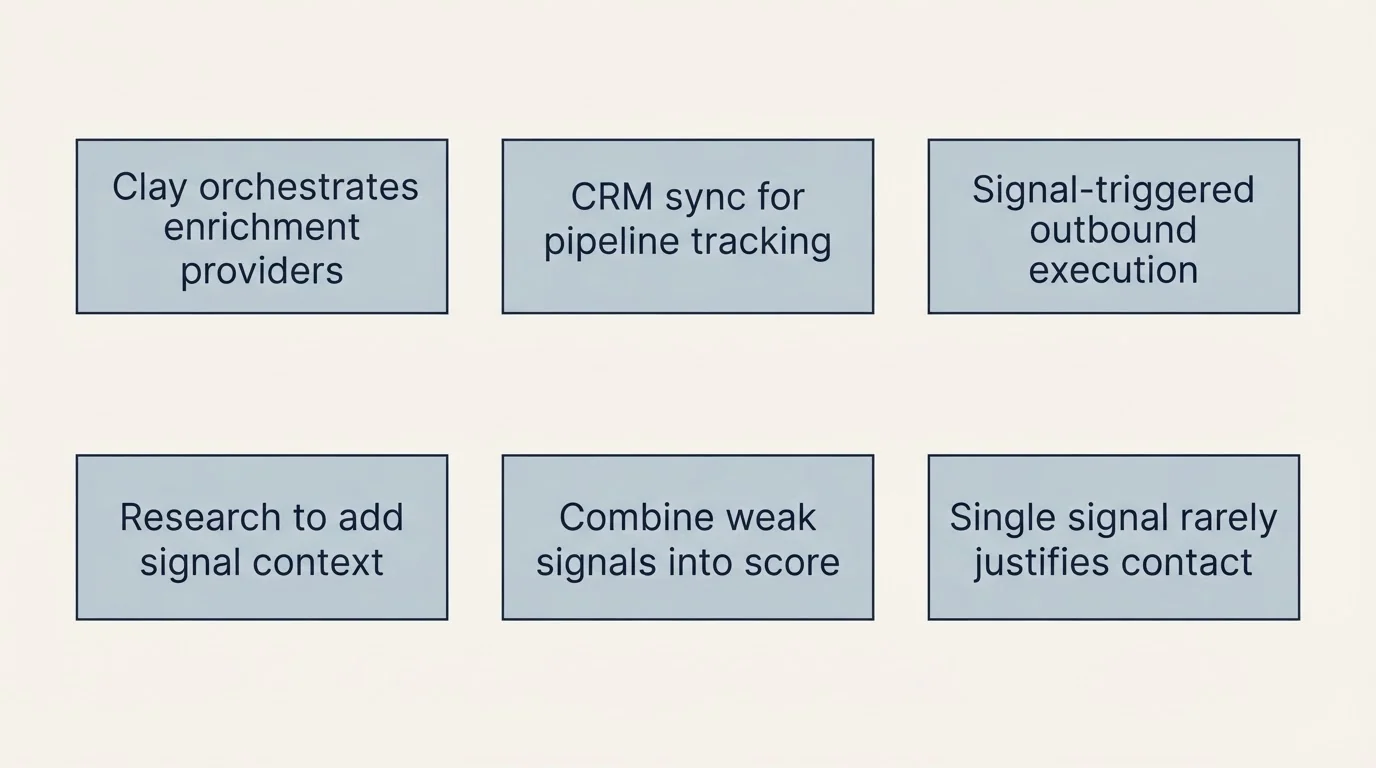
- Clay. 100+ enrichment providers in one workflow.
- HubSpot, Salesforce, Attio. CRM sync for signal-to-pipeline tracking.
- Instantly.ai, lemlist. Signal-triggered outbound execution.
- Perplexity. Research to enrich any signal with context.
What these are good for: turning several weak signals into one decision. A single signal is almost never enough to justify contact. Hiring for a role plus a competitor tech install plus a pricing page visit is a different proposition than any one alone, and orchestration is where that combination becomes a score you can sort on.
The cost trap
Intent data is the easiest line item in a GTM budget to overspend on, and the mechanism is always the same: the data is bought before the play exists.
The sequence that wastes money: buy an intent product, get a dashboard of surging accounts, look at it weekly, feel informed, book nothing. The sequence that works: define one play with a written trigger and a written first message, run it manually against a handful of accounts, then buy the API that automates the trigger you have already proven.
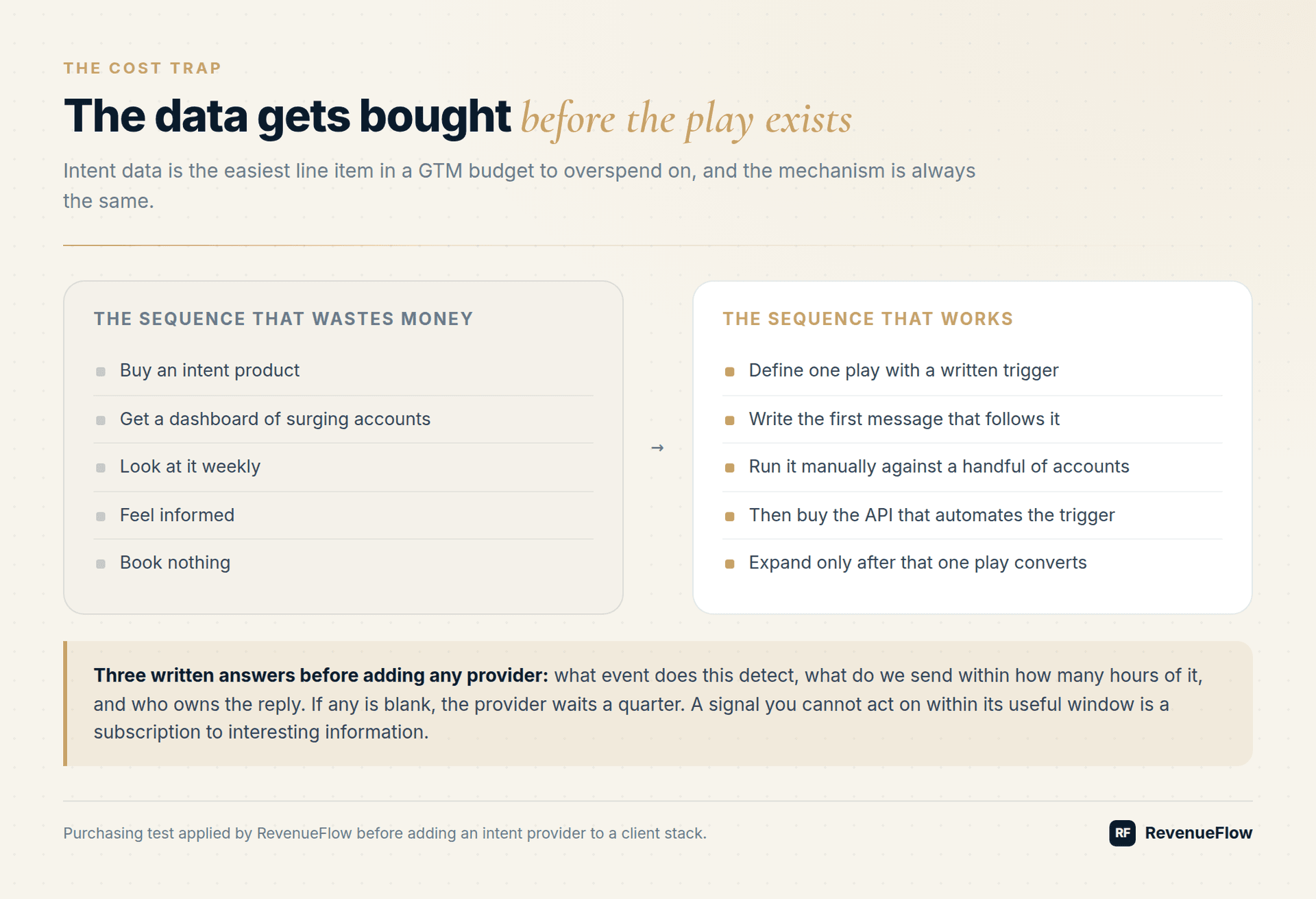
A signal you cannot act on within its useful window is a subscription to interesting information. Before adding a provider I want written answers to three questions: what event does this detect, what do we send within how many hours of it, and who owns the reply. If any is blank, the provider waits a quarter.
The manual work required to action an insight is the hidden cost in that sequence, and it is the reason a provider should wait until the play exists: an insight nobody has time to act on is indistinguishable from one you never bought.
Intent narrows a list you have already defined and cannot rescue one defined badly, which is why the ICP work comes before any of this. For category background, see the B2B intent data guide.
How to choose between the four groups
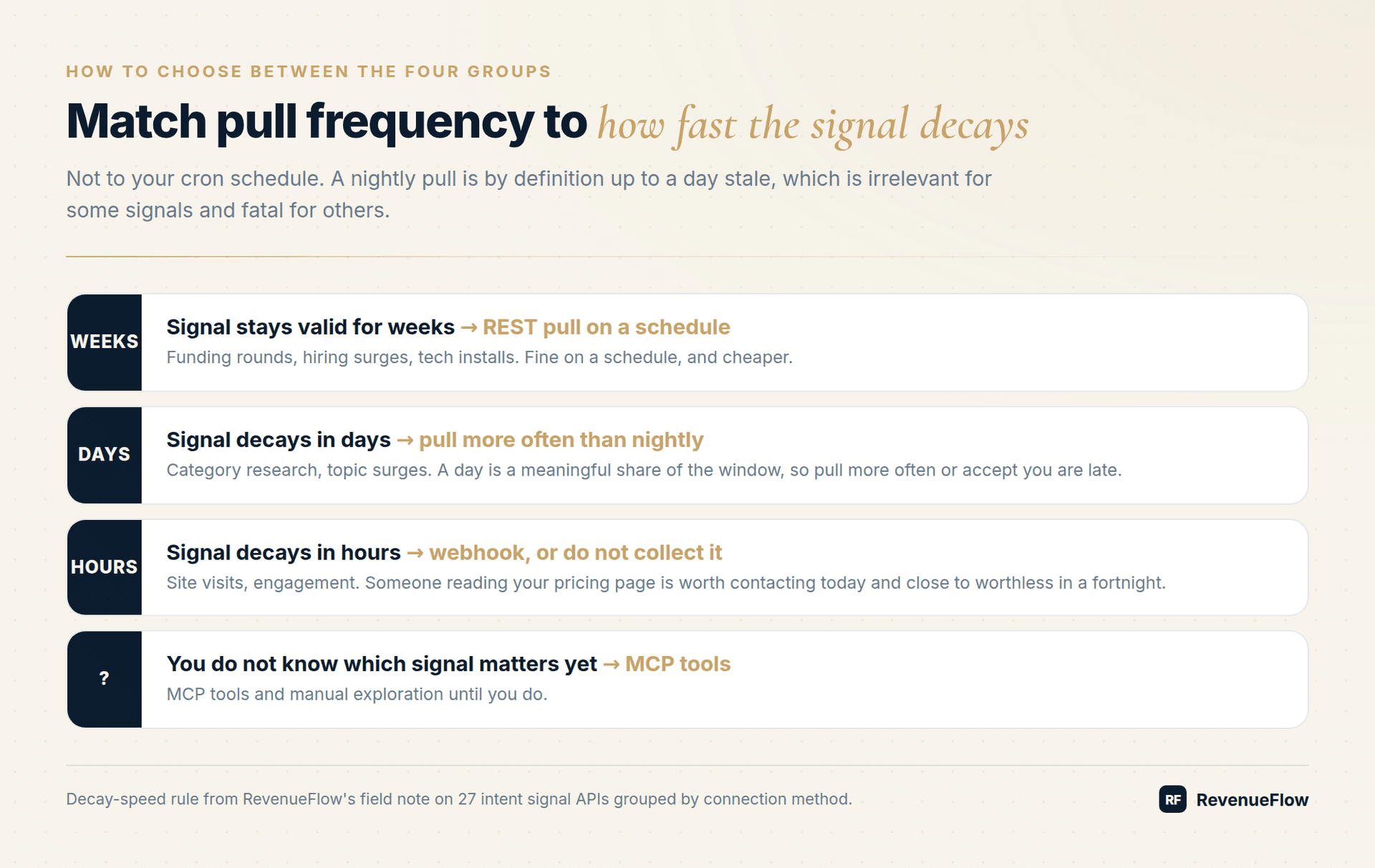
The rule I use is decay speed:
- Signal stays valid for weeks (funding, hiring, tech install): a REST pull on a schedule is fine and cheaper.
- Signal decays in days (category research, topic surge): pull more often than nightly, or accept you are late.
- Signal decays in hours (site visit, engagement): webhook, or do not bother collecting it.
- You do not know which signal matters yet: MCP tools and manual exploration until you do.
Ben's parallel piece on which APIs survive automation is the companion to this one: the 18 APIs that actually help you sign clients, plus the fuller 22-API outbound stack.
Frequently Asked Questions
What is the difference between an intent data API and a webhook provider?
An API is pulled on your schedule, so the data is as fresh as your last request, and a nightly job is by definition up to a day stale. A webhook pushes the event as it happens. Use pulls for slow-decaying signals like funding and hiring, and webhooks for signals that lose value within hours, like a pricing page visit.
Which intent signals are worth paying for first?
The ones that precede a purchase in your specific market and that you can act on the same week. Hiring surges and funding rounds are unambiguous events with clear timing. Category research on a review site is high quality because the person is already comparing vendors. Start with one, prove a play, then expand.
How much intent data does a small team actually need?
Usually one source, applied to an account list that is already well defined. The common failure is buying several providers before a single play exists that acts on a signal within its useful window. If nobody owns the reply and there is no written trigger, more data will not produce more meetings.
Can Claude Code call these intent APIs directly?
The five MCP-native tools listed here connect as native agent tools with no wrapper code. The REST group takes roughly one HTTP call each to integrate. MCP server availability changes frequently across vendors, so verify current support rather than assuming it from a list.
What does person-level visitor identification add over account-level intent?
Account-level intent tells you a company is researching a topic. Person-level identification names the individual on your site, which turns a prioritisation signal into a contactable one. It also carries more noise, since it fires on your own team, existing customers, and bots, so suppression lists matter more here than anywhere else.
RevenueFlow builds AI-native pipeline systems and you pay per qualified meeting, not a retainer. No paying for activity. You only pay when we book you a qualified sales meeting. See if you qualify.
Frequently asked questions.
Frequently asked questions- What is the difference between an intent data API and a webhook provider?
- An API is pulled on your schedule, so the data is only as fresh as your last request and a nightly job is up to a day stale. A webhook pushes the event as it happens. Use pulls for slow-decaying signals like funding and hiring, and webhooks for signals that lose value within hours, such as a pricing page visit.
- Which intent signals are worth paying for first?
- The ones that precede a purchase in your specific market and that you can act on the same week. Hiring surges and funding rounds are unambiguous events with clear timing. Category research on a review site is high quality because the person is already comparing vendors. Start with one, prove a play, then expand.
- How much intent data does a small team actually need?
- Usually one source, applied to an account list that is already well defined. The common failure is buying several providers before a single play exists that acts on a signal within its useful window. If nobody owns the reply and there is no written trigger, more data will not produce more meetings.
- Can Claude Code call these intent APIs directly?
- The five MCP-native tools listed here connect as native agent tools with no wrapper code, so an agent can chain them mid-task. The REST group takes roughly one HTTP call each to integrate. MCP server availability changes frequently across vendors, so verify current support rather than assuming it.
- What does person-level visitor identification add over account-level intent?
- Account-level intent tells you a company is researching a topic. Person-level identification names the individual on your site, which turns a prioritisation signal into a contactable one. It also carries more noise, since it fires on your own team, existing customers and bots, so suppression matters more here than anywhere else.
About the author.

Hosun Chung is COO at RevenueFlow, which builds and operates outbound revenue engines for B2B companies. Previously at Gleacher Shacklock LLP. Studied at London School of Economics.
Hosun Chung · COO
Connect on LinkedIn →Explore more.
Ready to scale your outreach?
We build GTM engines that book real meetings. See the receipts.
Related articles.
ZoomInfo Renamed Its Ticker to GTM. It Now Trades Under $1B
ZoomInfo took the ticker GTM in May 2025. By late July 2026 it traded under $1B. Here is what the GTM software category is actually worth, with dates attached.
48 RevOps Rules Every Operator Should Know
All 48 RevOps rules across data, pipeline, forecasting, comp, reporting and alignment, with the reasoning behind the ones operators actually argue about.
1.4K to 32K Followers: The Distribution Playbook
A client went from 1.4K to 32K+ followers in 5.5 months and 36.5M impressions. The three-phase distribution playbook, the cadence, and what the numbers omit.
ARR Became a Marketing Metric: How to Vet the Claim
Cluely retracted $7M and admitted to $5.2M. Decagon is valued at 128 times revenue. Here are the six questions that separate real revenue from a headline.
The Tel Aviv AI Map: 24 Companies and a $32B Exit
Google closed a $32B acquisition in Tel Aviv and 23 more AI companies sit within 3km. The map, the exit velocity behind it, and what it means for your stack.
We Burned $430K on Go-To-Market. Here Is What Survived
In 2025 we spent more than $430K testing go-to-market plays. Six survived. Here is what the money bought, what it did not, and what I would do differently.