RB2B Review and Alternatives: Person-Level Visitor ID
RB2B returns the name of a person who visited your site, not just the company. Verified pricing, real match rates, the US-only constraint and four alternatives.
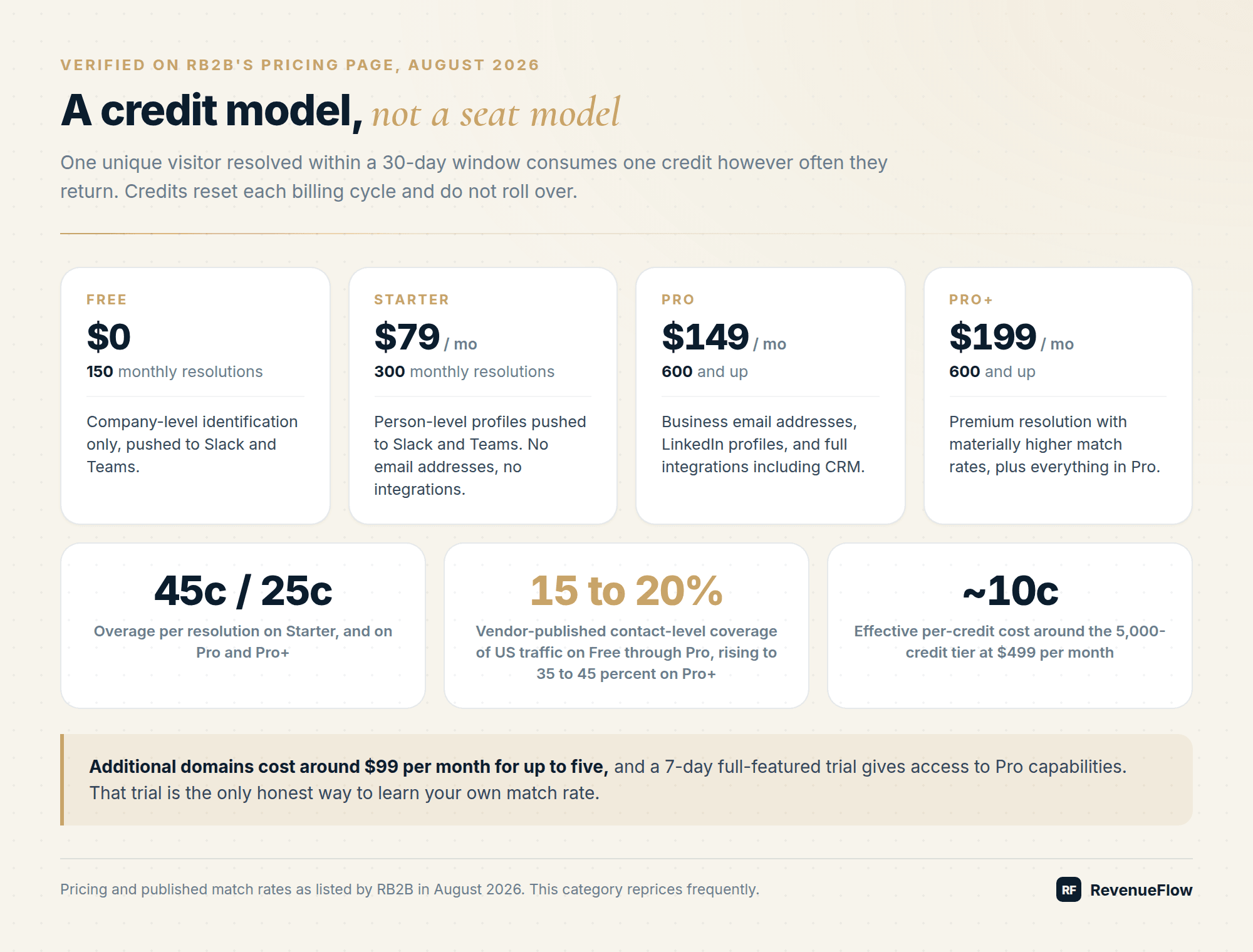
RB2B pricing, from its own page: Free at $0 for 150 company-level resolutions a month, Starter at $79 for 300, Pro from $149 for 600 with business emails and integrations, and Pro+ from $199 for 600 with premium resolution. Each unique visitor uses one credit per 30 days, and credits do not roll over.
Key takeaways
- RB2B's pricing page lists Free at $0, Starter at $79, Pro from $149 and Pro+ from $199 a month, with no annual billing switch.
- Pro climbs to 2,500 resolutions at $349 and Pro+ reaches 5,000 at $499, about 10 cents a resolution; overage is 45 cents on Starter and 25 on Pro.
- RB2B's help centre says every identified visitor, company-level included, uses one credit per 30 days whether or not it fits your ICP.
- RB2B's pricing page and its own support article publish different coverage figures, so only a trial on your own traffic answers how accurate it is.
Reviewed and updated September 19, 2026
RB2B does one thing that most of the visitor-identification category does not: it returns the name of a person who visited your website, not just the company, and it pushes that person into Slack within minutes. That single capability explains both its adoption and its pricing, because person-level resolution is why the product is US-only in practice and why it is priced per resolution rather than per seat.
This is a review of what you actually get at each tier, where it breaks, and which alternatives fit the cases it does not.
What RB2B does
You install a script on your site. When a visitor arrives, RB2B attempts to resolve them against an identity graph and returns, at the higher tiers, a named individual with their LinkedIn profile and a business email address. Results push to Slack, or on Starter to Slack or Teams, and on Pro and Pro+ into your CRM and other tools.
The mechanism is a data co-op. Participating sites contribute hashed identifiers captured when users log in or submit forms; those hashes attach to a device or browser signature; when that signature reappears on your site, RB2B resolves it. Coverage is therefore a function of how much of the co-op your visitor has previously touched, which is precisely why US B2B traffic resolves well and non-US traffic largely does not. The mechanics of the wider category are covered in our website visitor identification guide.
RB2B pricing: what each plan costs
RB2B's pricing page lists four plans: Free at $0 with 150 monthly resolutions of company-level identification, Starter at $79 for 300, Pro from $149 for 600 with business emails and integrations, and Pro+ from $199 for 600 with premium resolution. Pro's menu climbs to 2,500 resolutions at $349 and Pro+ to 5,000 at $499 and far beyond. There is no annual billing switch.
| Plan | Monthly | Monthly resolutions | What unlocks |
|---|---|---|---|
| Free | $0 | 150 | Company-level identification only, pushed to Slack |
| Starter | $79 | 300 | LinkedIn URLs pushed to Slack or Teams, no email addresses, no other integrations |
| Pro | from $149 | 600, 1,250 or 2,500 | Business email addresses and all other integrations, including HubSpot and Salesforce CRM |
| Pro+ | from $199 | 600 up to 2,500,000 | Premium resolution, plus everything in Pro |
How the credits work, from RB2B's own help centre:
- One credit per unique visitor per 30 days. A visitor identified in that window uses one credit however often they return, and that applies to company-level identifications as well as person-level ones, so a resolution that only names the visitor's company spends a credit too.
- Credits refresh each billing cycle and do not roll over. Every identified visitor uses a credit whether or not it fits your ICP; restricting low-intent URLs such as careers or blog pages is the lever RB2B names for saving them.
- At the cap, tracking stops. The script is disabled until you add overage credits, upgrade or wait for the reset, and visitors during the pause cannot be identified afterwards. Overages run at 45 cents per resolution on Starter and 25 cents on Pro and Pro+.
- Additional domains cost $99 a month for up to five on Pro and Pro+.
- The trial. The pricing page says to try the Pro plan free for 7 days; RB2B's support article says new accounts get a 7-day trial of Pro+ with no payment details. Either way, it is the only honest way to learn your own match rate.
The pricing page also runs a banner reading "RB2B + DEMANDBASE = 70-80% RESOLUTION", and its Pro+ menu extends to 2,500,000 monthly resolutions.
How accurate is RB2B?
RB2B publishes its coverage in two places, and they do not agree. The pricing page shows no contact-level identification on Free, 15-20% contact-level coverage on US traffic for Starter and Pro, and 35-45% on Pro+, with company-level coverage at 15-20% below Pro+. RB2B's own support article, updated this week, says Starter and Pro reach roughly 30 to 40% in total and Pro+ averages 70 to 80%.
| Plan | Pricing page | Support article |
|---|---|---|
| Free | No contact-level ID; company-level 15-20% | Company-level only, about 15 to 20% of traffic |
| Starter | Contact-level (US) 15-20% | Roughly 30 to 40% in total |
| Pro | Contact-level (US) 15-20% | Roughly 30 to 40% in total |
| Pro+ | Contact-level (US) 35-45% | Average 70 to 80% |
Both are averages the vendor states about itself. The number that matters is the one your own trial produces on your own traffic.
The number that decides whether it is worth it
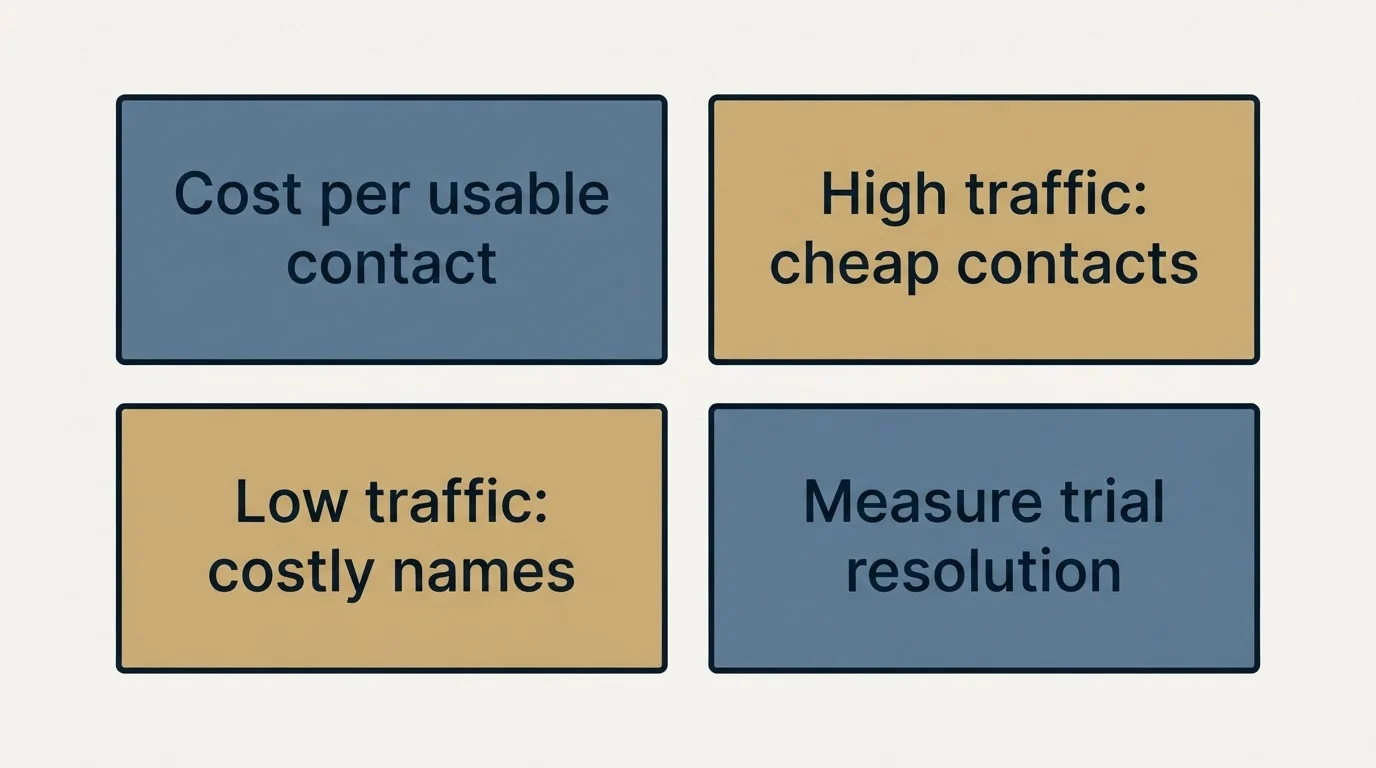
Do not compare monthly prices. Compare cost per usable, ICP-fit contact.
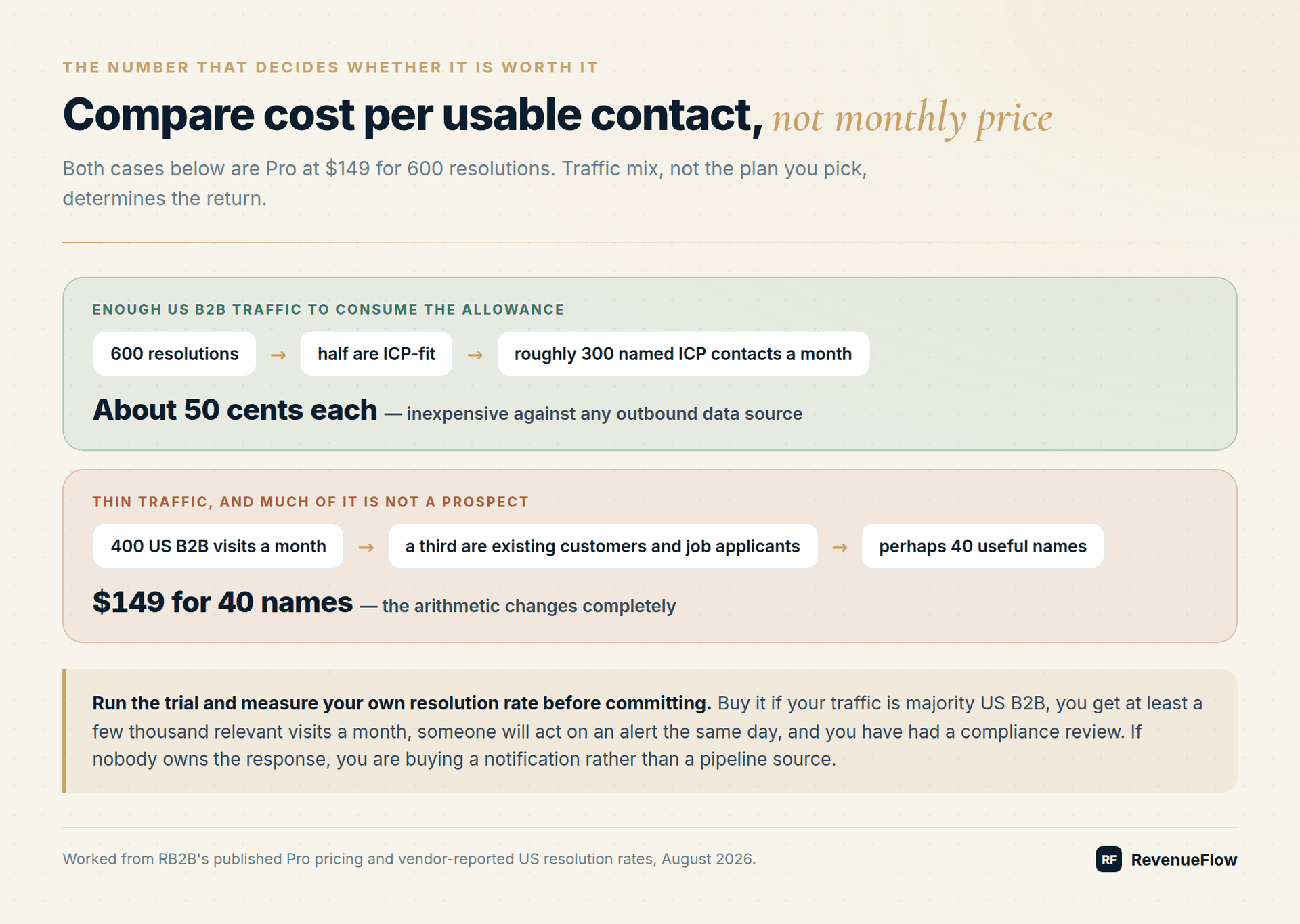
Take Pro at $149 for 600 resolutions, with invented but ordinary inputs: if half of what resolves is ICP-fit, 600 credits buys you roughly 300 named ICP contacts a month at about 50 cents each, assuming your traffic volume is high enough to consume the allowance and few credits go on company-only resolutions. The arithmetic is illustrative. That is inexpensive against any outbound data source. If instead your site gets 400 US B2B visits a month and a third of those are existing customers and job applicants, you are paying $149 for perhaps 40 useful names, and the arithmetic changes completely.
Run the trial and measure your own resolution rate before committing. Traffic mix, not the plan you pick, determines the return.
Honest limitations
Person-level is US-only in practice. The identity graph does not have the coverage outside the US, and GDPR plus ePrivacy make consent-free person-level de-anonymisation extremely difficult to justify in the EU and UK regardless. If your buyers are European, this product is not for you and you want a company-level tool instead.
Compliance is your exposure, not the vendor's. The active US risk in 2026 is state wiretapping and session-tracking litigation, including claims under the California Invasion of Privacy Act, alongside state privacy statutes. Get a privacy policy disclosure, a properly configured consent banner, honouring of global privacy control signals, and geographic gating reviewed by counsel before you deploy the pixel.
A resolved visitor is not a buyer. Competitors, job seekers, students, and your own contractors all resolve. Filter to ICP fit before anything reaches a human.
The Slack firehose becomes wallpaper. This is the most common failure mode by far. Route on page and fit, not on every visit, and suppress everything below threshold.
Teams that route these resolved-visitor alerts into a sales engagement platform should read the Salesloft review and testing guide before trusting vendor review scores.
Person-level resolution is probabilistic. Shared devices and stale graph entries produce a confident, wrong name. Never reference the visit itself in outreach, both because it is creepy and because you will occasionally be wrong.
Credits expire monthly and overages are real money. A traffic spike from a launch or a press mention can burn a month's allowance in two days at 45 cents a head on Starter, and at the cap the tracking script stops until you pay for more or the cycle resets.
The LeadIQ credit pricing breakdown shows how spending an email versus a phone number diverges sharply, tying the plan choice to CRM hygiene rather than credit volume.
No off-site intent layer. RB2B tags hot pages and hot leads on your own site (its pricing page lists Hot Pages for high-intent tagging and Hot Leads for ICP filtering, which come after a visitor has been resolved and the credit spent), and tells you who arrived. It does not tell you what they are researching elsewhere. That is a different purchase, and our B2B intent data guide covers whether you need it.
Alternatives
| Tool | Resolution | Priced from, on its own page | Choose it when |
|---|---|---|---|
| RB2B | Person-level, US only; company-level global | Free plan; paid from $79 a month | US B2B traffic, small budget, Slack-first workflow |
| Vector | Site de-anonymization within an ABM platform | A flat platform fee plus credits; its calculator's default example shows $3,000 a month | You want identified accounts to feed ads and ABM, not just outbound |
| Warmly | Contacts and companies, with chat and orchestration | AI Web-Deanonymization from $10,000 a year billed annually, or $4,875 a quarter | You want alerts, chat and follow-up bundled rather than assembled |
| Leadfeeder | Company-level, with contacts from its Activate plan | Free Lite plan; Discover from €79 a month billed annually | EU and UK traffic, or a company-level ABM motion |
| Clearbit | Visitor intent now inside HubSpot's Breeze Intelligence | A paid HubSpot subscription | You already run HubSpot |
Three notes on that table. Clearbit is now part of HubSpot: Clearbit's own blog says its free tools, including the Weekly Visitor Report, were sunset and that Breeze Intelligence's buyer intent feature offers the website visitor intent data those users were accustomed to, and HubSpot's knowledge base lists data enrichment on paid Starter, Professional and Enterprise subscriptions. Replacements are covered in best Clearbit alternatives. Leadfeeder serves euros here: its pricing page, which now says Dealfront is Leadfeeder, lists a free Lite plan and Discover from €79 a month billed annually. And Vector versus RB2B is a workflow question rather than a data question: Vector's page describes a platform fee plus credits for tracked accounts, site traffic, signals and actions, so if your response to an identified visitor is an ad impression, Vector's activation is what you are paying for; if it is a human reaching out, RB2B plus your own outreach is cheaper.
The vendor missing from that table is the one that publishes no figure at all, and the field of Lead Forensics alternatives sorts by which vendors print a volume band you can read before a sales call.
Who should buy RB2B
Buy it if your traffic is majority US B2B, you get at least a few thousand relevant visits a month, someone will act on an alert the same day, and you have had a compliance review.
Do not buy it if your buyers are in Europe, your traffic is under a few hundred relevant visits a month, or nobody owns the response. In the last case you are buying a notification, not a pipeline source.
Making it produce pipeline
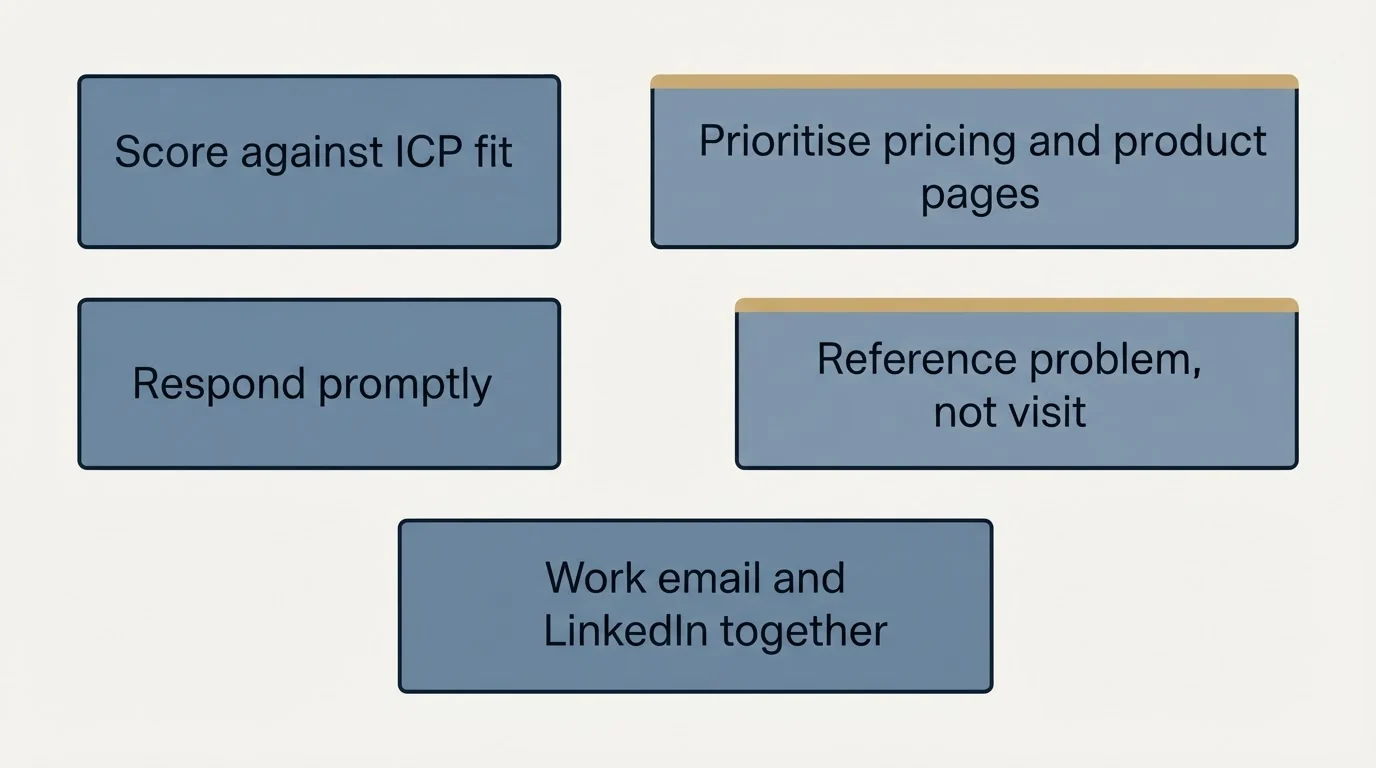
The tool is the cheap part. The motion is what converts.
- Score every resolution against ICP fit automatically and drop the rest before Slack sees them.
- Weight by page. Pricing and product pages route to a human; blog and careers pages do not.
- Respond inside 24 hours. The signal is perishable and its whole value is timing.
- Reference the problem, never the visit.
- Run the account across email and LinkedIn simultaneously rather than sequentially, using the patterns in the outbound sales playbook. If LinkedIn is the primary channel for that segment, the multi-sender approach in our HeyReach review is how to run it at volume.
Verdict
RB2B is the most accessible person-level visitor identification product on the market, and at $79 to $199 a month it is priced where a small team can actually test it. Its constraints are structural rather than fixable: US-only coverage, probabilistic resolution, credit expiry, and a compliance burden that sits with you. Buy it for US B2B traffic with a same-day response motion behind it. Buy a company-level tool instead if your market is European.
If the missing piece is the motion rather than the data, get a free campaign plan and we will build the campaign that runs when a named account shows up.
Frequently asked questions.
Frequently asked questions- How much does RB2B cost?
- RB2B's pricing page lists a Free plan at $0 with 150 monthly resolutions, Starter at $79 for 300, Pro from $149 for 600 and Pro+ from $199 for 600. Pro's menu goes to 2,500 resolutions at $349 and Pro+ to 5,000 at $499 and beyond. Overages cost 45 cents per resolution on Starter and 25 cents on Pro and Pro+.
- How accurate is RB2B?
- RB2B states its coverage in two places that disagree. The pricing page shows 15-20% contact-level coverage on US traffic for Starter and Pro and 35-45% on Pro+, while its support article says roughly 30 to 40% in total for Starter and Pro and 70 to 80% on Pro+. Measure your own rate during the 7-day trial.
- Does RB2B charge for every visitor?
- For every identified one. RB2B's credit article says each unique visitor identified within a 30-day period uses one credit, company-level identifications included, and that it does not filter by ICP before spending the credit. Credits refresh each billing cycle and do not roll over, and at the cap the tracking script pauses.
- What are the best RB2B alternatives?
- It depends on the job. Leadfeeder suits company-level identification, especially for European traffic, from a free Lite plan. Warmly bundles visitor identification with chat and follow-up from $10,000 a year billed annually. Vector prices a platform fee plus credits for ABM and ads. Clearbit's visitor intent now lives inside HubSpot's paid plans.
About the author.

B2B cold email experts helping companies generate qualified leads through done-for-you outreach campaigns.
RevenueFlow Team
Explore more.
Ready to scale your outreach?
We build GTM engines that book real meetings. See the receipts.
Related articles.
Is Clay Free? The Free Plan, the Trial and Where Each Stops
Clay's free plan, its 14-day trial and the no-charge-on-a-miss rule are three different things. What each holds and where it stops, from clay.com on 19 September 2026.
Seamless.AI Email Finder: How It Works, What a Credit Buys
How Seamless.AI's email finder resolves a contact in real time, what one Universal Credit buys, the Total AI score on every address, and what the Chrome extension reads.
Social Selling Tools by Job, and the Account-Risk Line
Fourteen social selling tools sorted into six jobs, split by whether each acts through your LinkedIn account or beside it, from the vendors' own pages.
Video Prospecting Tools by Job: What Each One Is For
Ten video prospecting tools sorted by the job each vendor's own page describes: record and share, personalise at volume, avatars, hosting and interactive demos.
Snitcher Pricing: The $49 Table Is the Annual Rate
Snitcher's visible price table is the annual-billing ladder. The ten bands at both billing states, the unique-company meter, and the rules on a help page.
LeadIQ Salesforce Integration: What Syncs, What Blocks It
How LeadIQ's Salesforce integration works, from LeadIQ's own help centre: per-user OAuth, Lead or Contact, domain matching, duplicates, API calls and plan gates.