Gong Engage vs Salesloft Cadence: How They Differ
Gong Engage and Salesloft Cadence compared from each vendor's own pages: where each starts, six jobs side by side, and what the pricing pages disclose.
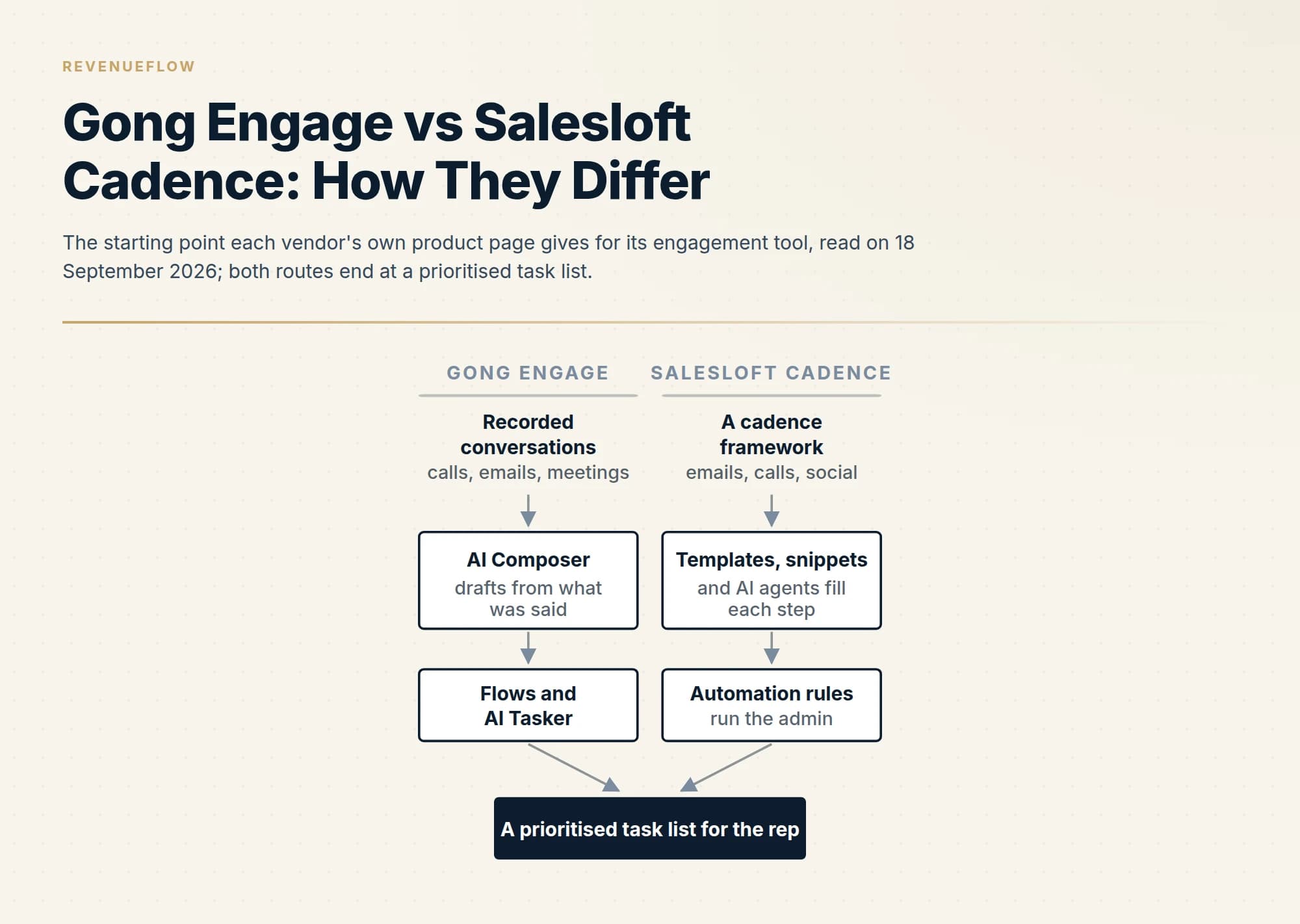
Gong Engage and Salesloft Cadence do the same engagement jobs from opposite starting points. As read on 18 September 2026, Gong's page builds outreach from recorded conversations and relies on named partners for scheduling and power dialing, while Salesloft's builds from cadence frameworks with its own meetings, dialer and mobile features. Neither vendor publishes a price.
Key takeaways
- Gong's product page describes Engage as turning recorded customer conversations into outreach, with AI Composer, Flows, AI Tasker, a dialer and Gong Anywhere.
- Salesloft's page defines a cadence as a structured sequence of touchpoints and lists its own dialer, Salesloft Meetings, automation rules and a mobile app.
- Gong's pricing page prints no figure and states a per-user licence plus a platform fee; Salesloft's pricing address redirected to Talk to Sales on 18 September 2026.
- Each product is one module of a larger suite, so the real comparison is usually an add-on to a system you own against a new platform.
Reviewed and updated September 18, 2026
Most comparisons of Gong and Salesloft set a call recorder beside a sequencer and declare them complementary. That was a fair reading when Gong only listened. It stopped being one when Gong started selling its own engagement product, because a team that already pays for Gong now faces a sharper decision at renewal, which is whether Gong Engage replaces the Salesloft seats or sits beside them.
The like-for-like comparison is Gong Engage against Salesloft's Cadence product, and neither vendor makes it easy, since both describe their product as a platform and neither publishes a price. This page reads what each vendor's own product and pricing pages said on 18 September 2026, lines the two up on the jobs an engagement tool has to do, and says plainly where the pages are silent. Our wider Gong vs Salesloft comparison covers the two companies as whole platforms. This one stays inside the engagement product.
Where each product starts
The clearest difference is the raw material each product begins from, and both vendors state it in their own first paragraph.
Gong's page is titled "AI Sales Engagement Software | Gong Engage (Email, Dialer & Workflows)" and its opening claim is that "Gong Engage is the only sales engagement solution that transforms customer conversations into personalized outreach and next-best action, powered by the Gong Revenue AI OS." Set the word only aside, since that is a vendor describing itself, and the structure of the claim is still informative: the input is recorded conversations, and the output is outreach. The page says of its email drafting agent, AI Composer, that "It pulls real context from your customer conversations to write messages that resonate."
Salesloft's page is headed "Sales Engagement Software To Power Pipeline" and carries a Cadence badge above it. Its starting point is the framework rather than the recording. The page promises "proven-to-win frameworks", says that "Multi-channel Cadences meet buyers where they are", and defines the unit of work in its own FAQ: "A sales cadence is a structured sequence of touchpoints", which it lists as emails, calls and social messages.
So one product starts from what was said on calls and works outward to the next message. The other starts from a designed schedule of touches and fills each step. Both end at the same place, a rep with a prioritised list of things to send and people to ring, and the route there decides which team each one suits.
The jobs, read from each vendor's own page
An engagement tool has to do six things: draft the message, schedule the touches, place the calls, book the meeting, keep the CRM current, and work where the rep already is. Here is what each product page says about each, and where it says nothing.
Drafting. Gong names an agent, AI Composer, and ties it to conversation data. Salesloft says "AI agents draft emails using real buyer data" and adds customizable templates and snippets, plus a library of cadence templates that its FAQ describes as "built from proven prospecting frameworks".
Scheduling the touches. Gong's product tabs name the feature Flows, and a second tab, AI Tasker, builds the rep's to-do list. Salesloft's noun is the cadence, with steps a rep can sort by channel, time zone and account.
Calling. Both list a dialer. Gong's page has a Dialer tab, and the FAQ on the same page lists the power dialer Nooks as an integration, with Orum described as coming soon. Salesloft's page says reps can "Call or text buyers from anywhere" with its own dialer, "or seamlessly connect your preferred third-party dialer."
Booking. Salesloft sells this as its own feature: "Salesloft Meetings integrates your calendar with your outbound communications, so buyers can schedule time with you directly from emails." Gong's page names no scheduling feature of its own. Its FAQ lists Chili Piper and Calendly as scheduling integrations embedded in flows and in the email composer.
Keeping the CRM current. Gong's FAQ describes a bi-directional sync with Salesforce, HubSpot and Microsoft Dynamics 365. Salesloft's engagement page talks about automation rules and data enrichment and does not name its CRM connectors on that page, which is a statement about one page rather than about the product.
Working where the rep is. Gong's tab is called Gong Anywhere, and its FAQ says the Salesforce version lets reps view contact details, trigger flows, send emails and make calls without leaving the CRM. Salesloft's answer on its page is a mobile app: "Run any Cadence step and manage your day-to-day operations at any time, from any place with our mobile app."
| Job | Gong Engage page | Salesloft Cadence page |
|---|---|---|
| Draft the message | AI Composer, drawing on recorded conversations | AI agents, templates and snippets |
| Schedule the touches | Flows, with AI Tasker for the to-do list | Cadences, sortable by channel, time zone and account |
| Call | Dialer tab; Nooks integration listed | Own dialer, or a third-party dialer |
| Book the meeting | Chili Piper and Calendly integrations | Salesloft Meetings |
| Keep the CRM current | Two-way sync with Salesforce, HubSpot, Dynamics 365 | Not stated on this page |
| Work where the rep is | Gong Anywhere inside Salesforce | Mobile app |
Read across the rows and the pattern from the first section holds. Gong fills gaps by integrating: scheduling, power dialing and contact data all arrive through partners, with ZoomInfo and LeadIQ named in its FAQ as the providers that can add contacts straight into flows. Salesloft fills more of the rows with its own features. Neither approach is better in the abstract. One gives you fewer vendors, the other gives you the engagement layer inside the system that already holds your call recordings.
Each one is a module of something larger
Neither product is sold as a standalone tool in any way the public pages reveal, and the navigation on each site shows what it sits inside.
Gong's footer lists Gong Engage beside Gong Forecast, Gong Enable, Gong Revenue Graph and Gong AI. How those pieces fit is the subject of our guide to Gong as a sales tool.
Salesloft's navigation lists Cadence beside Conversation Intelligence, Deals, Inspect, Revenue Cadences, Rhythm, Signals and Analytics, and it also lists Clari Forecast. The login menu on the same page offers separate sign-ins for Salesloft, Clari Forecast, Conversations, Drift and Groove. That is what the navigation showed on 18 September 2026. This page draws no conclusion about corporate structure from a menu, and you should ask the vendor directly which of those products a Cadence contract includes. Rhythm, the prioritisation layer that sits on top of cadences, has its own explainer in Salesloft Rhythm.
The practical consequence is that the comparison you are really making is rarely Engage against Cadence in isolation. It is the second module of one suite against the first module of the other. A team whose system of record for customer conversations is already Gong is comparing an add-on with a new platform. A team that runs Salesloft and records calls elsewhere is making the mirror-image choice.
Pricing: neither page carries a number
Gong's pricing page, as published on 18 September 2026, prints no price. What it does publish is the model, in three lines: "Licenses are priced per user", "There is a platform fee based on the number of users supported", and "You can integrate your existing tech stack for free." Below that sits a form whose first question is team size, in four bands: 1 to 50, 51 to 1,000, 1,001 to 9,999, and 10,000 or more. The page does not say whether Engage is a separate licence from the core product, which is the first thing to ask. Our Gong pricing guide works through the platform-fee-plus-seats structure in more depth.
Salesloft publishes less. There is no pricing link in its navigation, and on 18 September 2026 the addresses salesloft.com/pricing and salesloft.com/plans both redirected to a page titled Talk to Sales. No pricing model, seat minimum or package name appears on the engagement page or the homepage as fetched that day. That is an absence in the pages read, which were the homepage, the engagement product page, the newsroom index and the two redirects, rather than proof that no public figure exists anywhere. The Salesloft pricing guide covers what can be established and how to approach the quote.
With no number on either side, the useful comparison is the shape of the bill. Gong tells you there are two lines, a fixed platform fee and a per-user licence, so the question is what the platform fee is before any seats and whether Engage seats are priced differently from recording seats. Salesloft tells you nothing in public, so every term is a question: which products are in the package, what the minimum seat count is, and how long the term runs.
A note on sequences, since both products are built around them
Flows and cadences are both multi-step schedules: message one, a wait, message two, a call task, and so on. Both vendors present that schedule as the core of the product, and most of the industry runs outbound that way.
We do not, and it is worth being clear that this is our documented policy rather than a finding about either tool. RevenueFlow sends one message per campaign, with no bumps and no thread replies, and a later approach to the same person is a new campaign with a new reason. We run our sending on Email Bison and in-house tooling, and we use neither Gong Engage nor Salesloft. If you adopt either product, the step count is a setting you control, and nothing on either vendor's page obliges you to run five touches because the template library ships with them.
Which one fits which team
Three questions sort the decision, and none of them is a feature question.
Where do your call recordings live today? If the answer is Gong, Engage works from data you already own and the evaluation is whether its integration-led approach to scheduling, dialing and contact data covers your workflow. If the answer is anywhere else, Engage's central advantage, drafting from your own conversations, arrives only after you move the recordings too.
Who designs your outreach? A team with an enablement function that writes frameworks and wants reps to follow them is describing Salesloft's model, where the cadence is the governed object. A team that wants each rep's next message shaped by the last call is describing Gong's.
How many vendors are you willing to manage? Gong's page leans on partners for scheduling, power dialing and contact data. Salesloft's page covers more of the six jobs with its own features. Count the contracts on each side before comparing the quotes.
- Yes: Is the engagement product a separate licence, and what is the platform fee before any seats?
- Yes: Which modules named in the site navigation does this contract include?
- Yes: Which of the six jobs are native, and which need a partner contract?
- Yes: What is the minimum seat count and the minimum term?
- Yes: Can the step count in a flow or cadence be set to one?
If the honest answer is that you need more conversations rather than a better tool to schedule them, that is a different purchase. You can see what a first campaign produces against your own market before committing to either suite. For a broader read of what Salesloft does well and badly, the Salesloft review covers the product beyond Cadence.
The short version
Gong Engage and Salesloft Cadence do the same six jobs from opposite starting points. Gong's page starts from recorded conversations and fills scheduling, power dialing and contact data through named integrations. Salesloft's starts from a cadence framework and covers meetings, dialing and mobile with its own features. Neither publishes a price: Gong's pricing page states a per-user licence plus a platform fee, and Salesloft's pricing address redirects to a sales form. Decide on where your recordings live, who designs your outreach and how many vendors you will manage, then ask both the same five questions.
Product descriptions, navigation entries and pricing-page statements above were read from gong.io and salesloft.com on 18 September 2026, from stored snapshots of the served pages; the integrations listed for Gong Engage come from the FAQ published on its product page. Neither vendor published a price on the pages read. Verify current terms with each vendor before relying on them.
Sources: Gong Engage, Gong pricing, Salesloft sales engagement software, Salesloft
Frequently asked questions.
Frequently asked questions- Is Gong Engage a replacement for Salesloft?
- It can be for some teams. Gong's own page lists email drafting, flows, a task list, a dialer and a Salesforce work surface, which covers the core of what Salesloft Cadence does. Gong's page relies on partners for meeting scheduling and power dialing, where Salesloft lists its own features, so the answer depends on which of those jobs you need from one vendor.
- How much does Gong Engage cost?
- Gong publishes no price. As read on 18 September 2026, its pricing page states that licences are priced per user, that there is a platform fee based on the number of users supported, and that integrating your existing stack is free, followed by a form asking for team size. The page does not say whether Engage is licensed separately.
- Does Salesloft publish its pricing?
- Not on the pages read for this comparison. On 18 September 2026 there was no pricing link in Salesloft's navigation, and the address salesloft.com/pricing redirected to a page titled Talk to Sales. No package names, seat minimums or pricing model appeared on the homepage or the engagement product page fetched that day.
- What is the difference between a Gong flow and a Salesloft cadence?
- Both are multi-step schedules of emails, calls and tasks. The difference the vendors draw is the input. Gong's page describes drafting each message from what was said in recorded conversations, while Salesloft's describes cadences built from prospecting frameworks, templates and snippets, with automation rules handling the repetitive steps around them.
About the author.

B2B cold email experts helping companies generate qualified leads through done-for-you outreach campaigns.
RevenueFlow Team
Explore more.
Ready to scale your outreach?
We build GTM engines that book real meetings. See the receipts.
Related articles.
Twain Pricing: Credits per Lead, Three Research Modes
Twain sells credits, not seats, and a lead costs 1 to 14 of them depending on the research mode. The two ladders, the four expiry clocks and the cap.
Lavender Pricing: Two Products, No Pricing Page
Lavender has no pricing page. The Email Coach ladder per seat at both billing states, the free routes, and the separate per-agent price for Ora.
Zeliq Pricing: One Seat Rate and a Credit Meter
Zeliq prices one self-serve seat in dollars with a credit meter that never expires. Both billing states, the three credit rates, the top-up ladder and the Custom floor.
Salesgear Pricing: Two Ladders Under One Plan Title
Salesgear's page is titled as one plan and carries a Data ladder and an Outreach ladder. Both at both billing states, what each meters, and the two vendor-side conflicts.
Overloop Pricing: Two Seat Rates and No Annual Toggle
Overloop publishes Starter and Growth per user with a credit allowance and no annual rate on the page. What each seat carries, and what the page leaves out.
PersistIQ Pricing: A Demo Form Where the Ladder Was
PersistIQ's pricing address serves a demo form and no platform price. What the site does publish, the Luka add-on ladder at both billing states, and how to read a quote.