Overloop Pricing: Two Seat Rates and No Annual Toggle
Overloop publishes Starter and Growth per user with a credit allowance and no annual rate on the page. What each seat carries, and what the page leaves out.
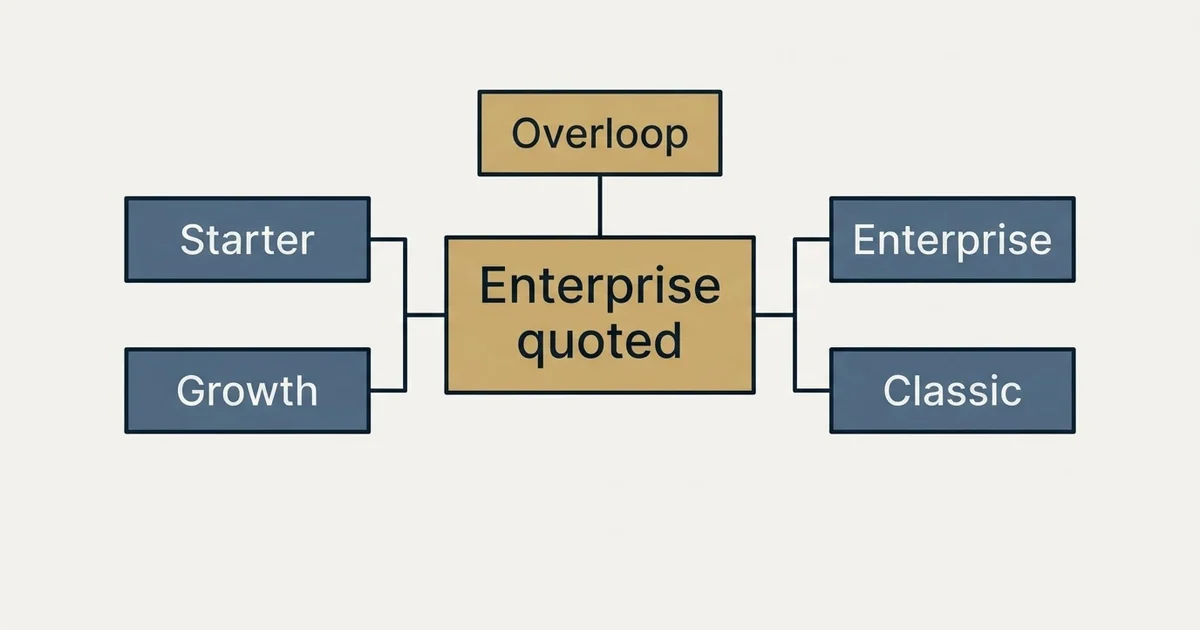
Overloop AI pricing is $69 per user a month on Starter and $99 per user a month on Growth, with Enterprise quoted. Seats carry 250, 500 or 1,000 credits a month; a database prospect costs 1 credit, a valid email 1 and a phone number 5. The page prints no annual rate and offers a 7-day free trial.
Key takeaways
- Overloop's pricing page lists Starter at $69 and Growth at $99 per user a month, Enterprise at a custom price, and no annual rate anywhere on the page.
- Credits cost 1 to source a prospect, 1 to find a valid email and 5 to reveal a phone number, so a 250-credit Starter seat covers 125 sourced prospects with emails.
- Growth adds 3 email accounts per user, 10 campaigns and HubSpot, Pipedrive and REST API access; Salesforce and a dedicated IP are Enterprise only.
- The page offers a 7-day free trial with no credit card and states that prospect replies cannot sync from Overloop into HubSpot.
Reviewed and updated September 21, 2026
Overloop AI pricing is two self-serve seat rates and a quote. Overloop's pricing page lists Starter at $69 per user a month and Growth at $99 per user a month, with Enterprise at a custom price. The page carries no monthly or annual toggle, prints no annual rate, and does not use the words annual, yearly or billed anywhere in the document. Third-party pages state that annual billing exists at a discount. It may. It is not on the vendor's pricing page, and this article records the page.
The pricing is for the product the nav calls Overloop AI. The same nav lists an Overloop Classic, and the pricing page is the AI product's.
Overloop AI Pricing at a Glance
Overloop AI costs $69 per user a month on Starter and $99 per user a month on Growth, and Enterprise is quoted. Each seat carries a monthly credit allowance of 250, 500 or 1,000, and the page's FAQ prints what a credit buys: 1 credit to source a prospect from its database, 1 to find a valid email address and 5 to reveal a phone number.
The ladder
Starter, $69 per user a month. 250 credits a month per user, one email account per user, three campaigns, Slack, Chrome extension and Zapier.
Growth, $99 per user a month. 500 credits a month per user, three email accounts per user, ten campaigns, HubSpot and Pipedrive integrations, a REST API.
Enterprise, quoted. 1,000 credits a month per user, unlimited email accounts and campaigns, Salesforce, a dedicated IP, wire or SEPA payment, a customer success manager.
The page offers a 7-day free trial, and its FAQ adds that no credit card is required.
What a credit is
The credit is the meter inside a seat, and the pricing page's FAQ prints the exchange rate. Credits are deducted in real time: sourcing a prospect from Overloop's database costs 1 credit, finding a valid email address costs 1 credit whether the prospect was sourced or imported, and revealing a phone number costs 5 credits. A prospect sourced from the database with a valid email therefore costs 2 credits, so a Starter seat's 250 credits cover 125 of them a month and a Growth seat's 500 cover 250. A team that imports its own lists and only needs emails found gets 250 or 500 a month per seat, and phone numbers come to 50 or 100.
Campaigns as a meter
Three campaigns on Starter is the limit most likely to bind for a disciplined team, and it is worth reading the right way. The plan table labels it active campaigns per account, which reads as campaigns running at the same time; ask the vendor whether a finished campaign frees its slot. Under a one message per campaign rule, every distinct message to a distinct audience is its own campaign, sent once. A team that runs one message to three segments has used all three Starter slots, and its fourth segment waits or costs a Growth seat. Growth's ten campaigns is the working number for a team that segments properly.
The upside of the campaign cap is that it discourages the thing a campaign tool should discourage: the same message sent again to the people who did not answer it, as a new campaign. On Starter there is no room for that, and it is the one campaign nobody should run anyway.
Email accounts per seat
One email account per user on Starter means each person sends from one mailbox, and a warmed mailbox sends a few dozen cold emails a day safely. Growth's three accounts per user triples that, and it is the reason a volume-minded team is on Growth regardless of the credit count. Enterprise's unlimited accounts plus a dedicated IP is the vendor's answer to a sending operation rather than a sales team. The mailbox pricing guide covers what a mailbox fleet costs to stand up and warm, which is a cost on top of any seat here.
Pricing a team
Three SDRs on Starter is $207 a month, $2,484 a year at the monthly rate, since the page gives no other. Three on Growth is $297 a month, $3,564 a year. The step from Starter to Growth is $30 a seat a month, and it buys double the credits, triple the email accounts, seven more campaigns and the CRM integrations. For a team on HubSpot or Pipedrive there is no choice; the integration is on Growth, so Starter is for a team without a CRM or one that will sync by hand.
| Seats | Starter | Growth |
|---|---|---|
| 1 | $69 a month, $828 a year | $99 a month, $1,188 a year |
| 3 | $207 a month, $2,484 a year | $297 a month, $3,564 a year |
| 5 | $345 a month, $4,140 a year | $495 a month, $5,940 a year |
| 10 | $690 a month, $8,280 a year | $990 a month, $11,880 a year |
Enterprise's Salesforce integration is the equivalent gate at the top. A Salesforce shop has no self-serve plan on this page.
The annual question
Everything above is per month, because the page prints per month and nothing else. A buyer offered an annual rate by the sales team is being offered something that exists but is not published, and the honest way to record it is as a quote. The pages that state an annual discount for this vendor are describing a rate they were told or read at some earlier date; the vendor could publish it tomorrow, and has not today.
That absence is scoped to the pricing page read for this article. It is not a claim that the vendor has no annual billing.
The two products on one site
The site's navigation lists Overloop AI and Overloop Classic as separate products, and the pricing page belongs to the AI one. The Classic product is the older sales engagement tool, and a buyer who has seen an older price for Overloop, or who has a colleague on the Classic product, may be comparing two different things. The AI product's pricing page is the one read here, and every figure above is from it. A team on Classic that wants to know what it would pay to move is pricing a migration, not a renewal, and should ask the vendor how the two relate.
The distinction matters for the third-party numbers as well. A review that quotes an Overloop price without saying which product it priced may be describing Classic, and Classic's ladder is not on this page.
What the integrations decide
The integration list is not decoration on this page; it is the gate between tiers. Starter carries Slack, a Chrome extension and Zapier, which is enough to push a notification and to pull a contact from a browser tab. Growth carries HubSpot and Pipedrive natively and a REST API, which is what a team needs for the sequence tool to write activity back to the CRM without a Zapier hop. Enterprise carries Salesforce. The page is specific about the limits: the native integrations map prospect fields, record types and users and can log sent emails through each CRM's BCC address, and for HubSpot it states that prospect replies cannot sync from Overloop into HubSpot.
For a team on HubSpot, the Zapier route on Starter is technically possible and practically a second subscription plus a maintenance burden, so the honest Starter price for that team is $69 plus a Zapier plan, and Growth at $99 is usually cheaper once that is counted. For a team on Salesforce, there is no self-serve route at all, and the Enterprise quote is the price.
Overloop AI Review: The Caveats Its Own Page Prints
A review built from the pricing page reads the fine print as closely as the prices, and Overloop's is unusually candid. The email finder "can find addresses and return a verification status; availability and results vary by contact." The built-in warm-up "sends low-volume traffic through a third-party network", and the page adds that deliverability and domain reputation still depend on provider policies, configuration, content, recipient behavior and sending history. Starter and Growth share an IP for secondary domains; only Enterprise gets a private setup with a dedicated IP. The database is described as 450M+ B2B contacts.
Third-party pages add an annual billing discount that the vendor page still does not print, so confirm it with the vendor rather than with a blog. The two-credit cost of a database prospect that those pages quote now follows from the page's own table: 1 credit to source the prospect and 1 to find its email.
The trial
The 7-day trial is the one commercial term on the page beyond the two seat rates and the credit table, and it is worth using deliberately. Run a normal week of prospecting on a Starter seat and read the credit balance at the end. That number, scaled to a month and read against 125 sourced prospects per seat, tells you whether Starter's allowance or Growth's is the one you need.
Where it sits
At $69 and $99 per user, Overloop sits in the middle of the per-seat ladders in the sales engagement platform survey, above the cold email senders in the cold email pricing guide and below the enterprise engagement platforms. Its distinguishing meter is the credit, which bundles a prospect database into the seat, so the fair comparison is against a sender plus a data subscription rather than against a sender alone. The vendor's nearest alternatives split along that line: some price the data separately and look cheaper per seat until the data is added back.
Whether an annual rate exists, since the pricing page prints none.
Your credit mix: 2 credits per sourced prospect with an email, 1 per email found on an imported contact, 5 per phone number.
Your campaign count: 3 active on Starter, 10 on Growth, and whether a finished campaign frees its slot.
Your CRM: HubSpot and Pipedrive on Growth, Salesforce on Enterprise, and no reply sync into HubSpot.
Whether Overloop AI or Overloop Classic is the product you are pricing.
The short version
Overloop's pricing page lists Starter at $69 per user a month with 250 credits, one email account and three campaigns; Growth at $99 per user a month with 500 credits, three accounts, ten campaigns and HubSpot, Pipedrive and API access; and Enterprise at a custom price with 1,000 credits, unlimited accounts, Salesforce and a dedicated IP. It offers a 7-day free trial, prints a credit table (1 credit per sourced prospect, 1 per valid email, 5 per phone number), and the pricing page prints no annual rate.
If the outbound program is something you would rather have run than priced, we operate outbound as a campaign engagement, and you can see what one would look like for your market.
Pricing and features are taken from the vendors' own pages. Verify current terms with the vendor before relying on them.
Frequently asked questions.
Frequently asked questions- What is Overloop AI pricing?
- Overloop's pricing page lists Starter at $69 per user a month and Growth at $99 per user a month, with Enterprise at a custom price. Starter includes 250 credits, one email account and three campaigns per user; Growth includes 500 credits, three email accounts, ten campaigns and HubSpot and Pipedrive integrations. The page prints no annual rate.
- How do Overloop credits work?
- Each seat gets a monthly allowance of 250, 500 or 1,000 credits by plan. The pricing page's FAQ says credits are deducted in real time: 1 credit to source a prospect from Overloop's database, 1 credit to find a valid email address, and 5 credits to reveal a phone number. A sourced prospect with an email costs 2 credits.
- Does Overloop have a free trial?
- Yes. Overloop's pricing page offers a 7-day free trial, and its FAQ says no credit card is required. The trial is the practical way to learn how far a seat's credits go: run a normal week of prospecting and read the credit balance at the end, then scale it to a month.
- Does Overloop offer annual billing?
- Overloop's pricing page shows no monthly or annual toggle and prints no annual rate; the words annual, yearly and billed do not appear on it. Third-party pages say an annual discount exists. It may, but it is not published by the vendor, so treat any annual price as a quote from the sales team.
About the author.

B2B cold email experts helping companies generate qualified leads through done-for-you outreach campaigns.
RevenueFlow Team
Explore more.
Ready to scale your outreach?
We build GTM engines that book real meetings. See the receipts.
Related articles.
Twain Pricing: Credits per Lead, Three Research Modes
Twain sells credits, not seats, and a lead costs 1 to 14 of them depending on the research mode. The two ladders, the four expiry clocks and the cap.
Lavender Pricing: Two Products, No Pricing Page
Lavender has no pricing page. The Email Coach ladder per seat at both billing states, the free routes, and the separate per-agent price for Ora.
Zeliq Pricing: One Seat Rate and a Credit Meter
Zeliq prices one self-serve seat in dollars with a credit meter that never expires. Both billing states, the three credit rates, the top-up ladder and the Custom floor.
PersistIQ Pricing: A Demo Form Where the Ladder Was
PersistIQ's pricing address serves a demo form and no platform price. What the site does publish, the Luka add-on ladder at both billing states, and how to read a quote.
Salesgear Pricing: Two Ladders Under One Plan Title
Salesgear's page is titled as one plan and carries a Data ladder and an Outreach ladder. Both at both billing states, what each meters, and the two vendor-side conflicts.
Gong Engage vs Salesloft Cadence: How They Differ
Gong Engage and Salesloft Cadence compared from each vendor's own pages: where each starts, six jobs side by side, and what the pricing pages disclose.