PersistIQ Pricing: A Demo Form Where the Ladder Was
PersistIQ's pricing address serves a demo form and no platform price. What the site does publish, the Luka add-on ladder at both billing states, and how to read a quote.
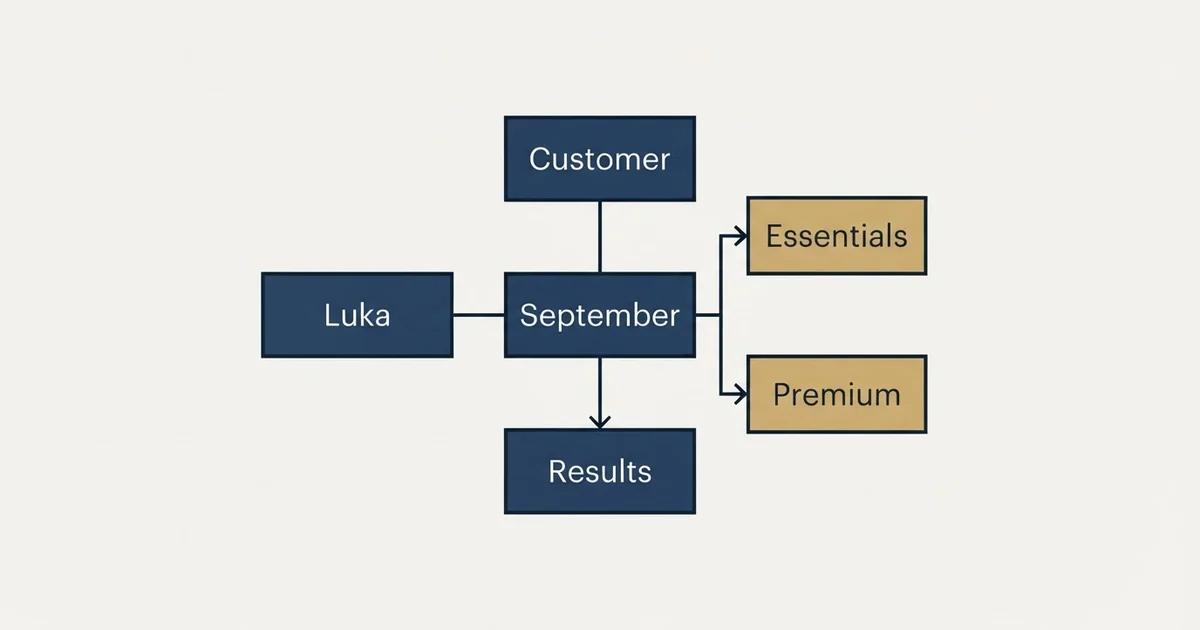
As published on PersistIQ's site on 4 September 2026, the platform has no published price: the pricing address serves a demo request form with no plan or figure. The vendor does publish a ladder for Luka, its email prospecting add-on, at $0, $25 and $40 per user a month billed yearly or $35 and $50 monthly.
Key takeaways
- The platform pricing address serves a demo form titled Customer Results with no figure on it, read plain and in a browser on 4 September 2026, so the platform price is a quote.
- Third-party listings quote $59 and $99 per user a month for the platform, and no vendor page carries those figures today.
- Luka, the email finder add-on, is published at $25 and $40 per user a month yearly or $35 and $50 monthly, with 2,000 and 5,000 email credits, and it is not the platform.
- Both products state a 14-day trial, so a team can try the platform before learning its price in the sales conversation the trial leads to.
Reviewed and updated September 4, 2026
PersistIQ does not publish a price for its platform on any page fetched on 4 September 2026. As published on PersistIQ's pricing page on 2026-09-04, the page at the pricing address is a demo request form titled Customer Results, with no plan, no figure and no currency on it. The apex page, the page at the same address without a trailing slash, and two rendered reads in a browser all served the same form. That is the state of the vendor's platform pricing today, and it is a fact worth stating plainly because several third-party pages quote a per-seat rate for it.
What the vendor does publish is a ladder for Luka, its email prospecting add-on, at two billing states. This article records the absence for the platform, the Luka ladder in full, and the trial terms, which is everything the vendor's site says about money.
The platform: a demo form where the price would be
- Step 1The pricing address
A demo request form titled Customer Results. No plan, no price, no currency.
- Step 2The apex
The same product page, with a free trial button and no price.
- Step 3The Luka pricing page
A three-plan ladder for the email prospecting add-on, billed yearly, with a link to a monthly copy.
- Step 4The link back
Both Luka pages link to the platform pricing address for PersistIQ pricing, which serves the form.
The demo form has a short list of fields and a heading about customer results. The same route answered one scripted fetch with a forbidden error earlier on 4 September 2026 and answered normally within the hour, so the page's behaviour toward automated readers varies; but on every read that returned the page, the page was the form. A buyer who wants the platform price talks to the vendor.
Third-party listings quote $59 per user a month for an Essentials plan and $99 for Premium, billed yearly. No vendor page fetched on 4 September 2026 prints those figures. They may be what the sales team quotes, or what the page said at an earlier date. They are not vendor facts today, and they are not treated as such here.
Luka: the ladder the vendor does publish
Luka is the vendor's email prospecting product, a finder for business email addresses with a monthly credit allowance. Its pricing page loads on yearly billing and links to a monthly copy at a separate address.
- Ten email credits a month
- Find a hundred business emails
- Unlimited contact import
- Two thousand email credits a month
- Find two thousand business emails
- CSV export
- Five thousand email credits a month
- Find five thousand business emails
- CSV export and a higher daily send limit
Billed yearly. On the page, Free $0, Bulk $25 per user a month, Plus $40 per user a month.
Billed monthly. On the page, Free $0, Bulk $35 per user a month, Plus $50 per user a month.
The yearly saving is $10 a month on either paid plan, which is 29% on Bulk and 20% on Plus. Bulk carries 2,000 email credits a month and Plus 5,000, with one credit per business email found. The free plan carries ten credits and is a trial in the shape of a plan.
The Luka FAQ states a 14-day free trial on the yearly plans, unlimited contact import, and a daily send limit that varies by plan. The daily send limit is the one figure the page names without giving, so a team that intends to send from Luka rather than just find addresses should ask for it.
What Luka is and is not
Luka is an email finder with sending attached, priced per user on a credit meter. It is not the PersistIQ sales engagement platform, and buying it does not buy the platform. The two pages link to each other, and the Luka page's link for PersistIQ pricing goes to the demo form. A buyer who arrives at Luka's ladder looking for the platform price has found the wrong product's price.
As an email finder, Luka's $25 per user a month yearly for 2,000 credits is 1.25 cents per email found at full use, which is at the low end against the standalone email finder and verification tools a sales team may already pay for. That comparison is the right one for Luka; the platform has no comparison because it has no price.
What the apex says
The product page positions PersistIQ for small sales teams and states a 14-day free trial and native sync with Copper and Salesforce. The trial is the only commercial term on the platform side of the site. A team can therefore try the platform without knowing what it costs, and learn the price in the sales conversation the trial leads to.
The vendor's customer stories page names sales development teams and account executives at small companies as the buyer.
Pricing a team, as far as the site allows
For the platform: not possible from the site. Three users cost three times a number the vendor will tell you.
For Luka: three users on Bulk, yearly, is $75 a month, $900 a year, for 6,000 email credits a month across the team. Three on Plus is $120 a month, $1,440 a year, for 15,000 credits. Monthly, the same three are $105 or $150 a month.
The trial without a price
The platform trial deserves a word because it is the vendor's actual commercial offer to a new buyer. Fourteen days of the product, with the sync to Copper and Salesforce that the apex advertises, and then a conversation in which the price appears. That sequence puts the buyer in the position of having done the setup work before knowing the number, which is not a trap, but it is the order the vendor has chosen. A team evaluating this against a published-price rival should get the quote before the trial starts, not after, and the demo form at the pricing address is where that request goes.
The trial is also the only place the vendor's own site describes what the platform includes in commercial terms. The customer stories page says who buys it; the apex says how long the trial is. Neither says what a seat carries. That is a second thing to ask for in writing alongside the price.
The Luka monthly page
The monthly Luka ladder lives at a separate address from the yearly one rather than behind a toggle, and the yearly page links to it. That structure means a scripted read of the main Luka page sees only the yearly figures, and a buyer who does not follow the link sees $25 and $40 without the monthly $35 and $50 beside them. Both pages carry the same plan names and credit counts; only the rate and the billing line differ. A team unsure about committing to a year of an email finder should read the monthly page and compare the $10 a month gap against the value of leaving.
The credit counts on both pages are per user per month, so a team of three on Bulk has 6,000 credits across the team rather than 2,000 shared, and the page does not describe pooling between users.
Why an unpublished price is the finding
A vendor that removes its ladder and replaces it with a form has made a commercial decision, and the decision is information. It usually means the price is negotiated per account, that it has moved up, or that the vendor is steering buyers to a conversation where the add-ons can be introduced. None of those is a reason not to buy, but each is a reason not to trust a figure from a page that is not the vendor's. The sales engagement platform survey sets out which vendors in this category publish and which quote, and PersistIQ has moved to the quoting side while its add-on stays on the publishing side.
The vendor's nearest alternatives mostly publish per-seat ladders, which makes the comparison one-sided: their prices are known and this one is not. A buyer in a comparison should get the PersistIQ quote in writing, with the billing period and the seat count, before setting it beside a published rate. The seat ladders for the cold email senders in that set are in the cold email pricing guide.
Whatever the platform costs, the sending rules do not change with the price. One message per campaign, sent once, and no second campaign to the people who did not reply with the same offer. A negotiated seat price is not a reason to send more from it.
- Yes: That the platform price is a quote, since the pricing page is a demo form
- Yes: The quote in writing with the billing period and seat count
- Yes: Whether you are pricing Luka or the platform, since only Luka is published
- Yes: Which Luka billing state you read, yearly on the main page and monthly on its copy
- Depends: The Luka daily send limit, which the FAQ names but does not give
- Depends: Whether the trial covers the platform features you need before the price is known
The short version
As published on PersistIQ's site on 4 September 2026: no platform price by any route, with the pricing address serving a demo form; Luka at $0, $25 and $40 per user a month billed yearly or $0, $35 and $50 monthly, with 10, 2,000 and 5,000 email credits; a 14-day trial on both products; third-party per-seat figures for the platform that no vendor page carries today.
If a vendor conversation is not how you want to learn what outbound costs, we run outbound as a campaign engagement with the price stated up front, and you can see what one would look like for your market.
Every statement above is as published on PersistIQ's site on 2026-09-04: the platform pricing address and apex read plain and in a browser, the Luka pricing page and its monthly copy, and the FAQ on each. The absence of a platform price is a statement about those pages on that day. Prices change; check the page before you buy.
Sources: PersistIQ pricing address, Luka pricing page, Luka monthly pricing
Frequently asked questions.
Frequently asked questions- How much does PersistIQ cost?
- The vendor does not publish a platform price as of 4 September 2026. The page at its pricing address is a demo request form with no plan or figure, and the apex page offers a 14-day trial without a price. Third-party listings quote $59 and $99 per user a month, but no vendor page carries those figures today, so the platform price is a quote to get in writing.
- What is Luka and how much does it cost?
- Luka is PersistIQ's email prospecting add-on, a business email finder with sending attached. As published on its pricing page on 4 September 2026, it is $0 on a Free plan with ten credits, $25 per user a month on Bulk with 2,000 credits and $40 on Plus with 5,000 credits, billed yearly; the monthly copy of the page prints $35 and $50. One credit finds one business email.
- Does PersistIQ have a free trial?
- Yes, on both products. The platform's apex page states a 14-day free trial, and the Luka FAQ states a 14-day trial on its yearly plans. The platform trial is the only commercial term the vendor publishes for the platform, so a team can evaluate the product before the price is disclosed in a sales conversation.
- Why do other sites list PersistIQ prices if the vendor does not?
- Because the vendor published a ladder at some earlier date, or because the sales team quotes those figures. Listings quote $59 per user a month for an Essentials plan and $99 for Premium, billed yearly. Those may be the current quotes, but they are not on any vendor page fetched on 4 September 2026, so treat them as a starting point for the conversation rather than a price.
About the author.

B2B cold email experts helping companies generate qualified leads through done-for-you outreach campaigns.
RevenueFlow Team
Explore more.
Ready to scale your outreach?
We build GTM engines that book real meetings. See the receipts.
Related articles.
Twain Pricing: Credits per Lead, Three Research Modes
Twain sells credits, not seats, and a lead costs 1 to 14 of them depending on the research mode. The two ladders, the four expiry clocks and the cap.
Lavender Pricing: Two Products, No Pricing Page
Lavender has no pricing page. The Email Coach ladder per seat at both billing states, the free routes, and the separate per-agent price for Ora.
SalesQL Pricing: Four Plans, Priced Per Credit
SalesQL publishes four plans on a monthly-first pricing page. Here is the dated ladder, the per-profile credit meter, the seat limits, and what the page leaves out.
Zeliq Pricing: One Seat Rate and a Credit Meter
Zeliq prices one self-serve seat in dollars with a credit meter that never expires. Both billing states, the three credit rates, the top-up ladder and the Custom floor.
Overloop Pricing: Two Seat Rates and No Annual Toggle
Overloop publishes Starter and Growth per user with a credit allowance and no annual rate on the page. What each seat carries, and what the page leaves out.
Salesgear Pricing: Two Ladders Under One Plan Title
Salesgear's page is titled as one plan and carries a Data ladder and an Outreach ladder. Both at both billing states, what each meters, and the two vendor-side conflicts.