Gong vs Salesloft: Sales Engagement Platform Comparison
An in-depth comparison of Gong and Salesloft for real sales teams. Covers pricing, features, integrations, and which tool fits different team sizes and budgets.
Gong vs Salesloft comes down to which job is the centre. Gong is built on captured conversations and suits teams that need to see and coach what happens on calls. Salesloft is built around Cadence and suits teams that live in sequences. Both now sell forecasting, and neither publishes a price.
Key takeaways
- Gong's pricing page publishes the shape of its bill and no figure: per-user licences, a platform fee based on the number of users supported, and free integration with existing tools.
- Salesloft's pricing address redirects to a Talk to Sales page that names no plan, package or price, so the first quote is the first data point.
- Clari and Salesloft completed their merger on December 3, 2025, which is why Salesloft's forecasting product is named Clari Forecast.
- Three product lines overlap, conversation capture, engagement and forecasting, so the choice turns on whether the team needs the recording layer or the sequencing layer first.
Reviewed and updated September 18, 2026
Gong's pricing page tells a buyer three things and no number: licences are priced per user, there is a platform fee based on the number of users supported, and existing tools integrate for free. Salesloft's pricing address tells a buyer less. It redirects to a page titled "Talk to Sales" that names no plan, no package and no price. In a Gong vs Salesloft evaluation that asymmetry is the first practical fact, because one quote can be sanity-checked before the call and the other cannot.
Gong vs Salesloft: The Quick Answer
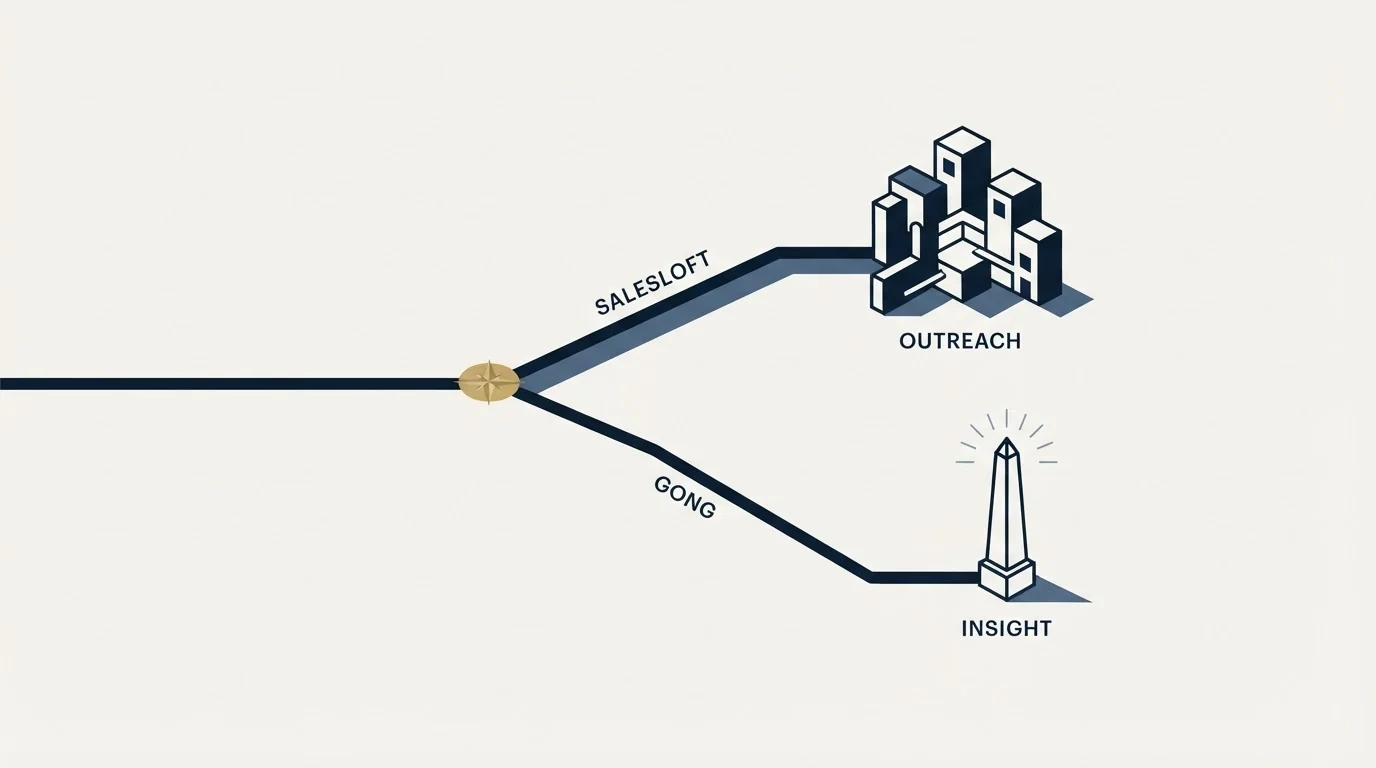
Gong is a revenue AI platform built on captured conversations, and Salesloft is a revenue platform built around Cadence, its sequencing product. Pick Gong when the job is seeing what happens on calls and coaching from it. Pick Salesloft when the job is running the outreach reps work from every day. Both now also sell forecasting, and neither publishes a price.
They compete at the edges and are bought for different centres: one for the recording layer, one for the sequencing layer.
Where the edges meet is Gong's own engagement product, and Gong Engage vs Salesloft compares that like for like with Cadence.
Teams weighing this decision often want the neighbouring comparison too, and how the same platform compares against a sequencing-first competitor covers it.
Two Suites, Two Centres
Both companies now sell a suite rather than a single product, and the two suites look alike on a menu.
Gong's site lists Gong Engage, Gong Forecast, Gong Enable, Gong Agents and the Gong Revenue Graph, which it describes as a living network of revenue data that captures and connects every interaction across the business. The homepage summary is to capture every interaction, analyze what is working, and automate what happens next. Everything Gong sells sits on top of that captured record.
Salesloft's menu sorts its products into two sets. For account teams it lists Cadence, Conversation Intelligence, Deals and Rhythm. For revenue leaders it lists Clari Forecast, Inspect and Analytics. The forecasting product carries the Clari name because Clari and Salesloft completed their merger on December 3, 2025, and clari.com now redirects to salesloft.com.
So three lines of the two menus overlap: conversation capture, engagement and forecasting. What separates the vendors is which product the rest was built around. Gong's suite is built on the recording, with a sequencer beside it. Salesloft's is built on the sequencer, with call intelligence beside it and, since the merger, Clari's forecasting.
Who Should Pick Which
Pick Gong when reviewing conversations is the job. Recording, deal risk and coaching are the centre of the product, and the pricing page publishes enough of its structure to model a quote before speaking to anybody.
Pick Salesloft when running and orchestrating the outreach is the job. Cadence, Rhythm, Deals, Clari Forecast and its own conversation intelligence sit on one platform, so a team wanting sequencing and forecasting together buys once.
Prepare differently for the two sales conversations. Gong's page gives a buyer two things to ask about: the per-user licence and the platform fee based on the number of users supported. Salesloft's gives a buyer nothing at all, so the first call is discovery in both directions, and going in with a written requirement and a headcount forecast is the only way to keep it short.
Pricing Comparison
Gong Pricing
| Plan | Price | What that rung carries |
|---|---|---|
| Gong (platform) | Contact sales | quoted per team |
Billing basis: the page publishes the shape of the bill rather than the number. Licences are priced per user, there is a platform fee on top based on the number of users supported, and existing tools integrate for free. The page then asks for a team size, in bands from 1 to 50 up to 10,000 and over, and offers a customized proposal.
Source: Gong Pricing
Salesloft Pricing
| Plan | Price | What that rung carries |
|---|---|---|
| No plan or package named | Talk to sales | the pricing address redirects to a booking form |
Billing basis: none published. The pricing address leads to a Talk to Sales page whose only structure is a three step process: a quick intro call, a tailored walkthrough and a follow up. No unit of billing appears anywhere on it.
Source: Salesloft Pricing
Gong's pricing page says
- Licenses are priced per user
- There is a platform fee based on the number of users supported
- You can integrate your existing tech stack for free
- No figure for either line
Salesloft's pricing address shows
- No plan, package or figure
- Step 1: a quick intro call
- Step 2: a tailored walkthrough
- Step 3: a follow up
Reading The Two Pages Together
Gong. The platform fee is the line that surprises people, because it sits on top of the per-user licences and scales with the same headcount.
Salesloft. The merger FAQ Salesloft published for customers says the merger does not change existing contracts, pricing or renewal dates, which is reassurance for current customers and no help to a new buyer.
Trials. Gong offers no trial on its pricing page, and Salesloft offers no trial on its pricing page.
What The Bill Actually Looks Like
The scenario below is a forty-person sales organisation.
Neither vendor publishes a rate, so no dollar figure is stated below and none is invented. The difference is in how much of the structure each one will tell you before a call.
Gong publishes two components: licences priced per user, and a platform fee based on the number of users supported. At forty people both lines scale with forty, so growth moves the bill twice, and the same page states that existing tools integrate for free.
Salesloft publishes nothing comparable. Its pricing address carries no package names and no prices, so a buyer cannot model anything in advance and the first quote is the first data point.
Salesloft's silence looks different beside another vendor that publishes nothing, and Salesloft measured against Clari's Groove module works through how to compare two such pages. That comparison predates the merger. Groove is now one of the sign-ins on Salesloft's own login menu, beside Clari Forecast and Drift, so it is a sibling product today rather than a rival quote.
The practical consequence is about sequencing the procurement rather than about arithmetic. Get the Salesloft quote first, because it takes longer to obtain and cannot be estimated, and use the Gong structure to sanity-check whichever quote arrives against a headcount that has not happened yet.
What Each One Gives Up
What Gong gives up. The sequencer is the newer half of the product, so a team whose day is spent inside cadences is buying Gong for its second strength. The platform fee on top of per-user licences means a hiring plan is a pricing input, and no rate is published.
What Salesloft gives up. Any ability for a buyer to prepare. Its pricing address carries no plan names and no prices, so the first quote is the first data point and there is nothing to sanity-check it against. Its conversation intelligence is one capability among several rather than the product's centre, so a team whose main requirement is call analysis is comparing a component against a whole platform.
Do Gong And Salesloft Work Together
The two can be run side by side, with Salesloft sending and logging while Gong records and analyses. Both vendors acknowledge the arrangement in their own words. Gong's pricing page says you can integrate your existing tech stack for free. Salesloft's merger FAQ names Gong, with Salesforce and HubSpot, as an example of the integrations customers asked about, and answers that the merger will not affect current integrations.
Running both means paying for overlap, since each suite now includes the other's centre in some form. The honest test is usage. If reps never open the second vendor's version of a feature the first vendor also sells, the overlap is costing nothing in practice, and the question becomes whether one contract could be dropped at renewal.
Switching Between Them
These are not substitutes and a straight swap is rare. Leaving Gong loses the conversation archive; leaving Salesloft loses the cadences, the mailbox connections and the contacted history.
Two items deserve to be settled in the contract rather than at cancellation. The first is recording export, because the archive is the coaching library and its retention terms are contractual rather than a product feature. The second is the contacted history, which is a suppression list in everything but name; a team that leaves without it will eventually contact somebody who already declined, and no amount of data enrichment reconstructs that record.
Where Each One Sits In A Cold Outbound Stack
Salesloft sits nearest the cold outbound slot and Gong sits after the meeting is booked.
A cadence tool is exactly where house practice bites hardest: one message per campaign, no bumps, no thread replies. A multi-step cadence is the default in this category and it is not the shape used here. A prospect who does not reply is retargeted with a fresh single-message campaign, and a LinkedIn no-reply retarget is never sent, because the second message lands directly under the one they ignored.
Whether the resulting meeting is a qualified one is agreed in writing before launch.
How To Run The Evaluation
A fortnight of real use answers more than a feature comparison does, but with two quote-only vendors the evaluation starts with the quote request. Send the same request to both on the same day, built around the questions their pricing pages leave open.
Subject: quote request, 40 users today, 55 by year end
"We are comparing two platforms and need a written quote against the headcount above." 1
"Please state the unit of billing for every line, and whether any line is a platform fee rather than a seat." 2
"List which products the quote covers by name, and which are separate purchases." 3
"Confirm the export terms for recordings and for contacted history if we leave." 4
- 1Both bills follow headcount, so the hiring plan goes in the first line. Gong's two published components both scale with users.
- 2Gong's page answers this in advance: a per-user licence plus a platform fee. Salesloft's publishes no unit, so this line is for Salesloft.
- 3Forecasting is a named product on both sides, Gong Forecast and Clari Forecast, so ask whether it is inside the quote.
- 4The archive and the contacted history are the two things a team cannot rebuild after leaving.
Then run the same real sample through both rather than a demo dataset, and confirm the export path works before committing, because leaving is the expensive half.
The Decision By Use Case
| Gong | Salesloft | |
|---|---|---|
| Entry paid rung | Not published | Not published |
| What it charges for | per-user licences plus a platform fee | not published |
| Free option | No | No |
| Where it sits | a revenue AI platform built on captured conversations, with an engagement product beside it | a revenue platform whose core is Cadence, its sequencing product |
Final Thoughts
Gong is the buy for a team that cannot see inside its own calls. Salesloft is the buy for a team that wants sequencing and forecasting on one platform.
Start the Salesloft conversation early, since nothing on its pricing address lets a buyer prepare, and bring a headcount forecast to both.
Related Reading
- Best Gong Alternatives in 2026
- Best Salesloft Alternatives in 2026
- Gong vs Outreach: Sales Engagement Platform Comparison
- Gong vs Groove by Clari: Sales Engagement Platform Comparison
- Outreach vs Salesloft: Sales Engagement Platform Comparison
If you would rather have this run for you, RevenueFlow books qualified meetings on a pay-per-meeting basis and publishes client results.
Pricing and features are taken from the vendors' own pages. Verify current terms with the vendor before relying on them.
Frequently asked questions.
Frequently asked questions- Is Gong better than Salesloft?
- Neither is better across the board, because they are built around different centres. Gong starts from captured conversations, so it is the stronger choice when the need is call visibility, deal risk and coaching. Salesloft starts from Cadence, its sequencing product, so it fits teams whose reps work from sequences all day. The two can also be run together, and each vendor acknowledges the other in its own pages.
- How much do Gong and Salesloft cost?
- Neither vendor publishes a figure. Gong's pricing page says licences are priced per user and that there is a platform fee based on the number of users supported, then asks for a team size and offers a customized proposal. Salesloft's pricing address redirects to a Talk to Sales page with a booking form and no plan names at all.
- Can you use Gong and Salesloft together?
- Yes. Salesloft runs the outreach and logs the activity while Gong records and analyses the calls. Gong's pricing page says you can integrate your existing tech stack for free, and Salesloft's merger FAQ names Gong among the integrations customers asked about, confirming that current integrations are not affected.
- Does Salesloft have conversation intelligence like Gong?
- Yes. Salesloft's product menu lists Conversation Intelligence beside Cadence, Deals and Rhythm, and Gong in turn sells a sequencer called Gong Engage. The difference is emphasis. Conversation capture is the foundation of everything Gong sells, while at Salesloft it is one capability among several around the sequencing product.
About the author.

Tim Carden is CMO / CTO at RevenueFlow, which builds and operates outbound revenue engines for B2B companies. Studied at McGill University.
Tim Carden · CMO / CTO
Connect on LinkedIn →Explore more.
Ready to scale your outreach?
We build GTM engines that book real meetings. See the receipts.
Related articles.
Gong vs NeverBounce: Sales Engagement Platform vs Data Enrichment Tool Comparison
Gong vs NeverBounce: what Gong's own pages say about enrichment, what NeverBounce's API returns about an address, and how each vendor prices.
11x vs Salesloft: Sales Engagement Platform Comparison
Compare 11x and Salesloft side by side. See pricing, features, and integrations to choose the right sales engagement platform for your needs.
MyEmailVerifier vs Salesloft: Data Enrichment Tool vs Sales Engagement Platform Comparison
Compare MyEmailVerifier (data enrichment tool) and Salesloft (sales engagement platform) side by side. See pricing, features, and integrations to decide which one, or both, your stack needs.
AroundDeal vs Leadspicker: Data Enrichment Tool vs Sales Engagement Platform Comparison
Compare AroundDeal (data enrichment tool) and Leadspicker (sales engagement platform) side by side. See pricing, features, and integrations to decide which one, or both, your stack needs.
GetSales.io vs Yet Another Mail Merge: Sales Engagement Platform vs Cold Email Platform Comparison
Compare GetSales.io (sales engagement platform) and Yet Another Mail Merge (cold email platform) side by side. See pricing, features, and integrations to decide which one, or both, your stack needs.
ContactOut vs Luru: Data Enrichment Tool vs Sales Engagement Platform Comparison
Compare ContactOut (data enrichment tool) and Luru (sales engagement platform) side by side. See pricing, features, and integrations to decide which one, or both, your stack needs.