Best Outreach Alternatives in 2026
Four of the five platforms in this comparison publish no price at all, so evaluating an Outreach alternative starts with a procurement cycle rather than a signup form.
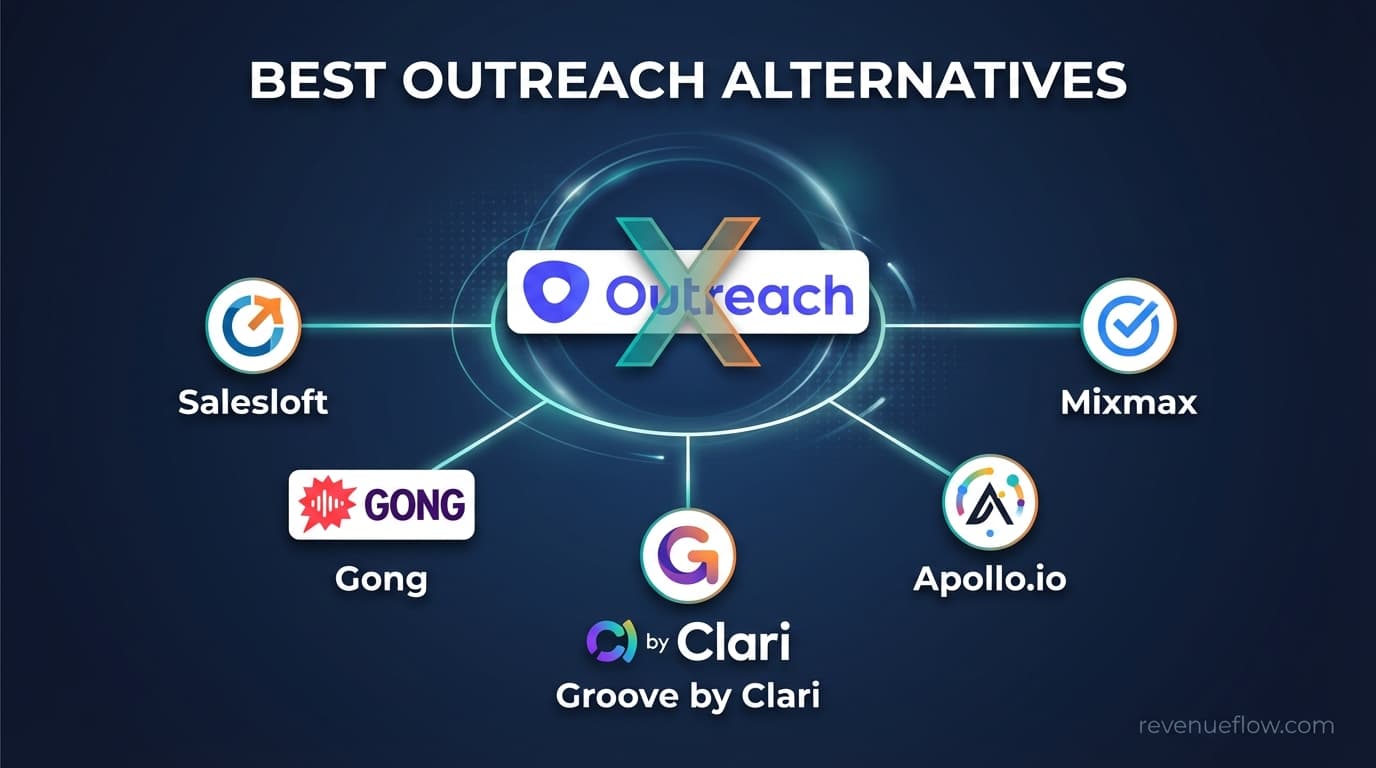
The best Outreach alternatives depend on the complaint. Apollo.io, Reply.io and lemlist publish prices, from $0, $49 and $55 a month, and suit smaller teams. Salesloft is the closest like for like and publishes nothing. Gong fits when coaching is the gap, and Salesforce's $50 Sales Engagement add-on fits Salesforce shops.
Key takeaways
- Outreach, Salesloft and Gong publish no dollar figure on their pricing pages, so comparing the enterprise options on cost means a sales call with each.
- Apollo.io's rendered pricing page lists a Free plan at $0, then Basic $49, Professional $79 and Organization $119 per seat per month on annual billing.
- Groove is no longer a separate Outreach alternative: Clari and Salesloft completed their merger on December 3, 2025, and Groove's product page redirects to Salesloft.
- Salesforce sells cadences inside the CRM as a Sales Engagement add-on at $50 per user per month billed annually, the published route for Salesforce-centred teams.
Reviewed and updated September 18, 2026
Outreach's pricing page publishes no dollar figure at all. Neither does Salesloft's or Gong's. Of the platforms usually named as Outreach alternatives, the enterprise ones all want a call before you can budget, which means the first cost of evaluating an alternative to Outreach is measured in calendar weeks. The lighter tools do the opposite and print their whole ladder.
What Are The Best Outreach Alternatives?
The best Outreach alternatives depend on the complaint. Apollo.io, Reply.io and lemlist suit smaller teams that want a published price and a trial. Salesloft is the closest like for like for a large team. Gong fits when coaching is the gap, and Salesforce's own $50 Sales Engagement add-on fits when CRM hygiene is. Gong is the only one of the six that does not replace the sequencer.
One correction to older lists, this one included: Groove is no longer a separate option. Clari and Salesloft completed their merger on December 3, 2025, Groove's product page redirects to Salesloft's, and Groove now appears as a sign-in on Salesloft's login menu. And if you are searching for outreach.io alternatives from an old bookmark, the company's site has moved to outreach.ai.
Why Teams Switch from Outreach
The reasons teams move away from Outreach cluster into four, and only one of them is really about features.
- Pricing at scale, and pricing opacity before that. Outreach's pricing page publishes no figure, so budgeting starts with a sales conversation. It lists four packages, Amplify Essentials, Core, Plus and Pro, metered from 10,000 to 100,000 AI credits, so the bill has a seat half and a usage half.
- The product assumes a team you may not have. Sequence permissions, shared template libraries and cross-rep reporting are the value. A team of four gets very little of that and pays for all of it.
- Integration friction. If your stack depends on something outside the supported set, the workarounds accumulate quietly and somebody ends up owning them. Outreach lists Connectors among its paid add-ons.
- Workflow fit. The platform that wins a feature comparison is not always the one a team adopts. Daily workflow, onboarding and how much administration the tool creates matter more than a feature count, and none of that is visible in a demo.
What the Category Actually Publishes
Before comparing individual tools, it is worth being honest about how little of this is public.
| Tool | Price published on its own pricing page | What evaluating it costs you |
|---|---|---|
| Outreach (current) | No figure; four packages marked Request pricing | A sales call before you can budget |
| Apollo.io | Yes, from a Free plan at $0 | A signup form |
| Reply.io | Yes, from $49 per user a month | A 14-day trial |
| lemlist | Yes, from $55 a month | A 14-day trial |
| Salesforce Sales Engagement | Yes, $50 per user a month | A Salesforce edition underneath |
| Salesloft | No figure; the pricing address is a booking form | A sales call before you can budget |
| Gong | No figure; licences per user plus a platform fee | A sales call before you can budget |
That split is the single most useful thing in this article. Evaluating the enterprise alternatives means a procurement cycle each before you can compare them on cost, so a genuine three-way evaluation is a month of calendar time. For the tools in the top half the cost question is answerable this afternoon, and for a smaller team that asymmetry can decide the outcome on its own.
Decision Framework: Choose Your Alternative
Pick the axis that matches your actual complaint rather than comparing feature grids.
- Choose Apollo.io if you want a price you can read and a contact database bundled with the sequencer, so prospecting and sending are one purchase rather than two.
- Choose Reply.io or lemlist if the job is multichannel sequences for a small team and a contract negotiation is the thing to avoid.
- Choose Salesloft if you want cadence execution, conversation intelligence and forecasting in the same platform, and you are large enough that governance is worth paying for.
- Choose Gong if the problem is what happens on calls rather than how many touches go out, since it is a revenue AI purchase rather than a sequencer.
- Choose the Salesforce add-on if Salesforce is your system of record and its hygiene is the live complaint, because cadences that live inside the CRM have nothing to sync.
Top Outreach Alternatives
1. Apollo.io
Starting Price: Free | Website: Apollo.io
Apollo bundles a contact database with sequences, a dialer and deal management, and it is the only enterprise-capable option here with a free plan. Its pricing page lists unlimited sequences, a deliverability suite with email warmup, waterfall enrichment and CRM integrations from the Basic plan, and call recordings with AI insights from Professional. None of that is a claim about what Outreach lacks. Outreach lists sequences, a dialer and conversation intelligence too. The difference is the database in the same subscription and a price on the page. Its plan cards list Prospecting, Gmail and Salesforce extensions on every plan. A move off Outreach is also a moment to look at the CRM underneath it, and the Pipedrive alternatives roundup covers that half of the decision.
Pricing Tiers:
| Plan | Price | Credits | Seats |
|---|---|---|---|
| Free | $0 | 900 credits per seat/year, granted monthly | 1 or more |
| Basic | $49/mo | 30,000 credits per seat/year, granted upfront | 1 or more |
| Professional | $79/mo | 48,000 credits per seat/year, granted upfront | 1 or more |
| Organization | $119/mo | 72,000 credits per seat/year, granted upfront | 3 minimum |
Prices are per seat per month on annual billing, which is the state the page opens in. Read the full Outreach vs Apollo.io comparison →
2. Salesloft
Starting Price: Talk to Sales | Website: Salesloft
Salesloft is the closest like for like. Its menu lists Cadence, Conversation Intelligence, Deals and Rhythm for account teams, and Clari Forecast, Inspect and Analytics for revenue leaders. Its pricing address redirects to a Talk to Sales page that names no plan, so the tier names older comparisons carried cannot be sourced today. The merger FAQ it published for customers says there are no current plans for required migrations between products.
Read the full Outreach vs Salesloft comparison →
3. Gong
Starting Price: Contact Sales | Website: Gong
Gong captures and analyses customer interactions across calls, emails and meetings. Its site lists Gong Engage, Gong Forecast, Gong Enable, Gong Agents and the Gong Revenue Graph. Its pricing page publishes a model and no figure: licences priced per user, a platform fee based on the number of users supported, and free integration with your existing tech stack.
Read the full Outreach vs Gong comparison →
4. Salesforce Sales Engagement, In Place Of Groove
Starting Price: $50 per user a month, billed annually | Website: Salesforce Sales Engagement
This slot used to belong to Groove by Clari, whose whole argument was Salesforce-native engagement. Groove has been folded into Salesloft, and the older Outreach vs Groove by Clari comparison now describes a product you buy through Salesloft. The vendor that makes the same argument with a published price is Salesforce itself. Its Sales Engagement pricing page lists Sales Cadences, Work Queue, Lead Scoring, Einstein Conversation Insights, Buyer Assistant and Einstein Activity Capture, and describes the product as sales engagement built directly into your CRM.
5. Reply.io And lemlist, The Lighter Pair
Starting Price: $49 and $55 a month | Websites: Reply.io and lemlist
Neither is an enterprise platform, which is the point. Reply.io's pricing page starts its Email Volume plan at $49 per user a month billed annually for 1,000 active contacts, and its Multichannel plan at $89, with LinkedIn automation as a $69 per account add-on. lemlist's Email plan is $55 a month on yearly billing with unlimited users and 50,000 emails a month, and its Multichannel plan is $87 per user with LinkedIn, SMS and a built-in dialer. Both offer a 14-day trial.
| Alternative | Published entry | What the entry leaves out |
|---|---|---|
| Apollo.io | Free at $0, then Basic $49, Professional $79, Organization $119 a seat | Free allows 2 sequences. Organization needs 3 seats minimum. |
| Reply.io | Email Volume from $49 a user; Multichannel from $89 a user | The $49 rung covers 1,000 active contacts. LinkedIn automation is $69 an account on top. |
| lemlist | Email $55 a month; Multichannel $87 a user | LinkedIn, calls and SMS start at Multichannel. Enrichment runs on credits. |
| Salesforce Sales Engagement | $50 a user, billed annually | It is an add-on, so a Salesforce edition is paid for underneath it. |
Reading the Roster: What Each Option Trades
The roster above lists what each tool sells. What follows is what each one costs you in something other than money.
Apollo.io bundles a contact database with the sequencer, so prospecting and sending sit in one subscription rather than two. What you give up is depth on the revenue-intelligence side, and data quality that varies by segment rather than holding uniformly. Teams that need enterprise sequencing governance find the ceiling quickly.
Salesloft competes with Outreach on the same ground, and its pricing address likewise carries no dollar figure. The distinguishing pitch is that cadence execution, conversation intelligence, deal management and now forecasting sit inside one platform. The trade is the same as Outreach's: an unpublished price means a procurement cycle before you can even compare, and the product assumes multi-step cadences are how your team sells.
Gong appears in this roundup as an alternative and is mostly a different product. What it does is capture and analyse conversations. What it does not do is replace a sequencer, unless the team also buys Gong Engage. Teams that swap a cadence tool for call analysis alone discover that gap quickly.
The Salesforce add-on trades depth for position. Cadences that live inside the CRM need no sync and no second record, which is the hygiene argument Groove used to make. The cost is that it only makes sense on top of a Salesforce edition you already pay for.
Reply.io and lemlist trade governance for speed. A team can be sending in a day, and the ceilings are printed on the page: active contacts on Reply.io, plan features on lemlist.
Where This Sits in a Cold Outbound Stack
A sales engagement platform is a sending and tracking layer, and it is worth being precise about what it does not decide. It does not decide who you contact, and list quality moves reply rate further than sequence design does. It does not decide what you say. It does not make a weak offer land.
It is also worth noticing how much of the product a given team will actually use. Every platform in this roundup is built around multi-step cadences: a first touch, bumps on days three, seven and twelve, then a breakup message. RevenueFlow runs one message per campaign and sends no thread replies or bump sequences, on the view that a second message landing under the one somebody ignored reads as a bump whatever the campaign structure calls it. A team working that way is buying a cadence engine and using one step of it, which is a real argument for the cheapest competent option rather than the most capable one.
The same logic applies to conversation intelligence. Recording and scoring calls is valuable once there are calls to record. On a programme still trying to book the first ten meetings a month, it is a tool bought ahead of the problem it solves.
How to Make the Switch
- Run a 2-week parallel test. Sign up for the alternative and run both tools simultaneously. Compare deliverability, UX, and team adoption.
- Export everything first. Save your contact lists, sequence templates, and analytics from Outreach before canceling. The contacted history matters most, because it is your suppression list.
- Migrate in phases. Move one campaign or one team member first. Validate results before going all-in.
- Check contract terms. Some platforms have annual commitments or cancellation fees. Factor this into your timeline.
- Measure after 30 days. Compare key metrics (reply rates, meetings booked, data accuracy) between your old and new tool.
How This Comparison Was Put Together
Prices and plan details come from each vendor's own pricing page, read on the day of writing and kept as a dated snapshot. Outreach, Salesloft and Gong publish no dollar figure on that page at all, which is recorded as what it is rather than filled in from a third-party blog. Feature lists are the vendors' own descriptions of their products, and a capability listed under one vendor is never a claim that another lacks it.
Nothing here is ranked by measured reply rate, deliverability or meetings booked. Those outcomes belong to the list, the offer and the sending infrastructure far more than to the platform pushing the send, so a league table presented as a measurement would be invented.
The Short Version
If you want a price you can read today, Apollo.io, Reply.io and lemlist all print one, and Apollo adds the data. If you need governance across a large rep team, Salesloft is the closest like for like and pricing it means booking a call. If Salesforce hygiene is the complaint, cadences inside the CRM for $50 a user are the structural answer. If the gap is coaching rather than sending, Gong is the honest recommendation and it will not replace your sequencer.
For a large, coordinated sales organisation already running on Outreach, staying and fixing the list is usually the higher-return move. The sending platform sits a long way downstream of the things that decide whether a cold email works.
Fixing the list means deciding which stages of the motion a tool should own, and where automation belongs in an outbound motion separates retrieval from the premise behind a segment.
Related Reading
- Outreach vs Salesloft: Sales Engagement Platform Comparison
- Gong vs Outreach: Sales Engagement Platform Comparison
- Groove by Clari vs Outreach: Sales Engagement Platform Comparison
- Apollo.io vs Outreach: Sales Engagement Platform Comparison
If you would rather have this run for you, RevenueFlow books qualified meetings on a pay-per-meeting basis and publishes client results.
Pricing and features are taken from the vendors' own pages. Verify current terms with the vendor before relying on them.
Frequently asked questions.
Frequently asked questions- What is the best alternative to Outreach?
- It depends on why you are leaving. For a published price and bundled contact data, Apollo.io, which starts with a Free plan at $0. For a large team that needs the same governance, Salesloft, which publishes no price. For lightweight multichannel sequencing, Reply.io from $49 or lemlist from $55 a month. Gong fits only when coaching is the gap.
- Is there a cheaper alternative to Outreach.io?
- Yes, and several print their prices, which Outreach does not. Apollo.io has a Free plan and paid plans from $49 per seat a month on annual billing. Reply.io's Email Volume plan starts at $49 per user a month, and lemlist's Email plan is $55 a month on yearly billing with unlimited users. All three offer a trial.
- Is Groove still an alternative to Outreach?
- Not as a separate vendor. Clari and Salesloft completed their merger on December 3, 2025. Groove's old product page now redirects to Salesloft's sales engagement page, and Groove appears as one of the sign-ins on Salesloft's login menu. A team that wants Salesforce-centred engagement with a published price can look at Salesforce's own $50 Sales Engagement add-on.
- Can Gong replace Outreach?
- Mostly no. Gong captures and analyses calls, emails and meetings, and its core value is coaching and deal insight rather than sending. It does sell a sequencer, Gong Engage, as a separate product. Its pricing page lists a per-user licence plus a platform fee and no figure, so treat it as an addition to a sequencer unless Engage is in the quote.
About the author.

Tim Carden is CMO / CTO at RevenueFlow, which builds and operates outbound revenue engines for B2B companies. Studied at McGill University.
Tim Carden · CMO / CTO
Connect on LinkedIn →Explore more.
Ready to scale your outreach?
We build GTM engines that book real meetings. See the receipts.
Related articles.
Best Kixie Alternatives in 2026
Looking for alternatives to Kixie? Compare the top sales engagement platforms by pricing, features, and integrations.
Gong vs NeverBounce: Sales Engagement Platform vs Data Enrichment Tool Comparison
Gong vs NeverBounce: what Gong's own pages say about enrichment, what NeverBounce's API returns about an address, and how each vendor prices.
11x vs Salesloft: Sales Engagement Platform Comparison
Compare 11x and Salesloft side by side. See pricing, features, and integrations to choose the right sales engagement platform for your needs.
AiSDR vs Apollo.io: Sales Engagement Platform Comparison
Compare AiSDR and Apollo.io side by side. See pricing, features, and integrations to choose the right sales engagement platform for your needs.
MyEmailVerifier vs Salesloft: Data Enrichment Tool vs Sales Engagement Platform Comparison
Compare MyEmailVerifier (data enrichment tool) and Salesloft (sales engagement platform) side by side. See pricing, features, and integrations to decide which one, or both, your stack needs.
AroundDeal vs Leadspicker: Data Enrichment Tool vs Sales Engagement Platform Comparison
Compare AroundDeal (data enrichment tool) and Leadspicker (sales engagement platform) side by side. See pricing, features, and integrations to decide which one, or both, your stack needs.