Gong vs Outreach: Sales Engagement Platform Comparison
An in-depth comparison of Gong and Outreach for real sales teams. Covers pricing, features, integrations, and which tool fits different team sizes and budgets.
Gong vs Outreach.io is Gong vs Outreach: every outreach.io address now redirects to outreach.ai. Gong is a revenue AI platform built on recorded conversations, priced per user plus a platform fee. Outreach is an AI agent platform priced by seats plus AI credits, with sequences starting on its Amplify Core package.
Key takeaways
- Outreach.io redirects to outreach.ai, so Gong vs Outreach.io and Gong vs Outreach are the same comparison.
- Gong's pricing page prices licences per user plus a platform fee based on users supported, and says integrating the existing stack is free.
- Outreach lists four packages with 10,000, 25,000, 50,000 and 100,000 AI Credits, all marked Request pricing, and sequences start on Amplify Core.
- Outreach's Amplify Essentials is built around conversation intelligence and lists no sequences, which makes it the package to compare with Gong directly.
Reviewed and updated September 18, 2026
Outreach's pricing page states that it charges a combination of seat-based pricing and consumption-based pricing powered by AI credits. Gong's states that licences are priced per user with a platform fee on top. Two different bill shapes, no numbers on either page, and a buyer has to model both from those sentences alone.
Gong vs Outreach.io: The Quick Answer
Outreach.io and Outreach are the same company: every outreach.io address now redirects to outreach.ai, the pricing page included. Gong is a revenue AI platform built on recorded customer conversations, with Gong Engage beside it for outreach. Outreach is an AI agent platform whose packages run from conversation intelligence to full sequencing. Buy Gong to understand the conversations, and Outreach to run the outreach.
The two overlap enough to be shortlisted together and are bought for different reasons. Teams weighing this decision often want the neighbouring comparison too, and how the same platform compares against Groove covers it.
Who Should Pick Which
Pick Gong when the coaching problem is the real one. Its homepage describes a Revenue AI OS that captures every interaction and analyses what is working, with Gong Engage, Gong Forecast and Gong Enable built on that customer interaction data. A team whose reps are having conversations nobody can review is losing more than it thinks.
Pick Outreach when the volume problem is the real one. Multi-channel engagement and sequences are its centre, and they start on the Amplify Core package, which includes 25,000 AI Credits. The smaller Amplify Essentials package, with 10,000 AI Credits, is built for teams that need conversation intelligence at the centre of their stack and lists no sequences, which makes it a direct Gong competitor rather than an outreach tool.
Model the consumption half before signing anything. Seat-based pricing is predictable and consumption-based pricing is not. Outreach's own FAQ answers the obvious question: a team that needs more credits than its plan includes can buy additional credit packs at any time, so the contract question is the price of those packs. Gong's platform fee is the mirror-image question: it is predictable, and it scales with the same headcount as the licences, so a quote grows twice per hire.
Pricing Comparison
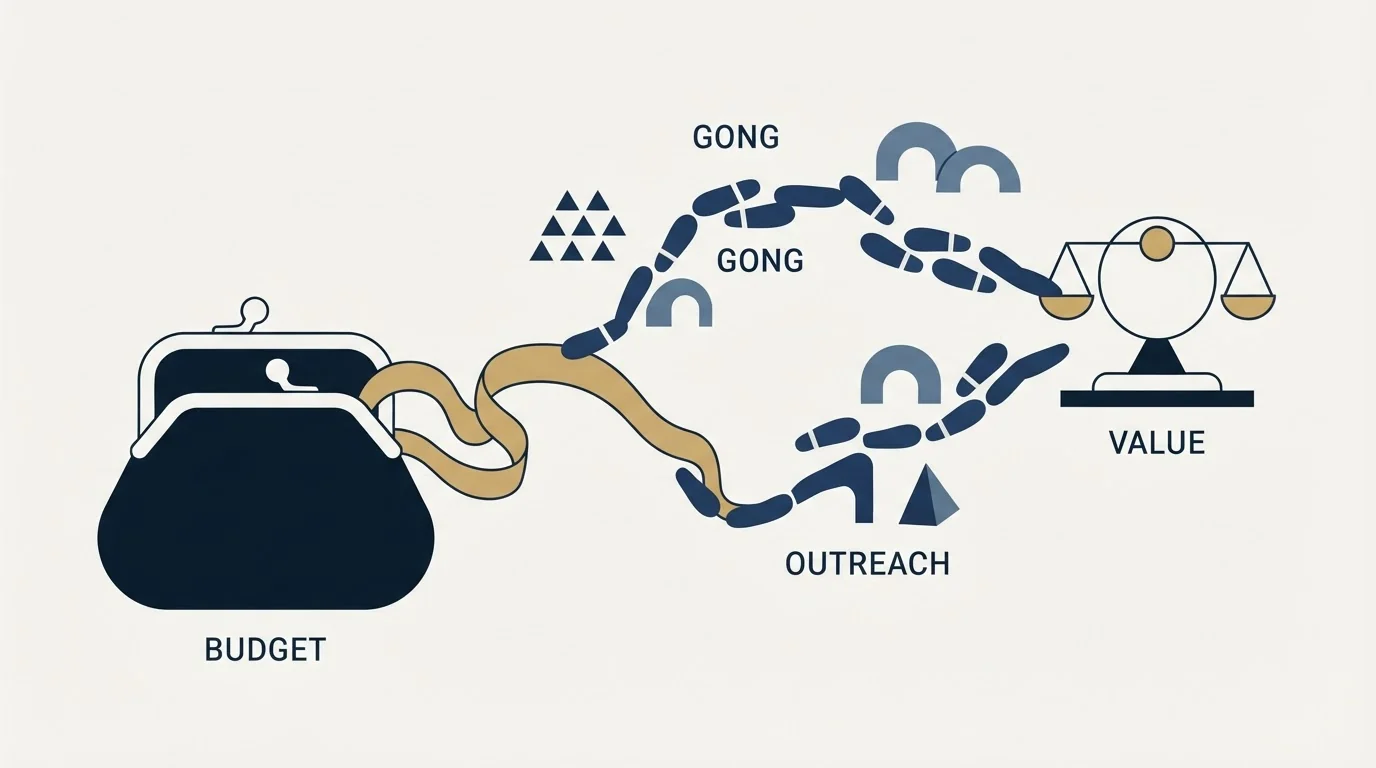
Neither vendor publishes a number. Both publish the shape of the bill, which is what can be compared honestly.
Gong. The pricing page says the model depends on a few factors: licences are priced per user, there is a platform fee based on the number of users supported, and the existing tech stack can be integrated for free. It then asks for team size and routes to a customised proposal.
Outreach. The pricing page says Outreach uses a combination of seat-based pricing and consumption-based pricing powered by AI credits, and measures consumption on discrete actions, each with a predictable credit cost, such as generating a personalised message or completing an individual search. It lists four packages, each marked Request pricing: Amplify Essentials with 10,000 AI Credits, Amplify Core with 25,000, Amplify Plus with 50,000 and Amplify Pro with 100,000. Essentials is built for conversation intelligence and Core for pipeline creation and account management; Plus includes everything in Essentials and Core, and Pro adds the forecasting suite.
Trials. Neither pricing page offers a trial; both route to a demo or a proposal.
What The Bill Actually Looks Like
Take a growth-stage team of twenty-five. Neither vendor publishes a rate, so no dollar figure is stated below and none is invented.
Gong's quote has two components that both scale with headcount: per-user licences and a platform fee based on the number of users supported. For twenty-five people that means two lines moving together, and it means a hiring plan is a pricing input. Integrating the existing tech stack is free on Gong's own page, which is a line other vendors charge for.
Outreach's quote has a fixed half and a variable half: seats for platform access plus consumption metered in AI credits. The variable half is the one that needs a price per credit pack in the contract, because a team that adopts the agents enthusiastically consumes more than one that does not, and enthusiasm is what the vendor is selling.
A useful procurement move on both: ask for the same quote at today's headcount and at headcount plus fifty percent, and compare the two deltas rather than the two totals.
What Each One Gives Up
What Gong gives up. Most of the sending layer. Gong Engage exists, but the platform is built around interactions that have already happened, so it helps least a team whose problem is that there are not enough conversations. The platform fee on top of per-user licences means headcount moves the bill twice, and there is no published rate to model against.
What Outreach gives up. Predictability. A consumption line without a known price per credit pack is a budget risk rather than a feature. And its conversation intelligence is one package among four, so a team buying Outreach primarily for call analysis should compare Amplify Essentials with Gong directly, since that is the package built for it.
The Lines After The Licence
Outreach's pricing page carries a line that reads as a direct answer to Gong's model: "Per user pricing. No platform fees. Support included." Its FAQ fills in what that support is. Plus support is included with Amplify Core, and additional managed services are included with Amplify Pro. Add-ons are sold on top, and the page names four: Data Sharing, Connectors, Additional Instances and Listener Licenses. Onboarding is quoted separately, through professional services packages that range from self-serve to complete implementation and training.
Gong's pricing page covers none of that ground: it states the licence and platform-fee model, asks for team size, and routes to a proposal. So the onboarding, support tier and retention terms are questions to put in writing before the Gong quote comes back, and the credit-pack price and add-on list are the ones to put to Outreach.
What Each Page Lists Today
Gong's homepage lists four product lines on its Revenue AI OS: Gong Engage for prioritising and personalising sales engagement, Gong Forecast, Gong Enable for enablement grounded in real customer interactions, and Gong Agents. Outreach's pricing page lists, on Amplify Essentials, real-time transcription, AI coach cards with automated scoring, live coaching, meeting summaries and an integrated dialer, and names Zoom, Microsoft Teams, Google Meet and Cisco Webex as meeting integrations. Read side by side, the overlap between the two is wider than the category names suggest: each now sells a slice of the other's core.
Switching Between Them
These are not substitutes, so a switch is usually an addition or a removal rather than a swap. Removing Gong takes the conversation archive with it; removing Outreach takes the sequences, the mailbox connections and the contacted history.
The contacted history is the item to secure first in either direction, because it is the suppression list under another name, and a team that loses it will email somebody who has already said no. Export it before the seat lapses. Recording retention and export rights sit in the contract rather than in the product, so raise them at renewal rather than at cancellation.
Where Each One Sits In A Cold Outbound Stack
Outreach sits nearest the cold outbound slot and Gong sits well after it.
House practice puts one message in a campaign and sends no bumps and no thread replies, which constrains a sequencing platform considerably. A prospect who does not answer is retargeted with a new single-message campaign rather than a follow-up under the original, and no LinkedIn no-reply retarget is sent at all, because it lands in the same thread as the message they already ignored.
Deciding which parts of a motion should run unattended is separate from choosing a platform, and which outreach stages automate cleanly sorts them stage by stage.
Gong's role begins once a meeting exists. Whether that meeting counts is agreed in writing before launch, against criteria that never include budget, timing or authority.
How To Run The Evaluation
A fortnight of real use answers more than a feature comparison does. The order below puts the questions that eliminate one of these tools before the questions that merely rank them.
In a sentence, before opening either site: understand conversations, or run the outreach.
Fixed and variable, at today's headcount and at headcount plus fifty percent.
Real calls and real sequences, rather than a demo dataset.
AI credits on Outreach, users supported on Gong, and recording retention on both.
Leaving is the expensive half: the contacted history is the suppression list under another name.
The Decision In One Table
| Gong | Outreach | |
|---|---|---|
| Published price | None; a customised proposal | None; every package says Request pricing |
| Bill shape | Per-user licences plus a platform fee by users supported | Seats plus AI credits consumed per action |
| What it centres on | Recorded customer interactions | AI agents, from conversation intelligence to sequences |
| Sequencing | Gong Engage | From Amplify Core, 25,000 AI Credits |
| Trial on the pricing page | No | No |
Final Thoughts
Gong is the buy for a team that needs to see inside its conversations. Outreach is the buy for a team that needs to run and manage the outreach at volume, and its Amplify Essentials package is the one to set against Gong when call analysis is the need.
Neither publishes a price, so get both quotes broken into fixed and variable components and model them against next year's headcount rather than this year's.
Related Reading
- Best Gong Alternatives in 2026
- Best Outreach Alternatives in 2026
- Gong vs Salesloft: Sales Engagement Platform Comparison
- Gong vs Groove by Clari: Sales Engagement Platform Comparison
- Outreach vs Salesloft: Sales Engagement Platform Comparison
If you would rather have this run for you, RevenueFlow books qualified meetings on a pay-per-meeting basis and publishes client results.
If you would rather have this run for you, RevenueFlow books qualified meetings on a pay-per-meeting basis and publishes client results.
Pricing and features are taken from the vendors' own pages. Verify current terms with the vendor before relying on them.
Frequently asked questions.
Frequently asked questions- Is Outreach.io the same as Outreach?
- Yes. Outreach moved its domain, and every outreach.io address now redirects to outreach.ai, including the pricing page. The product, the Amplify packages and the pricing model are the same whichever spelling you search, so a Gong vs Outreach.io comparison is a Gong vs Outreach comparison. Links and bookmarks to the old domain still resolve through the redirect.
- What is the difference between Gong and Outreach?
- Gong is built around recorded customer interactions, with Gong Engage, Forecast and Enable on top, and is priced per user plus a platform fee. Outreach is an AI agent platform priced by seats plus AI credits, whose packages run from conversation intelligence on Amplify Essentials to multi-channel sequences from Amplify Core upward. Gong reads conversations; Outreach mostly runs outreach.
- How much do Gong and Outreach cost?
- Neither publishes a price. Gong's pricing page says licences are priced per user with a platform fee based on the number of users supported, and routes to a customised proposal. Outreach's page marks all four packages Request pricing and combines seats with AI credits consumed per action, with additional credit packs available at any time.
- Can you use Gong and Outreach together?
- Yes, and many teams shortlist them together because they sit at different points: Outreach nearest the first touch, Gong once a meeting exists. The overlap to watch is that Outreach's Amplify Essentials is itself a conversation intelligence package, and Gong Engage covers sales engagement, so check which of the two jobs each licence is actually doing.
About the author.

Tim Carden is CMO / CTO at RevenueFlow, which builds and operates outbound revenue engines for B2B companies. Studied at McGill University.
Tim Carden · CMO / CTO
Connect on LinkedIn →Explore more.
Ready to scale your outreach?
We build GTM engines that book real meetings. See the receipts.
Related articles.
Gong vs NeverBounce: Sales Engagement Platform vs Data Enrichment Tool Comparison
Gong vs NeverBounce: what Gong's own pages say about enrichment, what NeverBounce's API returns about an address, and how each vendor prices.
AroundDeal vs Leadspicker: Data Enrichment Tool vs Sales Engagement Platform Comparison
Compare AroundDeal (data enrichment tool) and Leadspicker (sales engagement platform) side by side. See pricing, features, and integrations to decide which one, or both, your stack needs.
GetSales.io vs Yet Another Mail Merge: Sales Engagement Platform vs Cold Email Platform Comparison
Compare GetSales.io (sales engagement platform) and Yet Another Mail Merge (cold email platform) side by side. See pricing, features, and integrations to decide which one, or both, your stack needs.
ContactOut vs Luru: Data Enrichment Tool vs Sales Engagement Platform Comparison
Compare ContactOut (data enrichment tool) and Luru (sales engagement platform) side by side. See pricing, features, and integrations to decide which one, or both, your stack needs.
Enginy vs Success.ai: Sales Engagement Platform vs Cold Email Platform Comparison
Compare Enginy (sales engagement platform) and Success.ai (cold email platform) side by side. See pricing, features, and integrations to decide which one, or both, your stack needs.
Enrich Layer vs La Growth Machine: Data Enrichment Tool vs Sales Engagement Platform Comparison
Compare Enrich Layer (data enrichment tool) and La Growth Machine (sales engagement platform) side by side. See pricing, features, and integrations to decide which one, or both, your stack needs.