AiSDR vs Apollo.io: Sales Engagement Platform Comparison
Compare AiSDR and Apollo.io side by side. See pricing, features, and integrations to choose the right sales engagement platform for your needs.
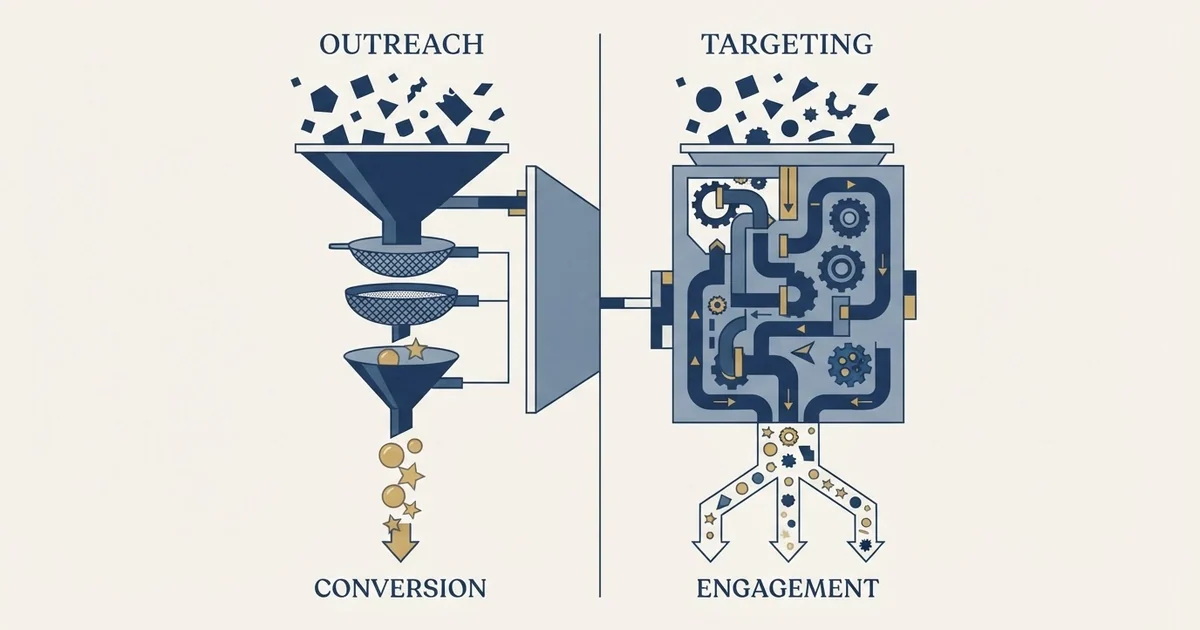
AiSDR's Solo plan buys 200 AI-researched contacts a month for $250, researched and worked by its AI agent; Explore buys 800 for $900 and Scale 2,500 for $2,500. Apollo.io sells seats from $49 a month billed annually, whose credits reveal contact data while your reps research, write and send.
Key takeaways
- AiSDR's pricing page lists 200, 800 and 2,500 AI-researched contacts a month for $250, $900 and $2,500 on its Quarterly view, or $2,400, $8,640 and $24,000 a year on Annual.
- Apollo's pricing page lists Basic at $49, Professional at $79 and Organization at $119 per seat a month billed annually, with credits that reveal an email for 1 and a phone number for 8.
- An AiSDR contact arrives researched and worked by its agent from mailboxes it sets up, while an Apollo credit arrives as data for a rep to use.
- Apollo lists unlimited sequences from Basic and A/Z testing on Professional; AiSDR lists omnichannel sequences with unlimited touchpoints on every plan.
Reviewed and updated September 21, 2026
AiSDR's cheapest plan buys 200 AI-researched contacts a month for $250. Apollo.io's cheapest paid seat buys 2,500 credits a month for $65 on monthly billing, or 30,000 a year upfront at $49 a month billed annually. Put side by side, Apollo looks cheaper by a mile, and the comparison is wrong in an instructive way: the two units do different amounts of work. An AiSDR contact is found, researched and worked by an AI agent. An Apollo credit reveals an email address, and a person on your team does everything after that.
This page reads both pricing pages as they display today, sets out what each unit buys, and works the numbers for a team that wants 800 new contacts a month. For background on the category, see our explainer on what an AI SDR is.
AiSDR's 200 AI-researched contacts: what the Solo plan buys
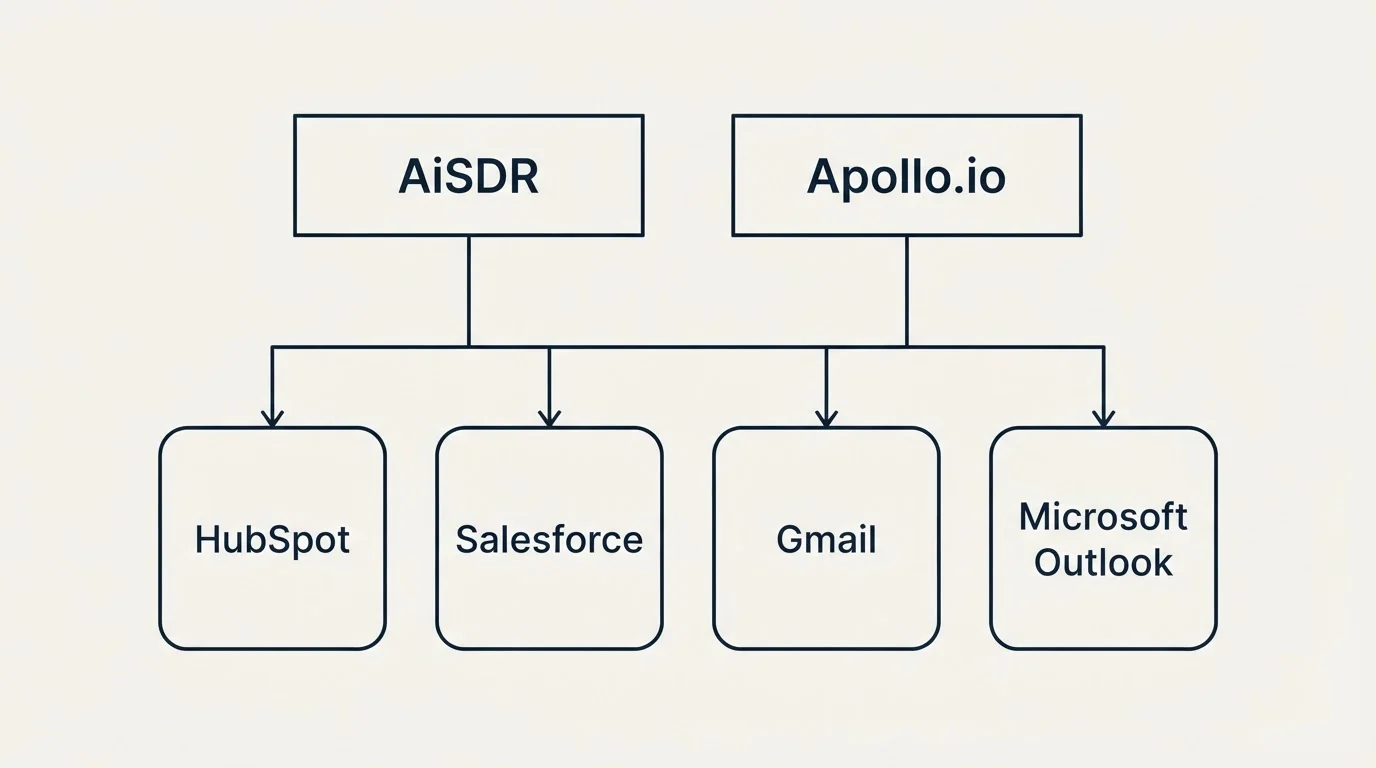
AiSDR's Solo plan lists 200 AI-researched contacts a month for $250 a month, with 1 user, 1 domain, 3 mailboxes and 1 LinkedIn account. Each contact is one the AiSDR agent researches and then works through AI-written emails and LinkedIn actions on autopilot. Explore raises it to 800 a month for $900, and Scale to 2,500 for $2,500.
The Solo card describes a sales team of one: founders and solo sellers who want pipeline without the headcount. It includes Ami AI, which the page calls your expert GTM agent, unlimited AI personas, turnkey email setup and warmup, a native two-way HubSpot sync and self-serve onboarding with email and in-app chat support. Solo is the one plan the page says runs month to month.
AiSDR pricing: three plans priced by researched contacts
AiSDR's pricing page opens on its Quarterly view: Solo at $250 a month, Explore at $900 and Scale at $2,500, for 200, 800 and 2,500 AI-researched contacts a month. Switched to Annual, advertised at 20% off, the same plans read $2,400, $8,640 and $24,000 a year. The page adds that all plans are billed monthly, and that Explore and Scale carry quarterly contracts, cancel anytime.
The tiers add capacity and services as well as contacts. Explore gives unlimited users, 2 domains, 6 mailboxes and 5 LinkedIn accounts, AI research and monitoring of HubSpot data, LinkedIn signals from post engagement, profile visits and keyword tracking, and a per-campaign managed service for +$149 a campaign. Scale gives 6 domains, 18 mailboxes and 20 LinkedIn accounts, native two-way Salesforce sync, AI videos in messages and AI voice notes in LinkedIn messages, website visitor tracking, and a fully managed service for +$2,500 a month.
Divide each price by its contacts and the cost per researched contact falls from $1.25 on Solo to $1.00 on Scale on the Quarterly view, and from $1.00 to $0.80 on Annual. That arithmetic is derived from the page, which does not print a per-contact price itself.
The page explains the quarterly contract in terms of infrastructure. It says it takes 30+ days to safely get multiple inboxes ready for the sending volume a plan needs, which is why Explore and Scale commit for a quarter, while Solo starts sending sooner with fewer mailboxes to warm up. Every plan sends from mailboxes AiSDR creates and warms for you, so the warmup period is part of what the first quarter of a contract pays for, before the plan reaches its full contact volume.
| Plan | Quarterly, or Annual | Contacts a month, cost each |
|---|---|---|
| Solo | $250 a month, or $2,400 a year | 200, at $1.25 or $1.00 |
| Explore | $900 a month, or $8,640 a year | 800, at $1.125 or $0.90 |
| Scale | $2,500 a month, or $24,000 a year | 2,500, at $1.00 or $0.80 |
Sending capacity: Solo 1 domain, 3 mailboxes, 1 LinkedIn account; Explore 2, 6 and 5; Scale 6, 18 and 20. All plans are billed monthly; Explore and Scale carry quarterly contracts; Annual is advertised at 20% off.
What every AiSDR plan includes
Beyond the per-plan specs, the pricing page lists a long set of inclusions common to all three plans. On the sending side: email through Gmail or Outlook, LinkedIn connection requests, direct messages and InMail, replies in 5 to 10 minutes or in co-pilot mode, and AI call steps with the Aircall dialer. On the list side: live AI lead search from a conversational ICP description, real-time list building on qualification criteria and intent signals, champion tracking, finding people who changed jobs, and processing your existing lead lists with data enrichment. On deliverability: creation of new mailboxes, ongoing domain warmup, 3x bounce checks before sending, domain health tracking, automated inbox rotation and cleaning out leads who unsubscribe.
LinkedIn is worth a note of its own. AiSDR runs LinkedIn actions on autopilot beside email. RevenueFlow runs LinkedIn as its own motion and never sends a second LinkedIn message to someone who did not answer the first, so a team adopting an agent like this should decide how its LinkedIn steps are configured before the first campaign goes out.
Apollo pricing: seats and credits
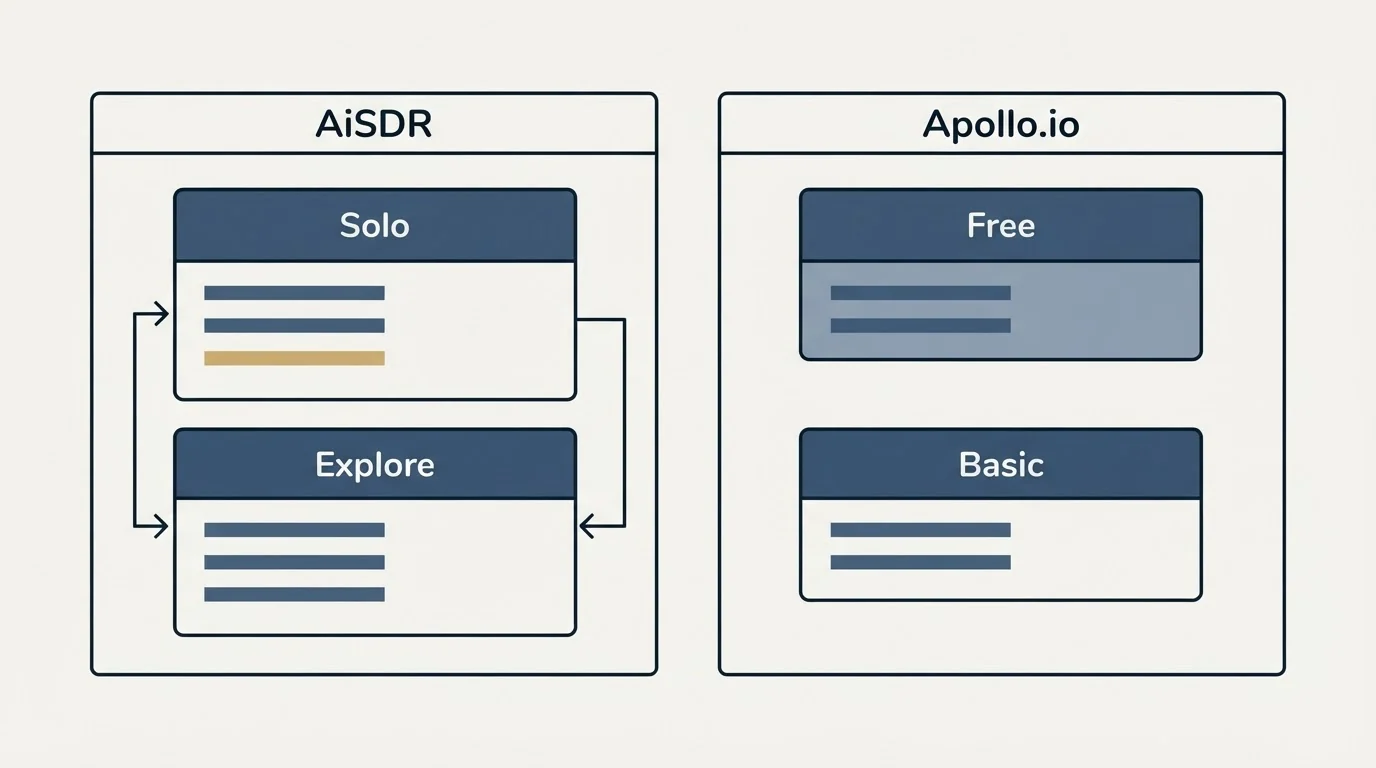
Apollo's pricing page opens on annual billing: Basic at $49, Professional at $79 and Organization at $119 per seat a month, with Organization requiring 3 seats. On monthly billing Basic reads $65 and Professional $99, while Organization shows $149 marked Annual Only. A Free plan at $0 carries 900 credits per seat per year. Each paid seat brings credits, 30,000, 48,000 or 72,000 a year upfront on annual billing, or 2,500 and 4,000 a month on monthly Basic and Professional. An email costs 1 credit and a phone number 8, and the page describes the database as 240M contacts and 30M companies. Basic and Professional each carry a 14-day trial, and upgrades of plan or seat count take effect immediately, while cancellations take effect at the end of the current term.
The full ladder, and what drives the bill beyond the seat price, is set out in our Apollo.io pricing breakdown.
Can SDR teams build multi-step sequences with A/B testing in Apollo?
Yes, by Apollo's own pricing page. Its Basic card lists unlimited sequences, and its Professional card lists unlimited sequences with A/Z testing, alongside prospecting, Gmail and Salesforce extensions and a deliverability suite. The rep builds the steps, the follow-ups and the variants; Apollo runs them. AiSDR's page lists configurable omnichannel sequences with unlimited touchpoints on every plan, with its agent writing the messages.
Both vendors sell follow-up sequences as a core feature. RevenueFlow's own campaigns send one message per campaign, with no bumps and no thread replies, so treat the sequence depth on either page as the vendor's feature rather than a recommendation. The reasoning is in why we stopped using follow-ups.
What one unit buys on each side
The honest comparison starts with the unit. AiSDR's pricing page says every plan includes deep research of the top 3 most relevant data points for each lead, a native database of 300M+ leads, the Sales Navigator database for real-time LinkedIn data, suppression lists, the creation of new mailboxes and ongoing domain warmup. So an AiSDR contact arrives researched, written to and sent from infrastructure AiSDR sets up. An Apollo credit arrives as data. The seat also carries sequences, a dialer and a deliverability suite, but the research, the writing and the decision to send are the rep's.
One AiSDR contact
- Researched by the agent, top 3 data points per lead
- Worked by AI-written emails and LinkedIn actions
- Sent from mailboxes AiSDR creates and warms
- Picked from a native database of 300M+ leads, or your list
One Apollo credit
- Reveals one email; a phone number costs 8
- From a database of 240M contacts and 30M companies
- A rep builds and sends the sequence
- Credits come with each seat, 2,500 a month on Basic monthly
What 800 contacts a month costs (illustrative)
These sums use list prices only, so read them as illustrative arithmetic. AiSDR's Explore plan covers 800 AI-researched contacts a month for $900 a month on the Quarterly view. On Apollo, 800 email reveals a month is 800 credits, which one Basic seat's 2,500 monthly credits covers; two seats, so that two reps can share the work, cost 2 x $65 = $130 a month on monthly billing, or 2 x $49 = $98 a month billed annually.
The gap is the labour. The Apollo figure buys data and the tooling to send; the AiSDR figure buys the agent's research, copy and sending as well, plus 2 domains and 6 mailboxes. A team comparing the two is really comparing $900 against $98 or $130 plus the hours two reps spend researching, writing and sending to 800 people a month. Neither pricing page names a currency beside its dollar sign, so the figures are shown side by side and never combined.
Which one fits
- Choose AiSDR if you want outbound done by an agent: research, copy and sending, with mailboxes set up for you, priced per contact worked. Solo is the month-to-month entry at $250.
- Choose Apollo if you have reps who will do the work and need a database, sequences and a dialer per seat, from $49 a seat a month billed annually.
- Look further if neither shape fits. The best Apollo alternative for AI SDR workflows depends on how much of the work you want automated, and our guides to the best Apollo alternatives and the best AiSDR alternatives compare the field.
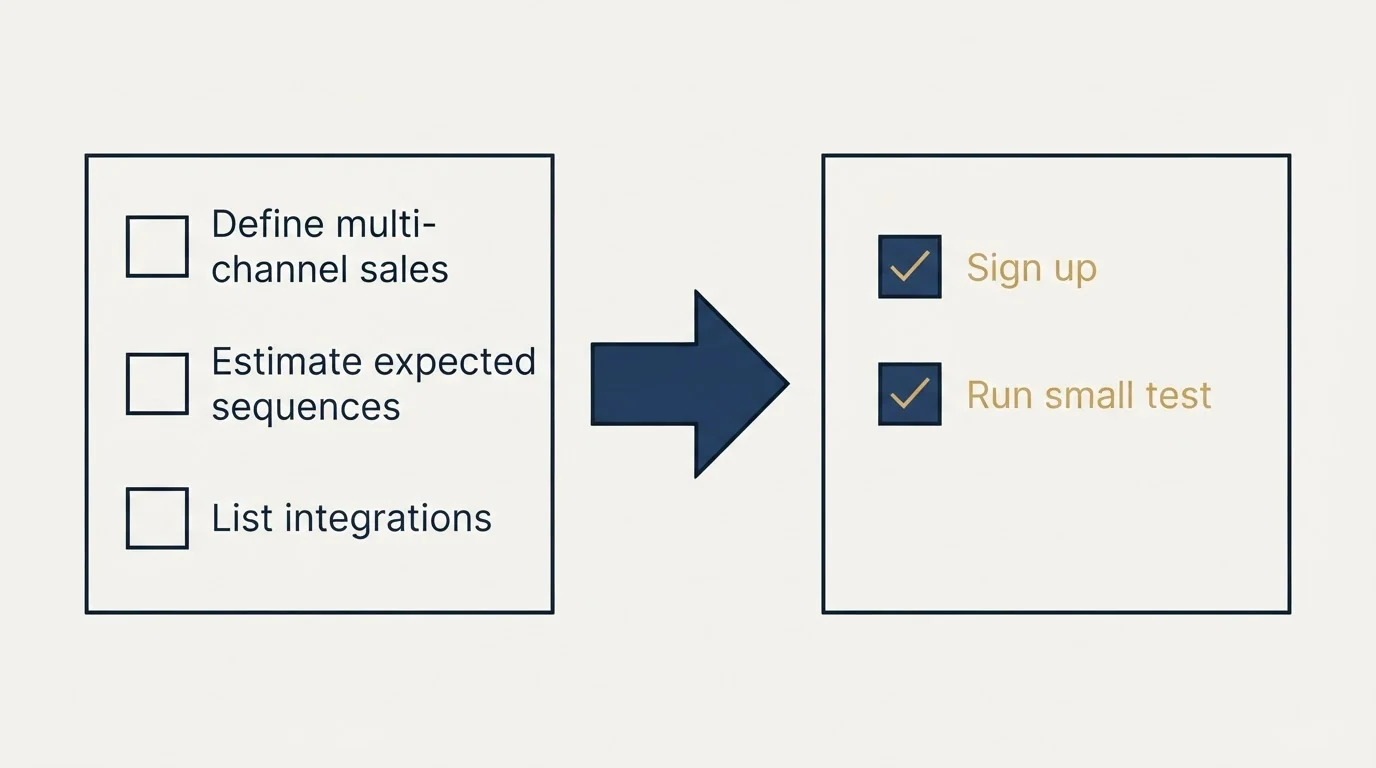
Whichever you pick, the constraint on booked meetings is usually the list and the message, not the tool. See what a free campaign looks like if you would rather have outbound run for you.
Pricing and features are taken from the vendors' own pages. Verify current terms with the vendor before relying on them.
Frequently asked questions.
Frequently asked questions- What does AiSDR's Solo plan include?
- AiSDR's pricing page lists Solo at $250 a month for 200 AI-researched contacts a month, 1 user, 1 domain, 3 mailboxes and 1 LinkedIn account. It includes the Ami AI GTM agent, AI-written emails and LinkedIn actions on autopilot, unlimited personas, turnkey email setup and warmup, and a two-way HubSpot sync. Solo is the plan the page says runs month to month.
- Can SDR teams build multi-step email sequences with A/B testing in Apollo.io?
- Yes. Apollo's pricing page lists unlimited sequences on Basic and unlimited sequences with A/Z testing on Professional, from $49 and $79 a seat a month billed annually. The rep builds the steps and variants and Apollo runs them. RevenueFlow's own campaigns send one message per campaign, so treat sequence depth as the vendor's feature, not a recommendation.
- Is AiSDR more expensive than Apollo?
- Per unit it looks that way, but the units differ. AiSDR charges $250 for 200 contacts its agent researches and works, about $1.25 each. Apollo's Basic seat is $65 a month on monthly billing for 2,500 credits, and a credit only reveals an email. On Apollo, the research, writing and sending are your reps' time, which the seat price does not include.
- What is the best Apollo alternative for AI SDR workflows?
- It depends on how much of the work you want automated. AiSDR's agent researches, writes and sends from mailboxes it sets up, priced per contact worked, while Apollo sells seats to reps who do that work themselves. Our guides to the best Apollo alternatives and the best AiSDR alternatives compare the wider field of tools on that axis.
About the author.

Tim Carden is CMO / CTO at RevenueFlow, which builds and operates outbound revenue engines for B2B companies. Studied at McGill University.
Tim Carden · CMO / CTO
Connect on LinkedIn →Explore more.
Ready to scale your outreach?
We build GTM engines that book real meetings. See the receipts.
Related articles.
AiSDR vs Clearout: Sales Engagement Platform vs Data Enrichment Tool Comparison
Compare AiSDR (sales engagement platform) and Clearout (data enrichment tool) side by side. See pricing, features, and integrations to decide which one, or both, your stack needs.
AroundDeal vs Leadspicker: Data Enrichment Tool vs Sales Engagement Platform Comparison
Compare AroundDeal (data enrichment tool) and Leadspicker (sales engagement platform) side by side. See pricing, features, and integrations to decide which one, or both, your stack needs.
GetSales.io vs Yet Another Mail Merge: Sales Engagement Platform vs Cold Email Platform Comparison
Compare GetSales.io (sales engagement platform) and Yet Another Mail Merge (cold email platform) side by side. See pricing, features, and integrations to decide which one, or both, your stack needs.
Gong vs NeverBounce: Sales Engagement Platform vs Data Enrichment Tool Comparison
Gong vs NeverBounce: what Gong's own pages say about enrichment, what NeverBounce's API returns about an address, and how each vendor prices.
ContactOut vs Luru: Data Enrichment Tool vs Sales Engagement Platform Comparison
Compare ContactOut (data enrichment tool) and Luru (sales engagement platform) side by side. See pricing, features, and integrations to decide which one, or both, your stack needs.
Enginy vs Success.ai: Sales Engagement Platform vs Cold Email Platform Comparison
Compare Enginy (sales engagement platform) and Success.ai (cold email platform) side by side. See pricing, features, and integrations to decide which one, or both, your stack needs.