AI SDR: What It Replaces, What It Doesn't and What It Costs
AI SDRs handle research, list building, sending and reply triage well. Discovery, objections and relationships do not transfer. Capability matrix and real pricing.
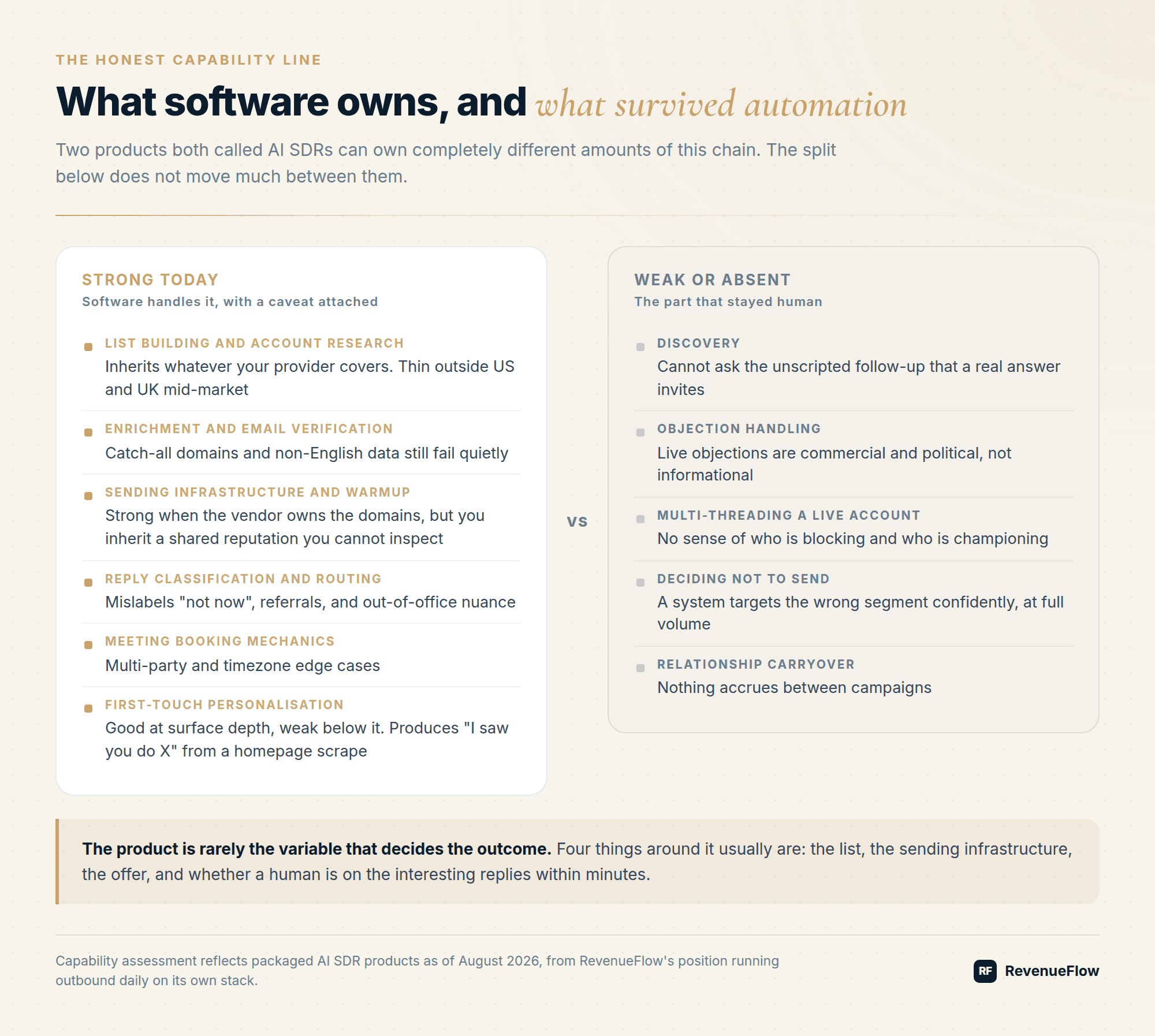
An AI SDR automates the mechanical half of sales development: list building, account research, first-touch drafting, sending, reply classification and meeting booking. Discovery, objection handling, multi-threading and the judgment to not send stay human. Published pricing runs from $250 per month to roughly $2,500 per month, with autonomous agents quoted privately.
Key takeaways
- AI SDRs reliably own six steps: list building, research, personalisation, sending, reply triage and booking.
- Four capabilities do not transfer: discovery, objection handling, multi-threading and deciding not to send.
- AiSDR publishes tiers at $250, $900 and $2,500 per month; Regie.ai's seat minimums put a real floor near $1,800 per month.
- Artisan and 11x quote privately, with third-party estimates of $2,000 to $5,000 per month and year-one budgets of $60,000 to $100,000.
- Cost per meeting decides the renewal: a $30,000 annual contract is $625 per meeting at four a month and $2,500 per meeting at one.
- A March 2025 TechCrunch investigation into 11x, which the company disputed, made customer-chosen references and cohort retention standard diligence in the category.
Reviewed and updated September 5, 2026
AI SDR: What It Actually Replaces, What It Doesn't, and What It Costs
An AI SDR is software that runs the mechanical half of sales development: building a target list, researching each account, drafting a first-touch message, sending it across email and LinkedIn, classifying the reply, and booking a meeting. The category term hides an enormous range. Two products both called AI SDRs can own completely different amounts of that chain.
SDR agent is the same category under another name, and it is worth reading a vendor's use of the phrase carefully, because some outsourcing firms use it for a human sales development rep working under contract rather than for software.
RevenueFlow runs outbound every day on its own stack rather than a packaged AI SDR, which puts us on the buyer's side of this table often enough to have a settled view. Below is the honest capability line, the named landscape as of mid-2026, published pricing, and the diligence questions that separate a working deployment from a cancelled contract.
Three product shapes, one category term
Autonomous outbound agents. Artisan (its agent is called Ava) and 11x (Alice for outbound, Julian for voice) sell an end-to-end worker: sourcing, research, personalisation, sending, reply handling, booking. You supervise rather than operate.
Copilots for an existing team. Regie.ai sits inside the workflow of human reps, drafting and prioritising while a person keeps the decision. Instantly and Apollo occupy similar ground from the sending and data side.
Managed hybrids. AiSDR and several newer entrants run autonomously on paper but land in practice as a managed service with a human on the account.
The shape matters more than the feature list. An agent with nobody supervising it produces volume you will apologise for. A copilot with nobody using it produces nothing at all.
The honest capability matrix
Buyers ask directly whether outreach is fully automated or human managed, and this matrix is what makes the answer checkable rather than reassuring. Ask which specific steps the automation performs unattended and which a person reviews before anything sends, because the answer differs by step and a single word covering the whole programme is not an answer.
| Job in the chain | How software handles it today | What still goes wrong |
|---|---|---|
| List building and account research | Strong | Inherits whatever your provider covers; thin outside US and UK mid-market |
| Enrichment and email verification | Strong | Catch-all domains and non-English data still fail quietly |
| First-touch personalisation | Good at surface depth, weak below it | Produces "I saw you do X" from a homepage scrape, rarely a real observation |
| Sending infrastructure and warmup | Strong when the vendor owns the domains | You inherit the reputation of a shared pool you cannot inspect |
| Reply classification and routing | Strong | Mislabels "not now", referrals, and out-of-office nuance |
| Meeting booking mechanics | Strong | Multi-party and timezone edge cases |
| Discovery | Weak | Cannot ask the unscripted follow-up that a real answer invites |
| Objection handling | Weak | Live objections are commercial and political, not informational |
| Multi-threading a live account | Weak | No sense of who is blocking and who is championing |
| Deciding not to send | Weak | A system targets the wrong segment confidently, at full volume |
| Relationship carryover | None | Nothing accrues between campaigns |
The top half of that table is roughly the same list we published in the five things B2B companies hire SDRs to do. The bottom half is the part that survived automation, which is why the role that replaces the SDR looks like a GTM engineer rather than a cheaper rep.
The named landscape and what it costs
| Vendor | Shape | Channels | Pricing signal (mid-2026) |
|---|---|---|---|
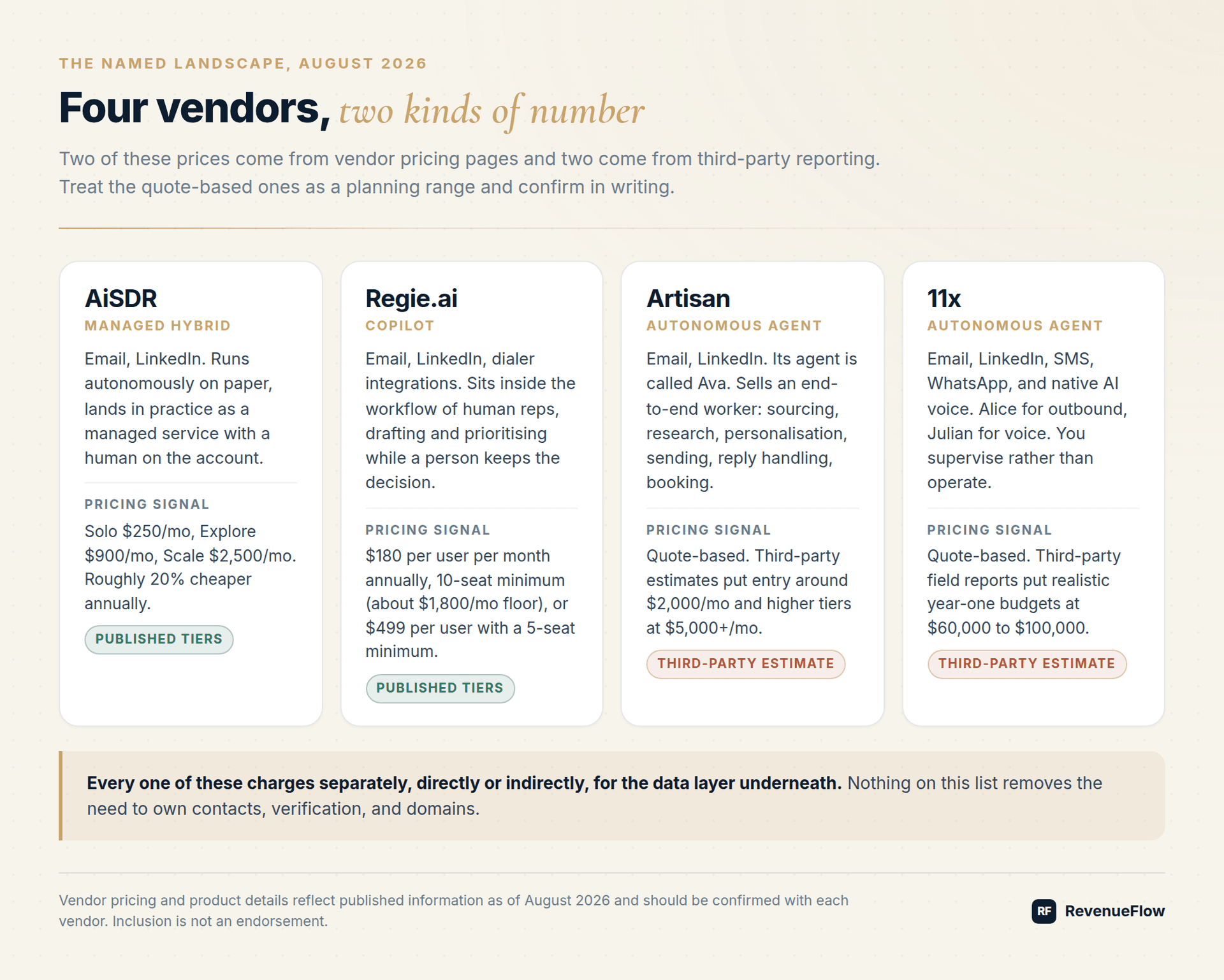
| AiSDR | Managed hybrid | Email, LinkedIn | Public tiers: Solo $250/mo, Explore $900/mo, Scale $2,500/mo, roughly 20% cheaper annually |
| Regie.ai | Copilot | Email, LinkedIn, dialer integrations | $180 per user per month billed annually with a 10-seat minimum (about $1,800/mo floor), or $499 per user per month with a 5-seat minimum |
| Artisan | Autonomous agent | Email, LinkedIn | Quote-based. Third-party estimates put entry around $2,000/mo and higher tiers at $5,000+/mo |
| 11x | Autonomous agent | Email, LinkedIn, SMS, WhatsApp, and native AI voice | Quote-based. Third-party field reports put realistic year-one budgets at $60,000 to $100,000 |
Two of those four numbers come from vendor pricing pages and two come from third-party reporting, so treat the quote-based ones as a planning range and confirm in writing. Every one of these vendors also charges separately, directly or indirectly, for the data layer underneath. Nothing on this list removes the need to own contacts, verification, and domains, which is the argument behind the seven-layer GTM AI stack.
The diligence lesson the category earned
In March 2025, TechCrunch published an investigation into 11x reporting that companies whose logos appeared on the site were not customers or had only briefly trialled the product, and citing former staff describing heavy churn in the first months. ZoomInfo was reported to have stopped after roughly a month. 11x disputed the reporting publicly and stated a retention rate of 79 percent.
You do not need to decide who was right to take the buyer's lesson from it. Three things belong in every AI SDR evaluation now:
- References you choose. Ask for three customers in your segment who are past month six, and pick which ones you call.
- Cohort retention, not logo walls. The question is what share of customers who started twelve months ago are still paying, not how many logos exist.
- A break clause with a real trigger. Tie it to a booked-meeting threshold on an agreed qualification definition, not to satisfaction.
What actually determines whether it works
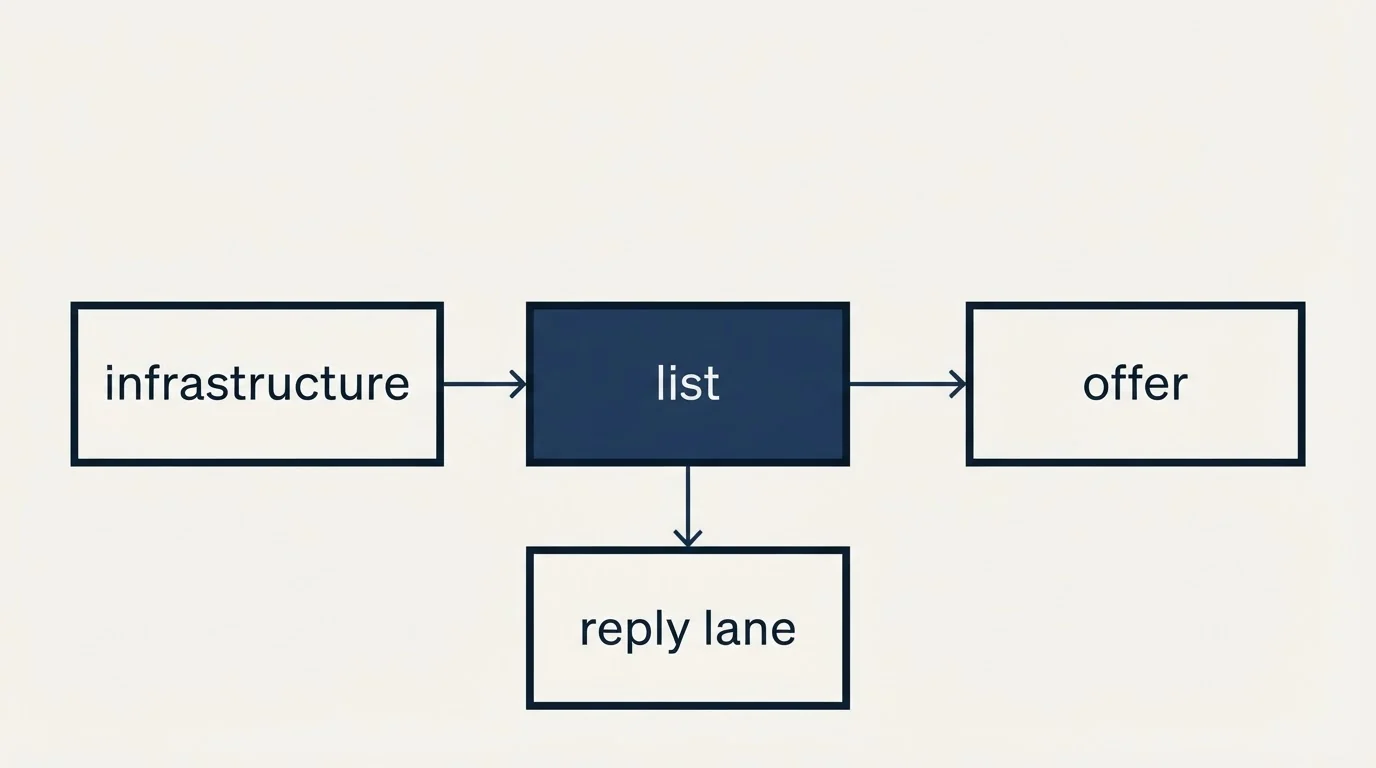
The product is rarely the variable that decides the outcome. Four things upstream and downstream of it usually are.
- Yes: The list. An AI SDR executing against a loose target definition burns your domains faster than a human would.
- Yes: The infrastructure. Volume through too few domains is the most common cause of a dead deployment
- Yes: The offer. No agent rescues a message that gives the reader no reason to reply.
- Yes: The reply lane. Software that books meetings still needs a human on the interesting replies within minutes
The list. An AI SDR executing against a loose target definition burns your domains faster than a human would. Fix the definition first, using a real ICP with the TAM math attached.
The infrastructure. Volume through too few domains is the most common cause of a dead deployment, which is why we hold far more sending capacity than the plan needs.
The offer. No agent rescues a message that gives the reader no reason to reply.
The reply lane. Software that books meetings still needs a human on the interesting replies within minutes, because the fastest responder wins the deal.
Whichever product you pick, someone still owns the handoffs between steps. That runtime job is the one no vendor sells, and it is the reason we map stacks by job in the eight GTM agent workflows that matter.
The cost comparison people actually want
Software cost is the easy part of the arithmetic and the least useful. Cost per booked meeting is the number that decides renewals.
Take the $2,500 per month tier as an example: $30,000 a year. At four qualified meetings a month, that is $625 a meeting. At one a month, the same contract costs $2,500 a meeting. The subscription did not change. The list, the offer, and the infrastructure did.
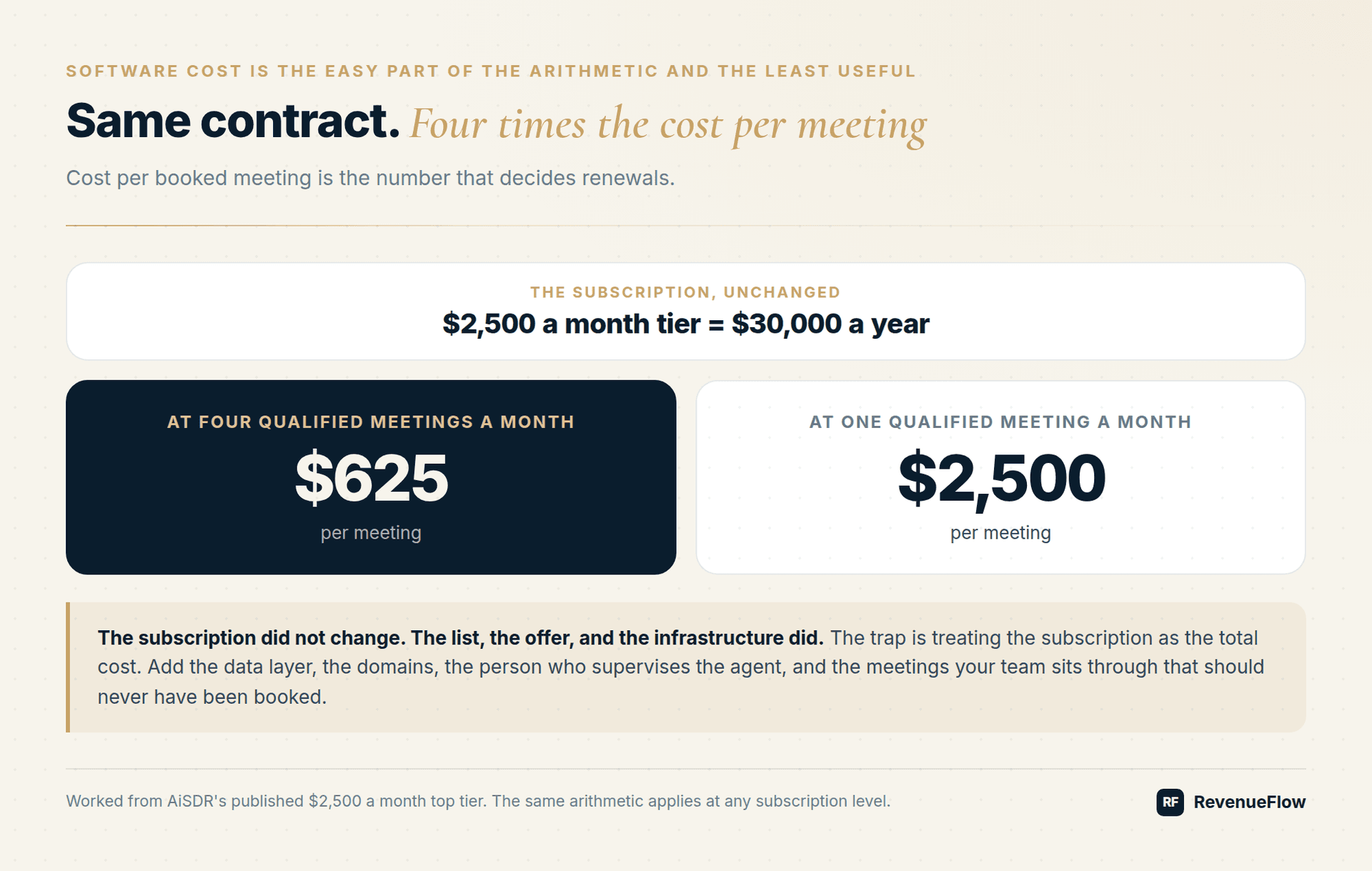
Set against a fully loaded in-house SDR, the software line is small, which is the point we made when we worked through what a $180K-a-year SDR function actually costs. The trap is treating the subscription as the total cost. Add the data layer, the domains, the person who supervises the agent, and the meetings your team sits through that should never have been booked.
Who should buy one, and who should not
Buy one if you have a proven offer, a defined ICP, an existing reply process, and you want to add volume without adding headcount. Autonomy is a multiplier on something that already converts.
Do not buy one if you have not yet booked meetings manually in this market. An AI SDR will scale your unproven message to ten thousand people and you will learn nothing except which domains are now burnt.
Frequently Asked Questions
Does an AI SDR replace a human SDR?
It replaces the mechanical portion of the job: list building, research, drafting, sending, reply sorting, and booking. Discovery, objection handling, multi-threading and relationship building remain human. Most teams that deploy one end up with fewer, more senior people rather than none.
How much does an AI SDR cost in 2026?
Published pricing runs from $250 a month at AiSDR's entry tier to $2,500 a month at its top tier. Regie.ai's seat minimums put a real floor around $1,800 a month. Artisan and 11x quote privately, with third-party estimates of $2,000 to $5,000 a month and year-one budgets of $60,000 to $100,000 respectively.
What is the biggest reason AI SDR deployments fail?
Targeting. The software executes a bad list faster and more confidently than a person would, and the damage shows up as domain reputation rather than as an obvious error. The second most common reason is nobody owning the replies.
Are AI SDRs safe for domain reputation?
Only if you can inspect the sending setup. Vendors that supply their own inboxes give you speed and a shared reputation you do not control. Ask how many domains your volume is spread across and who else sends from them.
We build AI-native pipeline systems and you pay per qualified meeting, not a retainer. If you want the outbound engine operated for you, see if you qualify.
Vendor pricing and product details reflect published information as of mid-2026 and should be confirmed with each vendor. Inclusion is not an endorsement.
Frequently asked questions.
Frequently asked questions- Does an AI SDR replace a human SDR?
- It replaces the mechanical portion: list building, research, drafting, sending, reply sorting and booking. Discovery, objection handling, multi-threading and relationship building remain human work. Most teams that deploy one successfully end up with fewer and more senior people rather than none at all, because someone still has to own the interesting replies and the targeting decisions.
- How much does an AI SDR cost in 2026?
- AiSDR publishes tiers at $250, $900 and $2,500 per month, roughly 20 percent cheaper billed annually. Regie.ai charges $180 per user per month annually with a 10-seat minimum, which is about $1,800 per month in practice. Artisan and 11x quote privately, with third-party estimates of $2,000 to $5,000 per month and year-one budgets of $60,000 to $100,000.
- Why do AI SDR deployments fail?
- Targeting is the usual cause. The software executes a weak list faster and more confidently than a person would, and the damage shows up as burnt domain reputation rather than an obvious error. The second most common cause is nobody owning replies, so interested prospects wait hours for a human response that should have taken minutes.
- Are AI SDRs safe for domain reputation?
- Only when you can inspect the sending setup. Vendors that supply their own inboxes give you speed and a shared reputation you cannot control or audit. Ask how many domains your volume spreads across, what the per-inbox daily cap is, and who else sends from the same pool before signing anything.
- Should a company buy an AI SDR before it has booked meetings manually?
- No. Autonomy multiplies whatever already converts. Without a proven offer and a defined ICP, an AI SDR scales an untested message to thousands of contacts, and the only lesson available afterwards is which domains are now damaged. Prove the message on a small manual batch first, then add volume.
About the author.

Tim Carden is CMO / CTO at RevenueFlow, which builds and operates outbound revenue engines for B2B companies. Studied at McGill University.
Tim Carden · CMO / CTO
Connect on LinkedIn →Explore more.
Ready to scale your outreach?
We build GTM engines that book real meetings. See the receipts.
Related articles.
Claude Code Is the Best GTM Tool of 2026
Your GTM stack is fine. The problem is that you are the integration layer holding it together. Here is what changes when an agent with API access takes that job instead.
AI Sales Agents: 6 Jobs They Do Well and 4 They Fail At
Agents plan and act, copilots suggest, workflows follow a fixed path. Here are the six sales jobs agents handle today, the four they fail, and the buying test.
AI Appointment Setters vs Human Setters: Cost per Meeting
2026 pricing for voice AI setters, AI SDR platforms, human setters and agencies, with a cost-per-meeting table that adds back oversight and no-shows.
Claude Code for RevOps: 5 Workflows to Run From the Terminal
Five recurring RevOps jobs run from the terminal with Claude Code: pipeline hygiene, forecasting, deal intelligence, lead routing and attribution, and the team setup.
Outbound Teams Hold Their Stack With 3 Ops People or 22 APIs
Five categories of tooling, all API-addressable, run from one terminal. Here is the full stack, what MCP actually changes, and the honest version of what replaces the ops headcount.
Chat App or Engineer: 5 B2B Marketing Workflows
Competitor teardowns, campaign reports, a versioned brand voice file, SEO refresh, and ABM briefs. Five workflows that read real files, run real scripts, and write finished artifacts to disk.