The 8 Agent Workflows That Matter From 48 GTM Tools
Organise your stack by job, not by vendor. Most teams have three jobs covered twice and two covered by nobody, and the eighth job is the one no vendor sells you.
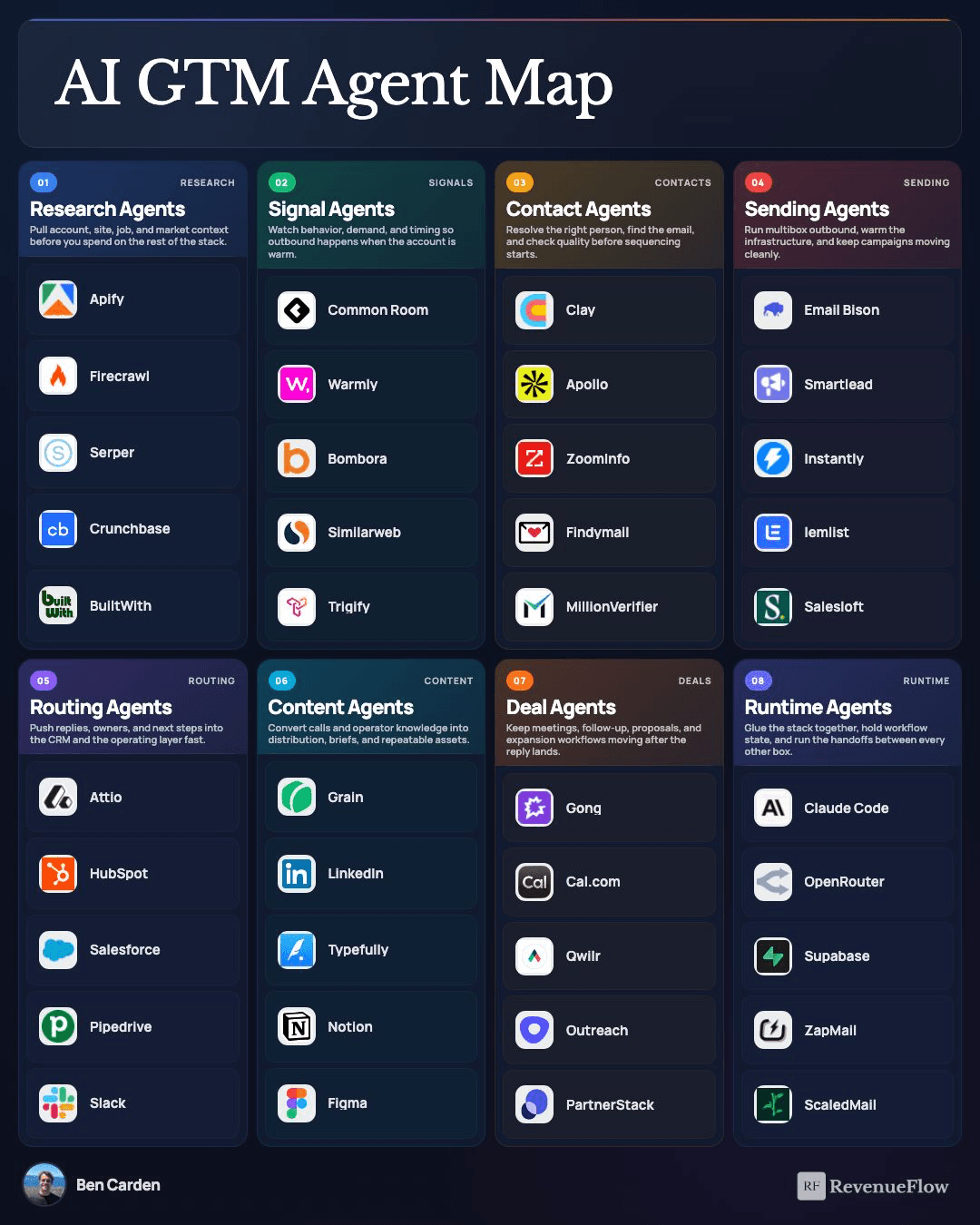
A functional GTM agent stack contains eight distinct jobs: research, signals, contacts, sending, routing, content, deals, and runtime. Most teams duplicate coverage in contacts and sending while leaving content and runtime (especially runtime, the workflow layer between tools) completely unowned. Organizing by job function rather than vendor category immediately reveals which capabilities you've bought twice and which critical handoffs have no owner.
Key takeaways
- Testing 48 GTM tools across 150+ hours revealed that integration quality matters more than individual tool capability, with most products in each category performing within a similar band.
- The runtime job (deciding what runs when, in what order, and handling failures) has no vendor category and is typically handled manually by a person with calendar reminders.
- Most GTM stacks have two or three tools covering contacts and sending while content and runtime jobs have zero ownership.
- Free trials fail to expose real problems that only appear at 10,000+ records, with international data, and after three months of accumulated edge cases.
- Six handoffs exist between research and deals, and each handoff is a point where processes stop until someone manually moves them forward.
Reviewed and updated September 5, 2026
The 8 Agent Workflows That Actually Matter
I spent more than 150 hours testing 48 GTM tools. The most useful output was not a shortlist of products. It was a way of organising the problem.
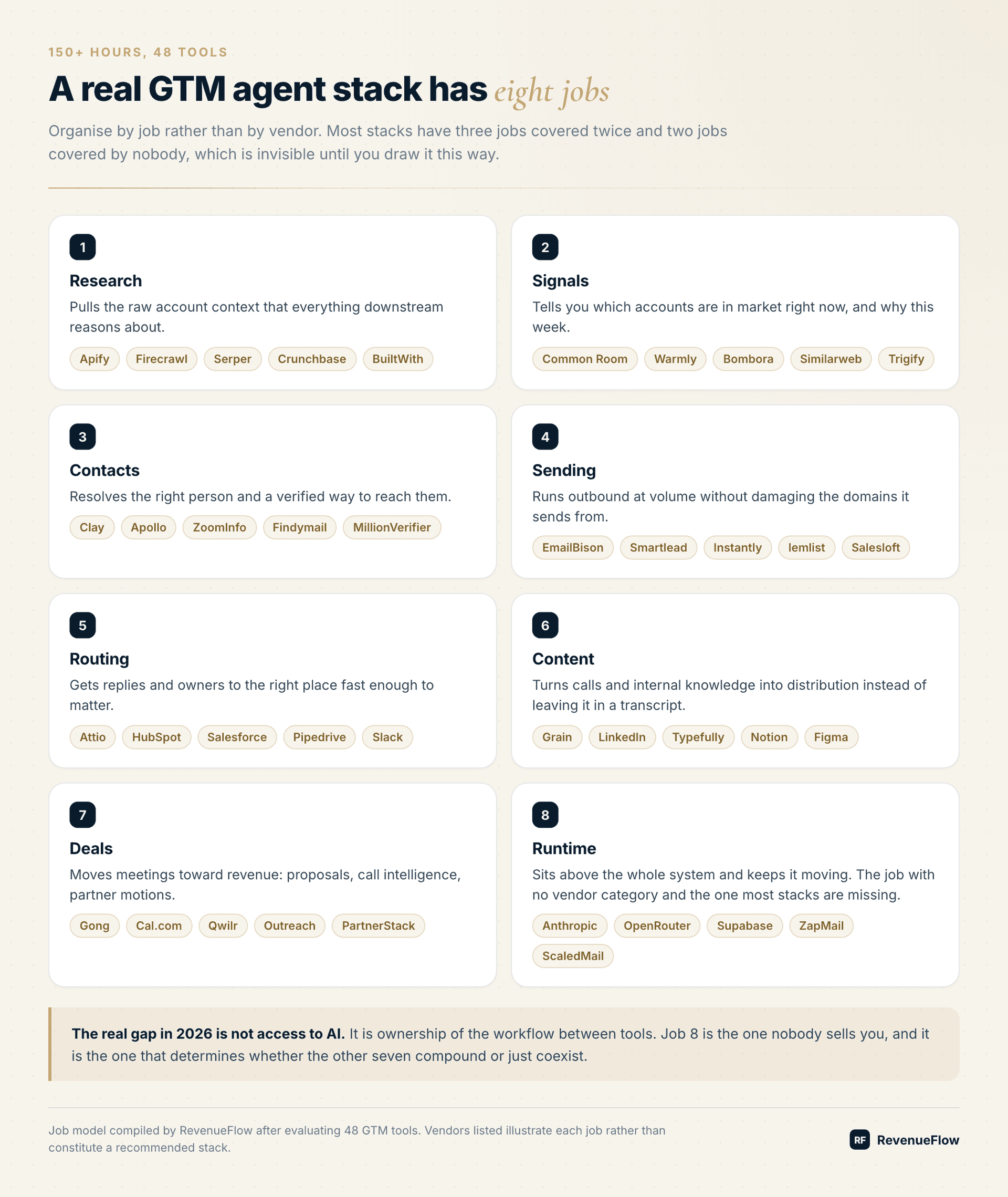
A real GTM agent stack has jobs for: research, signals, contacts, sending, routing, content, deals, and runtime.
The 2026 Map
Research. Apify, Firecrawl, Serper, Crunchbase, BuiltWith. Pulls the raw account context that everything downstream reasons about.
Signals. Common Room, Warmly, Bombora, Similarweb, Trigify. Tells you which accounts are in market right now.
Contacts. Clay, Apollo, ZoomInfo, Findymail, MillionVerifier. Resolves the right person and a verified way to reach them.
Sending. EmailBison, Smartlead, Instantly, lemlist, Salesloft. Runs outbound at volume without destroying the domains it sends from.
Routing. Attio, HubSpot, Salesforce, Pipedrive, Slack. Gets replies and owners to the right place quickly.
Content. Grain, LinkedIn, Typefully, Notion, Figma. Turns calls into distribution.
Deals. Gong, Cal.com, Qwilr, Outreach, PartnerStack. Moves meetings toward revenue.
Runtime. Anthropic, OpenRouter, Supabase, ZapMail, ScaledMail. Sits above the whole system and keeps it moving.
Why Organise By Job
Vendor categories are drawn by vendors, and they overlap deliberately. Apollo appears in contacts and sending. Clay appears in research and contacts. Outreach appears in sending and deals.
If you shop by category, you buy overlapping products without noticing, because each purchase looked like it filled a different box.
Organise by job and the picture changes. Draw the eight jobs, write your current tools next to each, and two things become visible immediately: the jobs with three owners, and the jobs with none.
In almost every stack I have audited, contacts and sending have two or three owners each, while content and runtime have zero.
The Eighth Job Is The One Nobody Sells You
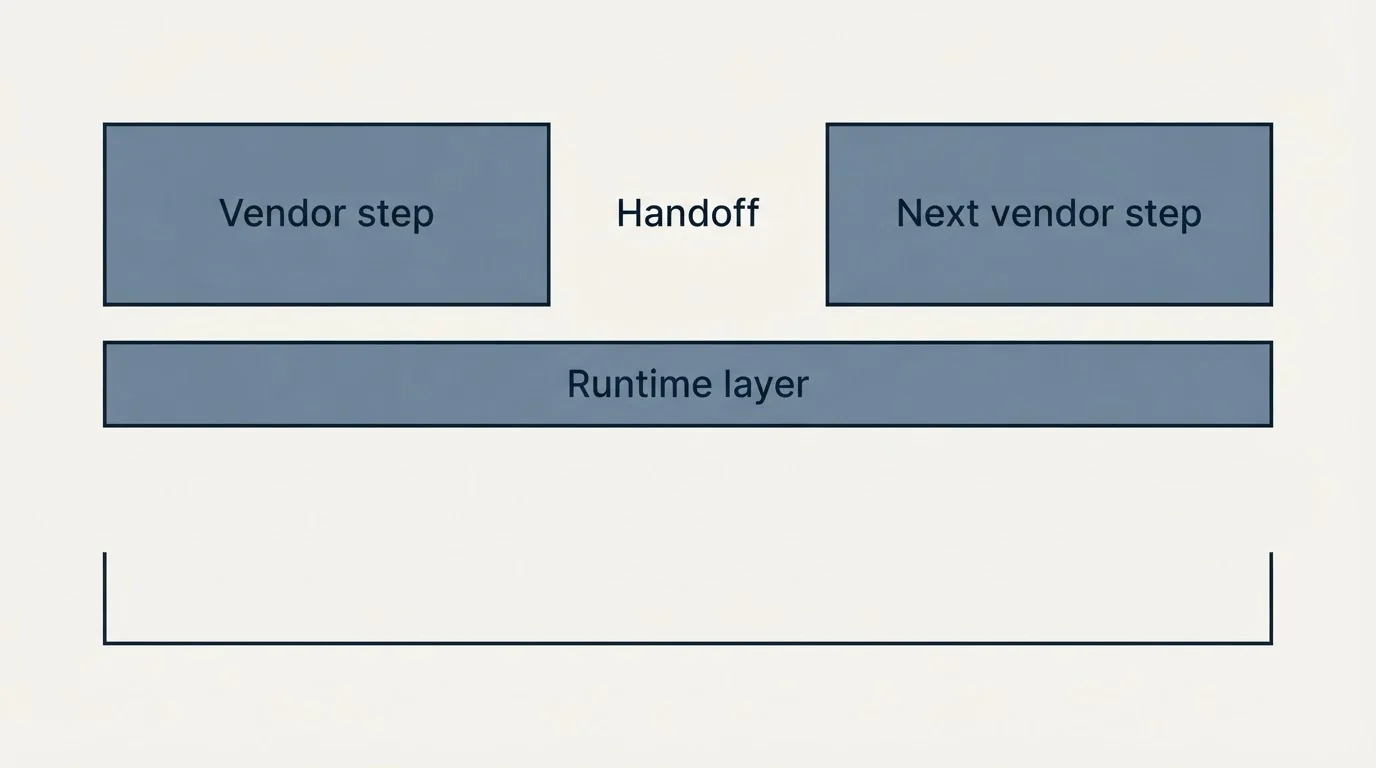
Teams who describe themselves as struggling to implement AI in sales operations are almost always stuck on this job rather than on any of the seven above it, because every vendor will automate its own step and none of them owns the handoff to the next one.
Research through deals are all product categories with vendors competing in them. Runtime is not.
Runtime is the layer that decides what runs, when, in what order, and what happens when a step fails. In most companies that layer is a person with a calendar reminder.
That is the real gap in 2026. Not access to AI. Ownership of the workflow between tools.
Every vendor on this list will happily automate their own step. None of them will run the handoff to the next step, because the handoff is not their product.
How The Chain Actually Runs
Worth walking through once, because seeing the sequence makes the runtime job obvious.
Apify and Firecrawl pull the raw account context. Clay, Apollo, ZoomInfo, Findymail, and MillionVerifier resolve the right contact. EmailBison, Smartlead, Instantly, lemlist, and Salesloft run the outbound. Attio, HubSpot, Salesforce, Pipedrive, and Slack route replies and owners. Grain, LinkedIn, Typefully, Notion, and Figma turn calls into distribution. Gong, Cal.com, Qwilr, Outreach, and PartnerStack move meetings and revenue forward.
Six handoffs in that chain. Each one is a place where the process stops until someone moves it along.
What 150 Hours Of Testing Actually Taught Me
Three things worth passing on.
Tool quality varies less than integration quality. Most products in each category are within a reasonable band of each other on core capability. The difference in outcome comes from how well the thing is wired into the rest of the stack.
Free trials do not reveal the real problems. Every tool works on a clean 100-record test. Problems appear at 10,000 records, on international data, and after three months of accumulated edge cases.
Coverage claims are not comparable. Every data vendor counts records differently. The only meaningful test is running your own target list through each one and comparing what comes back.
What To Do With This
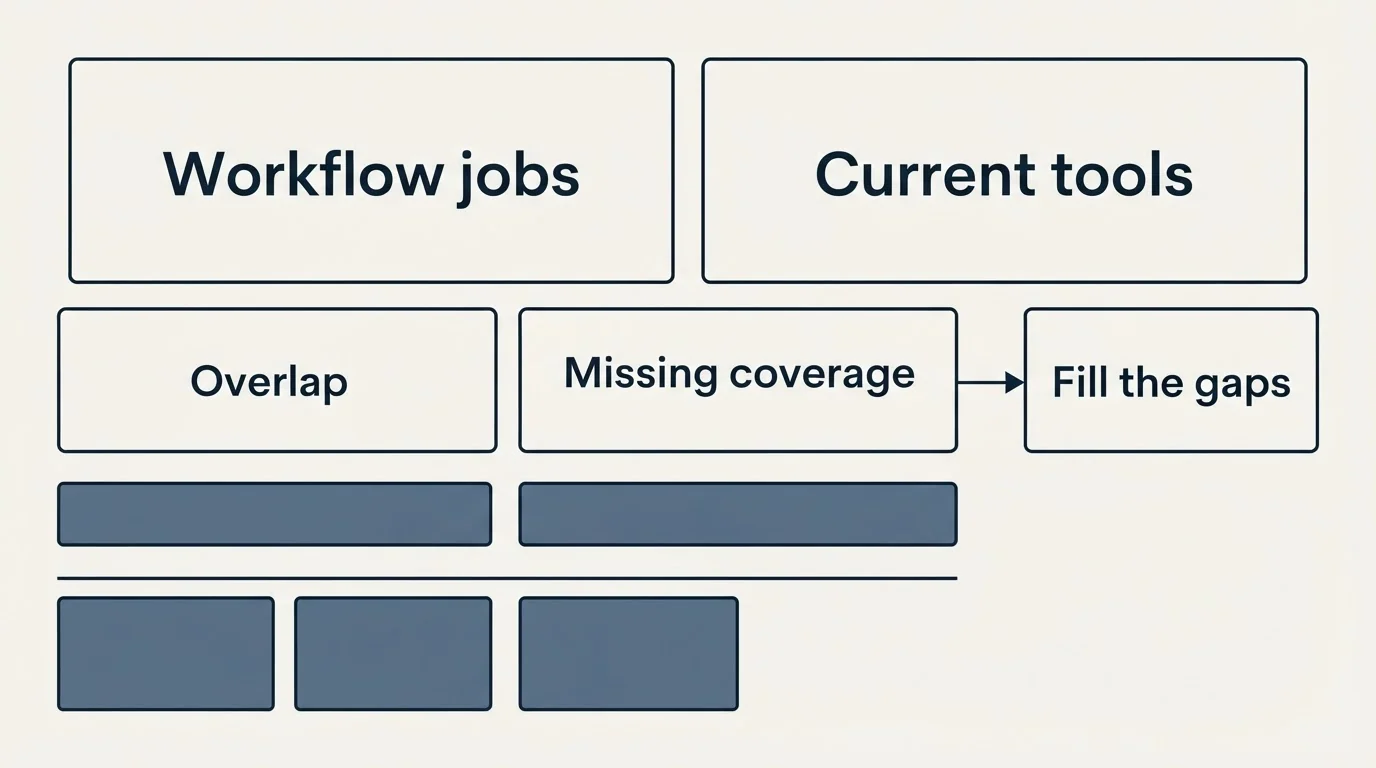
Draw the eight jobs on a page. Fill in your tools. Look for the doubles and the blanks.
Fix the blanks before you upgrade anything that already works. A stack with all eight jobs covered adequately outperforms one with six jobs covered excellently and two not at all, because the two gaps become the bottleneck for everything else.
The Eight Jobs
| Job | What it produces | Commonly over-covered | Commonly missing |
|---|---|---|---|
| Research | Raw account context | ||
| Signals | Who is in market now | Often | |
| Contacts | A verified person to reach | Usually 2–3 tools | |
| Sending | Outbound at volume | Usually 2 tools | |
| Routing | Replies reaching an owner fast | Sometimes | |
| Content | Calls turned into distribution | Usually | |
| Deals | Meetings moving to revenue | ||
| Runtime | Everything running on a schedule | Almost always |
Frequently Asked Questions
Why organise a stack by job instead of by category?
Vendor categories are drawn by vendors and overlap deliberately. Apollo appears in contacts and sending, Clay in research and contacts, Outreach in sending and deals. Shopping by category means buying overlapping products while believing each filled a different box.
What is the runtime job?
The layer that decides what runs, when, in what order, and what happens when a step fails. It is the only one of the eight with no vendor category competing for it, which is why in most companies it is a person with a calendar reminder.
Which jobs are usually over-covered?
Contacts and sending, almost always with two or three tools each. Content and runtime are usually covered by nobody. Drawing the eight jobs and filling in your tools makes both problems visible in about ten minutes.
What did 150 hours of testing actually reveal?
That tool quality varies less than integration quality. Most products within a category sit in a similar band on core capability, and the difference in outcome comes from how well each is wired into the rest of the stack.
Why are free trials misleading?
Every tool works on a clean 100-record test. The problems appear at 10,000 records, on international data, and after three months of accumulated edge cases. Coverage claims are also not comparable across vendors, because each counts records differently.
Related Reading
- GTM Tools Worth Watching in 2026: The Full Market Map (27 Tools)
- The 7-Layer GTM AI Stack for 2026 (The Order Matters More Than the Tools)
- France Is Building a GTM Software Empire and Nobody's Talking About It
We build AI-native pipeline systems and you pay per qualified meeting, not a retainer. No paying for activity. You only pay when we book you a qualified sales meeting. See if you qualify.
Tool inclusion reflects products evaluated by RevenueFlow and is not an endorsement.
Frequently asked questions.
Frequently asked questions- Why should I organize my GTM stack by job instead of vendor category?
- Vendor categories overlap deliberately, causing you to buy duplicate products without realizing it. Apollo covers both contacts and sending, Clay handles research and contacts, and Outreach spans sending and deals. When you organize by the eight distinct jobs your stack must perform, you immediately see which functions have three owners and which have none, typically revealing that contacts and sending are over-covered while content and runtime are completely unowned.
- What is the runtime job in a GTM stack?
- Runtime is the layer that decides what runs, when, in what order, and what happens when a step fails. Unlike the other seven jobs, no vendor category exists for runtime, which is why most companies handle it manually through a person with calendar reminders. It manages the six handoffs between research and deals: the points where processes stop until someone moves them forward.
- Which GTM jobs are usually over-covered and which are missing?
- Contacts and sending typically have two or three tools each in most stacks. Content and runtime are almost always covered by nobody. Drawing the eight jobs on a page and filling in your current tools makes both problems visible in about ten minutes, revealing where budget is wasted on redundancy and where critical gaps exist.
- What did 150 hours of testing GTM tools actually reveal?
- Tool quality varies less than integration quality: most products within each category perform similarly on core capability, and outcomes depend on how well tools connect to the rest of the stack. Free trials don't reveal real problems that only emerge at 10,000+ records, with international data, and after three months of edge cases. Coverage claims from data vendors aren't comparable because each counts records differently, making your own target list test the only meaningful comparison.
- What are the eight jobs every GTM agent stack needs?
- Research pulls raw account context, signals identifies in-market accounts, contacts resolves verified people to reach, sending runs outbound at volume, routing gets replies to owners quickly, content turns calls into distribution, deals moves meetings toward revenue, and runtime keeps the entire system operating on schedule. A stack with all eight jobs covered adequately outperforms one with six covered excellently and two missing, because the gaps become bottlenecks for everything else.
About the author.

Ben Carden is CRO at RevenueFlow, which builds and operates outbound revenue engines for B2B companies. Previously at Gartner Enterprise. Studied at London School of Economics.
Ben Carden · CRO
Connect on LinkedIn →Explore more.
Ready to scale your outreach?
We build GTM engines that book real meetings. See the receipts.
Related articles.
GTM Tools Worth Watching in 2026: The Market Map
A founder asked what tools you actually need to run outbound in 2026. The honest answer depends on whether you want to look busy or book meetings. Here is the full map, organised by job rather than by category.
The 7-Layer GTM AI Stack for 2026 (The Order Matters)
Your outbound will plateau this year. Not because of the tools you picked, but because of the order you stacked them in. Each layer caps the performance of every layer above it.
France Is Building a GTM Software Empire
The default assumption is that the best go-to-market software comes from San Francisco or London. France has 22+ tools across the entire stack, and most buyers cannot name three of them.
Old GTM vs New GTM: What Changed in the Last Two Years
Most teams still run the 2019 playbook: buy a list, load a sequencer, hire BDRs. Here is the signal-based model that replaced it, and the honest cost of switching.
How to Build an ICP That Changes Your Target List
Most ICPs never change the target list. Here is the count test, the five inputs, a worked TAM, SAM and SOM example with full arithmetic, and an eight-field worksheet.
The 20-Tool Sales Stack That Built a $50M Pipeline
We helped one FinTech founder secure meetings with a $3.25B CEO and build a $50M+ investment pipeline. Here's every tool in the stack, and how they work together.