The 20-Tool Sales Stack That Built a $50M Pipeline
We helped one FinTech founder secure meetings with a $3.25B CEO and build a $50M+ investment pipeline. Here's every tool in the stack, and how they work together.
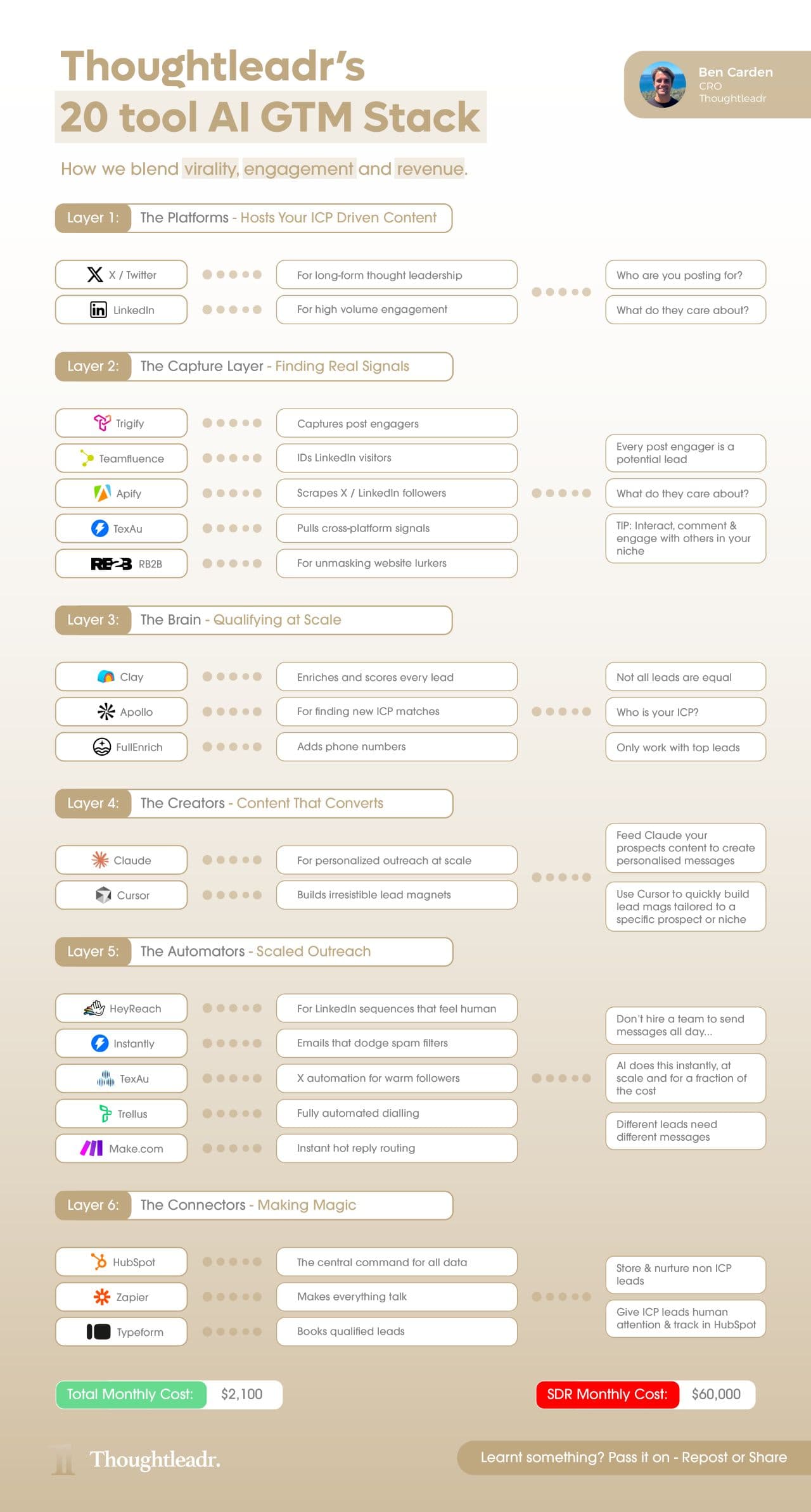
A B2B sales stack combining 20 tools creates a system that captures engagement signals, enriches leads in real-time, and automates personalized outreach within minutes. The core workflow uses Trigify to capture LinkedIn/X engagement, Clay to enrich and score leads automatically, and HeyReach or Instantly to send personalized messages while interest is fresh. This approach generated $220M in forecasted revenue for one client and a $50M investment pipeline for another, with total monthly tool costs around $2,000.
Key takeaways
- Responding to content engagement within minutes triples response rates compared to waiting an hour, making timing more critical than message volume.
- Clay automatically scores and enriches leads based on company size, funding, and tech stack, eliminating the six hours per day SDRs previously spent on manual research.
- Feeding Claude a prospect's last five LinkedIn posts plus company information produces personalized outreach that achieves 30% response rates versus 2% for generic templates.
- One FinTech client built a $50M investment pipeline in 18 months using this stack, while another secured a meeting with a $3.25B CEO within six days.
- The complete 20-tool stack costs approximately $2,000 per month, compared to hiring three SDRs at $60,000+ each annually.
Reviewed and updated September 1, 2026
The 20-Tool Sales Stack That Built a $50M Investment Pipeline
Everyone wants to post content, get clicks, go viral.
Fair enough. Exposure to millions sounds great.
But here's what we learned the hard way: content alone won't fill your pipeline. You need a system that turns attention into conversations.
I spent two years testing every sales tool that promised to "revolutionize" our GTM. Most were expensive disasters. A few were transformational.
The breakthrough came when we figured out the timing. Fire off outreach within minutes of someone engaging with your content, and response rates triple. Wait an hour? You've lost the moment.
Here's the exact stack that makes that possible.
Where to Post
Before we talk tools, let's talk platforms.
LinkedIn works for long-form thought leadership. Your prospects are there. They're in work mode. They're thinking about business problems.
X works for high-volume engagement. The algorithm rewards consistency. You can build reach faster here than anywhere else.
Pick one to dominate before you spread thin.
The Capture Layer
Most companies blast cold emails and pray. We do something different. We capture people who already showed interest.
RB2B identifies website visitors. Someone hits your pricing page but doesn't fill out a form? Now you know who they are.
Trigify captures post engagers. Someone likes your post about pipeline challenges? That's a buying signal. Trigify grabs their profile automatically.
Apify scrapes followers at scale. Want a list of everyone following your competitor? Your target investor? A relevant hashtag? Done.
Teamfluence catches profile visitors. Someone viewed your LinkedIn profile three times this week? They're curious. Follow up.
TexAu pulls signals across platforms: LinkedIn engagement, X followers, website visits. It connects the dots. The product has since been rebuilt around pay-on-match enrichment credits, and the current tiers are set out in TexAu pricing.
The Brain

Raw data is noise. You need something to make sense of it.
Apollo finds new ICP matches. Great database, solid search filters, useful for proactive prospecting beyond your inbound signals.
FullEnrich adds phone numbers. When you need to call instead of email, this is how you get verified numbers.
Clay is where the magic happens.
Seriously. Clay changed everything for us.
It auto-scores every lead based on company size, recent funding, tech stack, whatever criteria matter to you. Our SDRs used to spend six hours a day researching prospects. Now it happens while they sleep.
One tip: don't use Clay's credits directly. Plug in API keys from Claude, GPT-4, or Gemini. Better results, lower costs.
The Creators
Claude writes personalized outreach. But not the way most people use it.
The secret: feed Claude the prospect's last five LinkedIn posts plus their company info. Instead of generic templates, you get messages that reference specific things they've shared. Response rates go from 2% to 30%.
Cursor builds lead magnets: custom calculators, interactive tools, personalized reports, anything that provides immediate value. These convert better than PDFs.
The Automators
HeyReach handles LinkedIn outreach: connection requests, follow-ups, and messages, all automated but timed to feel human.
Instantly runs email sequences. Built specifically for cold outreach with automatic warmup, inbox rotation, and smart sending limits.
TexAu also automates X outreach. When someone engages with your tweets, it can trigger a follow-up DM.
Trellus powers phone outreach. AI-assisted dialing, voicemail drops, callback tracking.
Make routes hot replies instantly. Someone responds positively? Within seconds, you get a Slack alert, your CRM updates, and the next action triggers. Speed wins.
The Connectors
HubSpot is central command. Everything flows here: contacts, deals, activity logs, pipeline forecasts. If it's not in HubSpot, it didn't happen.
Typeform captures high-intent leads. Beautiful forms that qualify as they collect information.
Zapier connects everything. HeyReach gets a reply, Zapier tells HubSpot. Someone fills a Typeform, Zapier triggers Clay enrichment.
The Math
Total monthly cost: around $2,000.
Compare that to three SDRs at $60k+ each who can't work 24/7.
But the real advantage isn't cost. It's speed. This stack catches signals humans miss and responds before your competition even knows there's an opportunity.
How This Actually Works
Let me walk you through a typical sequence:
- 9:00 AMYou post about a specific pain point your ICP faces.
- 9:17 AMSarah, VP at a Series B startup, likes your post.
- 9:32 AMTrigify captures her profile and sends it to Clay.
- 9:45 AMClay enriches her data
reveals she just raised $30M. Scores her as Tier 1.
- 10:15 AMHeyReach sends a personalized connection request referencing her engagement.
- 2:30 PMShe accepts and replies to your message.
- 2:31 PMMake alerts you via Slack.
- 3:00 PMCall scheduled.
9:00 AM: You post about a specific pain point your ICP faces.
9:17 AM: Sarah, VP at a Series B startup, likes your post.
9:32 AM: Trigify captures her profile and sends it to Clay.
9:45 AM: Clay enriches her data and reveals she just raised $30M. Scores her as Tier 1.
10:15 AM: HeyReach sends a personalized connection request referencing her engagement.
2:30 PM: She accepts and replies to your message.
2:31 PM: Make alerts you via Slack.
3:00 PM: Call scheduled.
Your input? One post. The system handled everything else.
Real Results
This isn't theory. Here's what this stack has produced:
One FinTech client went from zero online presence to $220M in forecasted revenue.
Another built a $50M investment pipeline in 18 months.
A third secured a meeting with a $3.25B CEO within six days of starting.
Same tools. Same process.
Where to Start
Don't try to implement all 20 at once. Here's the sequence that works:
Weeks 1-2: Start posting consistently on LinkedIn or X. Set up HubSpot.
Weeks 3-4: Add Trigify for engagement capture. Connect to Clay.
Weeks 5-6: Set up HeyReach for LinkedIn automation. Build personalization workflows with Claude.
Week 7+: Layer in remaining tools based on your specific gaps.
The Point
Modern buyers leave signals everywhere. The companies that win are the ones who notice those signals first and respond with precision.
Most agencies sell you on volume: more calls, more emails, more content.
What if you could identify the 3% of prospects who are actually ready to buy right now?
That's what this stack does. Every day. While you focus on closing.
Related Reading
- The 7-Layer GTM AI Stack for 2026 (The Order Matters More Than the Tools)
- GTM Tools Worth Watching in 2026: The Full Market Map (27 Tools)
- Anthropic's Labour Market Report Isn't a Jobs Story. It's a Management Story.
Want us to build this for you? Book a call to see how we can set up your entire GTM system.
Frequently asked questions.
Frequently asked questions- How quickly should you follow up after someone engages with your content?
- You should respond within minutes of engagement to maximize effectiveness. When outreach fires within minutes of someone liking or commenting on your content, response rates triple compared to waiting an hour. The system described captures engagement signals automatically and triggers personalized outreach within 15-45 minutes, catching prospects while interest is fresh and before competitors can respond.
- What does Clay actually do in a sales stack?
- Clay serves as the intelligence layer that enriches raw contact data and automatically scores leads based on your ideal customer profile criteria. It eliminates manual research by analyzing company size, recent funding, tech stack, and other signals while SDRs sleep. The key cost-saving tip is plugging in your own API keys from Claude, GPT-4, or Gemini instead of using Clay's credits directly, which delivers better results at lower costs.
- Which platforms should B2B companies focus on for content-driven sales?
- LinkedIn works best for long-form thought leadership where prospects are in work mode thinking about business problems, while X (Twitter) works for high-volume engagement and faster reach building through algorithmic rewards for consistency. The recommendation is to pick one platform to dominate before spreading resources thin across multiple channels, rather than attempting to maintain presence everywhere simultaneously.
- How do you implement a 20-tool sales stack without overwhelming your team?
- Start with consistent posting on one platform and HubSpot CRM in weeks 1-2, then add Trigify for engagement capture connected to Clay in weeks 3-4, followed by HeyReach for LinkedIn automation with Claude personalization in weeks 5-6. Layer in remaining tools after week 7 based on specific gaps rather than trying to implement all 20 tools simultaneously, which allows your team to learn each component before adding complexity.
- What kind of results can this sales stack actually produce?
- One FinTech client generated $220M in forecasted revenue starting from zero online presence, another built a $50M investment pipeline within 18 months, and a third secured a meeting with a $3.25B CEO within six days of implementation. These results came from the same tools and process applied consistently, with the system catching buying signals that humans typically miss and responding before competition becomes aware of opportunities.
About the author.

Ben Carden is CRO at RevenueFlow, which builds and operates outbound revenue engines for B2B companies. Previously at Gartner Enterprise. Studied at London School of Economics.
Ben Carden · CRO
Connect on LinkedIn →Explore more.
Ready to scale your outreach?
We build GTM engines that book real meetings. See the receipts.
Related articles.
The 7-Layer GTM AI Stack for 2026 (The Order Matters)
Your outbound will plateau this year. Not because of the tools you picked, but because of the order you stacked them in. Each layer caps every layer above it.
Old GTM vs New GTM: What Changed in the Last Two Years
Most teams still run the 2019 playbook: buy a list, load a sequencer, hire BDRs. Here is the signal-based model that replaced it, and the honest cost of switching.
What Is a GTM Engineer? The Role, the Stack, the Pay
A GTM engineer builds the systems that produce pipeline. The role, the day-to-day ownership, the stack by layer, verified salary ranges, and how to hire one.
Anthropic's Labour Market Report Is a Management Story
The interesting number is not what the models can do. It is the gap between that and what companies have actually built into how they operate. That gap is an org-design problem, not a talent problem.
GTM Tools Worth Watching in 2026: The Market Map
A founder asked what tools you actually need to run outbound in 2026. The honest answer depends on whether you want to look busy or book meetings. Here is the full map, organised by job rather than by category.
Lead Generation for EHR Vendors: A Replacement Market
Adoption is close to complete, so every deal is a switch. Where the incumbent field is published, which rules shape the pitch and who actually signs.