The 7-Layer GTM AI Stack for 2026 (The Order Matters)
Your outbound will plateau this year. Not because of the tools you picked, but because of the order you stacked them in. Each layer caps the performance of every layer above it.
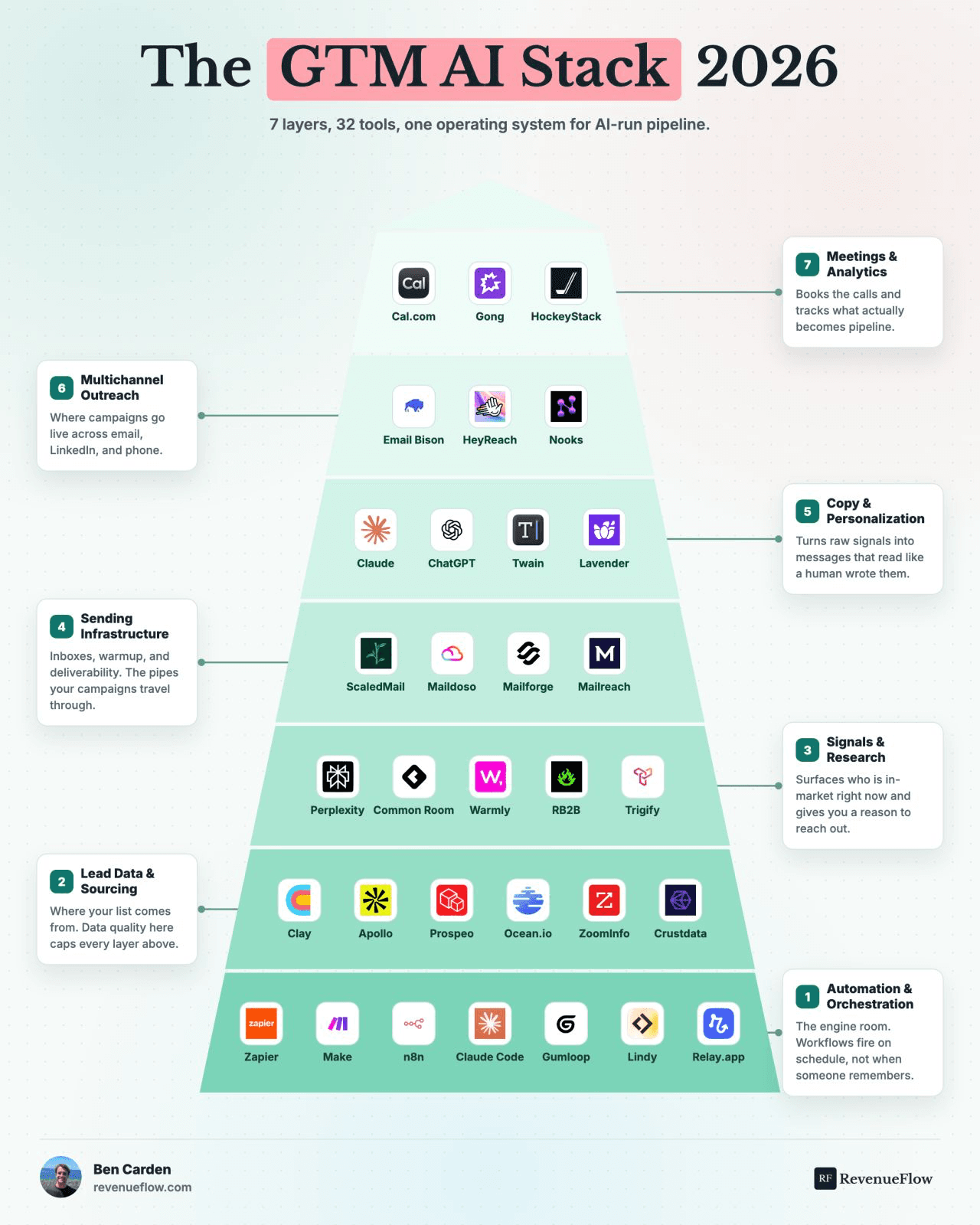
The 7-layer GTM AI stack arranges tools in strict order from automation and orchestration at the base, through lead data, signals, infrastructure, copy, multichannel outreach, to meetings and analytics at the top. Each layer caps the performance of every layer above it: excellent copy fails if data is stale, and perfect messages never arrive if infrastructure is broken. Most plateaus occur because teams invest heavily in visible layers like copy or data while skipping infrastructure or orchestration, creating constraints that upper-layer investment cannot overcome.
Key takeaways
- The seven layers are automation/orchestration, lead data, signals, sending infrastructure, copy/personalisation, multichannel outreach, and meetings/analytics, in that specific bottom-to-top order.
- Skipping layer 4 infrastructure causes all upper layers to fail because emails land in spam regardless of message quality.
- Seven tools chosen for fit and wired together will outperform twenty tools connected manually, because handoffs are where campaigns stall.
- Infrastructure and orchestration are the most commonly skipped layers because they lack visible output and feel like tasks a person can cover.
- The correct diagnostic approach is working bottom to top to find the first layer without a working owner, which represents the performance ceiling.
Reviewed and updated September 5, 2026
The 7-Layer GTM AI Stack for 2026
Your outbound will plateau this year.
Not because of the tools you picked. Because of the order you stacked them.
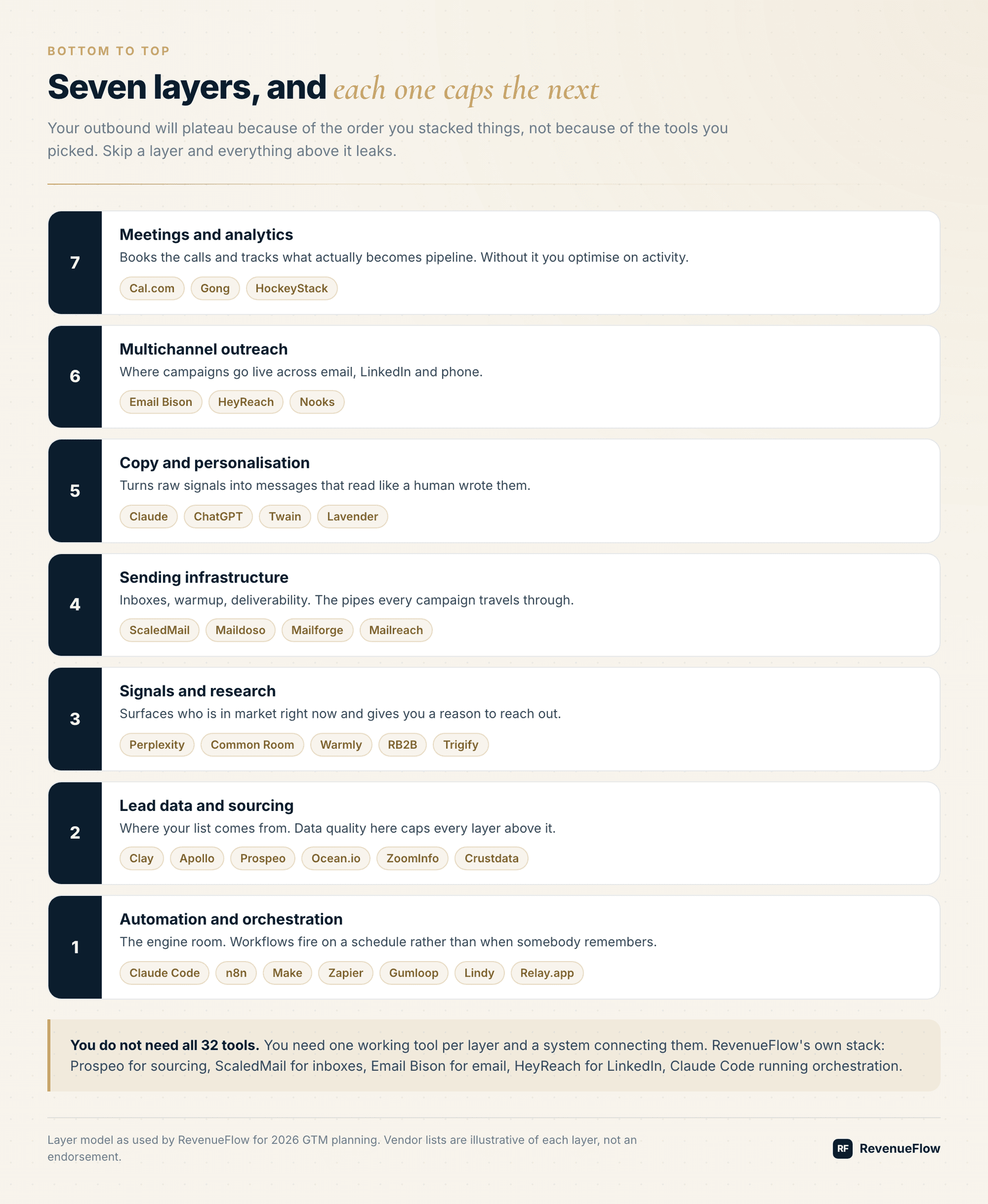
An AI go-to-market strategy is a claim about these seven layers rather than about any one product, because the order decides what a model added anywhere in the stack can actually do.
The Seven Layers, Bottom To Top
1. Automation and orchestration. The engine room. Workflows fire on a schedule rather than when someone remembers. Zapier, Make, n8n, Claude Code, Gumloop, Lindy, Relay.app.
2. Lead data and sourcing. Where your list comes from. Data quality here caps every layer above it. Clay, Apollo, Prospeo, Ocean.io, ZoomInfo, Crustdata.
3. Signals and research. Surfaces who is in market right now and gives you a reason to reach out. Perplexity, Common Room, Warmly, RB2B, Trigify.
4. Sending infrastructure. Inboxes, warmup, deliverability. The pipes every campaign travels through. ScaledMail, Maildoso, Mailforge, Mailreach.
5. Copy and personalisation. Turns raw signals into messages that read like a human wrote them. Claude, ChatGPT, Twain, Lavender.
6. Multichannel outreach. Where campaigns go live across email, LinkedIn and phone. Email Bison, HeyReach, Nooks.
7. Meetings and analytics. Books the calls and tracks what actually becomes pipeline. Cal.com, Gong, HockeyStack.
Why The Order Is The Whole Argument
Each layer feeds the one above it. Skip one and the whole thing leaks.
That sounds like a slogan, so here is what it means concretely.
- No: Skip layer 2 quality and layer 5 is wasted
- No: Skip layer 4 and layers 5, 6 and 7 do not exist
- No: Skip layer 3 and you are back to volume outbound
- No: Skip layer 1 and everything runs when someone remembers
- No: Skip layer 7 and you optimise the wrong thing
Skip layer 2 quality and layer 5 is wasted. The best personalisation model in the world writing about a company whose data is two years stale produces a confidently wrong email. Worse than a generic one, because the error is visible.
Skip layer 4 and layers 5, 6 and 7 do not exist. Beautiful copy sent from a cold domain lands in spam. The reply rate is zero regardless of how good the message was, and you will spend weeks debugging the copy.
Skip layer 3 and you are back to volume outbound. Without a signal, the send date is decided by a cadence position, which is the model that stopped working.
Skip layer 1 and everything runs when someone remembers. This is the most common failure. Teams buy layers 2 through 7 and connect them with a person. The system then operates at the speed of that person's calendar.
Skip layer 7 and you optimise the wrong thing. Without meeting-level attribution, you tune on reply rate, and reply rate is not revenue. Plenty of campaigns generate replies from people who will never buy.
The Plateau Explained
Here is the pattern I see repeatedly.
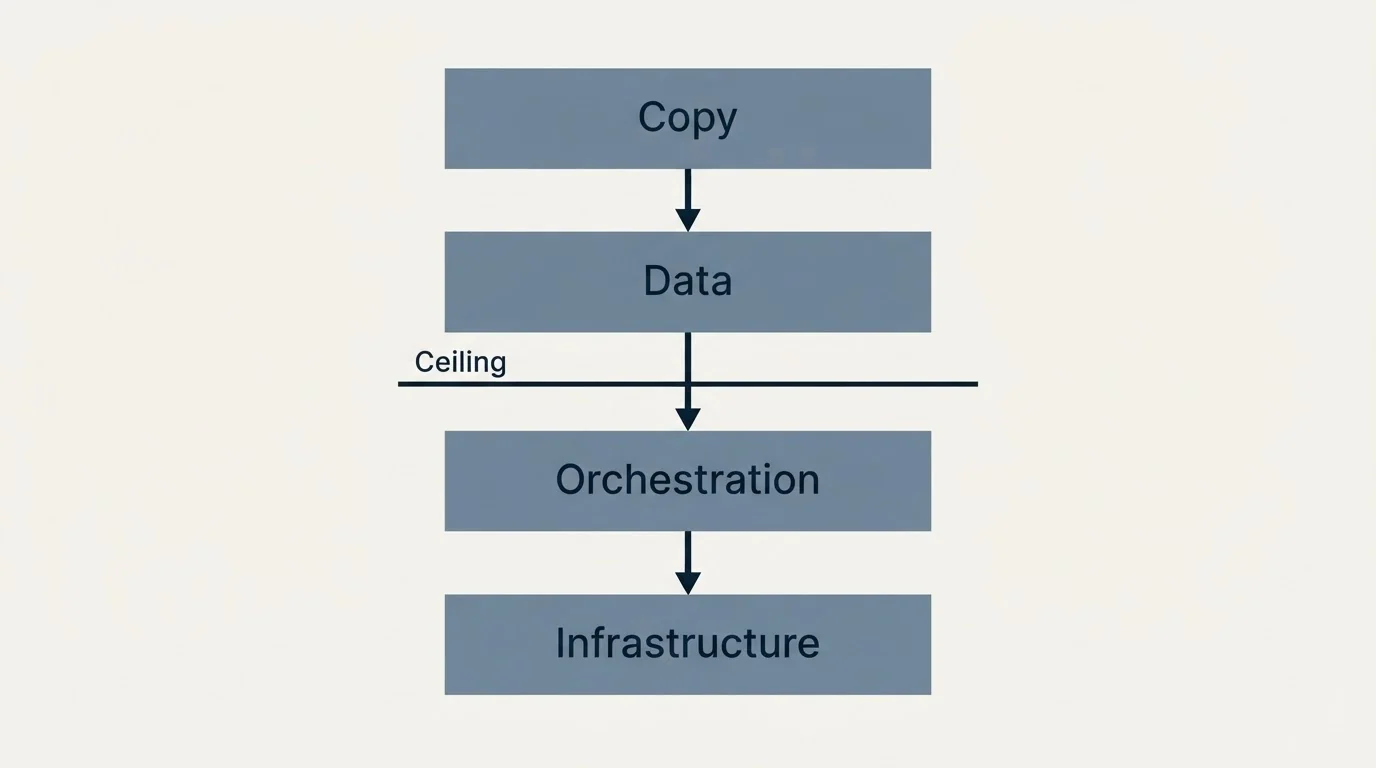
A team invests heavily in one layer, usually copy or data, because that is the layer with the most vendor marketing pointed at it. Performance improves for a quarter. Then it stops, and no further investment in that layer moves the number.
That is a constraint sitting somewhere else in the stack. Almost always infrastructure or orchestration, because those are the two layers nobody enjoys buying.
Diagnosing it is straightforward. Work bottom to top and ask whether each layer has one working owner. The first layer where the answer is no, or where the answer is a person doing it manually, is your ceiling.
You Do Not Need All 32 Tools
You need one working tool per layer and a system connecting them.
Seven tools, chosen for fit, wired together, will outperform twenty tools bought individually and connected by a human. This is not a cost argument, it is a throughput argument: each unconnected tool adds a manual handoff, and handoffs are where campaigns stall.
For reference, our own stack at RevenueFlow is deliberately small. Prospeo for sourcing. ScaledMail for inboxes. Email Bison for email. HeyReach for LinkedIn. Claude Code running the orchestration.
Where this piece sketches the seven layers in theory, a full production stack breakdown shows how those categories collapse into find, verify and send in practice.
Five tools covering seven layers, because some products span more than one.
How To Use This For Planning
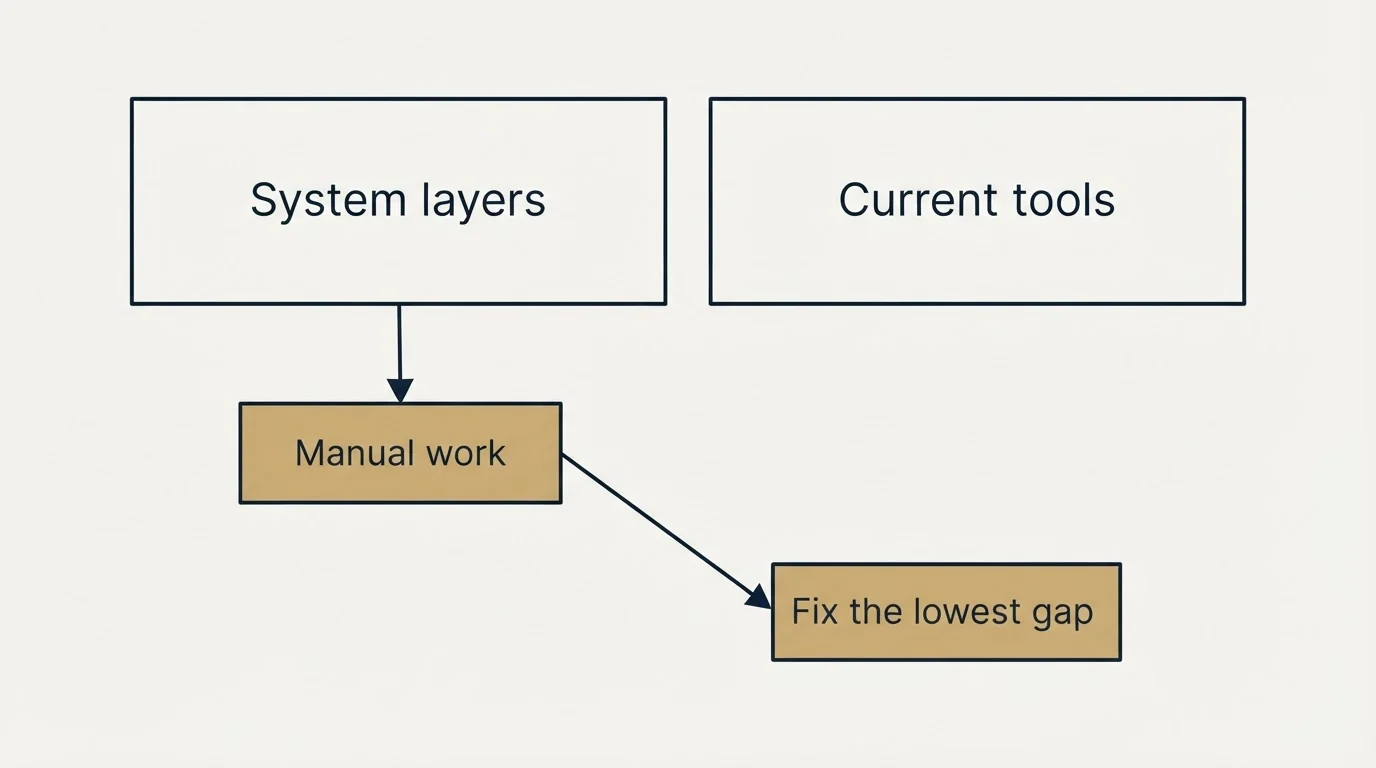
Draw the seven layers. Write your current tool next to each. Mark the ones where the honest answer is "a person does that."
Fix the lowest unowned layer first. Working upward is slower and feels less productive, and it is the only order that actually removes the constraint.
Save this for your 2026 planning.
Diagnosing Your Plateau
| Symptom | Likely constraint | Layer |
|---|---|---|
| Good copy, almost no replies | Emails are not arriving | 4: infrastructure |
| Replies from the wrong people | Targeting or data quality | 2: lead data |
| Campaigns only run when someone starts them | No orchestration | 1: automation |
| Personalisation reads as wrong, not generic | Stale enrichment feeding good copy | 2 into 5 |
| Reply rate fine, pipeline flat | Sending to people who are not in market | 3: signals |
| Cannot tell which campaign produced revenue | No meeting-level attribution | 7: analytics |
| Positive replies going cold | Nothing routes them | 6 into 7 |
Frequently Asked Questions
Why does the order matter more than the tools?
Because each layer caps the one above it. The best personalisation model writing from two-year-old data produces a confidently wrong email. Perfect copy sent from a cold domain lands in spam. Investment in an upper layer cannot exceed the quality of the layer beneath it.
Which layer do teams most commonly skip?
Infrastructure and orchestration, because neither is enjoyable to buy. Layer 4 has no visible output until it fails, and layer 1 looks like something a person can cover. Those two are the most common real constraints.
How do I know which layer is my bottleneck?
Work bottom to top and ask whether each layer has one working owner. The first layer where the answer is no, or where the answer is a person doing it manually, is your ceiling. Fixing a higher layer before that one will not move the number.
Do I need all 32 tools?
No. You need one working tool per layer and a system connecting them. Some products span several layers, so seven layers often means four or five subscriptions. RevenueFlow's own stack is five tools.
Why is analytics the top layer rather than an afterthought?
Because without meeting-level attribution you tune on reply rate, and reply rate is not revenue. Plenty of campaigns generate replies from people who will never buy, and optimising toward them makes the system worse in a way that looks like progress.
Related Reading
- GTM Tools Worth Watching in 2026: The Full Market Map (27 Tools)
- I Spent 150+ Hours Testing 48 GTM Tools. These Are the 8 Agent Workflows That Matter.
- France Is Building a GTM Software Empire and Nobody's Talking About It
We build AI-native pipeline systems and you pay per qualified meeting, not a retainer. No paying for activity. You only pay when we book you a qualified sales meeting. See if you qualify.
Frequently asked questions.
Frequently asked questions- Why does the order matter more than the tools?
- Because each layer caps the one above it. The best personalisation model writing from two-year-old data produces a confidently wrong email. Perfect copy sent from a cold domain lands in spam. Investment in an upper layer cannot exceed the quality of the layer beneath it.
- Which layer do teams most commonly skip?
- Infrastructure and orchestration, because neither is enjoyable to buy. Layer 4 has no visible output until it fails, and layer 1 looks like something a person can cover. Those two are the most common real constraints.
- How do I know which layer is my bottleneck?
- Work bottom to top and ask whether each layer has one working owner. The first layer where the answer is no, or where the answer is a person doing it manually, is your ceiling. Fixing a higher layer before that one will not move the number.
- Do I need all the tools mentioned in each layer?
- No. You need one working tool per layer and a system connecting them. Some products span several layers, so seven layers often require fewer than seven tools. Seven tools chosen for fit and wired together will outperform twenty tools bought individually and connected by a human.
About the author.

Ben Carden is CRO at RevenueFlow, which builds and operates outbound revenue engines for B2B companies. Previously at Gartner Enterprise. Studied at London School of Economics.
Ben Carden · CRO
Connect on LinkedIn →Explore more.
Ready to scale your outreach?
We build GTM engines that book real meetings. See the receipts.
Related articles.
The 8 Agent Workflows That Matter From 48 GTM Tools
Organise your stack by job, not by vendor. Most teams have three jobs covered twice and two covered by nobody, and the eighth job is the one no vendor sells you.
GTM Tools Worth Watching in 2026: The Market Map
A founder asked what tools you actually need to run outbound in 2026. The honest answer depends on whether you want to look busy or book meetings. Here is the full map, organised by job rather than by category.
France Is Building a GTM Software Empire
The default assumption is that the best go-to-market software comes from San Francisco or London. France has 22+ tools across the entire stack, and most buyers cannot name three of them.
Old GTM vs New GTM: What Changed in the Last Two Years
Most teams still run the 2019 playbook: buy a list, load a sequencer, hire BDRs. Here is the signal-based model that replaced it, and the honest cost of switching.
The 20-Tool Sales Stack That Built a $50M Pipeline
We helped one FinTech founder secure meetings with a $3.25B CEO and build a $50M+ investment pipeline. Here's every tool in the stack, and how they work together.
How to Build an ICP That Changes Your Target List
Most ICPs never change the target list. Here is the count test, the five inputs, a worked TAM, SAM and SOM example with full arithmetic, and an eight-field worksheet.