GTM Tools Worth Watching in 2026: The Market Map
A founder asked what tools you actually need to run outbound in 2026. The honest answer depends on whether you want to look busy or book meetings. Here is the full map, organised by job rather than by category.
You need six tools maximum for outbound in 2026: one to find accounts, one to resolve contacts, one to deliver mail, one to run sequences, one to handle replies, and one CRM to own the record. Most teams run fifteen tools but use three, paying for redundancy while leaving reply handling (the most conversion-critical job) completely unowned.
Key takeaways
- The outbound motion has six jobs: find accounts, resolve contacts, deliver mail, run sequences, handle replies, and own the record. Each needs exactly one tool.
- Most companies stack fifteen tools and actively use only three, with redundant subscriptions renewing for years after the champion who ran the trial shifts priorities.
- Reply handling is the most commonly unowned job, with teams automating everything up to the moment a prospect responds and then letting replies sit in a shared inbox checked twice daily.
- Heavy overlap exists across vendors: Apollo covers sourcing, sequencing, and dialling; Clay covers sourcing and enrichment; Instantly covers infrastructure and sending.
- The integration layer is missing from every stack: nothing on the market connects these tools by default, forcing teams to fill the gap with either Zapier, AI runtime, or manual human work.
Reviewed and updated September 5, 2026
GTM Tools Worth Watching in 2026
A founder asked me recently: what tools do I actually need to run outbound in 2026?
My answer was that it depends on whether you want to look busy or book meetings, which sounds glib but is genuinely the fork in the road. Buying tools is the visible activity. Connecting them is the one that produces pipeline.
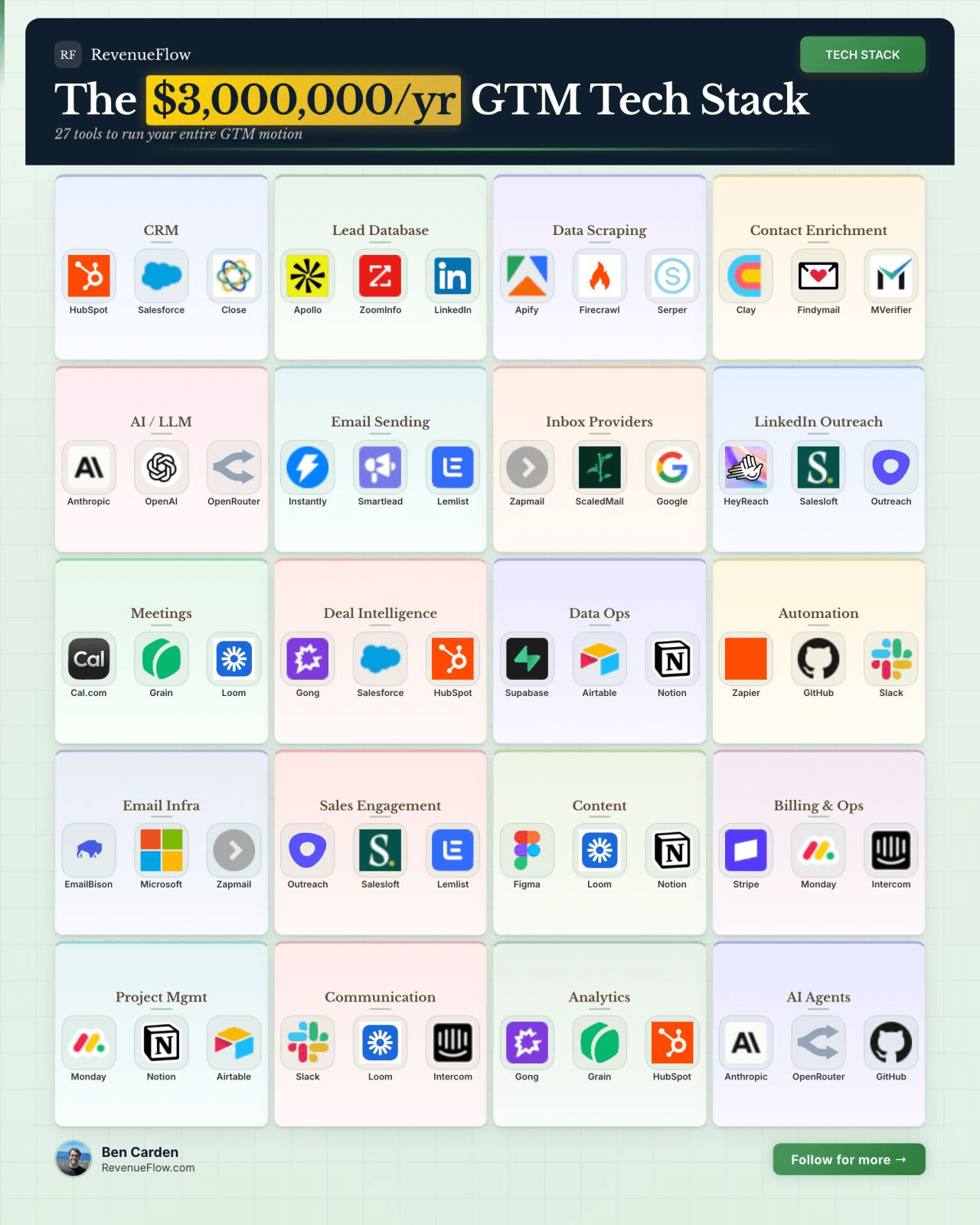
Here is the full map. 27 tools, no fluff.
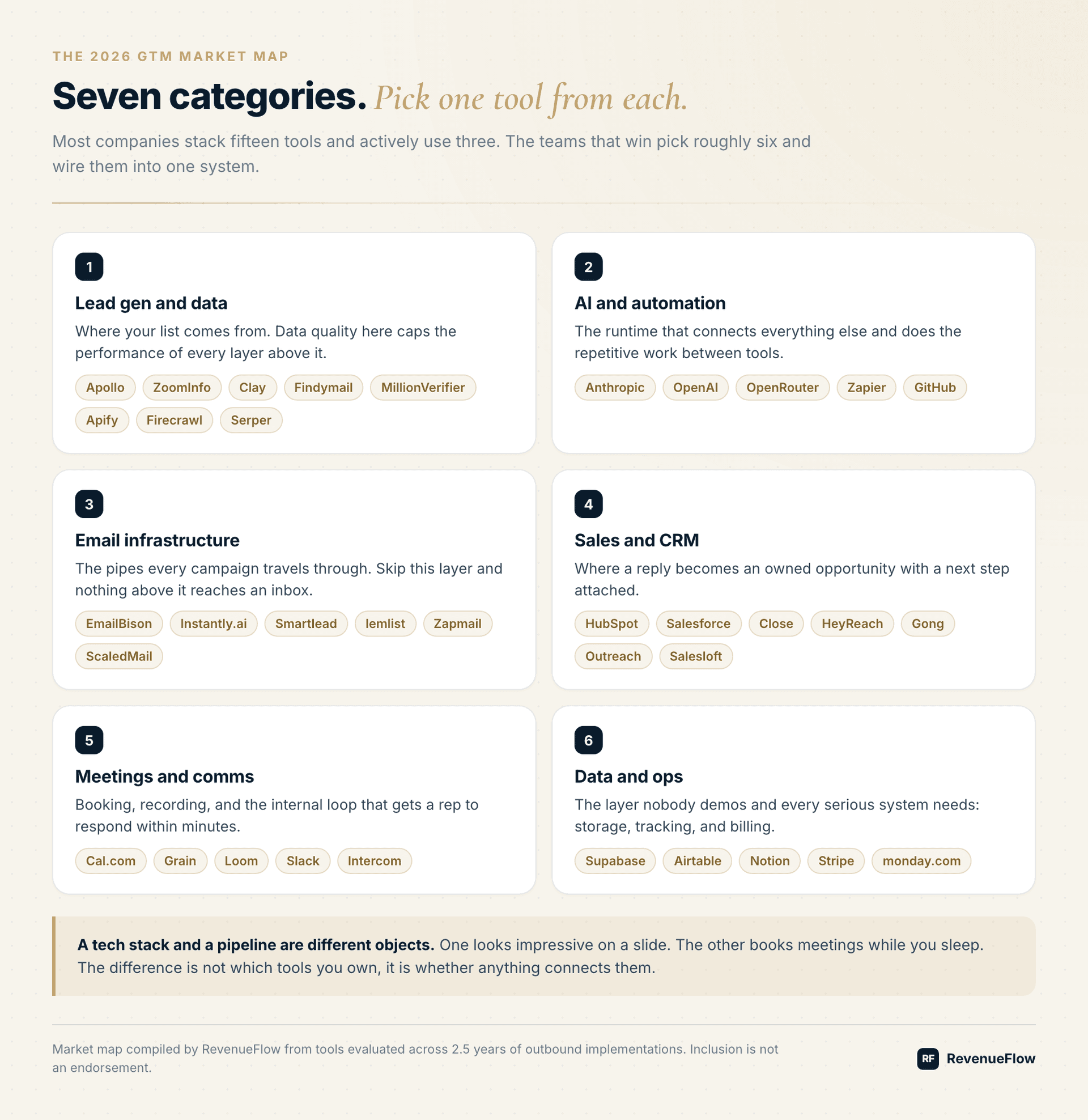
GTM tools, spelled out, are go-to-market tools: the software a team uses to find accounts, reach them, and route whatever comes back. The map below is organised by that job rather than by vendor category.
Since vendor category alone rarely explains where these tools come from, the European GTM tool landscape by city offers a geographic lens on the same market.
The Map
Lead gen and data. Apollo, ZoomInfo, Clay, Findymail, MillionVerifier, Apify, Firecrawl, Serper.
AI and automation. Anthropic, OpenAI, OpenRouter, Zapier, GitHub.
Email infrastructure. EmailBison, Instantly.ai, Smartlead, lemlist, Zapmail.ai, ScaledMail.
Sales and CRM. HubSpot, Salesforce, Close, HeyReach.io, Gong, Outreach, Salesloft.
Meetings and comms. Cal.com, Grain, Loom, Slack, Intercom.
Data and ops. Supabase, Airtable, Notion, Stripe, monday.com.
Content. Figma, Notion, Loom.
The Problem With Market Maps
A map like this is useful for orientation and actively harmful as a shopping list.
Most companies stack fifteen tools and use three. The other twelve get bought during an evaluation, championed by whoever ran the trial, and then quietly abandoned when that person's priorities shift. The subscriptions renew for years.
The failure is not that any individual tool was bad. It is that buying was treated as the decision, when the decision that matters is which job each tool owns and what connects it to the next one.
Buy By Job, Not By Category
There are six jobs in an outbound motion. Every purchase should answer one of them, and no job needs two tools.
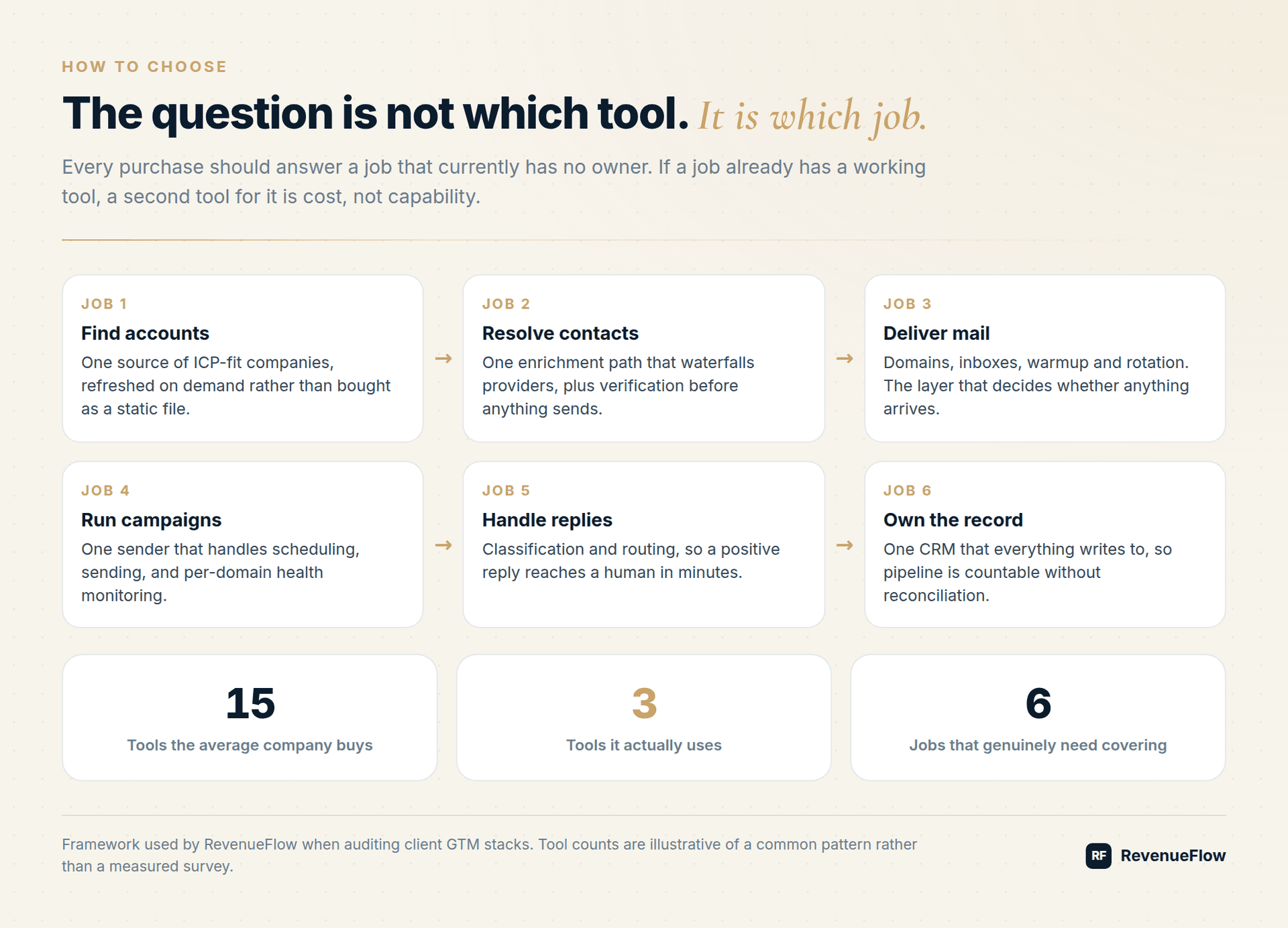
Find accounts. One source of ICP-fit companies, refreshed on demand rather than bought as a static file that decays from day one.
Resolve contacts. One enrichment path that waterfalls across providers, plus verification before anything sends. This is where Clay earns its position, because it is the layer that orchestrates the others.
Deliver mail. Domains, inboxes, warmup, rotation. Zapmail and ScaledMail exist because this is genuinely annoying to run yourself, and getting it wrong invalidates everything above it.
Run sequences. One sender handling scheduling, follow-ups, and per-domain health.
Handle replies. Classification and routing so a positive reply reaches a human in minutes. Most teams automate everything up to this point and then let responses sit in a shared inbox.
Own the record. One CRM that everything writes to, so pipeline is countable without a reconciliation exercise.
Asking which GTM tools for Salesforce belong in a stack is this question read from the CRM outwards, since Salesforce owns this job and the other five decide what has to write into it cleanly.
Six jobs. If you have fifteen tools, some jobs have three owners and at least one has none.
What The Map Does Not Show
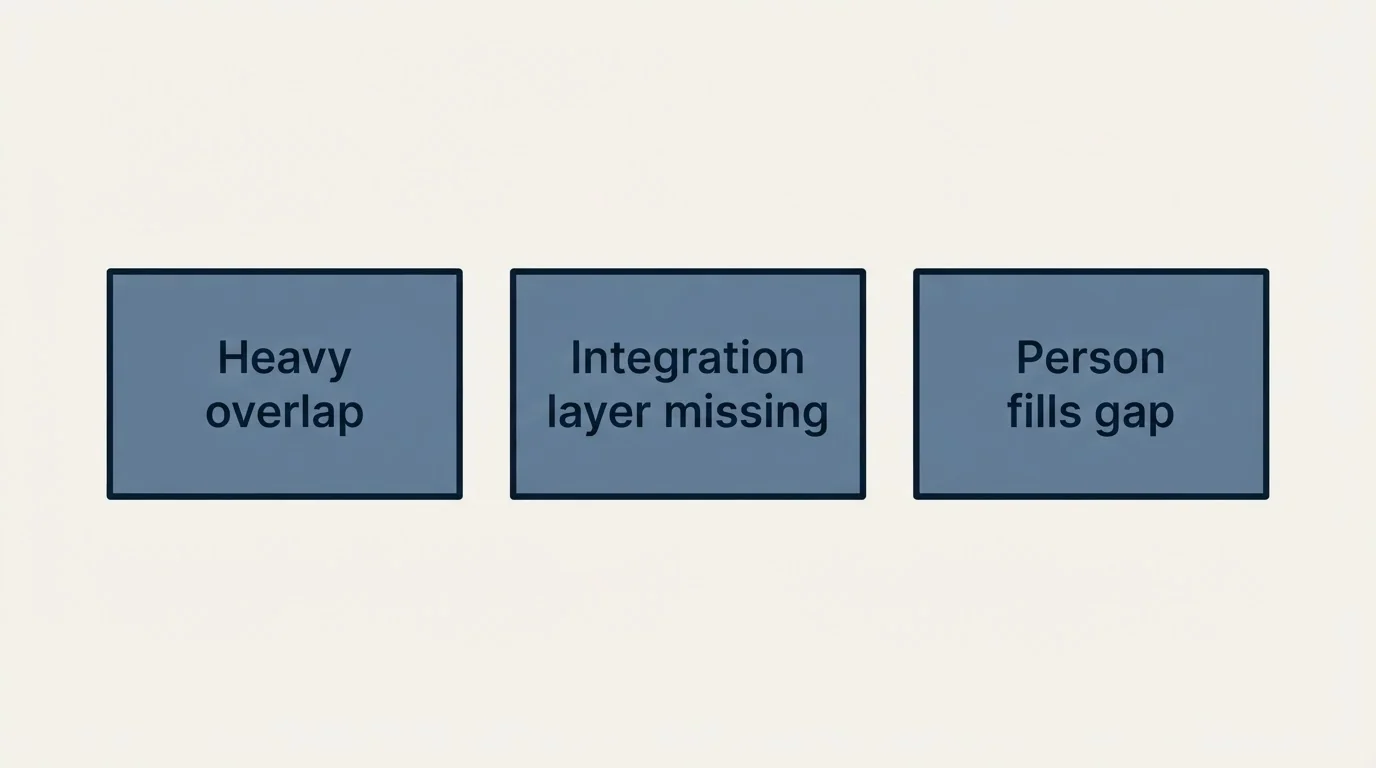
Two things worth naming.
Overlap is heavy. Apollo does sourcing, sequencing, and dialling. Clay does sourcing and enrichment. Instantly does infrastructure and sending. Several of these products are competing for two or three of the six jobs simultaneously, which is why stacks accumulate redundancy so easily.
The integration layer is missing. Nothing on this map connects the others by default. Zapier and the AI runtime sit closest to that role, and in practice most teams fill the gap with a person.
That gap is the actual constraint. We built our own to process a large volume of leads per hour, not because that volume was needed on day one, but because when a client says go, the system should already be running rather than being assembled.
How To Use This
Audit before you buy. List your six jobs, write which tool owns each one, and mark the ones with no owner or three owners.
Most teams discover the same two things: nothing owns reply handling, and three products are being paid for enrichment.
Fix those two and the stack gets cheaper and faster at the same time. Then, and only then, look at the map for the gap you actually have.
That is the difference between a tech stack and a pipeline. One looks impressive on a slide deck. The other books meetings while you sleep.
Frequently Asked Questions
What is the minimum viable outbound stack?
One tool per job across the six jobs: find accounts, resolve contacts, deliver mail, run sequences, handle replies, own the record. Several products cover more than one job, so in practice that is often four or five subscriptions rather than six.
Which tools overlap most?
Apollo covers sourcing, sequencing, and dialling. Clay covers sourcing and enrichment. Instantly covers infrastructure and sending. That overlap is deliberate on the vendors' part and is the main reason stacks accumulate redundancy without anyone noticing.
Which job is most commonly unowned?
Reply handling. Teams automate everything up to the moment a prospect responds, then let responses sit in a shared inbox that gets checked twice a day. It is the cheapest gap to close and the one that costs the most while it is open.
How do I audit my existing stack?
List the six jobs. Write which tool owns each. Mark the ones with three owners and the ones with none. Most teams find they are paying three vendors for enrichment and nobody is handling replies. Fixing those two makes the stack cheaper and faster simultaneously.
Is more tools ever the right answer?
Only when a job genuinely has no owner. If a job already has a working tool, a second one for the same job is cost rather than capability. The instinct to solve a pipeline problem by buying is usually the instinct that created the problem.
Related Reading
- The 7-Layer GTM AI Stack for 2026 (The Order Matters More Than the Tools)
- I Spent 150+ Hours Testing 48 GTM Tools. These Are the 8 Agent Workflows That Matter.
- France Is Building a GTM Software Empire and Nobody's Talking About It
We build AI-native pipeline systems and you pay per qualified meeting, not a retainer. No paying for activity. You only pay when we book you a qualified sales meeting. See if you qualify.
Tool inclusion reflects products evaluated by RevenueFlow and is not an endorsement. Verify current pricing and features with each vendor.
Frequently asked questions.
Frequently asked questions- What is the minimum viable outbound stack for 2026?
- One tool per job across six jobs: find accounts, resolve contacts, deliver mail, run sequences, handle replies, and own the record. Several products cover more than one job, so in practice that is often four or five subscriptions rather than six.
- Which tools overlap most in a GTM stack?
- Apollo covers sourcing, sequencing, and dialling. Clay covers sourcing and enrichment. Instantly covers infrastructure and sending. That overlap is deliberate on the vendors' part and is the main reason stacks accumulate redundancy without anyone noticing.
- Which part of the outbound process do teams neglect most often?
- Reply handling. Teams automate everything up to the moment a prospect responds, then let responses sit in a shared inbox that gets checked twice a day. It is the cheapest gap to close and the one that costs the most while it is open.
- How do I audit my existing GTM tool stack?
- List the six jobs: find accounts, resolve contacts, deliver mail, run sequences, handle replies, own the record. Write which tool owns each. Mark the ones with three owners and the ones with none. Most teams find they are paying three vendors for enrichment and nobody is handling replies.
- When should I add more tools to my outbound stack?
- Only when a job genuinely has no owner. If a job already has a working tool, a second one for the same job is cost rather than capability. The instinct to solve a pipeline problem by buying is usually the instinct that created the problem in the first place.
About the author.

Ben Carden is CRO at RevenueFlow, which builds and operates outbound revenue engines for B2B companies. Previously at Gartner Enterprise. Studied at London School of Economics.
Ben Carden · CRO
Connect on LinkedIn →Explore more.
Ready to scale your outreach?
We build GTM engines that book real meetings. See the receipts.
Related articles.
The 8 Agent Workflows That Matter From 48 GTM Tools
Organise your stack by job, not by vendor. Most teams have three jobs covered twice and two covered by nobody, and the eighth job is the one no vendor sells you.
The 7-Layer GTM AI Stack for 2026 (The Order Matters)
Your outbound will plateau this year. Not because of the tools you picked, but because of the order you stacked them in. Each layer caps the performance of every layer above it.
France Is Building a GTM Software Empire
The default assumption is that the best go-to-market software comes from San Francisco or London. France has 22+ tools across the entire stack, and most buyers cannot name three of them.
Old GTM vs New GTM: What Changed in the Last Two Years
Most teams still run the 2019 playbook: buy a list, load a sequencer, hire BDRs. Here is the signal-based model that replaced it, and the honest cost of switching.
The 20-Tool Sales Stack That Built a $50M Pipeline
We helped one FinTech founder secure meetings with a $3.25B CEO and build a $50M+ investment pipeline. Here's every tool in the stack, and how they work together.
How to Build an ICP That Changes Your Target List
Most ICPs never change the target list. Here is the count test, the five inputs, a worked TAM, SAM and SOM example with full arithmetic, and an eight-field worksheet.