The European GTM Tool Map: 33 Tools by City
HeyReach hit $10M with 23 people in Skopje. lemlist reached $53M with no primary VC. Here is the European GTM tooling map and what it changes for buyers.
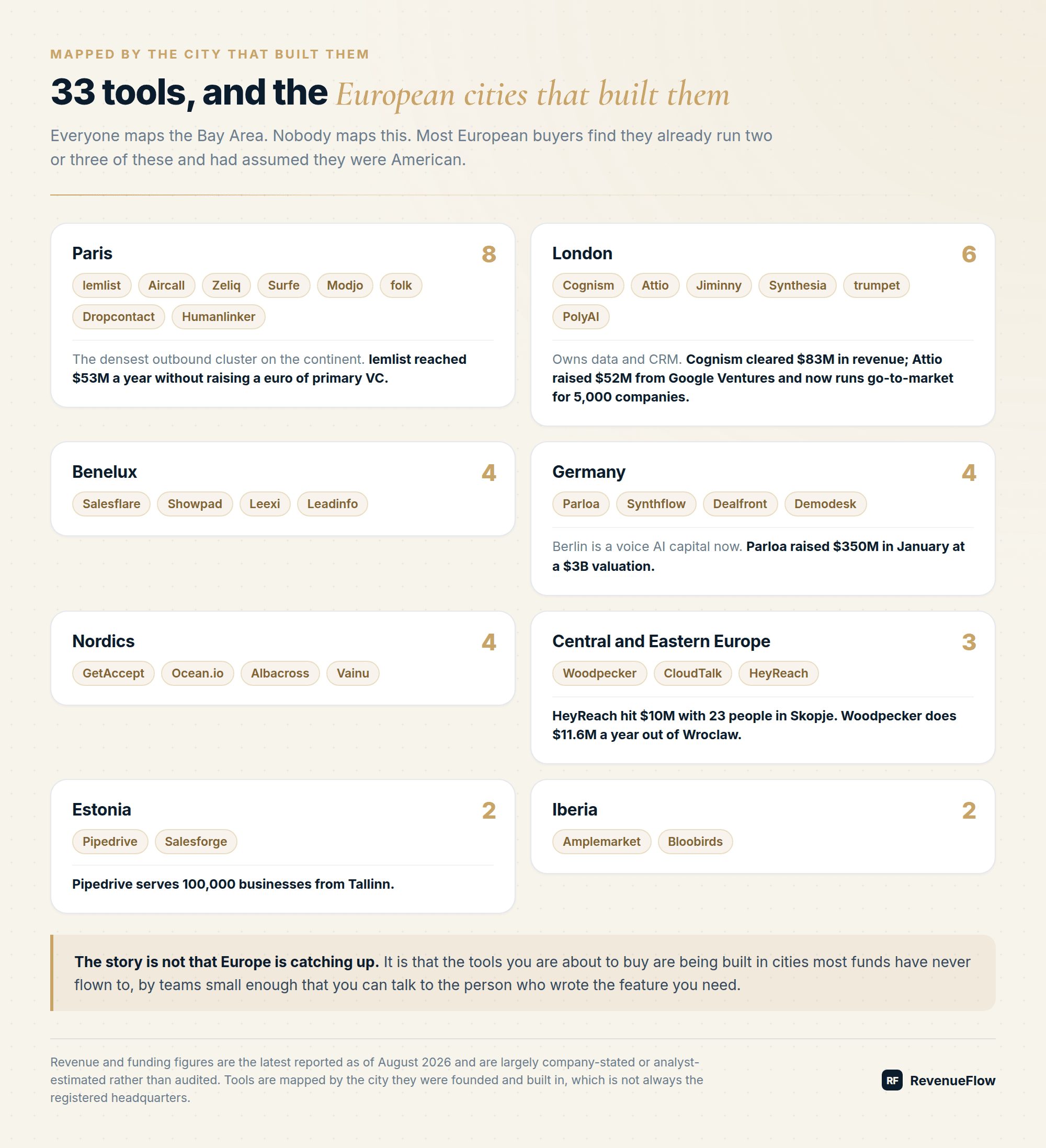
Europe has at least 33 serious AI go-to-market tools, concentrated in Paris with 8, London with 6, and clusters across Benelux, Germany, the Nordics, Estonia, Iberia and Central Europe. HeyReach reached $10M with 23 people in Skopje, lemlist $53M with no primary VC, Cognism $83M, and Woodpecker $11.6M from Wroclaw.
Key takeaways
- Paris holds the densest outbound cluster in Europe with 8 tools, followed by London with 6.
- HeyReach reached $10M a year with 23 people in Skopje, 24 months after starting.
- lemlist reached $53M a year without raising a euro of primary VC, and Cognism cleared $83M in revenue.
- Woodpecker does $11.6M a year from Wroclaw and Pipedrive serves 100,000 businesses from Tallinn.
- Parloa raised $350M in January at a $3B valuation, making Berlin a voice AI centre.
- Enterprise procurement, not product quality, is where deals with small European vendors most often stall.
Reviewed and updated September 5, 2026
The European GTM Tool Map: 33 Tools by the City That Built Them
In 2023, a startup in Skopje started building a LinkedIn tool. Twenty-four months later it was doing $10M a year.
Everyone maps the Bay Area. Nobody maps this. So I plotted every serious AI go-to-market tool in Europe by the city it was actually built in, and the result is a map of software most buyers already have in their stack without knowing where it came from.
London (6). Cognism, Attio, Jiminny, Synthesia, trumpet, PolyAI
Paris (8). lemlist, Aircall, Zeliq, Surfe, Modjo, folk, Dropcontact, Humanlinker
Zeliq publishes its rate card in dollars with a credit meter behind it, set out in Zeliq pricing as read on 4 September 2026.
Benelux (4). Salesflare, Showpad, Leexi, Leadinfo
Germany (4). Parloa, Synthflow, Dealfront, Demodesk
Nordics (4). GetAccept, Ocean.io, Albacross, Vainu
Estonia (2). Pipedrive, Salesforge
Iberia (2). Amplemarket, Bloobirds
Central and Eastern Europe (3). Woodpecker, CloudTalk, HeyReach
Four things surprised me
Berlin is a voice AI capital now. Parloa raised $350M in January at a $3B valuation, in a category most GTM buyers still think of as a US story.
Paris is the densest outbound cluster on the continent. Eight tools, and lemlist reached $53M a year without raising a euro of primary VC.
London owns data and CRM. Cognism cleared $83M in revenue. Attio raised $52M from Google Ventures and now runs go-to-market for 5,000 companies.
The smallest cities punch hardest. Woodpecker does $11.6M a year out of Wroclaw. Pipedrive serves 100,000 businesses from Tallinn. HeyReach hit $10M with 23 people in Skopje.
That last one is the number I keep coming back to. Twenty-three people, $10M, in a LinkedIn automation category that US-funded competitors have been pouring money into for years.
What actually changes when your vendor is a 23-person European team
This is the part the map does not answer, and it is the only part that affects your quarter. Six differences show up consistently, and they are not all in the small vendor's favour.
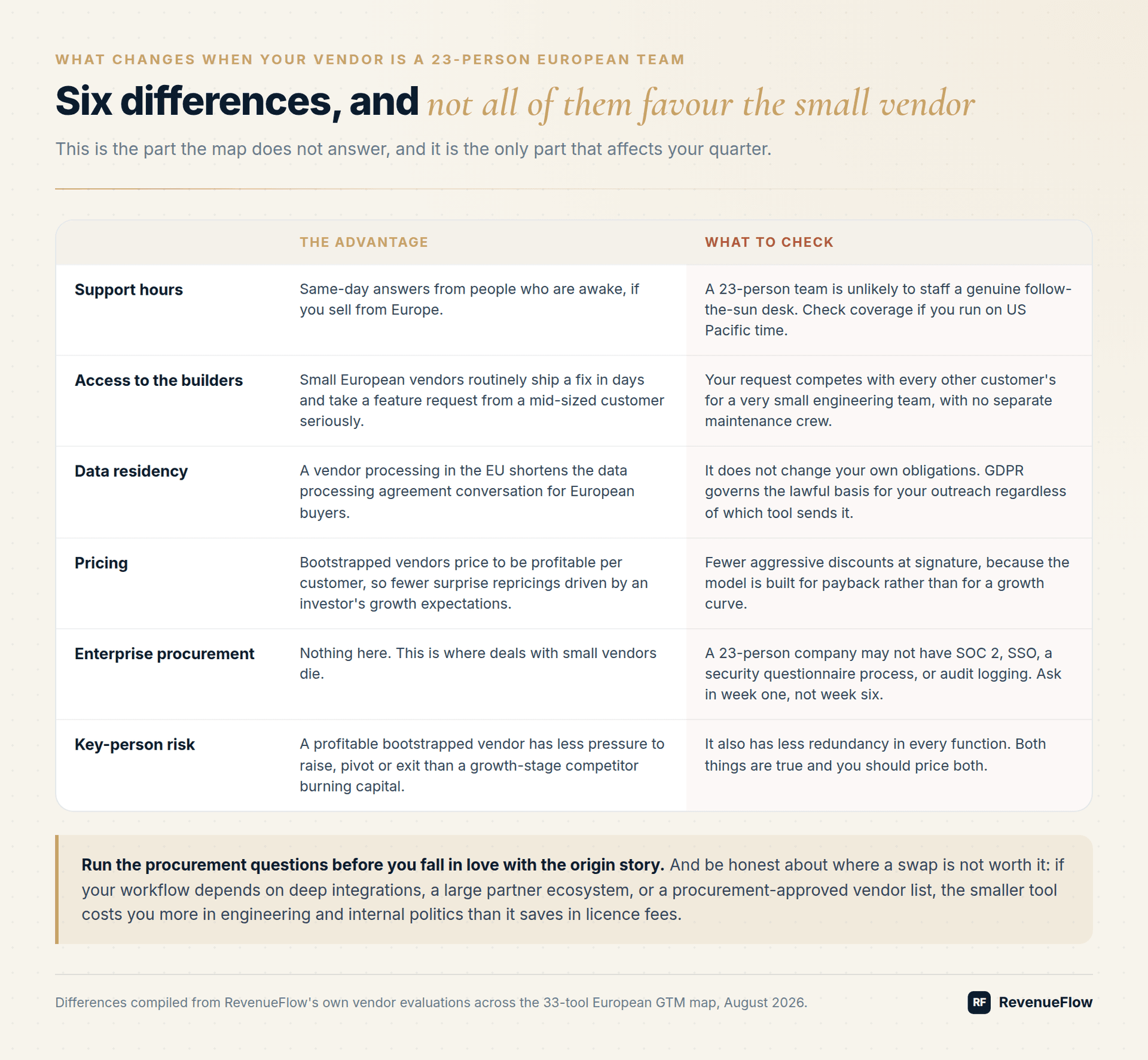
Support hours follow their timezone. Excellent if you sell from Europe, since you get same-day answers from people who are awake. Check the coverage carefully if your operations run on US Pacific time, because a 23-person team is unlikely to staff a genuine follow-the-sun desk.
You get access to the people who build it. Small European vendors routinely ship a fix in days and will take a feature request from a mid-sized customer seriously. The flip side is that your request competes directly with every other customer's for a very small engineering team, and there is no separate maintenance crew absorbing the bug backlog.
Data residency is usually simpler, and still your responsibility. A vendor processing in the EU shortens the data processing agreement conversation for European buyers. Ask where data is processed, which sub-processors handle it, and what the retention policy is. Note that none of this changes your own obligations: GDPR governs the lawful basis for your outreach regardless of which tool sends it, which is worth reading up on before you scale a list. Our take on whether cold email is legal covers the regime you are actually operating under.
Pricing is built for payback, not for a growth curve. Bootstrapped vendors tend to price to be profitable per customer rather than to buy market share. In practice that means fewer aggressive discounts at signature, less land-and-expand pressure afterwards, and fewer surprise repricings driven by an investor's growth expectations.
Enterprise procurement is the real blocker. This is where deals with small vendors die. A 23-person company may not have SOC 2, SSO, a security questionnaire process, or the audit logging your infosec review demands. Ask for the security documentation in week one rather than week six.
Key-person risk cuts against the runway advantage. A profitable bootstrapped vendor has less pressure to raise, pivot or exit than a growth-stage US competitor burning capital, which is a genuine stability argument. It also has less redundancy in every function. Both things are true and you should price both.
How to use the map in a stack audit
Three passes, roughly an hour of work.
- Step 1List your current stack next to the map
Most European buyers find they already run two or three of these and had assumed they were American.
- Step 2Look for like-for-like alternatives
In the categories where you are paying US enterprise pricing for a feature set you use a third of.
- Step 3Be honest about where a swap is not worth it
The smaller tool will cost you more in engineering and internal politics than it saves in licence fees.
First, list your current stack next to the map. Most European buyers find they already run two or three of these and had assumed they were American. That matters for the data residency and support questions above, in your favour.
Second, look for like-for-like alternatives in the categories where you are paying US enterprise pricing for a feature set you use a third of. Outbound sending, CRM, contact data, call intelligence and visitor identification all have credible European options on this map.
Third, and this is the discipline part, be honest about where a swap is not worth it. If your workflow depends on deep integrations, a large partner ecosystem, or a procurement-approved vendor list, the smaller tool will cost you more in engineering and internal politics than it saves in licence fees. If you want the deeper cut on one country's cluster, the France GTM software map goes further into the Paris side of this.
The actual story
The story is not that Europe is catching up.
It is that the tools you are about to buy are being built in cities most funds have never flown to, by teams small enough that you can talk to the person who wrote the feature you need.
Save the map for your next stack audit. Then run the procurement questions before you fall in love with the origin story.
We build AI-native pipeline systems and you pay per qualified meeting, not a retainer. No paying for activity. You only pay when we book you a qualified sales meeting. See if you qualify.
Revenue and funding figures are the latest reported as of mid-2026 and are largely company-stated or analyst-estimated rather than audited. Tools are mapped by the city they were founded and built in, which is not always the registered headquarters.
Frequently asked questions.
Frequently asked questions- What are the best European alternatives to US sales tools?
- Europe has credible options in most GTM categories: Cognism and Dealfront in contact data, Attio, folk, Pipedrive and Salesflare in CRM, lemlist, Woodpecker, Salesforge and Amplemarket in outbound, HeyReach and Surfe on LinkedIn, and Modjo, Jiminny and Leexi in call intelligence. Match on feature depth and integrations before origin.
- Is it risky to buy from a small European software vendor?
- The risks are specific rather than general. A 23-person team may lack SOC 2, SSO, follow-the-sun support and redundancy in each function, which is where procurement usually stalls. Against that, profitable bootstrapped vendors face less pressure to reprice, pivot or exit than growth-stage competitors burning capital. Request security documentation in week one.
- Does using a European vendor help with GDPR compliance?
- It simplifies the vendor side, not your side. An EU-processing vendor shortens the data processing agreement conversation and the sub-processor review. Your own lawful basis for contacting people is unchanged: GDPR governs your outreach regardless of which tool sends it, so the compliance work on list sourcing and opt-out handling stays with you.
- Which European city has the most go-to-market software companies?
- Paris, with 8 tools on this map including lemlist, Aircall, Zeliq, Surfe, Modjo, folk, Dropcontact and Humanlinker, making it the densest outbound cluster on the continent. London follows with 6, weighted towards data and CRM, including Cognism, Attio, Jiminny, Synthesia, trumpet and PolyAI.
- How do I run a stack audit against this map?
- Three passes. List your current tools next to the map, since most European buyers already run two or three without realising. Then look for like-for-like alternatives where you pay US enterprise pricing for a fraction of the feature set. Finally, rule out swaps where deep integrations or an approved vendor list would cost more than the licence saving.
About the author.

Tim Carden is CMO / CTO at RevenueFlow, which builds and operates outbound revenue engines for B2B companies. Studied at McGill University.
Tim Carden · CMO / CTO
Connect on LinkedIn →Explore more.
Ready to scale your outreach?
We build GTM engines that book real meetings. See the receipts.
Related articles.
ARR Became a Marketing Metric: How to Vet the Claim
Cluely retracted $7M and admitted to $5.2M. Decagon is valued at 128 times revenue. Here are the six questions that separate real revenue from a headline.
ZoomInfo Renamed Its Ticker to GTM. It Now Trades Under $1B
ZoomInfo took the ticker GTM in May 2025. By late July 2026 it traded under $1B. Here is what the GTM software category is actually worth, with dates attached.
The Tel Aviv AI Map: 24 Companies and a $32B Exit
Google closed a $32B acquisition in Tel Aviv and 23 more AI companies sit within 3km. The map, the exit velocity behind it, and what it means for your stack.
The 15 Most Valuable AI Companies Founded After ChatGPT
The 15 most valuable AI companies founded after ChatGPT are worth about $160B. The top sales agent company ranks last at $1.2B, and the gap has a cause.
The 60-Tool GTM Stack and the 31 We Run in Production
Twenty categories, three vendors each, and an honest split between the tools we run daily and the ones we only tested. The wiring matters more than the logos.
The AI Sales Agent Earning $3M a Year: What Actually Scales
I ranked 15 AI agent startups by reported ARR. Legal and clinical agents clear $300M, the three outbound agents total $41M, and one missing ingredient explains it.