The 15 Most Valuable AI Companies Founded After ChatGPT
The 15 most valuable AI companies founded after ChatGPT are worth about $160B. The top sales agent company ranks last at $1.2B, and the gap has a cause.
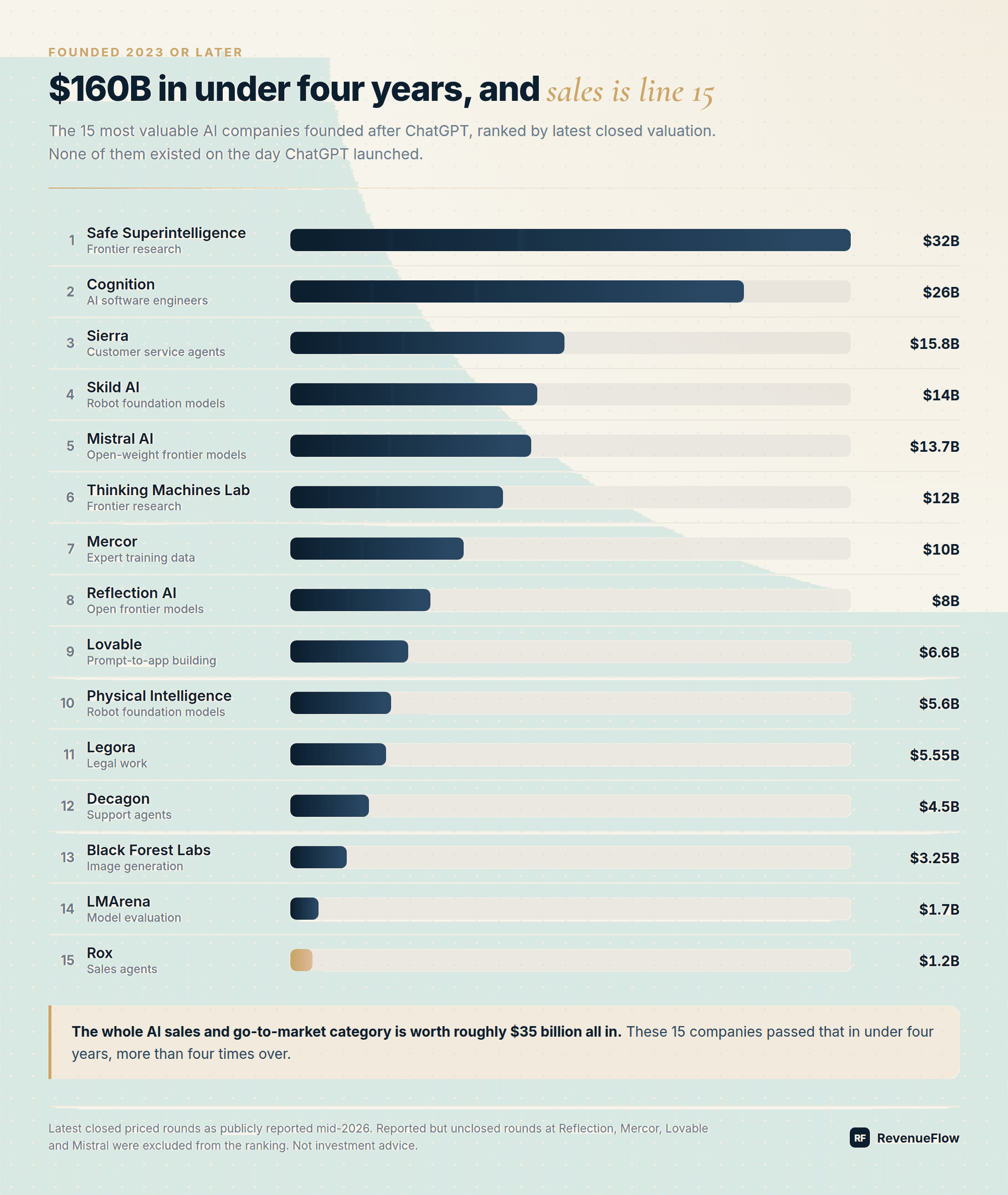
The 15 most valuable AI companies founded after ChatGPT are worth roughly $160 billion combined, led by Safe Superintelligence at $32 billion. Rox, the highest valued sales agent company, ranks last at $1.2 billion. Incumbent go-to-market vendors sold per-seat tools they had to protect, so new entrants never took the whole job.
Key takeaways
- The 15 most valuable AI companies founded in 2023 or later are worth roughly $160 billion combined.
- Safe Superintelligence leads the ranking at $32 billion with no product, no revenue and about 50 employees.
- Rox at $1.2 billion is the most valuable sales agent company founded after ChatGPT and ranks 15th of 15.
- The entire AI sales and go-to-market category is worth roughly $35 billion, which these 15 companies cleared more than four times over in under four years.
- Four reported but unclosed rounds were excluded from the ranking: Reflection at $25B, Mercor at $20B, Lovable at $12B and Mistral at 20 billion euros.
Reviewed and updated September 5, 2026
The 15 Most Valuable AI Companies Founded After ChatGPT
The most valuable AI company built after ChatGPT has no product, no revenue, and about 50 employees. It is worth $32 billion.
That is Safe Superintelligence, and it sits at the top of a list I put together of the 15 most valuable AI companies founded in 2023 or later, ranked by latest closed valuation. None of them existed on the day ChatGPT launched. Together they are worth roughly $160 billion.
The number that stopped me was not at the top of the board. It was at the bottom.
The board
Decacorns, $10B and up
- Safe Superintelligence. Frontier research. $32B.
- Cognition. AI software engineers. $26B.
- Sierra. Customer service agents. $15.8B.
- Skild AI. Robot foundation models. $14B.
- Mistral AI. Open-weight frontier models. $13.7B.
- Thinking Machines Lab. Frontier research. $12B.
- Mercor. Expert training data. $10B.
Unicorns, under $10B
- Reflection AI. Open frontier models. $8B.
- Lovable. Prompt-to-app building. $6.6B.
- Physical Intelligence. Robot foundation models. $5.6B.
- Legora. Legal work. $5.55B.
- Decagon. Support agents. $4.5B.
- Black Forest Labs. Image generation. $3.25B.
- LMArena. Model evaluation. $1.7B.
- Rox. Sales agents. $1.2B.
Why four bigger numbers are missing
Every figure above is a round that actually closed. I left off the ones that only got reported: Reflection at $25B, Mercor at $20B, Lovable at $12B, Mistral at 20 billion euros. All four were in the press when I built the list. None of the four had closed.
That distinction is not pedantry. A reported round is a negotiating position that someone leaked. A closed round is a number a fund was willing to wire against. Ranking on reported figures would have moved three companies up the board and changed the shape of the whole thing, which is exactly why the discipline matters.
Line 15 is the story
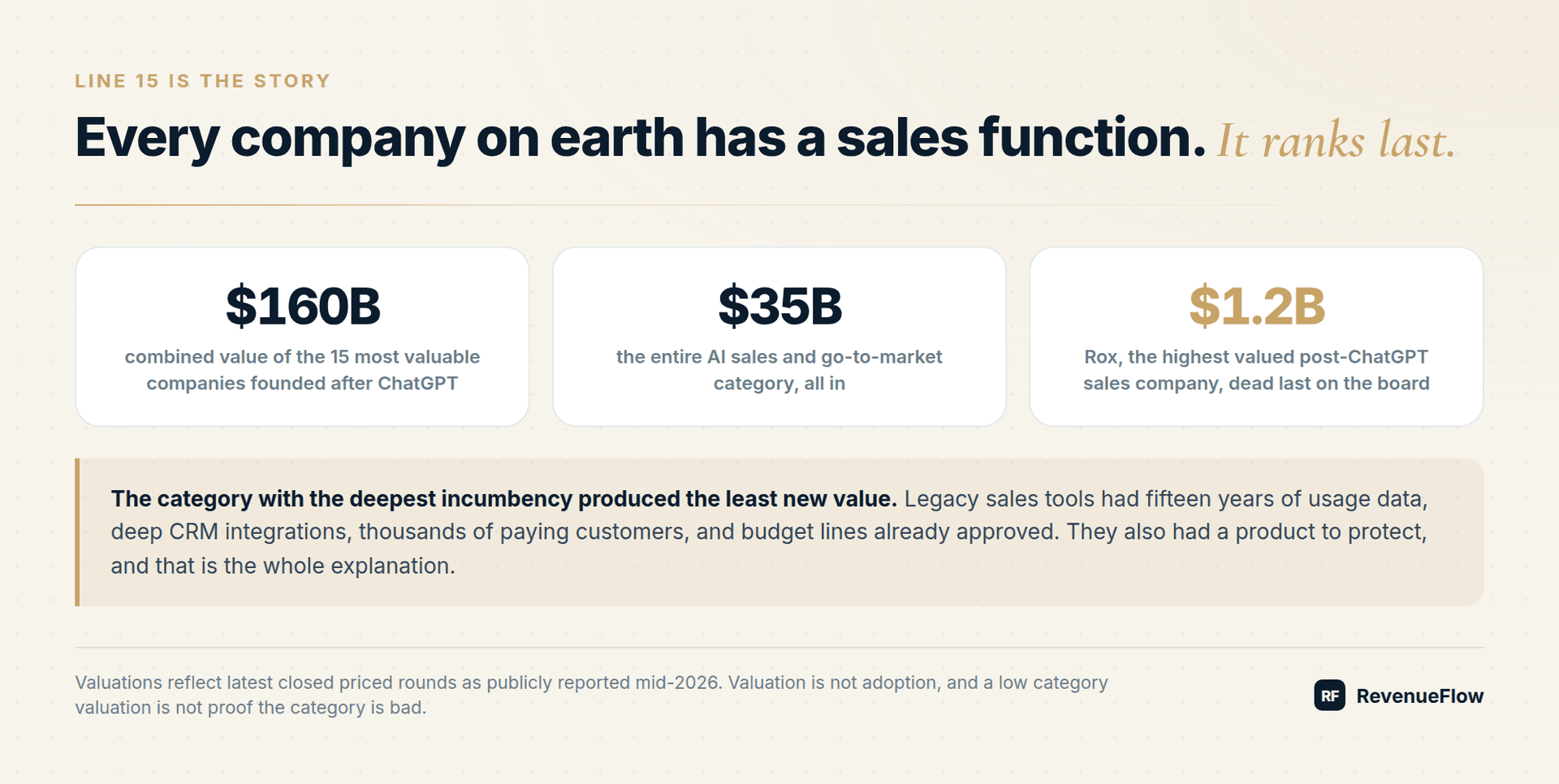
Every company on earth has a sales function. Sales tooling is one of the largest budget lines in B2B software. The most valuable sales company founded after ChatGPT sits dead last on this board at $1.2 billion.
The whole AI sales and go-to-market category, the tools your revenue team logs into every morning, is worth roughly $35 billion all in. These 15 companies passed that in under four years, more than four times over.
The category with the deepest incumbency produced the least new value. That is the part worth sitting with.
Why the deepest incumbency produced the least
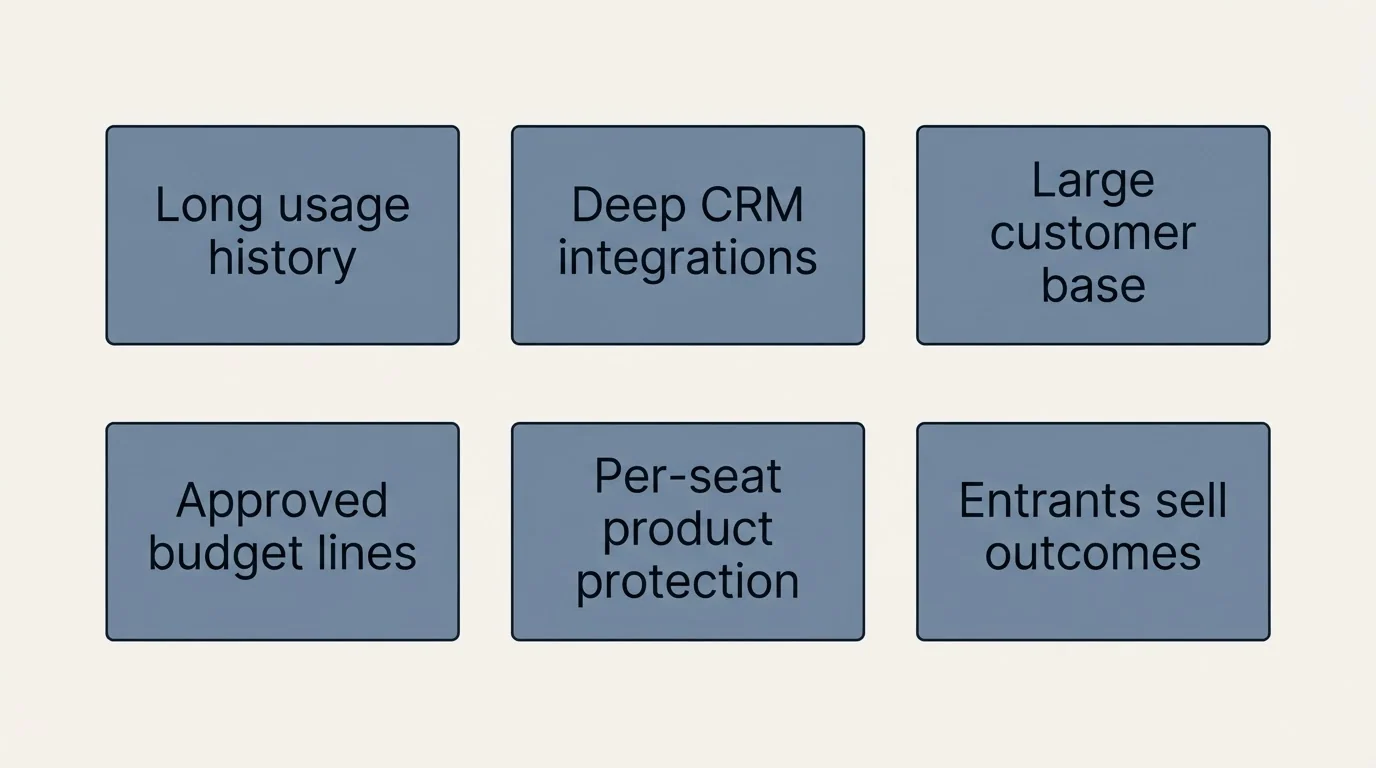
Legacy sales tools had every structural advantage a new entrant would kill for.
- Yes: Fifteen years of usage data. They know what a good sequence looks like because they watched a million of them run.
- Yes: Deep CRM integrations. The plumbing is already laid, already permissioned, already trusted by an IT team that took nine months to approve it.
- Yes: Thousands of paying customers. A distribution channel with a support contract attached.
- Yes: Budget lines already approved. This is the underrated one.
Fifteen years of usage data. They know what a good sequence looks like because they watched a million of them run. Nobody founded in 2023 has that.
Deep CRM integrations. The plumbing is already laid, already permissioned, already trusted by an IT team that took nine months to approve it.
Thousands of paying customers. A distribution channel with a support contract attached.
Budget lines already approved. This is the underrated one. Selling a new category means finding money. Selling into an existing line means winning an argument.
They also had a product to protect, and that is the whole explanation.
If your revenue is a per-seat licence for a tool that a human operates, then a system that removes the human is not an upgrade you can ship. It is a self-inflicted wound with a board deck attached. The rational move for an incumbent is to bolt an assistant onto the existing seat and keep the seat. Which is exactly what happened across the category.
The companies on this board did not have that constraint. They started from what the models can do today and built backwards from the finished job. Cognition sells completed engineering work rather than a faster editor. Sierra and Decagon sell resolved conversations rather than a better helpdesk. Legora sells legal work product. In each case the unit the buyer pays for is an outcome that either happened or did not.
That is the entire gap.
What this does not prove
Valuation is not adoption, and I want to be careful here.
Private valuations reflect the last round an investor priced, which can be months stale by the time you read it. Several of these figures will move before the year ends. They are a snapshot of what one group of buyers agreed at one moment, not a market price.
A low category valuation is also not proof that the category is bad. AI go-to-market is younger in dollars than it is in demand, and a $35 billion category is not a small one in absolute terms. The claim is narrower than it looks: the market rewarded companies that took a whole job off someone's desk, and almost nobody in go-to-market tried to take the whole job.
The same concentration pattern shows up one level higher. In America's 18 most valuable AI startups, two companies hold about 72% of the total value and everything below rank three is a specialist that owns one workflow end to end. In the GTM software valuation ranking and in the real ARR behind the most talked-about AI sales tools, the same shape appears again in miniature.
What I would ask if I were buying sales AI
Three questions, in this order.
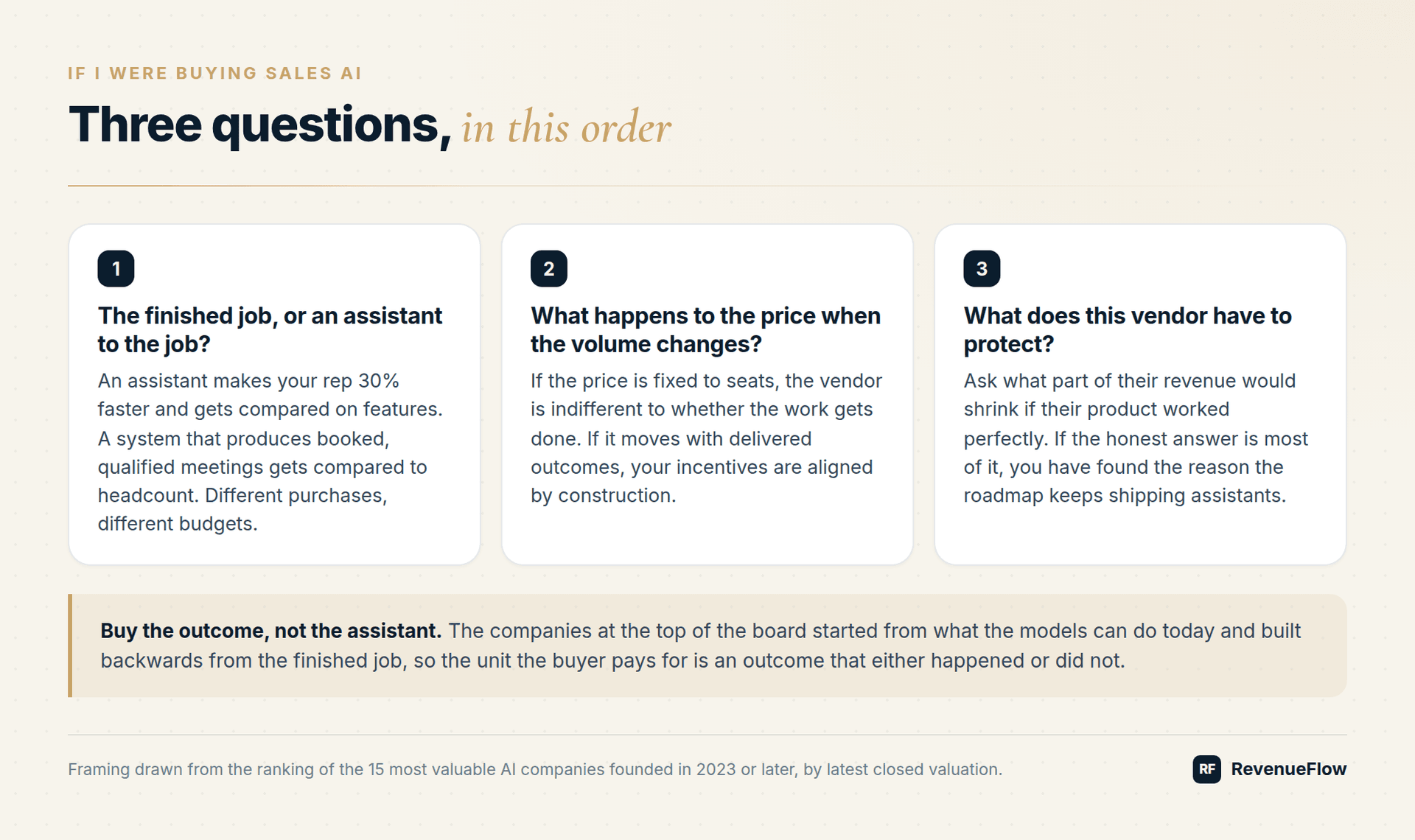
Does the vendor sell the finished job or an assistant to the job? An assistant makes your rep 30% faster and gets compared on features. A system that produces booked, qualified meetings gets compared to headcount. Those are different purchases with different budgets. The ranked list of the most valuable AI sales tools is a useful map of which vendors sit on which side of that line, and so is the breakdown of what an AI SDR actually does versus what an AI sales agent is.
What happens to the price when the volume changes? If the price is fixed to seats, the vendor is indifferent to whether the work gets done. If the price moves with delivered outcomes, your incentives are aligned by construction.
What does this vendor have to protect? Ask what part of their revenue would shrink if their product worked perfectly. If the honest answer is "most of it", you have found the reason the roadmap keeps shipping assistants.
The layer map in the 7-layer GTM AI stack is the version of this I use when auditing a stack, and the European AI startup valuation map shows the same specialist pattern outside the US.
Frequently Asked Questions
Why is the most valuable post-ChatGPT sales company only worth $1.2 billion?
The category with the most entrenched incumbents produced the least new value, because those incumbents sold per-seat licences for tools a human operates. Shipping a system that removes the operator would cannibalise their own revenue, so they shipped assistants instead. New entrants inherited a market where the finished job was still unowned but the budget was already committed elsewhere.
Are these valuations reliable?
They are the latest closed priced rounds as publicly reported, which is the most defensible figure available for a private company, but they are still snapshots. A round priced nine months ago tells you what one syndicate agreed then. Reported-but-unclosed rounds were excluded from this list precisely because they are less reliable than that.
Does a $35 billion AI go-to-market category mean the category is a bad bet?
No. It means the value in that category has not yet concentrated the way it has in code, support, and robotics. The companies on this board built backwards from a finished job, and go-to-market has an unusually legible finished job in the form of a booked, qualified meeting. The absence of a large winner there is an opening rather than a verdict.
What should a buyer take from the ranking?
Buy the outcome, not the assistant. Check whether the vendor's price moves with the work delivered, and check what part of their business would shrink if their product worked perfectly. Those two questions separate the companies building forward from the ones defending a seat.
RevenueFlow builds AI-native pipeline systems and you pay per qualified meeting, not a retainer. No paying for activity. You only pay when we book you a qualified sales meeting. See if you qualify.
Valuations reflect latest closed priced rounds as publicly reported in mid-2026. Not investment advice.
Frequently asked questions.
Frequently asked questions- Why is the most valuable post-ChatGPT sales company only worth $1.2 billion?
- The category with the most entrenched incumbents produced the least new value, because those incumbents sold per-seat licences for tools a human operates. Shipping a system that removes the operator would cannibalise their own revenue, so they shipped assistants instead. New entrants inherited a market where the finished job was still unowned but the budget was already committed elsewhere.
- How reliable are these AI company valuations?
- They are the latest closed priced rounds as publicly reported, which is the most defensible figure available for a private company, but they remain snapshots. A round priced nine months ago tells you what one syndicate agreed then. Reported but unclosed rounds were excluded from this ranking precisely because they are less reliable than that.
- Does a $35 billion AI go-to-market category mean the category is a bad bet?
- No. It means value has not yet concentrated there the way it has in code, support and robotics. The companies on this board built backwards from a finished job, and go-to-market has an unusually legible finished job in the form of a booked, qualified meeting. The absence of a large winner is an opening rather than a verdict.
- What should a buyer take from this ranking?
- Buy the outcome rather than the assistant. Check whether the vendor's price moves with the work delivered, and ask what part of their business would shrink if their product worked perfectly. Those two questions separate the companies building forward from the ones defending a per-seat product.
About the author.

Ben Carden is CRO at RevenueFlow, which builds and operates outbound revenue engines for B2B companies. Previously at Gartner Enterprise. Studied at London School of Economics.
Ben Carden · CRO
Connect on LinkedIn →Explore more.
Ready to scale your outreach?
We build GTM engines that book real meetings. See the receipts.
Related articles.
The Paris AI Map: 23 Companies and $35B
23 AI companies, more than $35B of reported value, and 10 of them inside one 2km circle. Here is the Paris AI map and why the density is the real asset.
ZoomInfo Renamed Its Ticker to GTM. It Now Trades Under $1B
ZoomInfo took the ticker GTM in May 2025. By late July 2026 it traded under $1B. Here is what the GTM software category is actually worth, with dates attached.
The Tel Aviv AI Map: 24 Companies and a $32B Exit
Google closed a $32B acquisition in Tel Aviv and 23 more AI companies sit within 3km. The map, the exit velocity behind it, and what it means for your stack.
Per-Seat Pricing Is Dying: The Market Is Pricing the Funeral
Six go-to-market software companies lost $224B in 19 months. Every one ships AI, so AI is not the variable. Seat pricing is, and HubSpot proved it publicly.
ARR Became a Marketing Metric: How to Vet the Claim
Cluely retracted $7M and admitted to $5.2M. Decagon is valued at 128 times revenue. Here are the six questions that separate real revenue from a headline.
We Burned $430K on Go-To-Market. Here Is What Survived
In 2025 we spent more than $430K testing go-to-market plays. Six survived. Here is what the money bought, what it did not, and what I would do differently.