16 GTM Software Companies Worth $170 Billion: Ranked
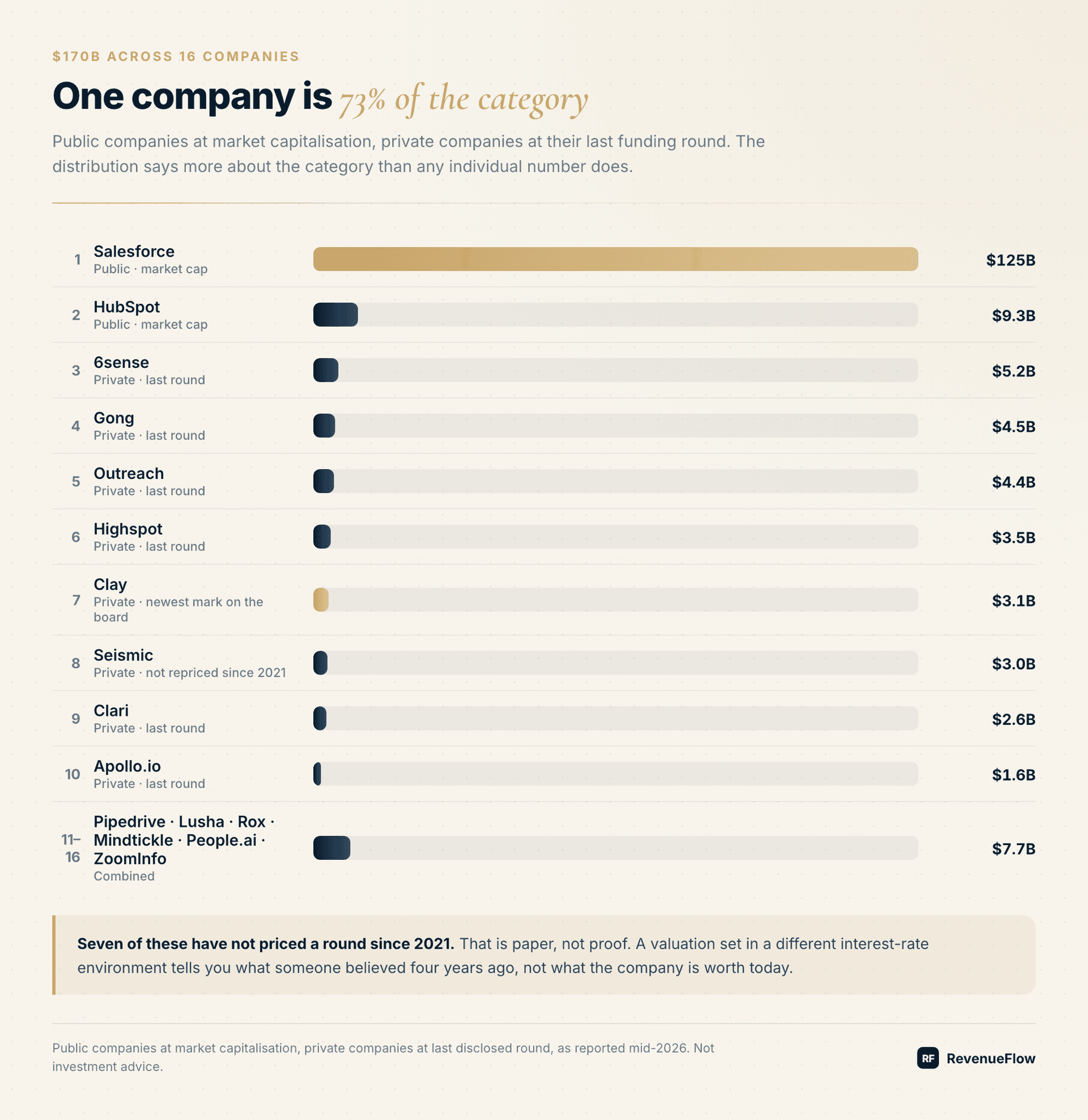
Salesforce is 73% of the category on its own. Seven of the private companies have not priced a round since 2021. Here is what the ranking actually tells a buyer, and what it cannot.
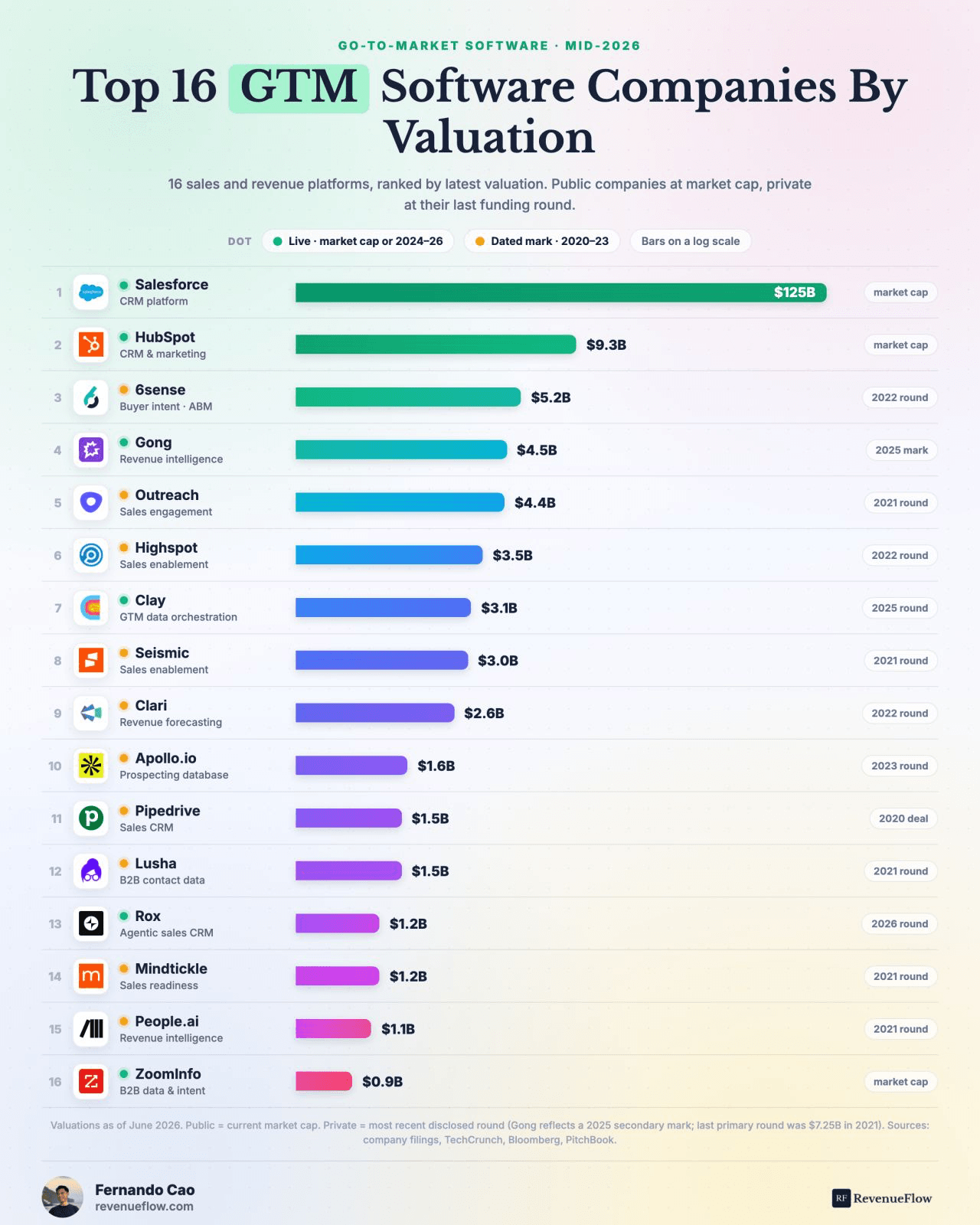
Salesforce dominates at $125B of the $170B total GTM software market valuation, with the public companies losing roughly half their value as the market repriced for profitability over growth. Seven private companies still carry 2021 valuations that have not been tested, while fresh capital flows exclusively to AI-native companies like Clay whose economics do not scale with headcount.
Key takeaways
- Salesforce accounts for 73% of the $170B total valuation across the sixteen largest GTM software companies.
- Seven of the private companies on the list have not priced a funding round since 2021, meaning their valuations reflect conditions from four years ago.
- Public GTM software companies lost roughly half their value in a year as the market shifted from rewarding growth to demanding profitability and retention.
- Clay at $3.1B represents the newest valuation mark and reflects capital flowing to AI-native companies whose unit economics do not scale with customer headcount.
- The combined cost of licences and the fractional headcount needed to operate each tool typically exceeds the licence price alone.
Reviewed and updated September 5, 2026
16 GTM Software Companies Worth $170 Billion
Public companies at market capitalisation. Private companies at their last funding round.
- Salesforce $125B
- HubSpot $9.3B
- 6sense $5.2B
- Gong $4.5B
- Outreach $4.4B
- Highspot $3.5B
- Clay $3.1B
- Seismic $3.0B
- Clari $2.6B
- Apollo.io $1.6B
- Pipedrive $1.5B
- Lusha $1.5B
- Rox $1.2B
- Mindtickle $1.2B
- People.ai $1.1B
- ZoomInfo $0.9B
Three Things Stand Out
The public market repriced GTM hard
The biggest names lost roughly half their value in a year. ZoomInfo, once a category darling trading well above its current level, now sits at under a billion.
ZoomInfo's collapse from category darling to sub-billion valuation is examined in depth in the database versus workflow repricing story, which traces how value shifted away from record ownership.
That repricing is not a judgment on the products. It reflects a market that stopped paying for growth at any cost and started asking about profitability and retention. Go-to-market software was particularly exposed because its customers cut sales headcount, and seat-based pricing follows headcount down.
Most private numbers are frozen
Seven of these companies have not priced a round since 2021.
A valuation set in 2021 was set in a different interest rate environment, by investors with different alternatives, before the current AI cycle existed. It tells you what someone believed four years ago. It is paper, not proof.
When you see a private company on a list like this at a number that has not moved in years, the honest interpretation is that nobody has tested it recently, not that it has held.
The only fresh money is going to AI-native GTM
Clay at $3.1B is the newest mark on the board, and Clay is a company rebuilding data orchestration around AI rather than around a seat count.
That is the pattern across the recent rounds in this category. Capital is flowing to companies whose unit economics do not scale with the customer's headcount, because the market no longer believes headcount is going up.
Salesforce Is 73% Of The Category
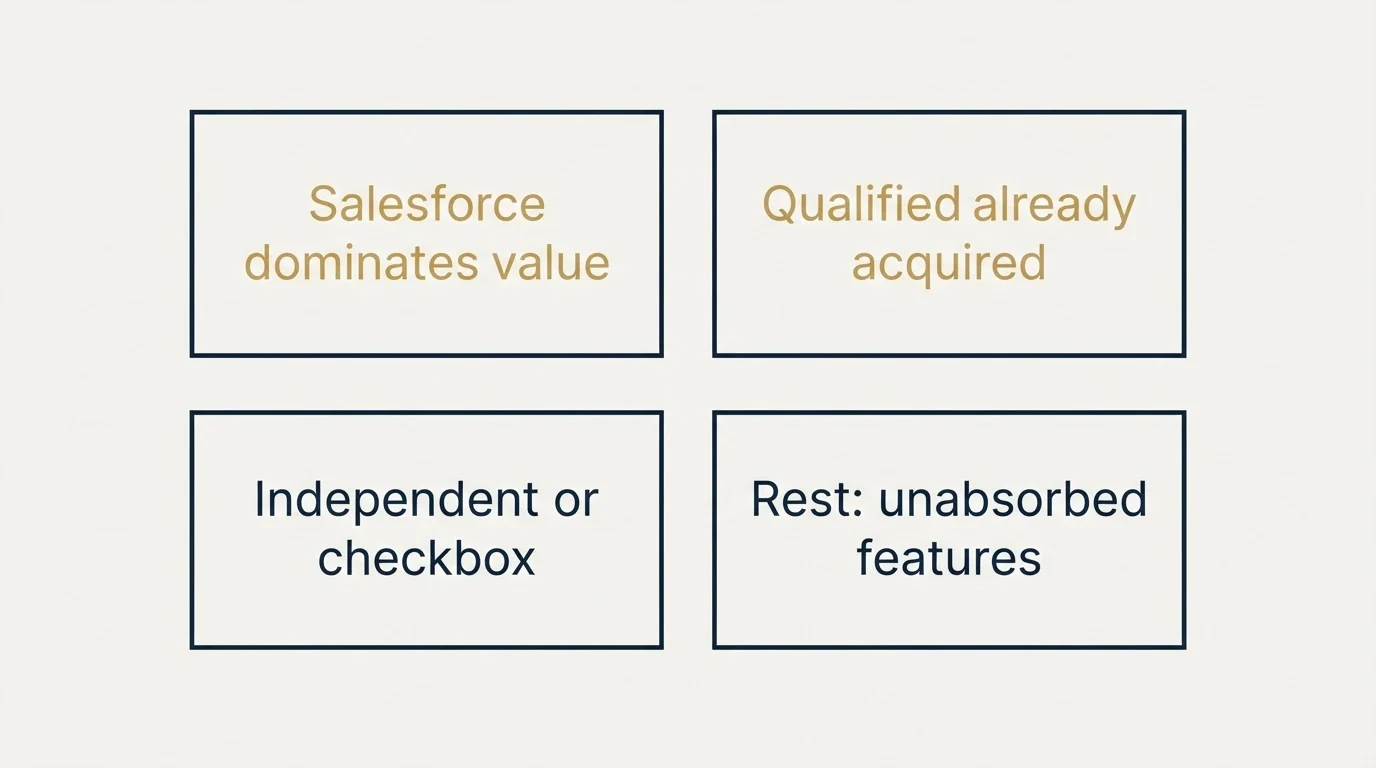
Worth sitting with this one. Salesforce alone accounts for roughly $125B of the $170B total.
Every other company on this list is, in some sense, a feature that Salesforce has not absorbed yet. Several have already been partially absorbed: Salesforce acquired Qualified, and its own product roadmap overlaps with forecasting, enablement, and engagement.
For a buyer, that concentration is a real consideration. If you are building a workflow on a $2B point solution, you are making a bet about whether that capability stays independent or becomes a checkbox in the platform you already own.
What No Number On This List Tells You
Whether the software books a single meeting.
That sounds like a rhetorical flourish, so let me make it concrete. You can construct a stack from the top eight companies on this list, spend several hundred thousand dollars a year, and generate no pipeline. It happens routinely. The tools are all good. Nothing in them makes the decisions about who to target, what to say, or when to follow up.
Owning the most expensive stack was never the hard part. Operating it is.
How To Read A List Like This As A Buyer
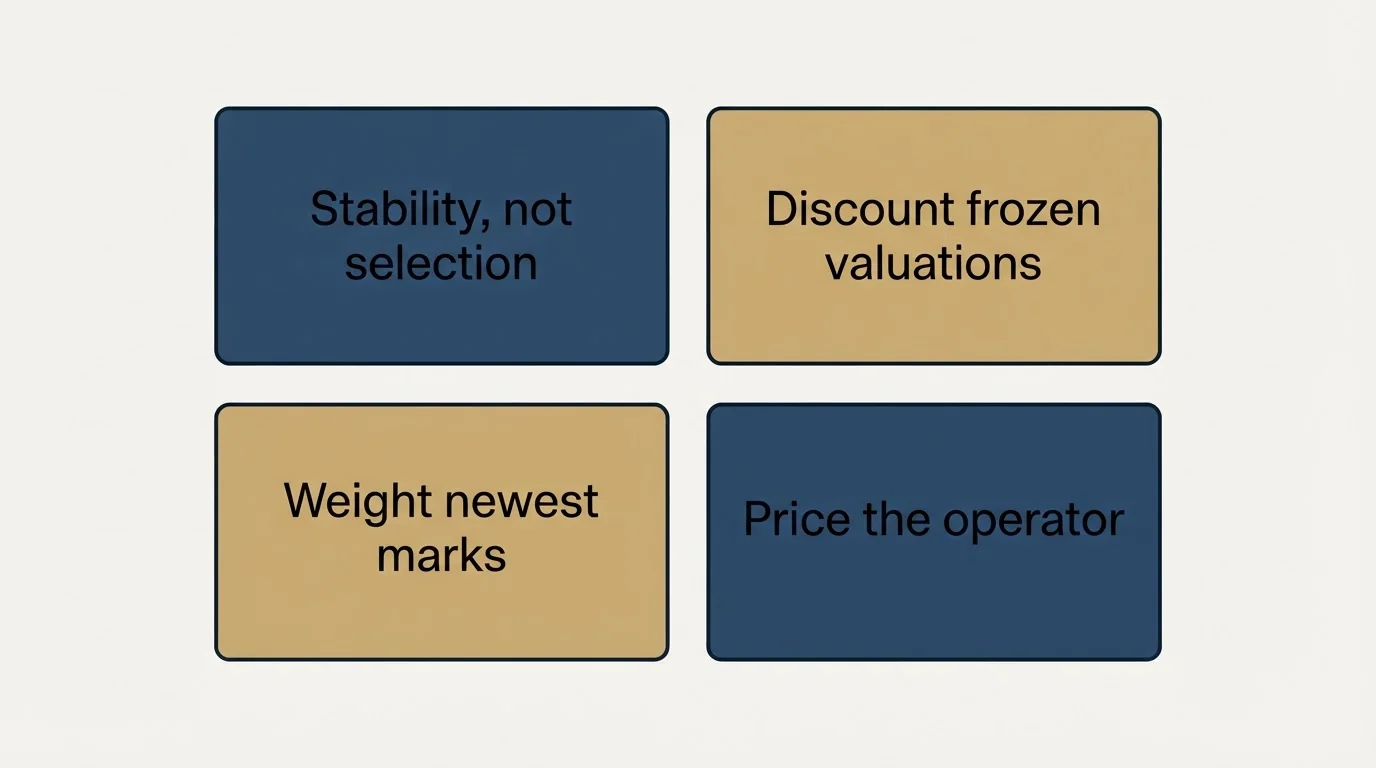
- Yes: Use it for stability, not selection: the top ten will exist at your renewal
- Yes: Discount frozen valuations: if a private company has not raised since 2021, ask why
- Yes: Weight the newest marks, because they reflect what the market believes now
- Yes: Price the operator: for every tool you add, add the fraction of a person needed to run it
Use it for stability, not selection. The top ten will exist at your renewal and will have engineers on the product. That is worth something when you are building process on top of a tool.
Discount frozen valuations. If a private company has not raised since 2021, ask why. Sometimes the answer is that they are profitable and do not need to, which is excellent. Sometimes it is that a round would have to be priced down.
Weight the newest marks. Clay being the freshest number in the category is more informative than Seismic being a larger one, because Clay's price reflects what the market believes now.
Price the operator. For every tool you add, add the fraction of a person needed to run it. That number is usually larger than the licence, and it never appears on a ranking like this.
Beyond this valuation lens, a real-world production GTM stack shows how spend has shifted from per-seat licences toward metered APIs.
Frequently Asked Questions
Why did GTM software get repriced so hard?
Customers cut sales headcount, and seat-based pricing follows headcount down. The market also stopped paying for growth at any cost and started asking about profitability and retention. Go-to-market software was doubly exposed to both changes.
What does it mean when a private valuation has not moved since 2021?
That nobody has tested it recently. A 2021 valuation was set in a different interest rate environment by investors with different alternatives. Sometimes the company is profitable and does not need to raise, which is excellent. Sometimes a new round would have to be priced down.
Why is Salesforce so much larger than everything else?
It owns the system of record, which is the seat every other product has to integrate with. Most companies on this list are, in some sense, a capability Salesforce has not absorbed yet, and it has already absorbed some of them.
Should that concentration change what I buy?
It is worth considering. If you are building a critical workflow on a $2B point solution, you are making an implicit bet about whether that capability stays independent or becomes a checkbox in the platform you already pay for.
Which number on this list should a buyer actually care about?
None of them directly. The useful signals are net revenue retention, how recently the valuation was set, and how much operating work the tool creates versus removes. Owning the most expensive stack was never the hard part. Operating it is.
Related Reading
- The 15 Most Valuable AI Sales Tools, Ranked by What Investors Actually Paid
- The Real ARR Behind 15 AI Sales Companies (The Order Flips Completely)
- 29 US AI Companies and Where They're Actually Headquartered
We build AI-native pipeline systems and you pay per qualified meeting, not a retainer. No paying for activity. You only pay when we book you a qualified sales meeting. See if you qualify.
Valuations reflect market capitalisation for public companies and last disclosed funding round for private companies, as publicly reported in mid-2026. Not investment advice.
Frequently asked questions.
Frequently asked questions- Why did GTM software valuations drop so much?
- Customers cut sales headcount and seat-based pricing follows headcount down. The market also stopped paying for growth at any cost and started demanding profitability and retention. Go-to-market software was doubly exposed because its pricing model directly tracks the sales teams that were being cut.
- What does it mean when a private company's valuation hasn't changed since 2021?
- It means nobody has tested the valuation recently with actual capital. A 2021 valuation was set in a different interest rate environment by investors with different alternatives. Sometimes the company is profitable and does not need to raise, but sometimes a new round would have to be priced down.
- Why is Salesforce so much bigger than every other GTM software company?
- Salesforce owns the system of record that every other product must integrate with. It accounts for roughly $125B of the $170B total category valuation. Most other companies on the list are, in some sense, a capability that Salesforce has not absorbed yet, and it has already acquired or built overlapping features for several categories.
- Does buying the most expensive GTM software stack guarantee pipeline?
- No. You can construct a stack from the top eight companies on the list, spend several hundred thousand dollars annually, and generate no pipeline. The tools do not make the decisions about who to target, what to say, or when to follow up. Owning the stack was never the hard part; operating it is.
- How should a buyer interpret this valuation ranking when selecting GTM software?
- Use it for stability assessment, not selection. The top companies will exist at renewal and have active engineering teams. Discount frozen valuations from 2021 and weight the newest marks like Clay. Most importantly, price the operator: for every tool you add, add the fraction of a person needed to run it, which usually costs more than the licence itself.
About the author.

Fernando Cao is CEO at RevenueFlow, which builds and operates outbound revenue engines for B2B companies. Previously at Accenture Strategy. Studied at University of Bath.
Fernando Cao · CEO
Connect on LinkedIn →Explore more.
Ready to scale your outreach?
We build GTM engines that book real meetings. See the receipts.
Related articles.
The Real ARR Behind 15 AI Sales Companies
In AI sales, valuations are measured in billions and revenue is measured in millions. Ranked by what customers actually pay, the leaderboard looks nothing like your feed.
The 15 Most Valuable AI Sales Tools, Ranked by Investors
Hundreds of AI tools are competing for your sales budget. Ranked by latest priced round, the order is not what you would expect, and the top of the list is full of companies that existed long before the AI cycle.
29 US AI Companies and Where They're Actually Headquartered
A few years ago, AI company meant San Francisco. The Bay Area still leads on count, but Boston, Pittsburgh and New York now own specific layers. Here is the map, and how to read it as a supply chain.
The New York AI Map: 22 Application Layer Companies
Ramp is worth $44B. VAST Data $30B. ElevenLabs $11B. None of them are in San Francisco. Here is how New York's AI cluster is organised, and why it matters for anyone building a go-to-market motion.
America's 18 Most Valuable AI Startups
Anthropic passed OpenAI in May. Together they hold $1.82 trillion of the $2.51 trillion total. The cliff after second place is bigger than every company below it added together.
Europe's AI Startups Crossed $140B: The Valuation Map
27 companies, 7 countries, and a defence company on top. Europe's AI cluster looks nothing like America's, and the difference says something useful about where applied AI value accrues.