America's 18 Most Valuable AI Startups
Anthropic passed OpenAI in May. Together they hold $1.82 trillion of the $2.51 trillion total. The cliff after second place is bigger than every company below it added together.
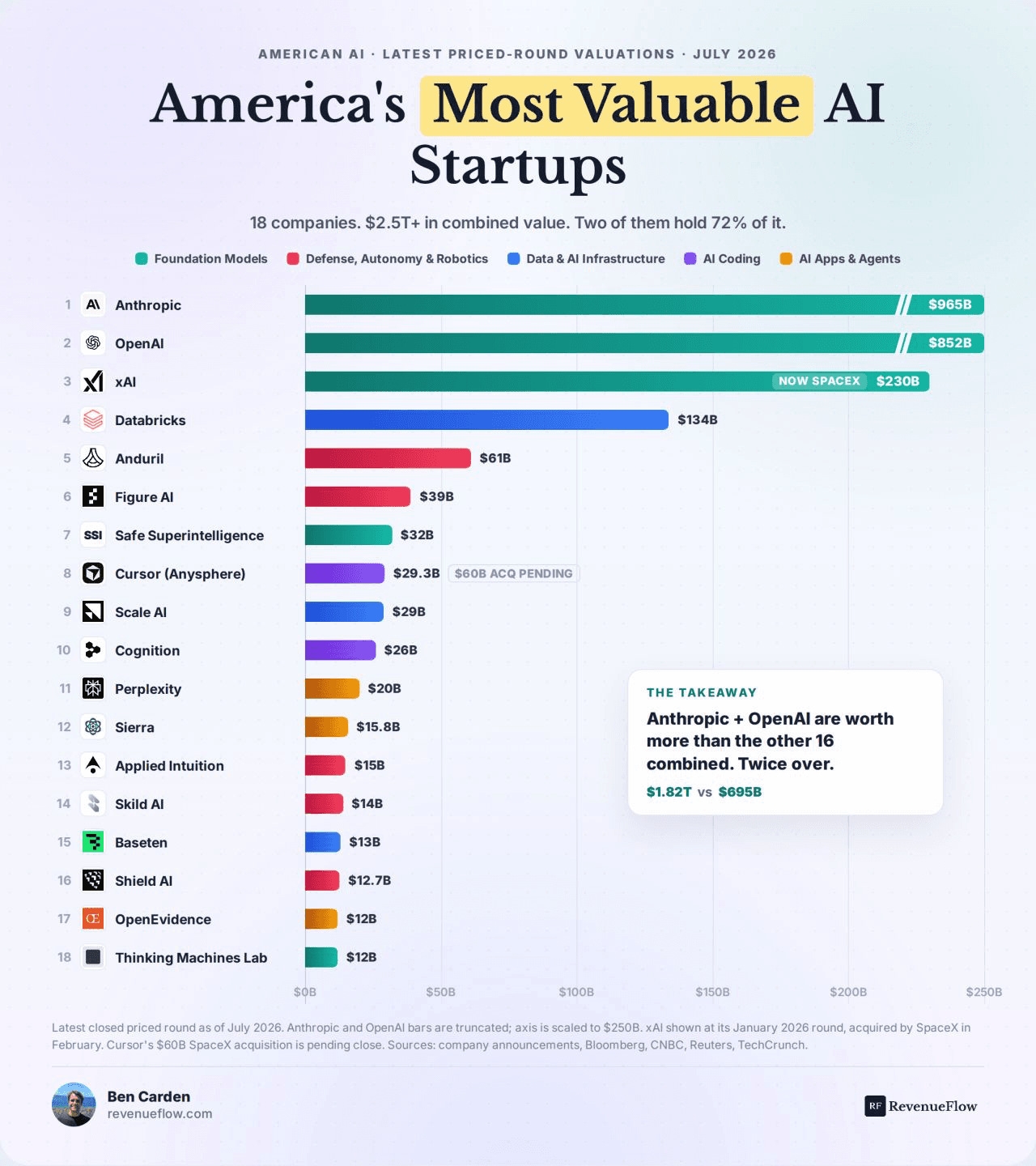
Anthropic ($965B) and OpenAI ($852B) control 72% of America's $2.51 trillion AI startup value, with Anthropic taking the lead in May. The gap from second to third place ($230B) exceeds the combined value of all 15 companies below. Every company ranked fourth or lower is a specialist owning one complete workflow (defense, clinical, code, or customer agents), not a generalist tool improving marginal steps.
Key takeaways
- Anthropic and OpenAI together hold $1.82 trillion of the $2.51 trillion total valuation across America's top 18 AI startups.
- The drop from second-place OpenAI to third-place xAI is roughly $230 billion, larger than the combined value of the next 15 companies.
- Every AI startup ranked fourth or below specializes in owning one complete workflow rather than competing at the model layer.
- SpaceX absorbed xAI in February and its reported $60B deal for Cursor would be the largest venture-backed acquisition ever.
- No AI go-to-market company has reached $10B valuation, while specialists in code and clinical workflows have produced several above that threshold.
Reviewed and updated September 5, 2026
America's 18 Most Valuable AI Startups
Two American companies are now worth more than every other AI startup in the country combined. Twice over.
Take every US company whose product is AI, rank them by their latest closed priced round, and the distribution is more extreme than almost any other technology market in living memory.
The Top Of The List
Anthropic sits at roughly $965B. OpenAI at roughly $852B. Anthropic passed OpenAI in May to become the most valuable AI startup in the world, a position it had not held before this year.
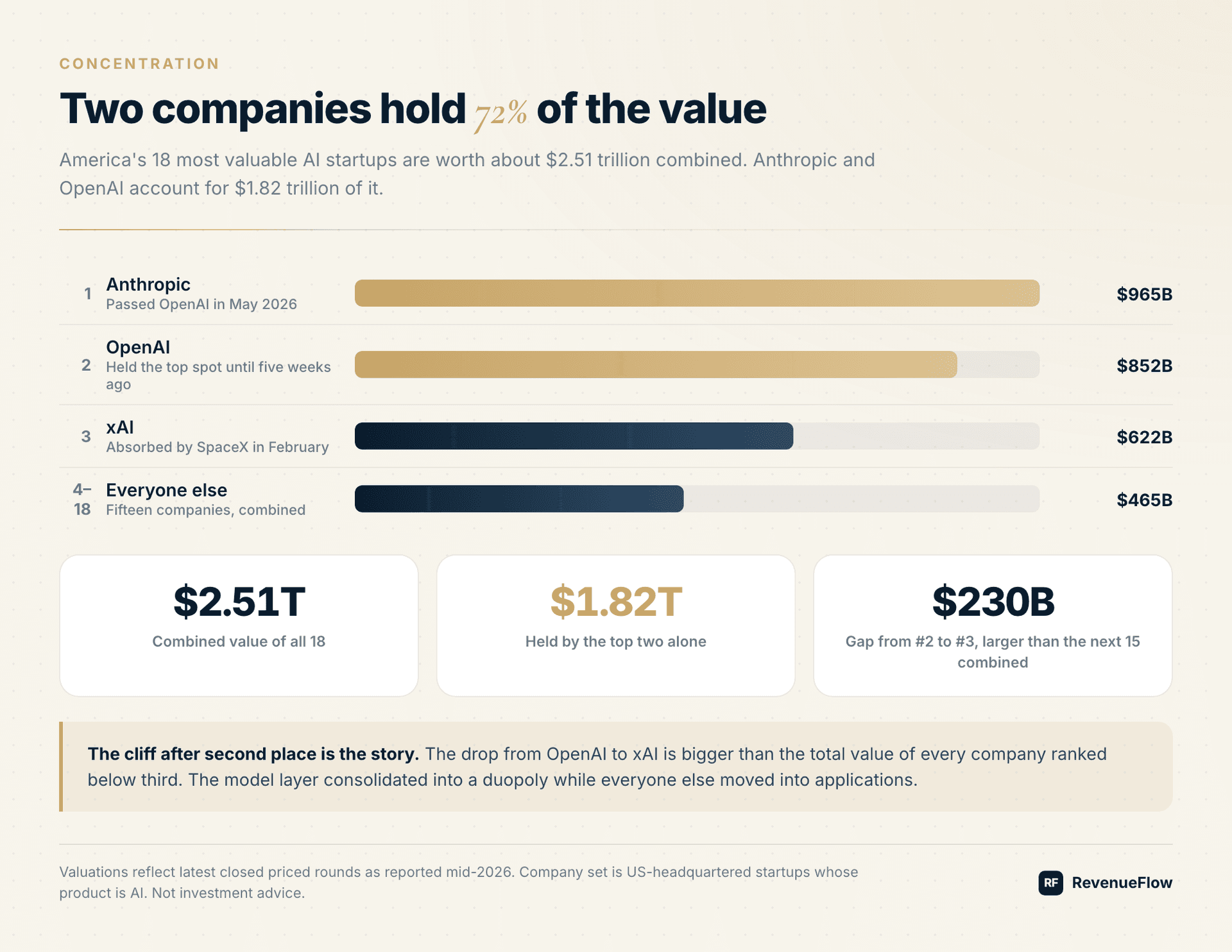
Together they account for $1.82 trillion of the $2.51 trillion total across all 18 companies. That is about 72% of the value in two names.
The Cliff Is The Real Story
xAI sits third at around $622B. The drop from OpenAI to xAI is roughly $230 billion.
That single gap is larger than the combined value of the next fifteen companies, which total around $465 billion.
the most valuable AI startup in the world
third
Markets with this shape usually have one thing in common: enormous fixed costs and winner-take-most dynamics. Training frontier models requires capital that only a handful of entities can raise, and the resulting advantage compounds. That is a duopoly forming, not a competitive market maturing.
SpaceX is also quietly consolidating the list. It absorbed xAI in February, and its reported $60B deal for Cursor would be the largest venture-backed acquisition ever completed.
Everyone Below Rank Three Has The Same Shape
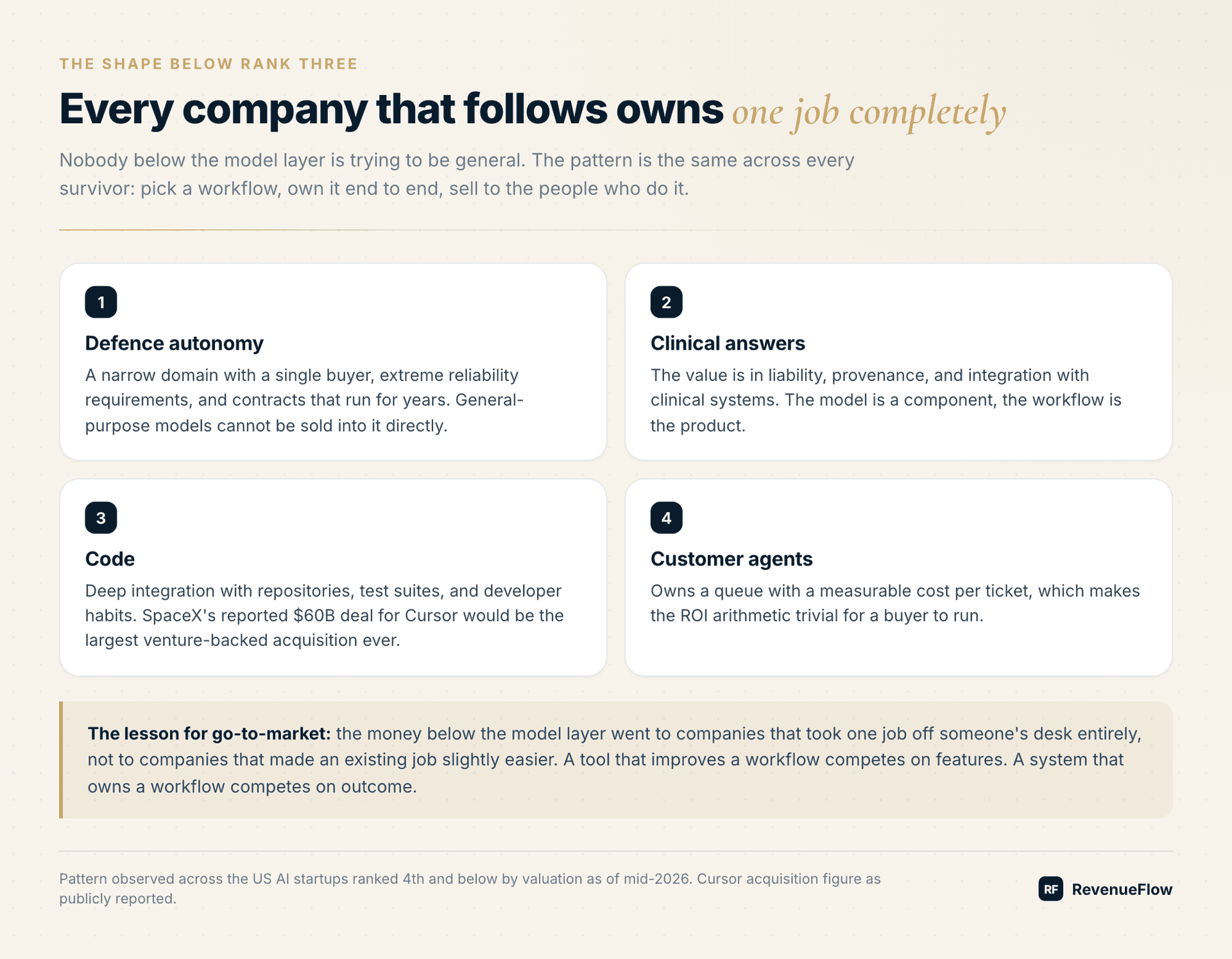
Look at the companies from fourth place down and a consistent pattern appears. Not one of them is trying to be general.
Defence autonomy. Clinical answers. Code. Customer agents. Each is a specialist that owns one workflow completely.
This is not a coincidence, and it is the part of the chart that actually applies to businesses outside of frontier AI.
The model layer became a duopoly because scale wins there. Everywhere else, the money went to companies that took one job off someone's desk entirely. Not companies that made an existing job marginally easier. Companies that own the whole job, including the parts that are unglamorous, regulated, or annoying to integrate.
Why This Matters If You Sell B2B Software
The market just ran a very expensive experiment on what kind of AI product accrues value, and the answer was consistent.
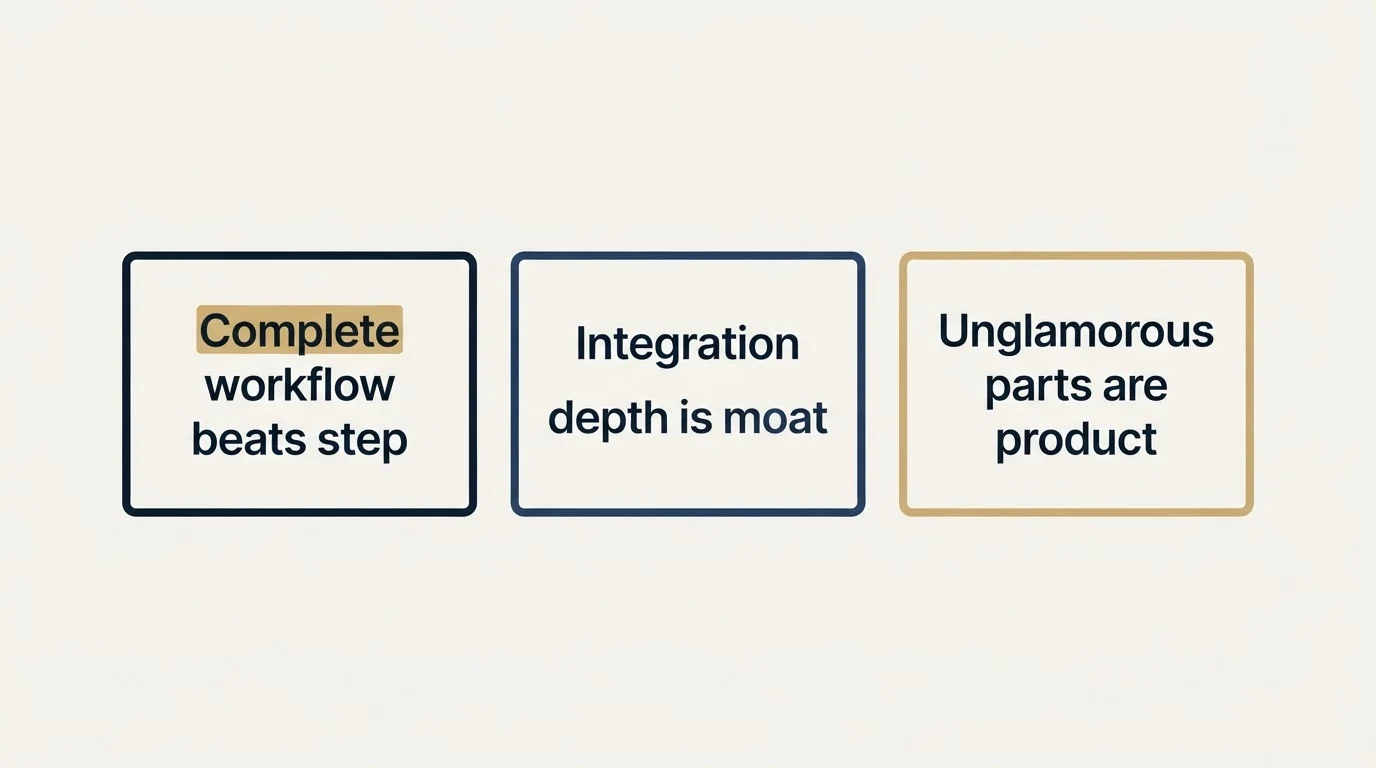
- Yes: Owning a complete workflow beats improving a step in one
- Yes: Integration depth is the moat, not the model
- Yes: The unglamorous parts are the product
Owning a complete workflow beats improving a step in one. A tool that makes a task 30% faster competes on features and gets compared on price. A system that removes the task competes on outcome and gets compared to headcount. Those are radically different sales conversations.
Integration depth is the moat, not the model. Every specialist on this list is defensible because of what it connects to and what it knows about a specific domain, not because it has a better model. The models are largely rented from the two companies at the top.
The unglamorous parts are the product. Liability in clinical AI. Reliability in defence. Repository context in code. The hard, boring, domain-specific work is precisely what a general model cannot replicate.
The Same Logic Applied To Go-To-Market
Go-to-market software has spent three years doing the opposite of this.
The category filled with tools that improve one step. A better prospecting database. A better sequencer. A better intent signal. Each of them genuinely useful, each of them leaving the buyer with more integration work than they started with.
Meanwhile the job itself, turning a target market into booked meetings, still belongs to a human who operates all of those tools. Nobody took the whole job.
That is why the AI GTM category has produced no company above $10B, while specialists in code and clinical workflows have produced several. The value was in owning the outcome, and almost nobody in go-to-market tried to own it.
A Note On These Numbers
Private valuations reflect the last round an investor priced, which may be months or years stale. They are a snapshot of what one group of buyers agreed at one moment, not a market price. Several figures here will move before the year ends.
Treat the ranking as directional. The concentration pattern is the durable observation, not the specific decimals.
Frequently Asked Questions
Why did the model layer consolidate into two companies?
Training frontier models requires capital at a scale very few entities can raise, and the resulting advantage compounds through better models attracting more revenue and more compute. That is the classic shape of a market with enormous fixed costs, and it produces duopolies rather than competitive fields.
Is a specialist AI company still worth starting?
The chart argues yes, emphatically. Everything below rank three is a specialist that owns one workflow, and collectively those companies are worth $465 billion. What the chart argues against is competing at the model layer.
What does this mean for AI go-to-market software specifically?
GTM tooling spent three years building products that improve one step and leave the buyer holding the integration work. The value in this market went to companies that removed a whole job. That is a reasonable explanation for why no AI GTM company has approached the scale of the specialists in code or clinical workflows.
How stale are these valuations?
Private valuations reflect the last priced round, which can be months or years old. Several of these figures will move before the year ends. Anthropic passing OpenAI happened within the last few months of this data being compiled.
Does SpaceX absorbing xAI change the ranking?
It complicates it. xAI is listed separately because its last independent priced round is the comparable figure, but the company now sits inside SpaceX. The reported $60B Cursor deal would push that consolidation further.
Related Reading
- 29 US AI Companies and Where They're Actually Headquartered
- The New York AI Map: 22 Companies Building the Application Layer
- Europe's AI Startups Just Crossed $140B: The Full Valuation Map
We build AI-native pipeline systems and you pay per qualified meeting, not a retainer. No paying for activity. You only pay when we book you a qualified sales meeting. See if you qualify.
Valuations reflect latest closed priced rounds as publicly reported in mid-2026. Not investment advice.
Frequently asked questions.
Frequently asked questions- Why did the model layer consolidate into just two companies?
- Training frontier models requires capital at a scale very few entities can raise, and the resulting advantage compounds through better models attracting more revenue and more compute. That is the classic shape of a market with enormous fixed costs, and it produces duopolies rather than competitive fields.
- Is it still worth starting a specialist AI company?
- Yes, emphatically. Everything below rank three is a specialist that owns one workflow, and collectively those companies are worth $465 billion. What the data argues against is competing at the model layer, where scale advantages create winner-take-most dynamics.
- What does this valuation pattern mean for AI go-to-market software?
- GTM tooling spent three years building products that improve one step and leave the buyer holding the integration work. The value in this market went to companies that removed a whole job. That is a reasonable explanation for why no AI GTM company has approached the scale of the specialists in code or clinical workflows.
- How accurate are these private company valuations?
- Private valuations reflect the last priced round, which can be months or years old. They are a snapshot of what one group of buyers agreed at one moment, not a market price. Several of these figures will move before the year ends. Treat the ranking as directional; the concentration pattern is the durable observation.
About the author.

Ben Carden is CRO at RevenueFlow, which builds and operates outbound revenue engines for B2B companies. Previously at Gartner Enterprise. Studied at London School of Economics.
Ben Carden · CRO
Connect on LinkedIn →Explore more.
Ready to scale your outreach?
We build GTM engines that book real meetings. See the receipts.
Related articles.
The New York AI Map: 22 Application Layer Companies
Ramp is worth $44B. VAST Data $30B. ElevenLabs $11B. None of them are in San Francisco. Here is how New York's AI cluster is organised, and why it matters for anyone building a go-to-market motion.
Europe's AI Startups Crossed $140B: The Valuation Map
27 companies, 7 countries, and a defence company on top. Europe's AI cluster looks nothing like America's, and the difference says something useful about where applied AI value accrues.
29 US AI Companies and Where They're Actually Headquartered
A few years ago, AI company meant San Francisco. The Bay Area still leads on count, but Boston, Pittsburgh and New York now own specific layers. Here is the map, and how to read it as a supply chain.
The Real ARR Behind 15 AI Sales Companies
In AI sales, valuations are measured in billions and revenue is measured in millions. Ranked by what customers actually pay, the leaderboard looks nothing like your feed.
16 GTM Software Companies Worth $170 Billion: Ranked
Salesforce is 73% of the category on its own. Seven of the private companies have not priced a round since 2021. Here is what the ranking actually tells a buyer, and what it cannot.
The 15 Most Valuable AI Sales Tools, Ranked by Investors
Hundreds of AI tools are competing for your sales budget. Ranked by latest priced round, the order is not what you would expect, and the top of the list is full of companies that existed long before the AI cycle.