29 US AI Companies and Where They're Actually Headquartered
A few years ago, AI company meant San Francisco. The Bay Area still leads on count, but Boston, Pittsburgh and New York now own specific layers. Here is the map, and how to read it as a supply chain.
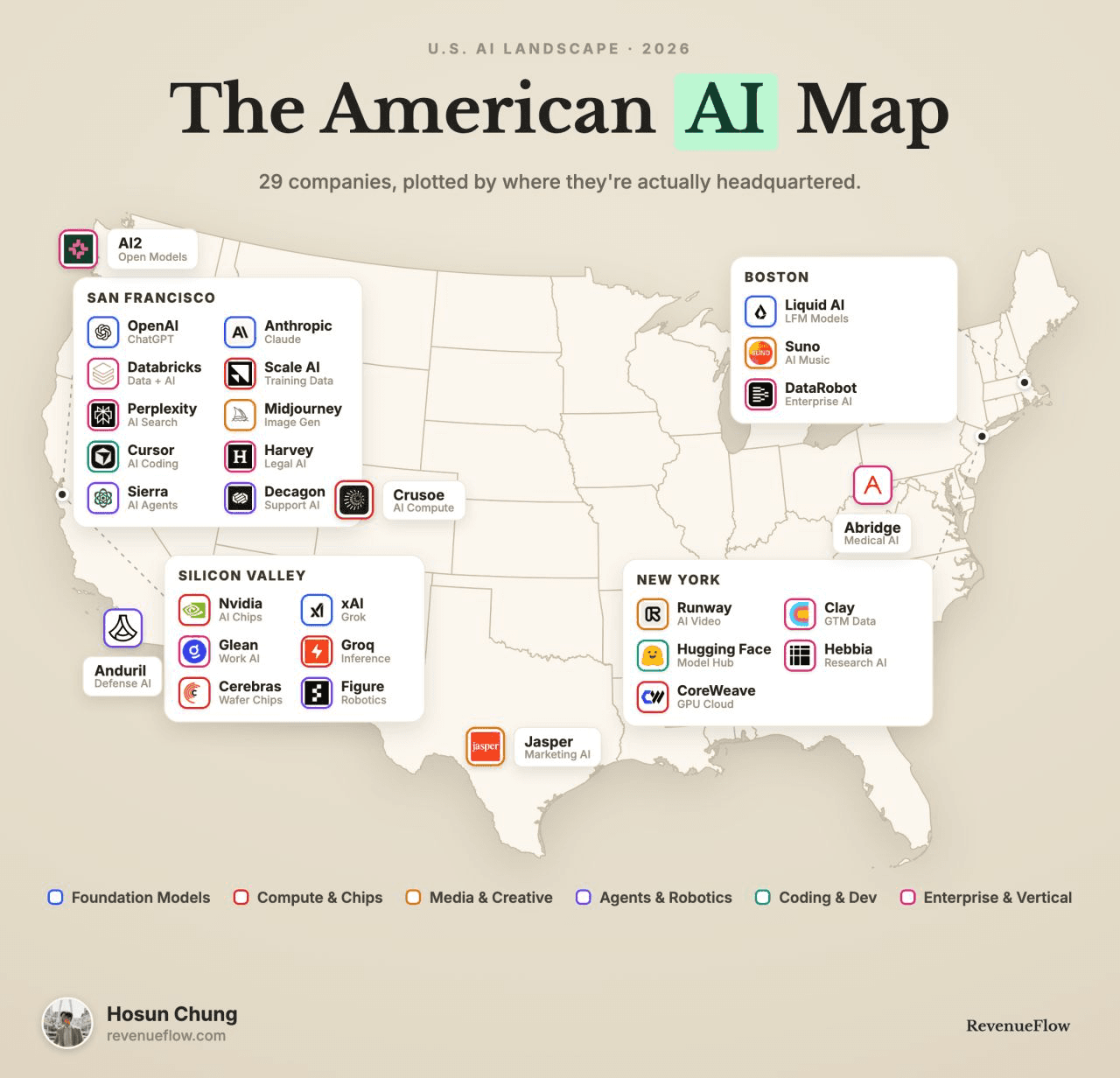
Sixteen of twenty-nine major US AI companies remain concentrated in San Francisco and Silicon Valley, but the other thirteen cluster by specialization rather than overflow: Boston builds foundation models near MIT, Pittsburgh owns medical AI through Carnegie Mellon and UPMC partnerships, New York commands creative and go-to-market layers serving finance and media, and Denver plus New Jersey handle compute infrastructure constrained by power availability rather than talent.
Key takeaways
- Sixteen of twenty-nine major US AI companies are located within a few miles of each other in the Bay Area.
- Boston is emerging as a foundation-model hub driven by MIT research, with Liquid AI as the clearest example of a serious model play outside California.
- Pittsburgh has become the center for medical AI because Carnegie Mellon and UPMC provide the research base and clinical partnerships that medical AI requires.
- New York owns the creative and go-to-market layer with companies like Runway, Clay, and Hebbia clustering near their finance, media, and advertising customers.
- Location matters more for customer access than talent access in applied AI, as products improve faster when builders can regularly interact with domain experts and buyers.
Reviewed and updated September 5, 2026
29 US AI Companies and Where They're Actually Headquartered
A few years ago, "AI company" basically meant San Francisco.
That is no longer true, and the way it stopped being true is more interesting than the fact itself. Other cities did not become smaller versions of the Bay Area. They each took a layer.
Teams that still assume geographic clustering is a Bay Area story will find a dense Tel Aviv AI cluster map showing how tightly packed specialists can get around a single industry hub.
The Map
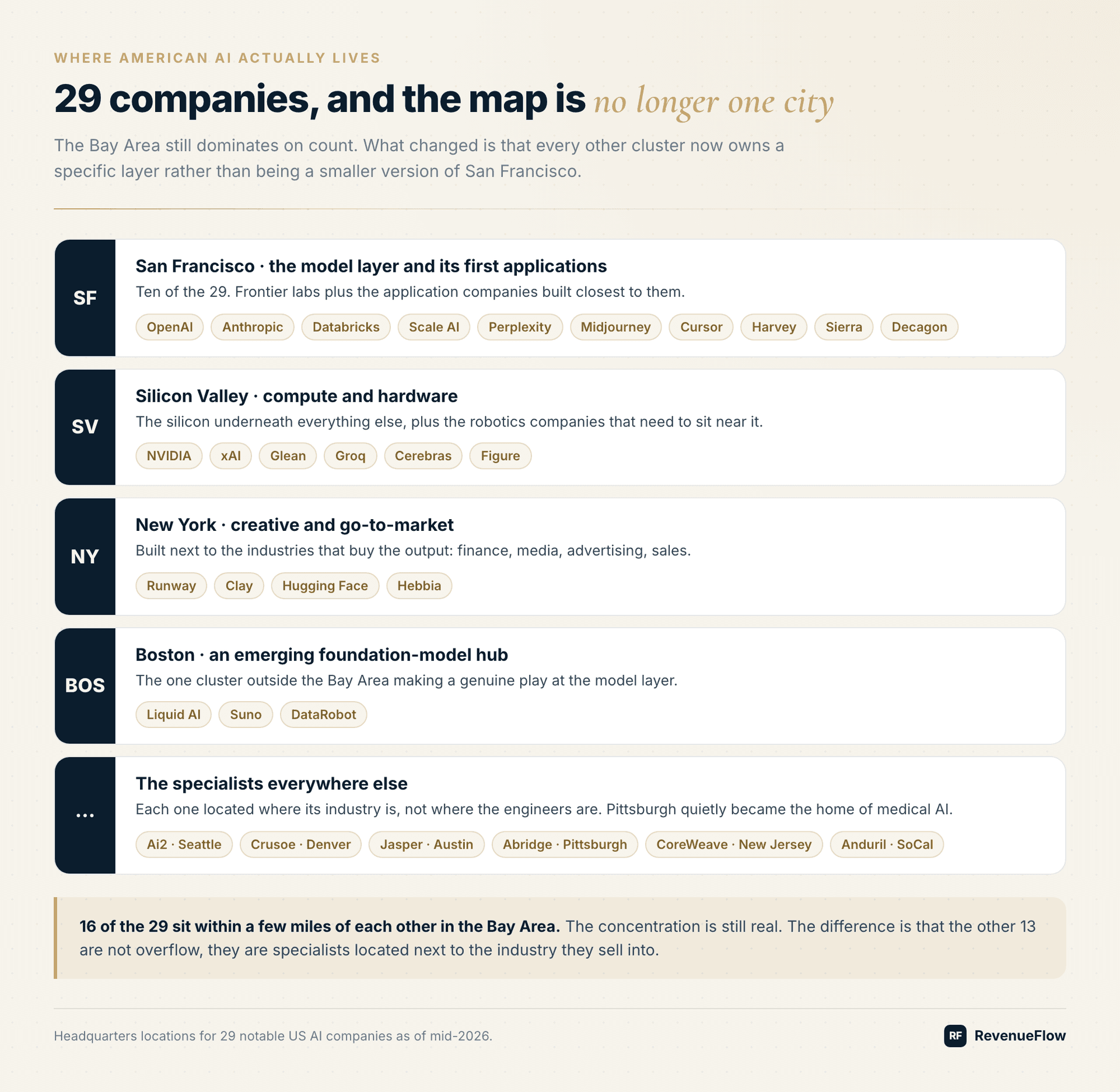
San Francisco. OpenAI, Anthropic, Databricks, Scale AI, Perplexity, Midjourney, Cursor, Harvey, Sierra, Decagon.
Silicon Valley. NVIDIA, xAI, Glean, Groq, Cerebras, Figure.
New York. Runway, Clay, Hugging Face, Hebbia.
Boston. Liquid AI, Suno, DataRobot.
Everywhere else. Ai2 in Seattle. Crusoe in Denver. Jasper in Austin. Abridge in Pittsburgh. CoreWeave in New Jersey. Anduril in Southern California.
Sixteen of the twenty-nine sit within a few miles of each other in the Bay Area. The concentration is still real and it would be silly to argue otherwise.
The Real Story Is The Other Thirteen
What changed is that the companies outside the Bay Area are not overflow. They are specialists located next to the industry they sell into.
Boston is becoming a foundation-model hub. Liquid AI is the clearest example of a serious model play outside California, and it exists because of MIT rather than in spite of the geography.
Pittsburgh quietly turned into the home of medical AI. Abridge is there for the same reason Carnegie Mellon and UPMC are there. Clinical AI needs clinical partners, and those are not in SoMa.
New York owns the creative and go-to-market layer. Runway next to advertising and media. Clay next to the sales organisations that buy it. Hebbia next to the finance firms it serves.
Denver and New Jersey own compute logistics. Crusoe and CoreWeave are infrastructure businesses whose constraint is power and land, not engineering talent density.
The pattern: the model layer clusters around research capital, and everything above it clusters around customers.
How To Read This As A Supply Chain
If you are building a go-to-market motion in 2026, this map is not industry trivia. Every company on it is a building block you can wire into how you find, reach, and close customers.
Some of them you will use directly. Clay for data orchestration. Hugging Face if you are running anything open-source. Some of them you will use through other products without knowing it.
The question worth asking about your own stack is which block does what, and whether you actually need a separate block for each job. Most teams accumulate tools by layer without ever mapping which layer each one occupies, which is how you end up paying three vendors for overlapping enrichment.
Why Proximity Still Matters In A Remote World
It is fair to ask whether headquarters means anything when the engineers are distributed anyway.
It means less than it did for hiring and more than it did for selling. The reason Rogo is in New York and Abridge is in Pittsburgh is not where the developers sit. It is that a product for investment bankers gets built faster when you can have coffee with investment bankers, and a clinical product needs a hospital that will let you watch the workflow.
That is the durable advantage in applied AI. Not talent access, customer access.
What This Predicts
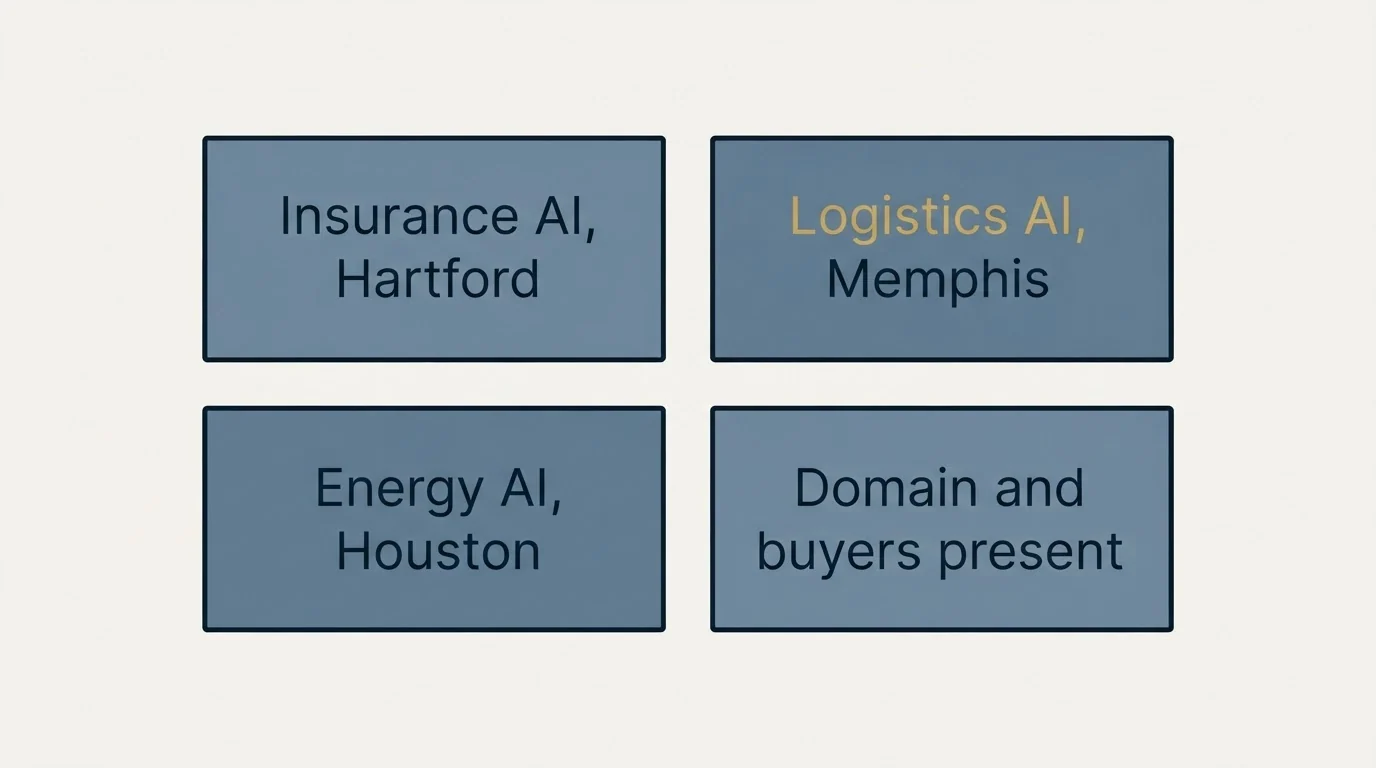
If the pattern holds, expect the next wave of valuable AI companies to appear in cities nobody currently associates with tech, clustered around whatever industry dominates locally.
Insurance AI in Hartford. Logistics AI in Memphis. Energy AI in Houston. Not because those cities will develop startup ecosystems, but because the domain knowledge and the buyers are already there, and that turned out to matter more than proximity to a model lab.
The teams that win will not be the ones with the most tools. They will be the ones who know which block does what.
The Clusters And What They Own
| Cluster | Layer it owns | Why it is there |
|---|---|---|
| San Francisco | Frontier models and first applications | Research capital and talent density |
| Silicon Valley | Compute, hardware, robotics | Semiconductor and manufacturing base |
| New York | Creative and go-to-market | Finance, media and advertising buyers |
| Boston | Emerging foundation models | University research pipeline |
| Pittsburgh | Medical AI | Carnegie Mellon plus hospital partners |
| Denver, New Jersey | Compute logistics | Power availability and land, not talent |
| Southern California | Defence autonomy | Aerospace and defence supply chain |
Frequently Asked Questions
Is San Francisco still dominant in AI?
On count, clearly. Sixteen of these twenty-nine companies sit within a few miles of each other in the Bay Area. What changed is that companies outside it are no longer overflow, they are specialists located next to the industry they sell into.
Why is medical AI concentrated in Pittsburgh?
Carnegie Mellon supplies the research base and UPMC supplies the clinical partner. Clinical AI needs a hospital willing to let you watch the workflow, and that access matters more than proximity to a model lab.
Does headquarters location still matter if teams are remote?
Less for hiring, more for selling. The reason applied AI companies cluster near their buyers is customer access, not talent access. You can hire an engineer anywhere. You cannot easily get repeated informal time with investment bankers or clinicians from another city.
What does this predict about the next wave?
If the pattern holds, valuable AI companies will keep appearing in cities with a dominant local industry rather than a startup ecosystem: insurance in Hartford, logistics in Memphis, energy in Houston. The domain knowledge and the buyers are already there.
How should a GTM team use this map?
As a supply chain rather than as news. Every company on it is a component you can wire into how you find, reach, and close customers. Map which layer each of your current tools occupies, and you will usually find three vendors covering one job and nobody covering another.
Related Reading
- The New York AI Map: 22 Companies Building the Application Layer
- America's 18 Most Valuable AI Startups (Two Are Worth More Than the Rest Combined, Twice Over)
- Europe's AI Startups Just Crossed $140B: The Full Valuation Map
We build AI-native pipeline systems and you pay per qualified meeting, not a retainer. No paying for activity. You only pay when we book you a qualified sales meeting. See if you qualify.
Headquarters locations reflect publicly reported data as of mid-2026.
Frequently asked questions.
Frequently asked questions- Is San Francisco still the dominant city for AI companies?
- Yes, on raw count San Francisco and Silicon Valley still dominate with sixteen of twenty-nine major companies located there. However, the companies outside the Bay Area are no longer overflow but specialists positioned near the specific industries they serve, making the dominance less absolute than it appears numerically.
- Why is Pittsburgh becoming a hub for medical AI companies?
- Pittsburgh hosts medical AI because Carnegie Mellon provides the research foundation while UPMC offers clinical partnerships. Clinical AI products require access to hospitals willing to let companies observe actual workflows, and that repeated informal access to domain experts matters more than proximity to model laboratories in San Francisco.
- Does company headquarters location still matter when engineering teams work remotely?
- Location matters less for hiring engineers but more for selling products. Applied AI companies cluster near their target customers because customer access drives product development more than talent access. You can hire engineers anywhere, but you cannot easily get regular informal time with investment bankers, clinicians, or other domain experts from a different city.
- What does the current geographic distribution predict about future AI companies?
- The pattern suggests valuable AI companies will emerge in cities dominated by specific industries rather than traditional tech hubs: insurance AI in Hartford, logistics AI in Memphis, and energy AI in Houston. These locations already have the domain knowledge and buyer organizations, which increasingly matters more than proximity to model labs.
About the author.

Hosun Chung is COO at RevenueFlow, which builds and operates outbound revenue engines for B2B companies. Previously at Gleacher Shacklock LLP. Studied at London School of Economics.
Hosun Chung · COO
Connect on LinkedIn →Explore more.
Ready to scale your outreach?
We build GTM engines that book real meetings. See the receipts.
Related articles.
The New York AI Map: 22 Application Layer Companies
Ramp is worth $44B. VAST Data $30B. ElevenLabs $11B. None of them are in San Francisco. Here is how New York's AI cluster is organised, and why it matters for anyone building a go-to-market motion.
America's 18 Most Valuable AI Startups
Anthropic passed OpenAI in May. Together they hold $1.82 trillion of the $2.51 trillion total. The cliff after second place is bigger than every company below it added together.
Europe's AI Startups Crossed $140B: The Valuation Map
27 companies, 7 countries, and a defence company on top. Europe's AI cluster looks nothing like America's, and the difference says something useful about where applied AI value accrues.
The Real ARR Behind 15 AI Sales Companies
In AI sales, valuations are measured in billions and revenue is measured in millions. Ranked by what customers actually pay, the leaderboard looks nothing like your feed.
16 GTM Software Companies Worth $170 Billion: Ranked
Salesforce is 73% of the category on its own. Seven of the private companies have not priced a round since 2021. Here is what the ranking actually tells a buyer, and what it cannot.
The 15 Most Valuable AI Sales Tools, Ranked by Investors
Hundreds of AI tools are competing for your sales budget. Ranked by latest priced round, the order is not what you would expect, and the top of the list is full of companies that existed long before the AI cycle.