Europe's AI Startups Crossed $140B: The Valuation Map
27 companies, 7 countries, and a defence company on top. Europe's AI cluster looks nothing like America's, and the difference says something useful about where applied AI value accrues.
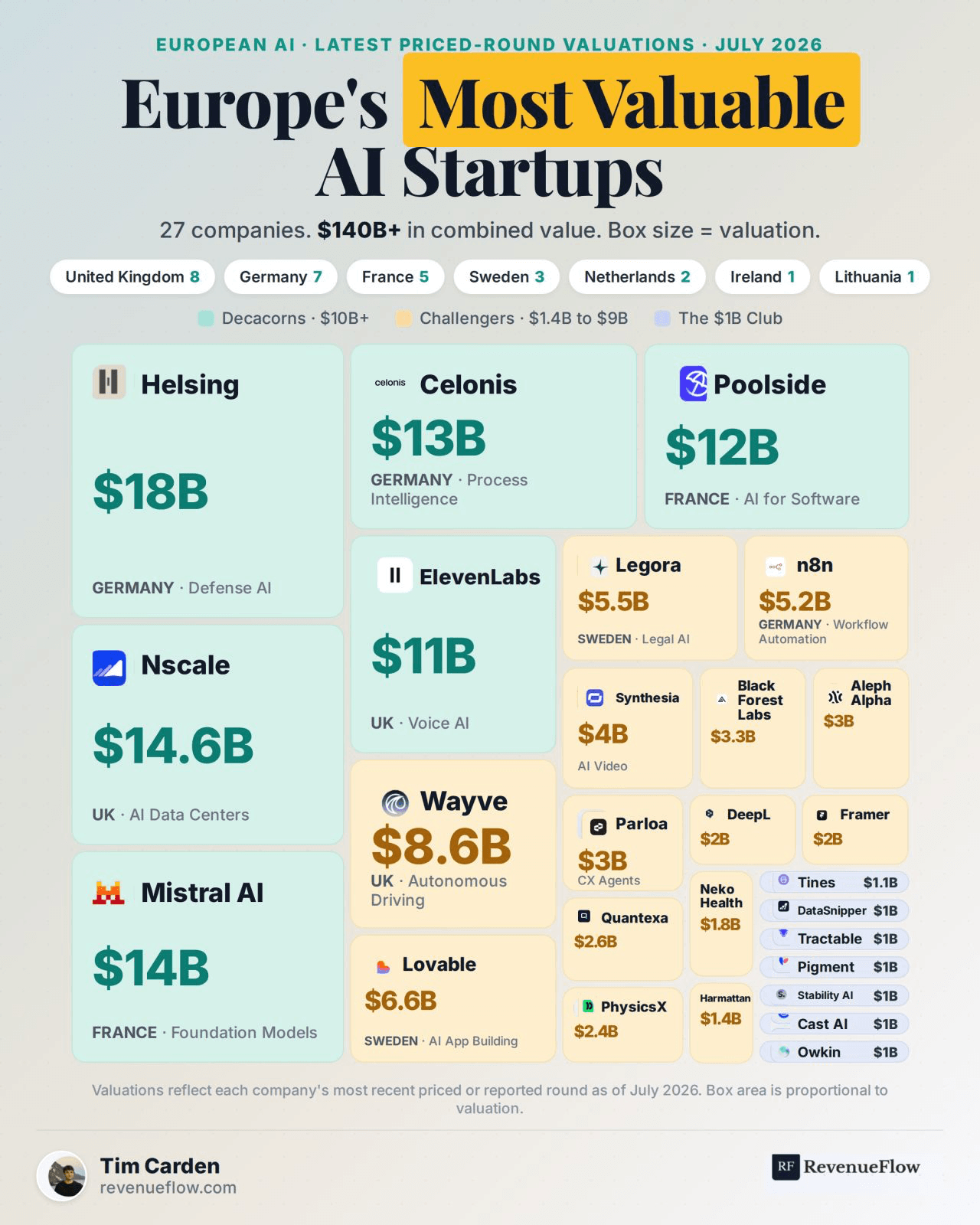
Europe's AI startup ecosystem has surpassed $140B across 27 companies, led by defence AI firm Helsing at $18B. Unlike America's foundation-model concentration, Europe favours application-layer companies in regulated domains like defence, legal, process intelligence, and healthcare. The UK leads with eight companies, Germany holds the highest total value at $47B, and application-layer firms are compounding fastest, with several tripling valuations in under a year.
Key takeaways
- Helsing, a defence AI company, leads Europe at $18B valuation, demonstrating that regulatory moats in sovereign sectors can exceed model advantages.
- Only one foundation model lab appears in Europe's top six AI companies, compared to US markets where model labs dominate total value.
- Application-layer companies including n8n, Parloa, and Legora doubled or tripled valuations within eight months by owning specific workflows rather than building models.
- Germany leads Europe with over $47B in combined AI startup value, while the UK has the most companies at eight and France owns the top valuation tier.
- Data residency requirements are mandatory procurement criteria for European buyers in regulated sectors, not optional compliance checkboxes.
Reviewed and updated September 5, 2026
Europe's AI Startups Just Crossed $140B
27 companies. 7 countries. A defence company on top.
Three years ago, most of the companies on this list did not exist. The composition is worth studying, because it looks nothing like the American one.
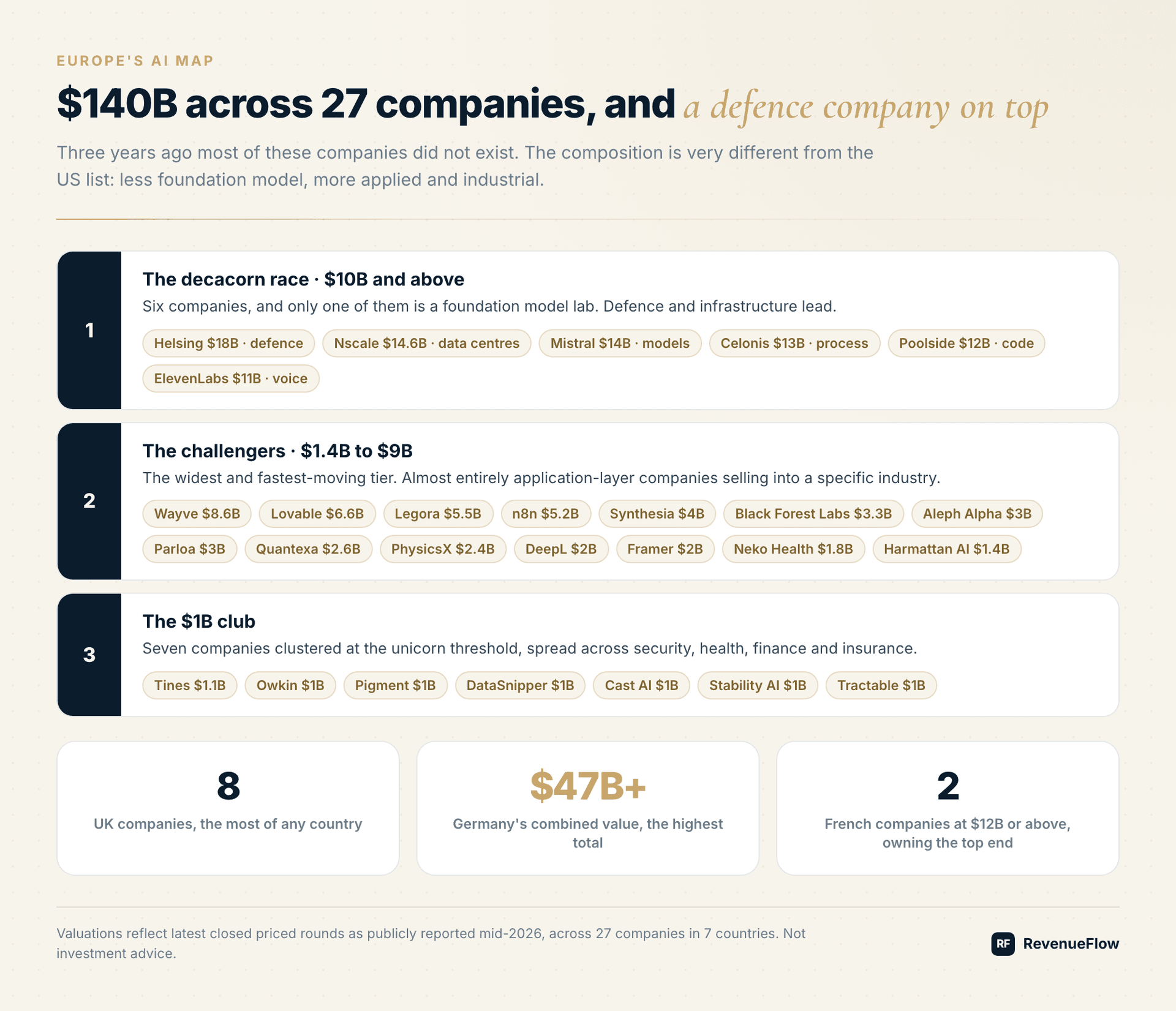
Tier 1: The Decacorn Race ($10B+)
- Helsing ($18B) defence AI
- Nscale ($14.6B) AI data centres
- Mistral AI ($14B) foundation models
- Celonis ($13B) process intelligence
- Poolside ($12B) AI for software engineering
- ElevenLabs ($11B) voice AI
Six companies above $10B, and exactly one of them is a foundation model lab.
Tier 2: The Challengers ($1.4B to $9B)
Wayve ($8.6B) in autonomous driving. Lovable ($6.6B) in AI app building. Legora ($5.5B) in legal. n8n ($5.2B) in workflow automation. Synthesia ($4B) in video. Black Forest Labs ($3.3B) in image models. Aleph Alpha ($3B) in sovereign LLMs. Parloa ($3B) in customer experience agents. Quantexa ($2.6B) in decision intelligence. PhysicsX ($2.4B) in engineering. DeepL ($2B) in translation. Framer ($2B) in website building. Neko Health ($1.8B) in health scans. Harmattan AI ($1.4B) in defence drones.
Tier 3: The $1B Club
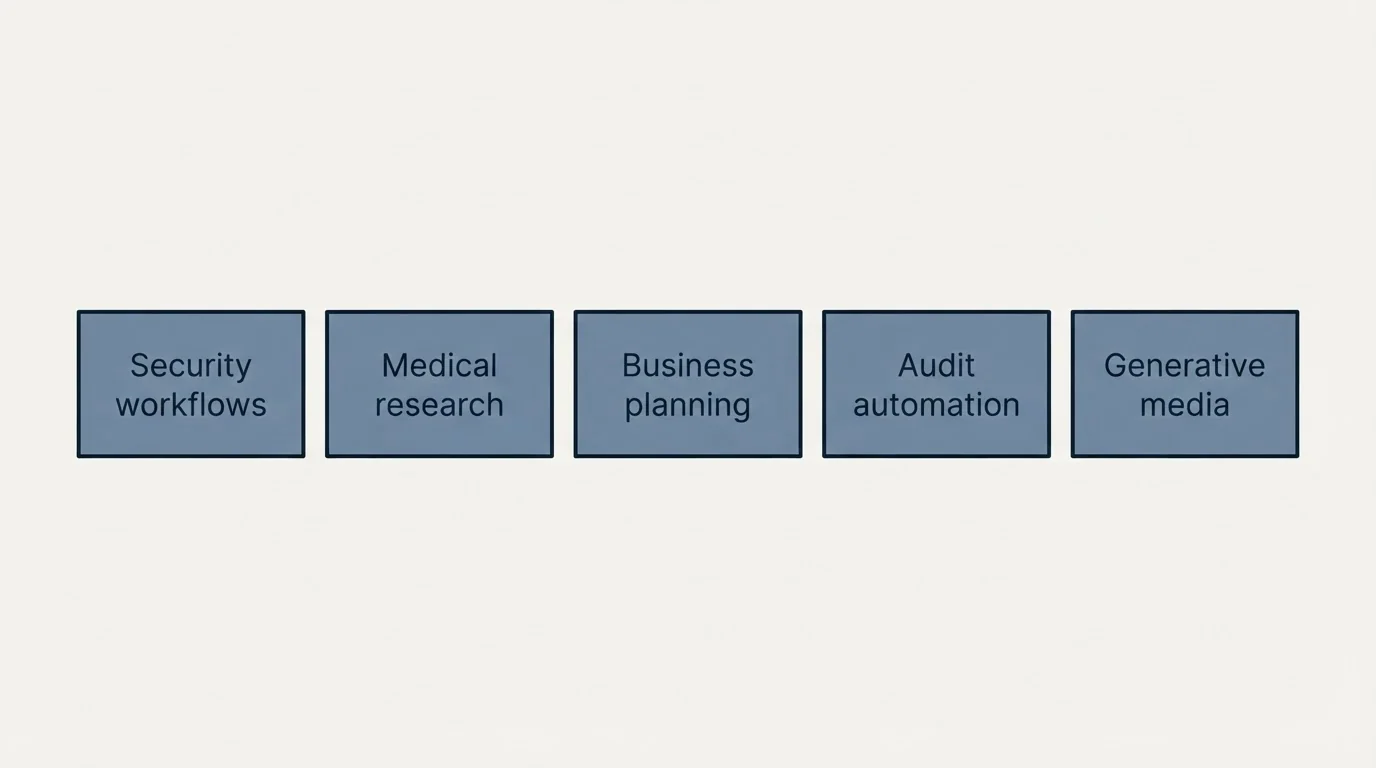
Tines ($1.1B) in security workflows. Owkin ($1B) in medical research. Pigment ($1B) in business planning. DataSnipper ($1B) in audit automation. Cast AI ($1B) in cloud and AI workloads. Stability AI ($1B) in generative media. Tractable ($1B) in computer vision for insurance.
Three Things That Stand Out
A defence company on top.
exactly one of them is a foundation model lab
carried by Helsing and Celonis
Defence AI took the crown
Helsing jumped from $14B to $18B in under a year, and France minted its first defence unicorn in January with Harmattan AI.
This is a genuinely European outcome. Defence procurement is national, relationships are decades long, and sovereignty requirements mean a European military will not buy an American autonomy stack for critical systems. That regulatory moat is worth more than any model advantage.
The UK has the most companies, Germany has the most value
Eight UK companies, the largest count of any country. Germany leads on total value at over $47B, carried by Helsing and Celonis. France owns the top end with two companies at $12B or above.
That spread matters if you sell into Europe. There is no single hub. A go-to-market motion that treats Europe as one market will miss most of it.
The question of geographic clustering plays out even more tightly in Israel, where a dense Tel Aviv AI cluster packs dozens of companies into a walkable radius.
The application layer is compounding fastest
n8n doubled to $5.2B in eight months. Parloa tripled. Legora tripled.
None of those are model companies. They are workflow companies that rent models and own a specific job: automation orchestration, customer conversations, legal work.
Why Europe Skewed Applied
The US list is dominated by two foundation model labs holding most of the value. The European list has one model lab in the top six.
Part of that is capital. Training frontier models requires funding at a scale European venture markets have historically not provided in single rounds.
But part of it is a genuine strategic difference. European companies went where domain knowledge and regulation create defensibility: process mining, legal, audit, insurance, healthcare, defence. Those are markets where being close to the customer and understanding the compliance regime beats having a marginally better model.
That is the same pattern visible in the US application layer, just more pronounced because Europe barely competed for the model layer at all.
What This Means If You Sell Into Europe
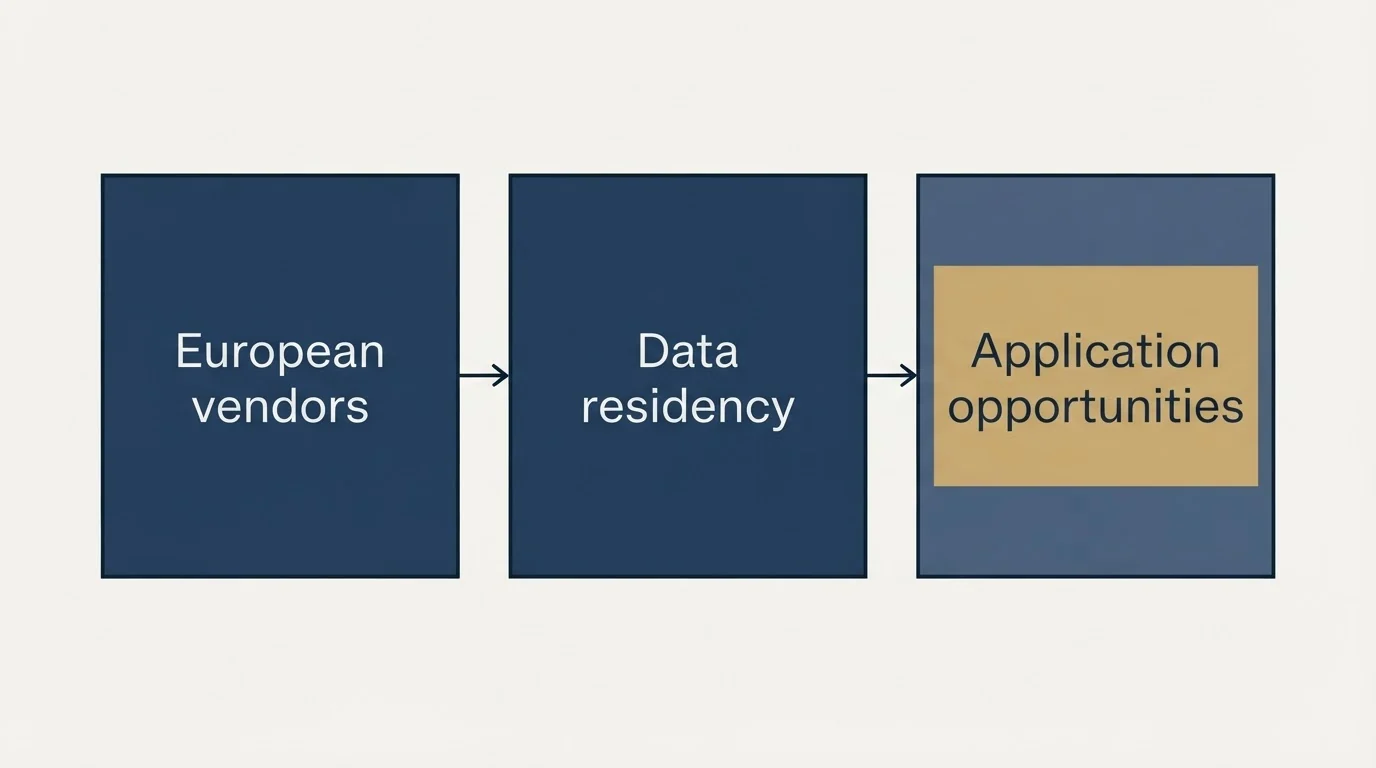
Three practical implications.
- Yes: Your buyer may be a European vendor now, increasingly one with local data residency
- Yes: Data residency is a real requirement, not a checkbox
- Yes: The fastest-growing segment is the one you can join, without a data centre
Your buyer may be a European vendor now. For workflow automation, voice, translation, or document intelligence, the incumbent in a European deal is increasingly a European company with local data residency. That changes the competitive conversation.
Data residency is a real requirement, not a checkbox. Aleph Alpha exists specifically because some European buyers will not run inference outside their jurisdiction. If your product cannot answer that question, it will lose deals it should win.
The fastest-growing segment is the one you can join. Application-layer companies with domain depth are compounding faster than anything else on the list. That is a market you can enter without a data centre.
A Caveat On The Numbers
These are latest closed priced rounds, which means several are stale by a funding cycle and all of them reflect what one group of investors agreed at one moment. European rounds are also disclosed less consistently than American ones.
Read the tiers and the country distribution. Do not read the decimals.
Frequently Asked Questions
Why is a defence company the most valuable AI startup in Europe?
Defence procurement is national, contracts run for years, and sovereignty requirements mean a European military will not buy an American autonomy stack for critical systems. That regulatory and political moat is worth more than any model advantage, and it is not available to an American competitor at any price.
Why does Europe have so few foundation model companies?
Partly capital, since training frontier models needs funding at a scale European venture rounds have rarely reached. Partly strategy: European teams went where domain knowledge and regulation create defensibility, which is process mining, legal, audit, insurance, healthcare, and defence.
Which country leads European AI?
It depends on the measure. The UK has the most companies at eight. Germany has the highest combined value at over $47B. France owns the top end with two companies at $12B or above. There is no single European hub, which matters if you sell into the region.
What does data residency actually change for a buyer?
For regulated European buyers, quite a lot. Aleph Alpha exists specifically because some organisations will not run inference outside their jurisdiction. If your product cannot answer where processing happens, it will lose deals it should otherwise win.
Which of these are relevant to a go-to-market team?
n8n for workflow orchestration, which doubled to $5.2B in eight months. ElevenLabs for voice. Parloa for customer conversation agents. Synthesia for video. Lovable and Framer if you build landing pages at volume.
Related Reading
- The New York AI Map: 22 Companies Building the Application Layer
- 29 US AI Companies and Where They're Actually Headquartered
- America's 18 Most Valuable AI Startups (Two Are Worth More Than the Rest Combined, Twice Over)
We build AI-native pipeline systems and you pay per qualified meeting, not a retainer. No paying for activity. You only pay when we book you a qualified sales meeting. See if you qualify.
Valuations reflect latest closed priced rounds as publicly reported in mid-2026. Not investment advice.
Frequently asked questions.
Frequently asked questions- Why is a defence company the most valuable AI startup in Europe?
- Defence procurement is national, contracts run for years, and sovereignty requirements mean European militaries will not buy American autonomy stacks for critical systems. That regulatory and political moat is worth more than any model advantage and is unavailable to American competitors at any price.
- Why does Europe have so few foundation model companies compared to the US?
- Partly capital constraints, since training frontier models requires funding at scales European venture rounds rarely reach. Partly strategic choice: European teams targeted domains where regulation and specialised knowledge create defensibility, including process mining, legal, audit, insurance, healthcare, and defence, rather than competing in the model layer.
- Which European country leads in AI startups?
- It depends on the measure. The UK has the most companies at eight. Germany has the highest combined value at over $47B. France owns the top valuation tier with two companies at $12B or above. There is no single European hub, which matters for regional go-to-market strategy.
- What does data residency mean for selling AI products in Europe?
- For regulated European buyers, data residency is a mandatory requirement, not a checkbox. Companies like Aleph Alpha exist specifically because some organisations will not run inference outside their jurisdiction. Products that cannot address where processing occurs will lose deals in regulated sectors regardless of technical superiority.
About the author.

Tim Carden is CMO / CTO at RevenueFlow, which builds and operates outbound revenue engines for B2B companies. Studied at McGill University.
Tim Carden · CMO / CTO
Connect on LinkedIn →Explore more.
Ready to scale your outreach?
We build GTM engines that book real meetings. See the receipts.
Related articles.
The New York AI Map: 22 Application Layer Companies
Ramp is worth $44B. VAST Data $30B. ElevenLabs $11B. None of them are in San Francisco. Here is how New York's AI cluster is organised, and why it matters for anyone building a go-to-market motion.
America's 18 Most Valuable AI Startups
Anthropic passed OpenAI in May. Together they hold $1.82 trillion of the $2.51 trillion total. The cliff after second place is bigger than every company below it added together.
29 US AI Companies and Where They're Actually Headquartered
A few years ago, AI company meant San Francisco. The Bay Area still leads on count, but Boston, Pittsburgh and New York now own specific layers. Here is the map, and how to read it as a supply chain.
The Real ARR Behind 15 AI Sales Companies
In AI sales, valuations are measured in billions and revenue is measured in millions. Ranked by what customers actually pay, the leaderboard looks nothing like your feed.
16 GTM Software Companies Worth $170 Billion: Ranked
Salesforce is 73% of the category on its own. Seven of the private companies have not priced a round since 2021. Here is what the ranking actually tells a buyer, and what it cannot.
The 15 Most Valuable AI Sales Tools, Ranked by Investors
Hundreds of AI tools are competing for your sales budget. Ranked by latest priced round, the order is not what you would expect, and the top of the list is full of companies that existed long before the AI cycle.