The 15 Most Valuable AI Sales Tools, Ranked by Investors
Hundreds of AI tools are competing for your sales budget. Ranked by latest priced round, the order is not what you would expect, and the top of the list is full of companies that existed long before the AI cycle.
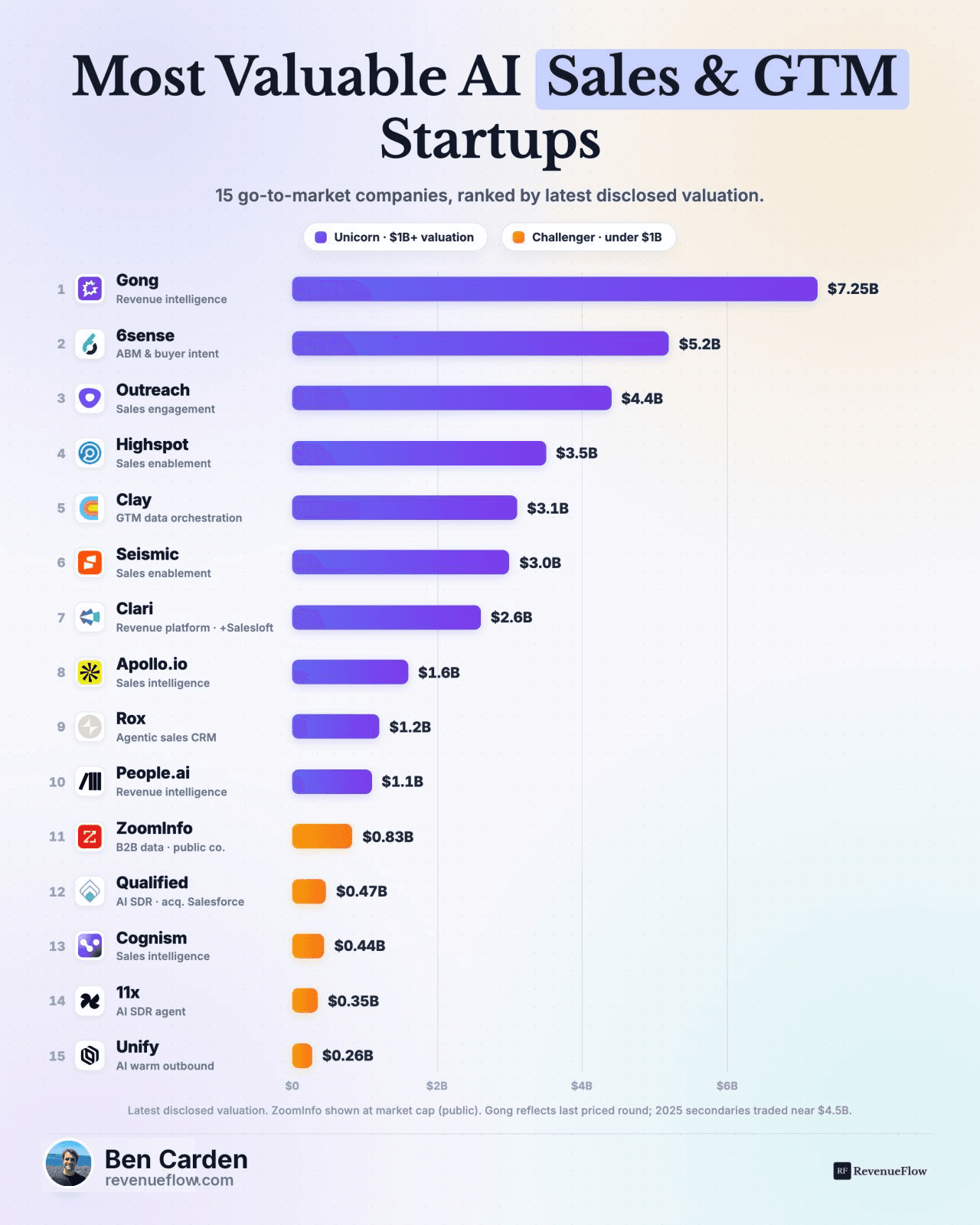
Ranked by latest priced round, Gong leads AI sales tools at $7.25B, followed by 6sense ($5.2B), Outreach ($4.4B), Highspot ($3.5B), Clay ($3.1B), Seismic ($3.0B), and Clari ($2.6B). All top performers are pre-AI incumbents founded a decade ago; AI-native tools like Rox, 11x, and Unify sit below $1.3B, and no company has crossed $10B on go-to-market software alone.
Key takeaways
- Gong tops the AI sales tool ranking at a $7.25B valuation, ahead of 6sense at $5.2B and Outreach at $4.4B.
- The ten highest-valued companies on the list are all unicorns, while the bottom five have not crossed $1B in valuation.
- AI-native companies Rox, 11x, and Unify all sit below $1.3B, despite being built from the first commit around models and agents.
- No standalone go-to-market software company has exceeded $7.25B, far below Salesforce's $125B market cap.
- Salesforce acquired Qualified for $0.47B, illustrating consolidation where platform vendors buy AI capability rather than lose the customer seat.
Reviewed and updated September 5, 2026
The 15 Most Valuable AI Sales Tools, Ranked
There are hundreds of AI tools fighting for your sales team's budget. Very few of them have been priced by an investor recently enough for that price to mean anything.
Here are the 15 that have, ranked by latest closed round for private companies and market capitalisation for public ones.
| # | Company | Valuation |
|---|---|---|
| 1 | Gong | $7.25B |
| 2 | 6sense | $5.2B |
| 3 | Outreach | $4.4B |
| 4 | Highspot | $3.5B |
| 5 | Clay | $3.1B |
| 6 | Seismic | $3.0B |
| 7 | Clari | $2.6B |
| 8 | Apollo.io | $1.6B |
| 9 | Rox | $1.2B |
| 10 | People.ai | $1.1B |
| 11 | ZoomInfo | $0.83B (public) |
| 12 | Qualified | $0.47B (acquired by Salesforce) |
| 13 | Cognism | $0.44B |
| 14 | 11x | $0.35B |
| 15 | Unify | $0.26B |
The first ten are unicorns. The last five have not crossed $1B.
The Incumbents Won The AI Cycle
The most striking thing about this list is how old the top of it is.
Gong was founded in 2015. 6sense in 2013. Outreach in 2014. Highspot in 2012. Seismic in 2010. Clari in 2012. These are products that existed for a decade before the current AI wave, added AI capabilities to what they already sold, and kept the value.
Manufacturing teams weighing these same incumbents against newer entrants can compare fit by motion in the guide to engagement tools built for manufacturers.
The genuinely AI-native players, the ones designed from the first commit around models and agents, sit at the bottom. Rox, 11x, and Unify are all below $1.3B.
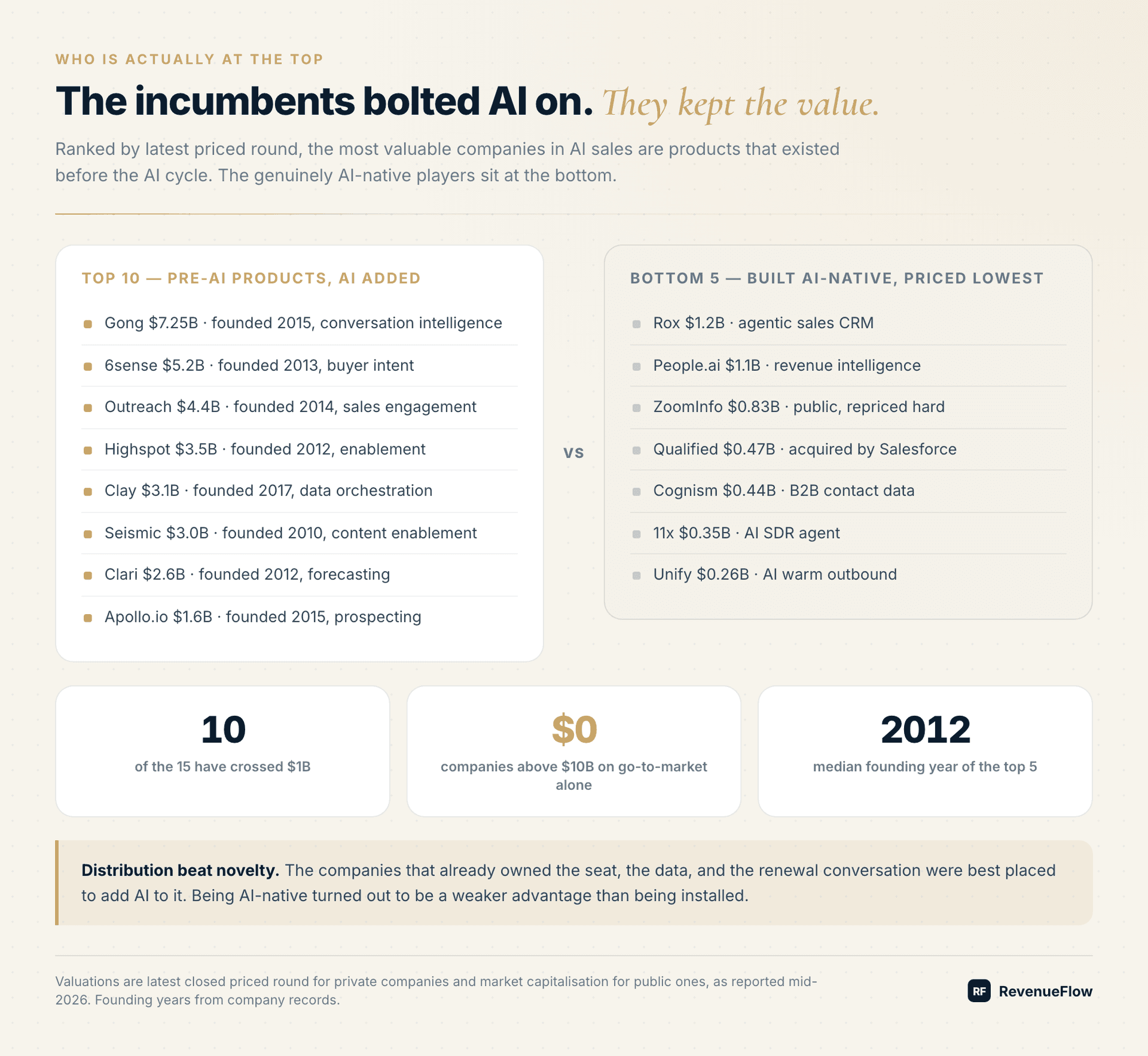
There is a straightforward reason for this. Being installed turned out to be worth more than being new. The incumbents already had the seat in the stack, the historical data, and an existing renewal conversation with the buyer. Adding AI to that was a feature release. Building the equivalent distribution from scratch is a decade of work.
Nobody Has Crossed $10B On Go-To-Market Alone
Not one company in this category has reached the scale of the platforms that sit above it. Salesforce is a $125B company. HubSpot trades in the tens of billions. The entire AI sales tooling category tops out at $7.25B.
That ceiling says something about the category's structure. Go-to-market software sells into a budget that is itself under pressure, competes against internal build, and struggles to prove attribution. Those are hard conditions for building a $10B standalone business, with or without AI.
It also explains the consolidation. Salesforce acquired Qualified. Expect more of that, because for a platform vendor it is cheaper to buy a $500M AI capability than to lose the seat.
What The Ranking Does Not Tell You
A valuation is a statement about how much capital a company raised and at what price. It is a genuinely useful signal for some things and completely silent on others.
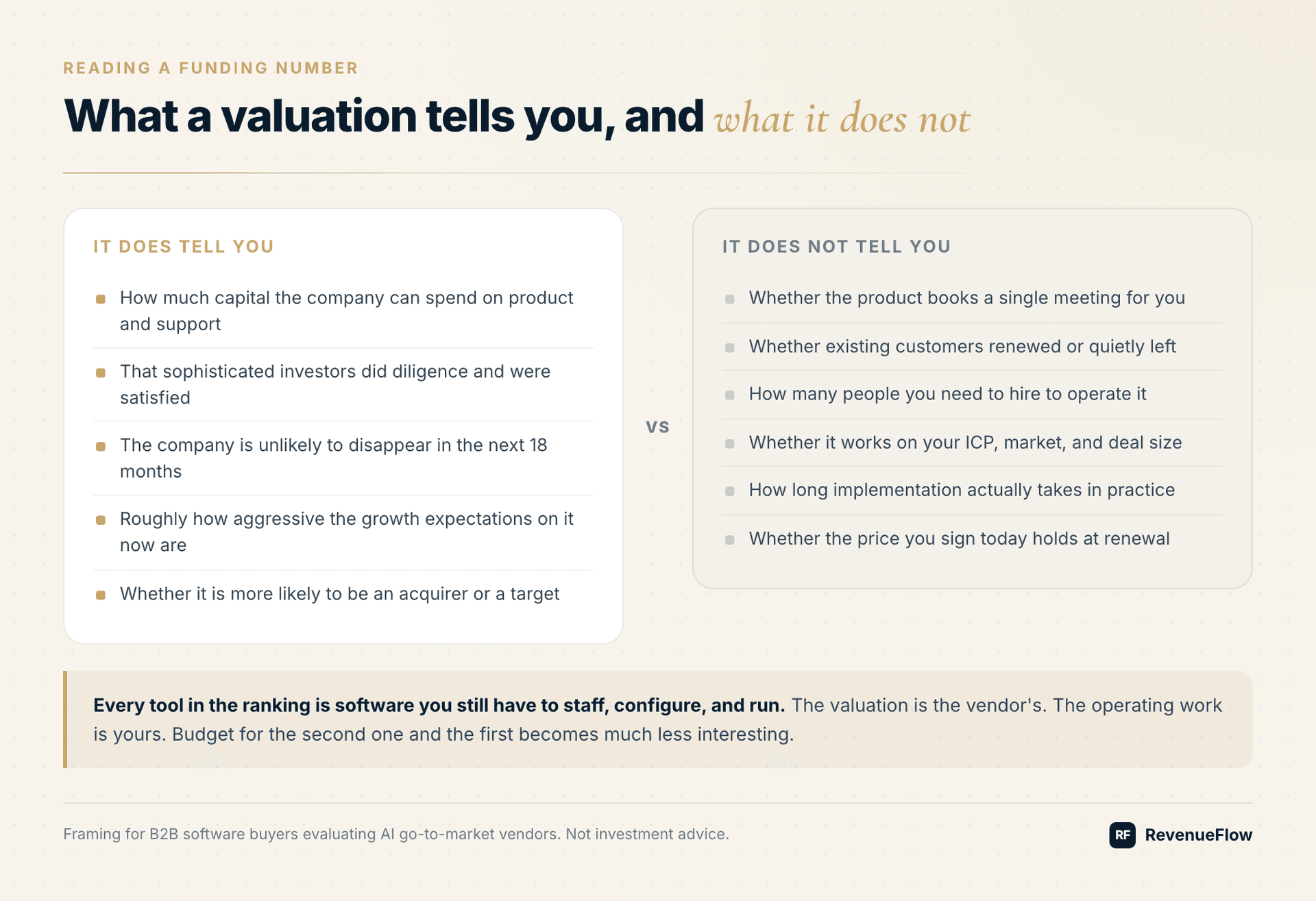
It tells you the company can fund product development and support, that investors did diligence and were satisfied, and that it is unlikely to vanish next quarter. Those are real.
It tells you nothing about whether the product will book you a meeting.
It does not tell you whether existing customers renewed. It does not tell you how many people you need to hire to operate the thing. It does not tell you whether it works on your ICP, your deal size, or your market. And it does not tell you whether the price you sign this year survives contact with renewal.
The Operating Cost Nobody Quotes You
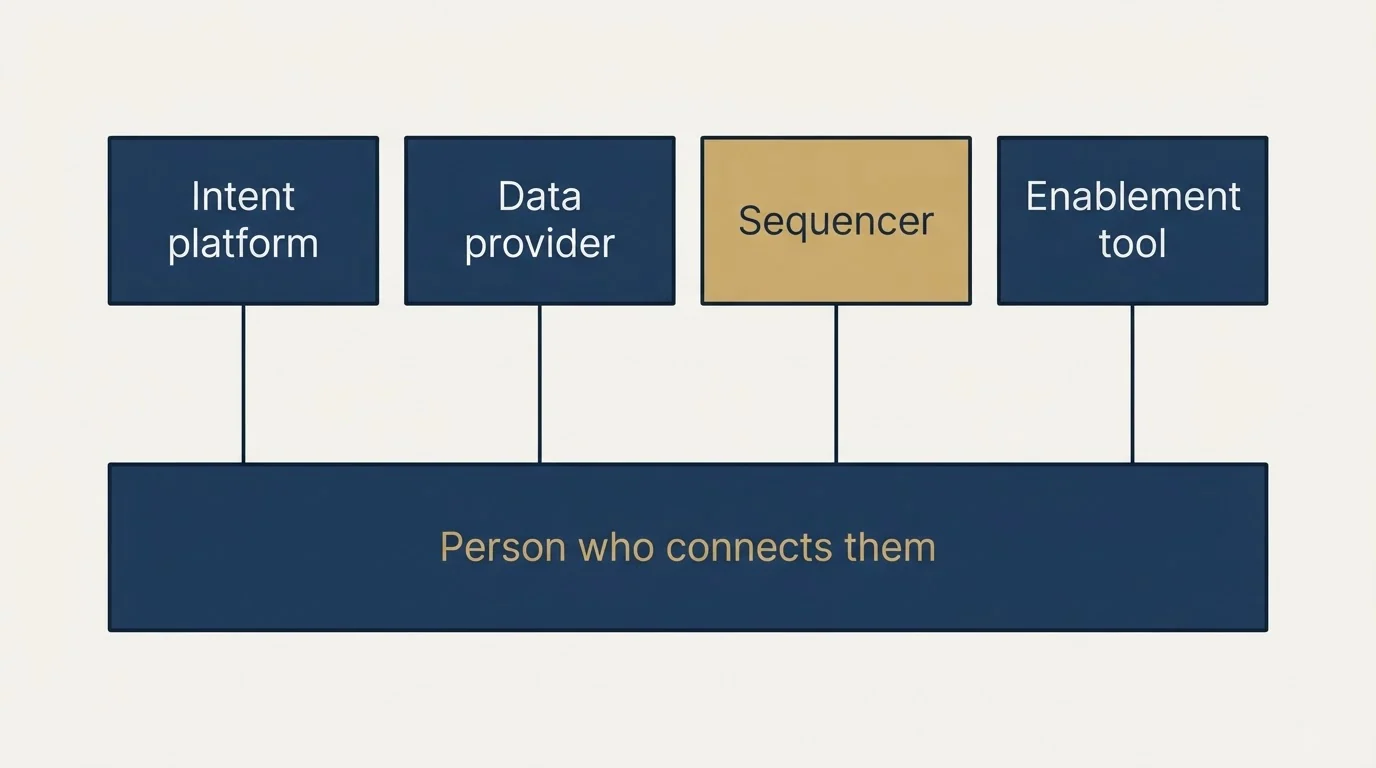
Every tool on this list is software you still have to staff, configure, and run.
That sentence is easy to skim past, so it is worth pricing out. A mid-market team buying an intent platform, a data provider, a sequencer, and an enablement tool is not buying four products. It is buying four products plus the person who connects them, maintains the connections, and interprets the output.
That person costs more than most of the licences. They are also the constraint on how much value you extract, because every workflow the stack could theoretically run is gated on someone having time to build it.
The valuation belongs to the vendor. The operating burden stays with you. No funding round changes that split.
How To Use This List
Use it as a stability filter, not a shortlist.
The top ten are safe bets in the narrow sense that they will exist at your renewal and will have engineers working on the product. That matters when you are building process on top of a tool.
Beyond that, ignore the ranking. Pick on fit with your motion, on net revenue retention if the vendor will share it, and on how much operating work the tool creates versus removes. A $440M company that fits your workflow will outperform a $7B company that does not.
Fit matters more than pedigree, and industries with their own compliance limits need a narrower lens, which is exactly what this breakdown of sales engagement tools for legal teams provides.
Ask for the qualified-meeting number from a customer that looks like you. If nobody will produce one, you have learned something the valuation could never have told you.
Frequently Asked Questions
Why are the AI-native companies worth less than the incumbents?
Distribution beat novelty. The incumbents already had the seat in the stack, a decade of customer data, and an existing renewal conversation. Adding AI to that was a feature release. Building equivalent distribution from nothing is a decade of work, and the AI-native players are a few years in.
Does a bigger valuation mean a better product?
No. It means investors paid more for a share of the company, which reflects growth expectations, market timing, and how competitive the round was. Cognism at $440M and Gong at $7.25B are not separated by a 16x quality gap.
Why has nobody in GTM software crossed $10 billion?
The category sells into a budget that is itself under pressure, competes against internal build, and struggles to prove attribution. Those are hard conditions for a standalone platform business. It is also why consolidation is active: for a platform vendor, buying a $500M capability is cheaper than losing the seat.
How should I weigh valuation when choosing a vendor?
Use it as a stability filter and nothing more. The top of the list will exist at your renewal and will have engineers on the product, which matters if you are building process on top of it. Beyond that, pick on fit with your motion and on how much operating work the tool creates versus removes.
What is the operating cost people forget?
The person who runs it. A mid-market team buying four products is buying four products plus the fraction of a hire who connects them and interprets the output. That cost usually exceeds the licences and never appears on a ranking like this one.
Related Reading
- The Real ARR Behind 15 AI Sales Companies (The Order Flips Completely)
- 16 GTM Software Companies Worth $170 Billion: The Full Ranking
- 29 US AI Companies and Where They're Actually Headquartered
We build AI-native pipeline systems and you pay per qualified meeting, not a retainer. No paying for activity. You only pay when we book you a qualified sales meeting. See if you qualify.
Valuations reflect latest publicly reported priced rounds for private companies and market capitalisation for public companies as of mid-2026. Not investment advice.
Frequently asked questions.
Frequently asked questions- Why are AI-native sales tools worth less than older incumbent companies?
- Distribution beat novelty. Incumbents like Gong, 6sense, and Outreach already held the seat in the customer's stack, years of historical data, and an existing renewal conversation, so adding AI was just a feature release. AI-native companies like Rox, 11x, and Unify have to build that distribution from scratch, which takes years they haven't had yet.
- Does a higher valuation mean a better sales tool?
- No, a higher valuation only reflects how much capital a company raised and at what price, shaped by growth expectations, market timing, and round competitiveness. It says nothing about whether the product books meetings, fits your ICP, or retains customers at renewal. Cognism at $440M isn't necessarily 16x worse than Gong at $7.25B.
- Why hasn't any AI sales or go-to-market company crossed $10 billion in valuation?
- The category sells into budgets that are themselves under pressure, competes against companies building tools internally, and struggles to prove clear attribution for results. These structural conditions make it hard to build a $10B standalone go-to-market business, which is also why consolidation is increasing, as seen with Salesforce acquiring Qualified.
- What should buyers actually look at instead of a vendor's valuation?
- Buyers should treat valuation only as a stability filter confirming a vendor will likely still exist at renewal, then evaluate fit with their sales motion, net revenue retention if the vendor shares it, and how much operating work the tool creates versus removes. A smaller, better-fitting tool can outperform a larger, poorly-fitting one.
- What hidden cost do AI sales tools have that valuations don't show?
- Every tool still requires staffing, configuration, and ongoing operation, meaning a team buying several point tools is really buying those tools plus the person who connects and maintains them. That person often costs more than the licences themselves and becomes the constraint on how much value the stack can actually deliver.
About the author.

Ben Carden is CRO at RevenueFlow, which builds and operates outbound revenue engines for B2B companies. Previously at Gartner Enterprise. Studied at London School of Economics.
Ben Carden · CRO
Connect on LinkedIn →Explore more.
Ready to scale your outreach?
We build GTM engines that book real meetings. See the receipts.
Related articles.
The Real ARR Behind 15 AI Sales Companies
In AI sales, valuations are measured in billions and revenue is measured in millions. Ranked by what customers actually pay, the leaderboard looks nothing like your feed.
16 GTM Software Companies Worth $170 Billion: Ranked
Salesforce is 73% of the category on its own. Seven of the private companies have not priced a round since 2021. Here is what the ranking actually tells a buyer, and what it cannot.
29 US AI Companies and Where They're Actually Headquartered
A few years ago, AI company meant San Francisco. The Bay Area still leads on count, but Boston, Pittsburgh and New York now own specific layers. Here is the map, and how to read it as a supply chain.
The New York AI Map: 22 Application Layer Companies
Ramp is worth $44B. VAST Data $30B. ElevenLabs $11B. None of them are in San Francisco. Here is how New York's AI cluster is organised, and why it matters for anyone building a go-to-market motion.
America's 18 Most Valuable AI Startups
Anthropic passed OpenAI in May. Together they hold $1.82 trillion of the $2.51 trillion total. The cliff after second place is bigger than every company below it added together.
Europe's AI Startups Crossed $140B: The Valuation Map
27 companies, 7 countries, and a defence company on top. Europe's AI cluster looks nothing like America's, and the difference says something useful about where applied AI value accrues.