The New York AI Map: 22 Application Layer Companies
Ramp is worth $44B. VAST Data $30B. ElevenLabs $11B. None of them are in San Francisco. Here is how New York's AI cluster is organised, and why it matters for anyone building a go-to-market motion.
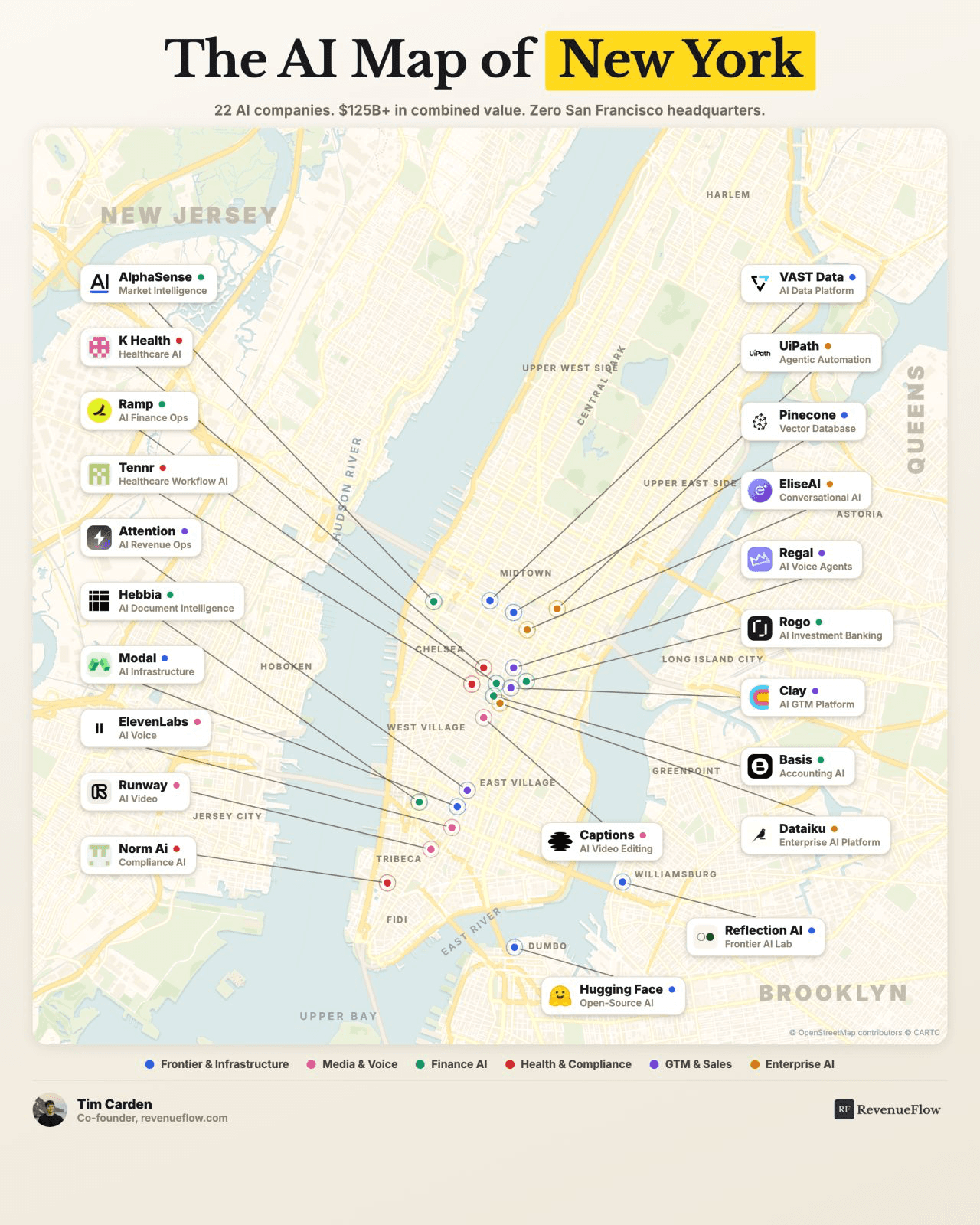
New York's AI ecosystem focuses on the application layer rather than foundation models, with 22 major companies worth collectively over $100B across finance, media, healthcare, and go-to-market sectors. Ramp ($44B), VAST Data ($30B), and ElevenLabs ($11B) lead distinct verticals, while San Francisco builds the underlying models. Over 1,000 NYC AI companies have raised more than $27B since 2019, with clustering in Flatiron creating network effects similar to San Francisco's SoMa district in 2012.
Key takeaways
- More than 1,000 NYC AI companies have raised over $27 billion since 2019, with several reporting substantial recurring revenue including UiPath at $1.85B ARR and Dataiku over $350M ARR.
- New York's three highest-valued AI companies are Ramp at $44B in finance operations, VAST Data at $30B in infrastructure, and ElevenLabs at $11B in voice AI.
- Finance AI represents the largest sector cluster in New York, led by companies like Ramp, Hebbia, AlphaSense, and Basis, concentrated near traditional financial institutions.
- Clay, Ramp, Basis, Dataiku and Captions are all located within ten blocks of Madison Square Park in Flatiron, creating geographic density that accelerates talent circulation and startup formation.
- The application layer fragmented into dozens of defensible niches because domain knowledge wins there, while the model layer consolidated into a duopoly where scale wins.
Reviewed and updated September 5, 2026
The New York AI Map
Ramp is worth $44B. VAST Data $30B. ElevenLabs $11B.
None of them are headquartered in San Francisco.
New York has quietly assembled an AI cluster with a completely different shape to the Bay Area's, and the difference tells you something useful about where value is accruing in this cycle.
The 22 Companies
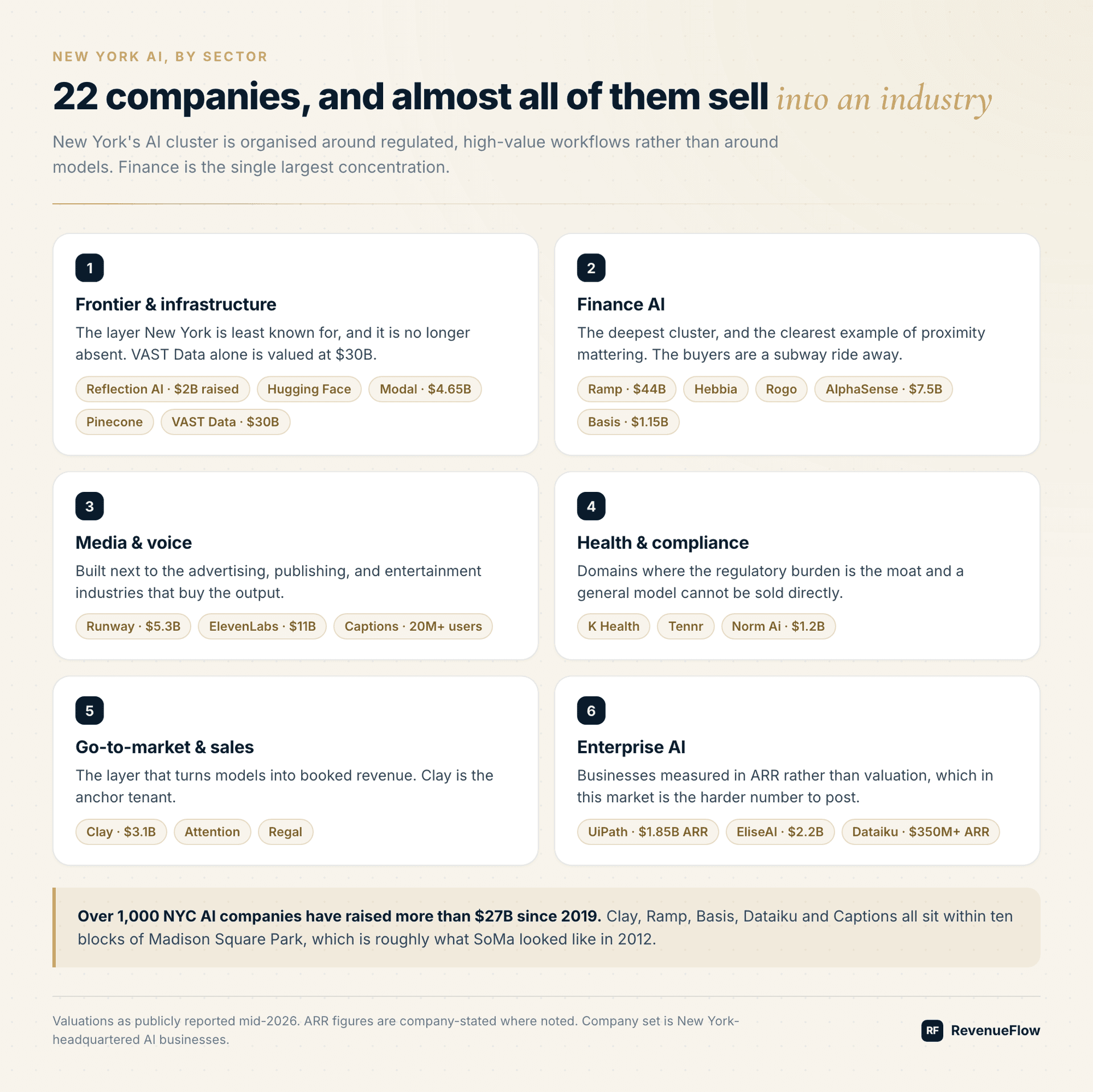
Frontier and infrastructure. Reflection AI, a frontier lab from ex-DeepMind researchers that raised $2B led by Nvidia. Hugging Face, the home of open-source AI. Modal at $4.65B. Pinecone in vector databases. VAST Data at $30B.
Finance AI. Ramp at $44B in finance operations. Hebbia in document intelligence. Rogo in investment banking, backed by Sequoia. AlphaSense at $7.5B in market intelligence. Basis at $1.15B in accounting agents.
Media and voice. Runway at $5.3B in AI video. ElevenLabs at $11B in voice. Captions with more than 20 million users in video editing.
Health and compliance. K Health in primary care. Tennr in healthcare workflow. Norm Ai at $1.2B in compliance.
Go-to-market and sales. Clay at $3.1B. Attention in revenue operations. Regal in voice agents.
Enterprise AI. UiPath at $1.85B ARR in agentic automation. EliseAI at $2.2B. Dataiku with $350M+ ARR.
Three Things That Stand Out
New York wins the application layer
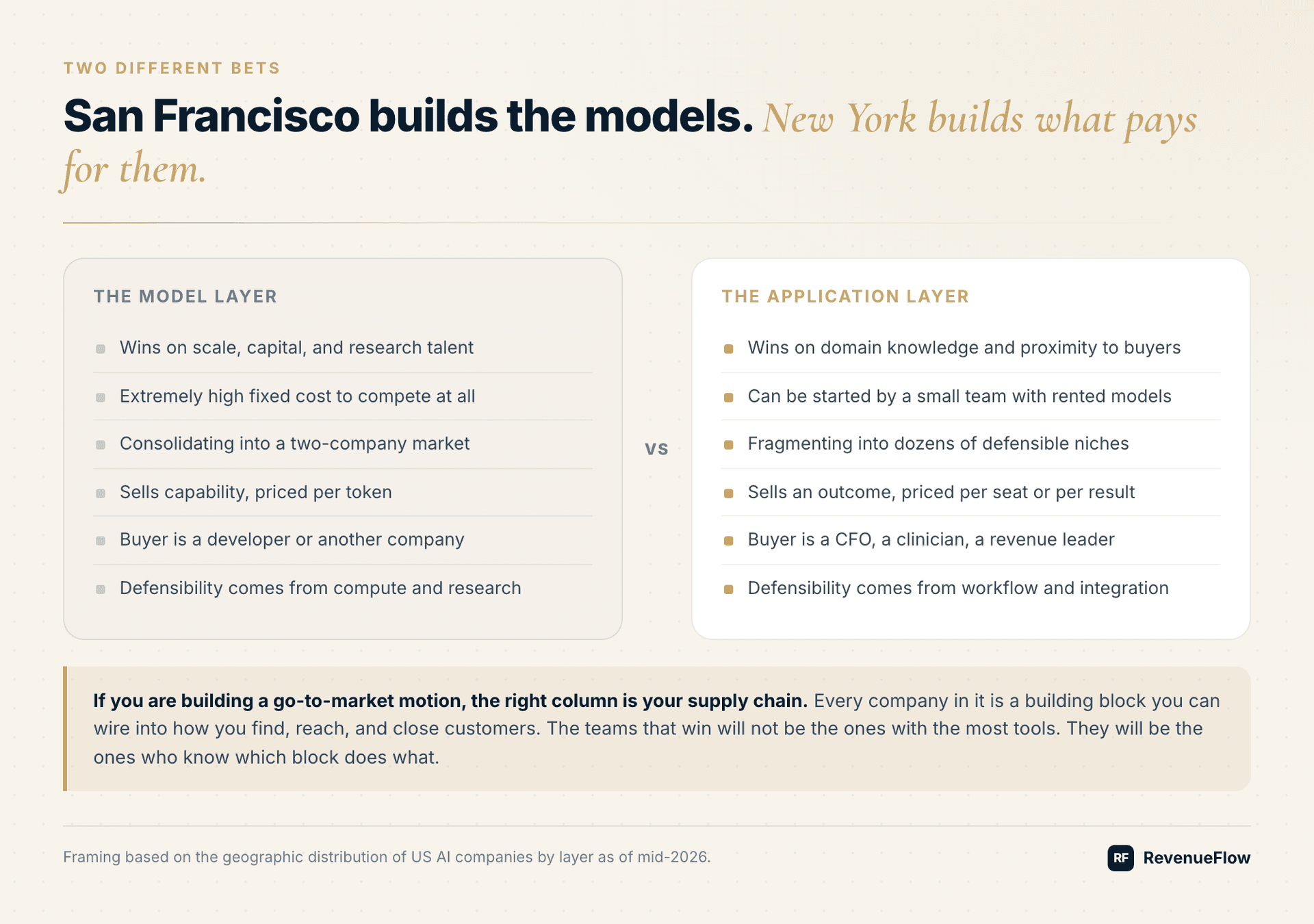
San Francisco builds the models. New York builds the things that make them pay: finance, law, healthcare, sales.
That split is not an accident of geography. It follows the buyers. If you are building AI for investment banking, being in the same city as the investment banks is worth more than being near the researchers. The feedback loop that matters runs through customers, not through papers.
The money is real
Over 1,000 NYC AI companies have raised more than $27 billion since 2019.
Worth noting the quality of the revenue, not just the valuations. UiPath reports $1.85B in ARR. Dataiku reports over $350M. In a market where most AI valuations rest on projections, New York's cluster has an unusual concentration of companies with disclosed, substantial, recurring revenue.
Flatiron is becoming what SoMa was in 2012
Clay, Ramp, Basis, Dataiku and Captions all sit within ten blocks of Madison Square Park.
Density like that produces the thing that is genuinely hard to manufacture: people leaving one company to start the next one, with the network intact.
Why This Matters If You Run Go-To-Market
The temptation with a map like this is to read it as tech news. There is a more practical reading.
Every company on the right-hand side of that split is a building block you can wire into how you find, reach, and close customers. Clay for data orchestration. Attention for revenue operations. Regal for voice. ElevenLabs if you are building anything with audio.
The teams that win will not be the ones with the most tools. They will be the ones who know which block does what, and who wire the blocks together rather than buying another one.
That is the actual lesson from the application layer. Every company in it succeeded by owning a workflow completely rather than adding a feature to someone else's. The same logic applies to your own stack. A tool that improves one step leaves you holding the integration. A system that owns the whole job does not.
The Broader Pattern
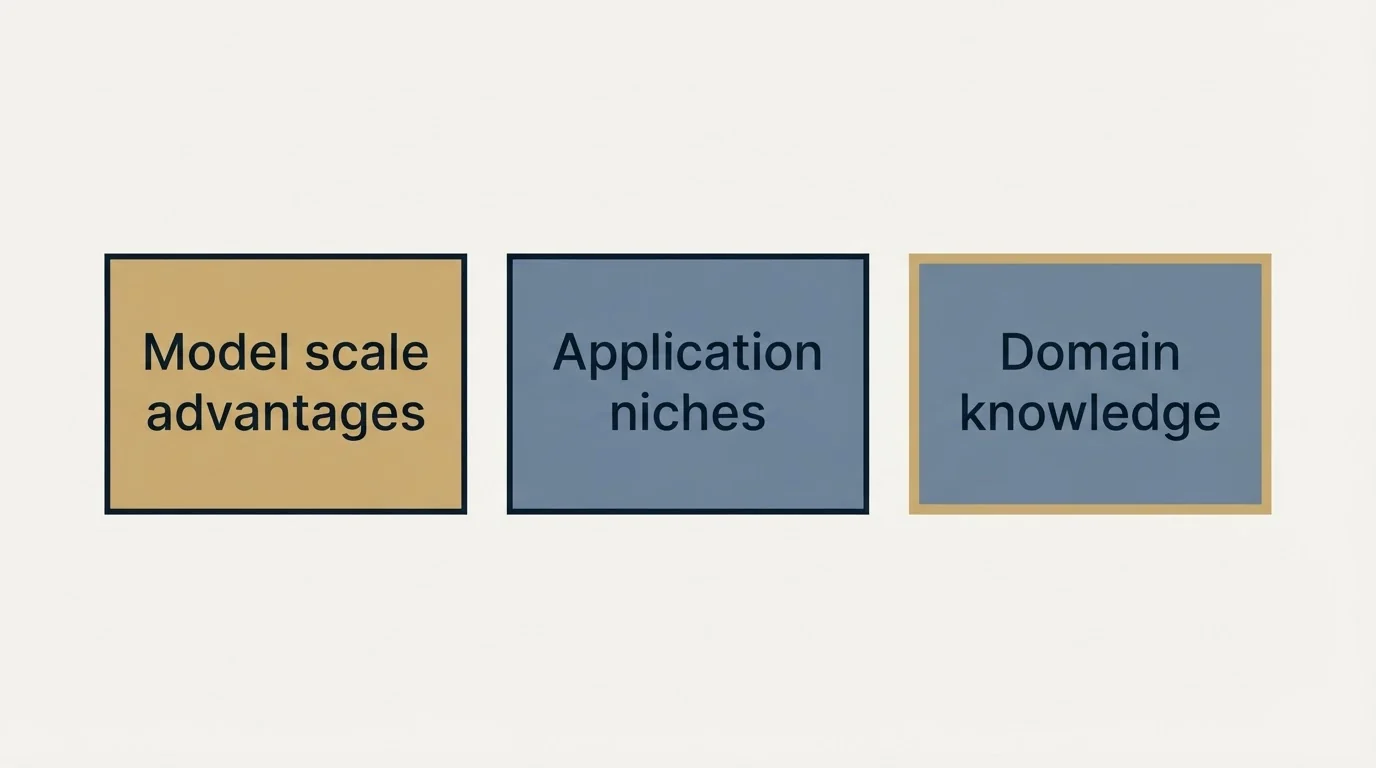
The model layer consolidated into a duopoly because scale wins there. The application layer fragmented into dozens of defensible niches because domain knowledge wins there.
For most businesses, only the second one is a place you can compete. You are not going to out-train Anthropic. You can absolutely know more about a specific workflow than a general model does, and turn that into a product.
New York's cluster is what it looks like when a city bets entirely on that second thing.
New York AI By Sector
| Sector | Companies | Largest by valuation |
|---|---|---|
| Frontier and infrastructure | Reflection AI, Hugging Face, Modal, Pinecone, VAST Data | VAST Data, $30B |
| Finance AI | Ramp, Hebbia, Rogo, AlphaSense, Basis | Ramp, $44B |
| Media and voice | Runway, ElevenLabs, Captions | ElevenLabs, $11B |
| Health and compliance | K Health, Tennr, Norm Ai | Norm Ai, $1.2B |
| Go-to-market | Clay, Attention, Regal | Clay, $3.1B |
| Enterprise AI | UiPath, EliseAI, Dataiku | EliseAI, $2.2B |
Frequently Asked Questions
Why is finance the largest cluster in New York?
Proximity to buyers. Building AI for investment banking is faster when you can have coffee with investment bankers, watch the workflow, and get corrected quickly. That feedback loop matters more in applied AI than proximity to researchers does.
The Tel Aviv AI map profiles a similarly compact cluster, where proximity to buyers and a landmark acquisition shaped the whole go-to-market layer.
Is New York competing with San Francisco?
Not directly, and that is the point. San Francisco builds the models. New York builds the applications that make them pay. They are complementary layers, and the New York companies mostly rent their models from the San Francisco ones.
Which of these matter for a go-to-market team?
Clay most directly, as the data orchestration layer in a lot of modern outbound stacks. ElevenLabs if you are building anything with voice. Attention and Regal in revenue operations and voice agents respectively. Hugging Face if you run open models.
How much money is actually in the NYC AI scene?
More than 1,000 NYC AI companies have raised over $27 billion since 2019. Unusually for this market, several of the largest have substantial disclosed recurring revenue rather than only valuations: UiPath reports $1.85B ARR and Dataiku over $350M.
What makes the Flatiron concentration significant?
Clay, Ramp, Basis, Dataiku and Captions all sit within ten blocks of Madison Square Park. That density produces the thing that is hard to manufacture deliberately: people leaving one company to start the next one with their network intact.
Related Reading
- 29 US AI Companies and Where They're Actually Headquartered
- Europe's AI Startups Just Crossed $140B: The Full Valuation Map
- America's 18 Most Valuable AI Startups (Two Are Worth More Than the Rest Combined, Twice Over)
We build AI-native pipeline systems and you pay per qualified meeting, not a retainer. No paying for activity. You only pay when we book you a qualified sales meeting. See if you qualify.
Valuations and funding figures reflect publicly reported data as of mid-2026. ARR figures are company-stated. Not investment advice.
Frequently asked questions.
Frequently asked questions- Which New York AI companies should go-to-market teams pay attention to?
- Clay is the most directly relevant at $3.1B valuation, serving as the data orchestration layer in modern outbound stacks. ElevenLabs matters if you're building anything with voice AI. Attention and Regal operate in revenue operations and voice agents respectively. Hugging Face is relevant if you run open models. The strategic insight is knowing which tool owns which workflow completely rather than accumulating features.
- Is New York competing directly with San Francisco for AI dominance?
- No, they occupy complementary layers. San Francisco builds foundation models where scale wins. New York builds applications where domain knowledge wins. Most New York AI companies rent their models from San Francisco providers while focusing on specific workflows in finance, healthcare, compliance, and go-to-market. The split follows where buyers are located rather than representing direct competition.
- What makes the Flatiron district significant for New York AI?
- Clay, Ramp, Basis, Dataiku and Captions all operate within ten blocks of Madison Square Park. This geographic density produces network effects where people leave one company to start the next with their professional networks intact, similar to San Francisco's SoMa district in 2012. Concentration at this scale is genuinely hard to manufacture and accelerates ecosystem development through talent circulation.
About the author.

Tim Carden is CMO / CTO at RevenueFlow, which builds and operates outbound revenue engines for B2B companies. Studied at McGill University.
Tim Carden · CMO / CTO
Connect on LinkedIn →Explore more.
Ready to scale your outreach?
We build GTM engines that book real meetings. See the receipts.
Related articles.
America's 18 Most Valuable AI Startups
Anthropic passed OpenAI in May. Together they hold $1.82 trillion of the $2.51 trillion total. The cliff after second place is bigger than every company below it added together.
Europe's AI Startups Crossed $140B: The Valuation Map
27 companies, 7 countries, and a defence company on top. Europe's AI cluster looks nothing like America's, and the difference says something useful about where applied AI value accrues.
29 US AI Companies and Where They're Actually Headquartered
A few years ago, AI company meant San Francisco. The Bay Area still leads on count, but Boston, Pittsburgh and New York now own specific layers. Here is the map, and how to read it as a supply chain.
The Real ARR Behind 15 AI Sales Companies
In AI sales, valuations are measured in billions and revenue is measured in millions. Ranked by what customers actually pay, the leaderboard looks nothing like your feed.
16 GTM Software Companies Worth $170 Billion: Ranked
Salesforce is 73% of the category on its own. Seven of the private companies have not priced a round since 2021. Here is what the ranking actually tells a buyer, and what it cannot.
The 15 Most Valuable AI Sales Tools, Ranked by Investors
Hundreds of AI tools are competing for your sales budget. Ranked by latest priced round, the order is not what you would expect, and the top of the list is full of companies that existed long before the AI cycle.