AI Sales Agents: 6 Jobs They Do Well and 4 They Fail At
Agents plan and act, copilots suggest, workflows follow a fixed path. Here are the six sales jobs agents handle today, the four they fail, and the buying test.
An AI sales agent is given a goal and decides its own next actions, calling tools and re-planning when a step fails, unlike a copilot that only suggests. Agents handle research, signal detection, first-touch drafting, reply triage, scheduling and data hygiene. Discovery, objection handling, multi-threading and restraint remain human.
Key takeaways
- A copilot suggests and a human decides each step, while an agent is given a goal and chooses its own actions at runtime.
- Most production sales deployments in 2026 run at autonomy level two or three, where a human approves or samples every batch.
- Gartner projects roughly a third of enterprise software interactions will be agent-handled by 2028, and forecast that over 40 percent of agentic AI projects would be cancelled by the end of 2027.
- The six jobs agents do well are research at volume, signal detection, evidence-grounded drafting, reply triage, scheduling and CRM hygiene.
- The four failures are discovery, objection handling with an economic buyer, multi-threading, and deciding not to act.
- The agent washing test is what happens on failure: a real agent re-plans, while a renamed workflow logs an error and stops.
Reviewed and updated September 5, 2026
AI Sales Agents: The 6 Jobs They Do Well and the 4 They Fail At
An AI sales agent plans and executes a multi-step revenue workflow with limited human input: it decides the next action, calls tools, reads what comes back, and continues. That definition is doing real work, because most products sold as agents in 2026 do not meet it. Gartner named the practice agent washing, meaning assistants, chatbots and rule-based automation rebranded as agents without the autonomy to justify the word.
Getting the category boundary right is the whole purchase. Below is the distinction that matters, the six jobs agents genuinely do well today, the four they consistently fail at, and the questions that expose a repackaged workflow.
An AI email agent is the same machine scoped to one channel, and it inherits both halves of this ledger: reply triage and first-touch drafting from evidence are the jobs it does well, and deciding not to send is the one it still fails.
Most lists of AI sales automation tools mix all three categories together, which is why the shortlists disagree so wildly: sort any list by the ladder above before comparing prices.
Agents are one application of a much wider category, and the five jobs models actually do inside a sales motion, from account research through to forecasting, are separated in sales artificial intelligence.
Agent, copilot, and workflow automation
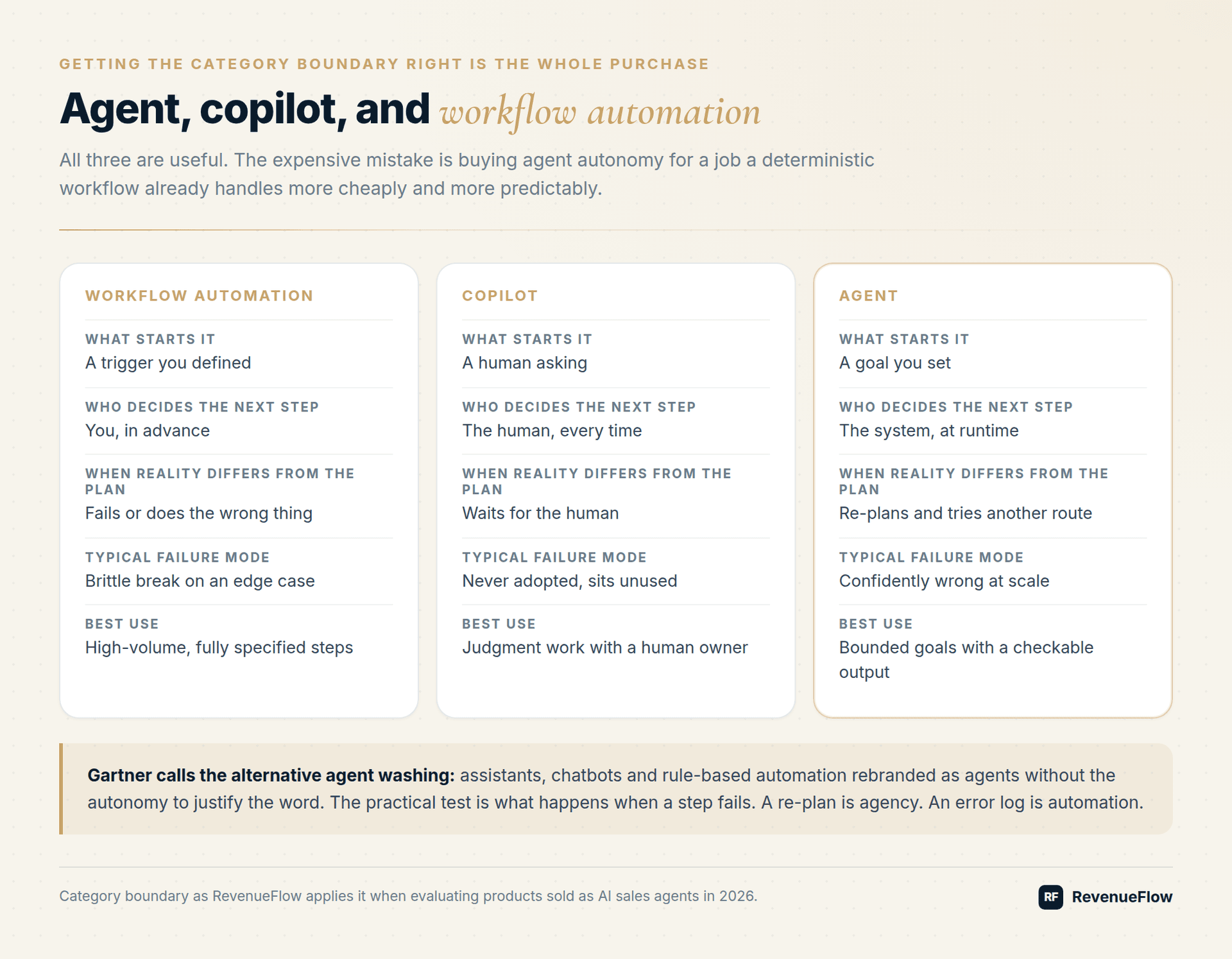
| Workflow automation | Copilot | Agent | |
|---|---|---|---|
| What starts it | A trigger you defined | A human asking | A goal you set |
| Who decides the next step | You, in advance | The human, every time | The system, at runtime |
| What it does when reality differs from the plan | Fails or does the wrong thing | Waits for the human | Re-plans and tries another route |
| Typical failure mode | Brittle break on an edge case | Never adopted, sits unused | Confidently wrong at scale |
| Best use | High-volume, fully specified steps | Judgment work with a human owner | Bounded goals with a checkable output |
All three are useful. The expensive mistake is buying agent autonomy for a job that a deterministic workflow already handles more cheaply and more predictably, which is the broader argument in stop overengineering your GTM.
AI agents for CRM are these same three shapes sold inside a CRM, so the first question about one is which of the three it actually is, before anything about the record it touches.
The autonomy ladder, and where real deployments sit
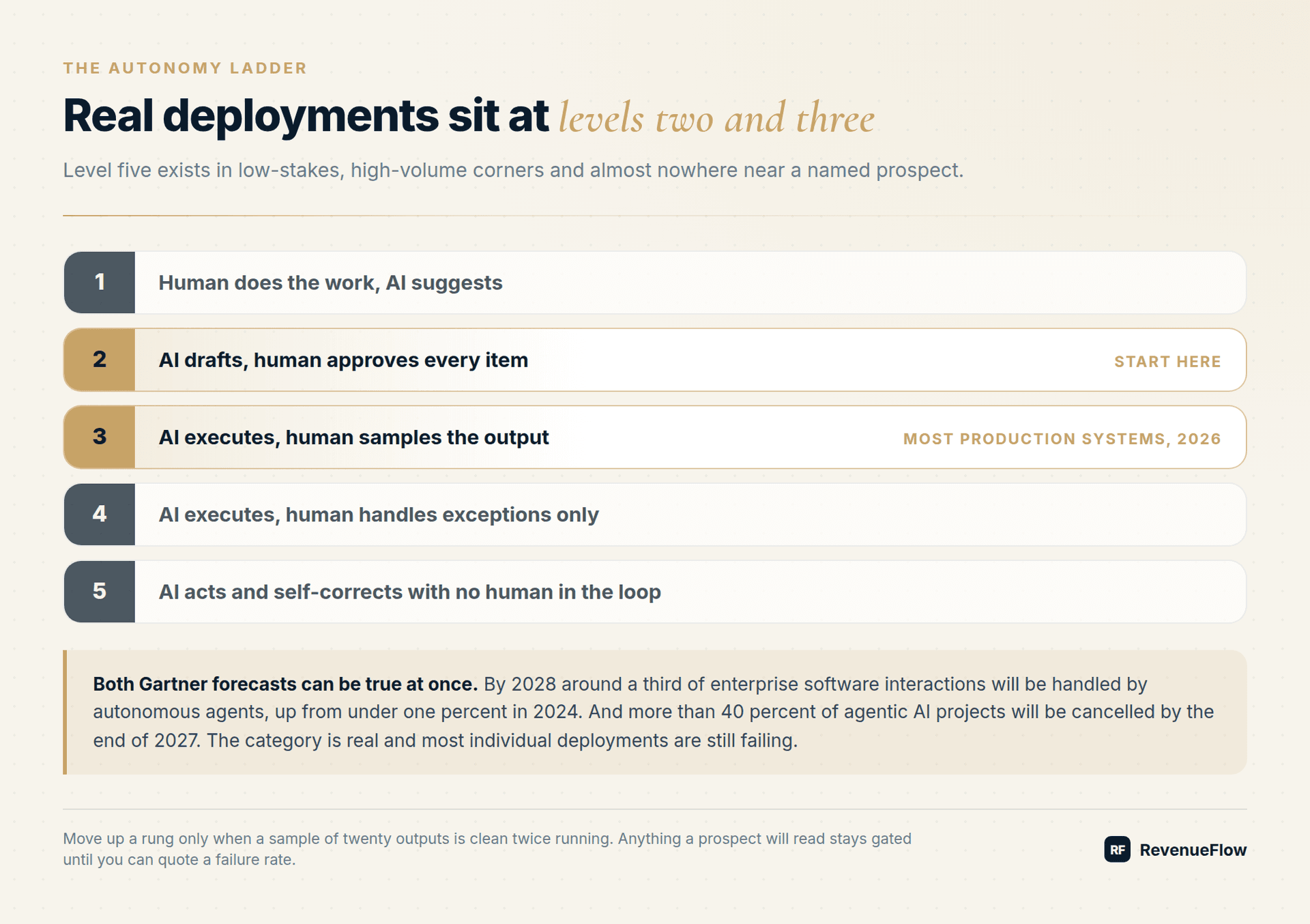
- Human does the work, AI suggests.
- AI drafts, human approves every item.
- AI executes, human samples the output.
- AI executes, human handles exceptions only.
- AI acts and self-corrects with no human in the loop.
Most production sales systems in 2026 run at levels two and three. Level five exists in low-stakes, high-volume corners and almost nowhere near a named prospect. Gartner projects that by 2028 around a third of enterprise software interactions will be handled by autonomous agents, up from under one percent in 2024, and in mid-2025 it also forecast that more than 40 percent of agentic AI projects would be cancelled by the end of 2027. Both of those can be true. The category is real and most individual deployments are still failing.
The six jobs they do well
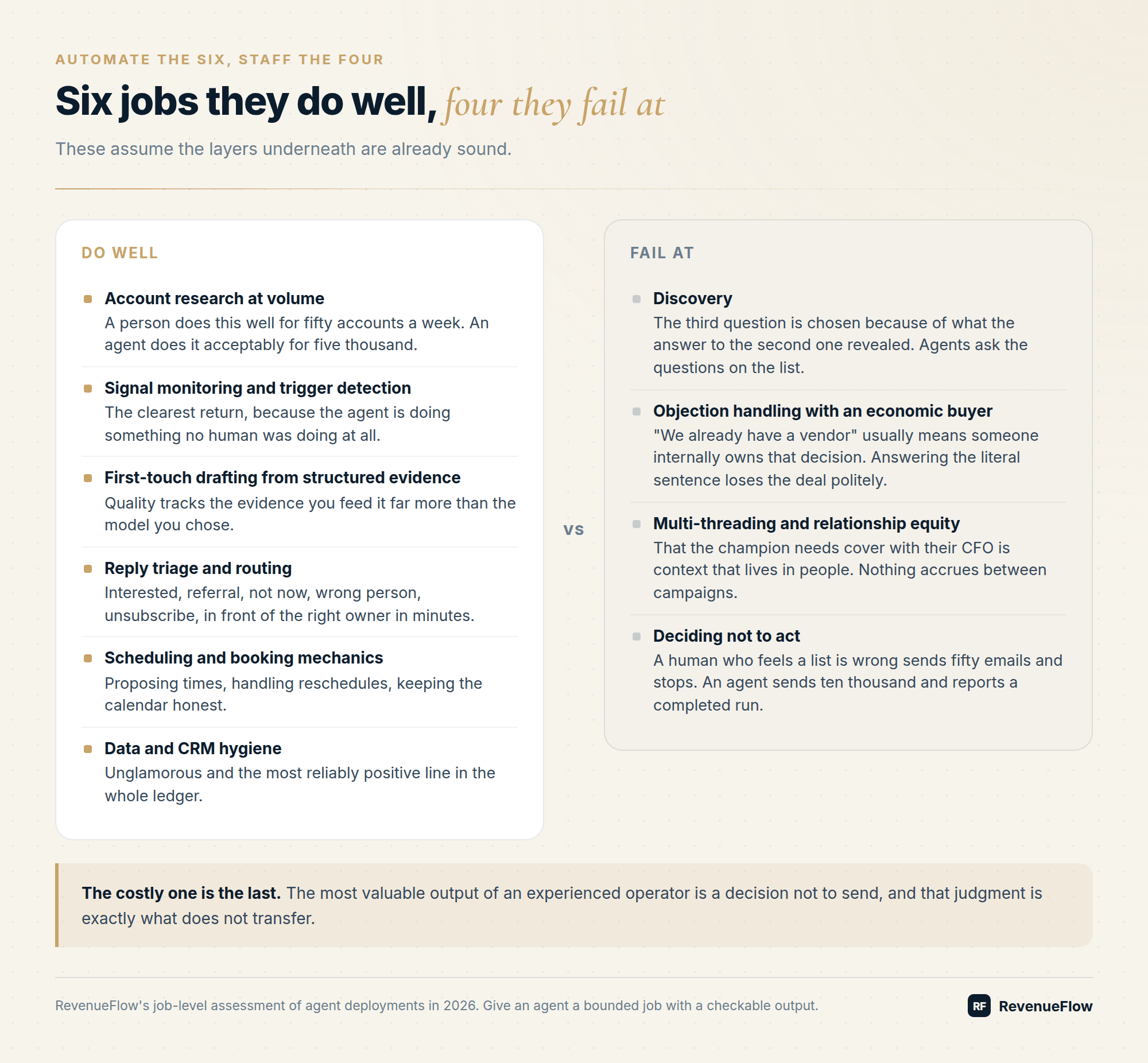
- Account research at volume.
- Signal monitoring and trigger detection.
- First-touch drafting from structured evidence.
- Reply triage and routing.
- Scheduling and booking mechanics.
- Data and CRM hygiene.
- Discovery is a chain of unscripted follow-ups
- Objection handling with an economic buyer. Real objections are rarely requests for information.
- Multi-threading and relationship equity. Knowing that the champion needs cover with their CFO
- Deciding not to act. This is the costly one.
1. Account research at volume. Reading a website, a funding history, job posts and a LinkedIn presence, then producing a structured account brief. A person does this well for fifty accounts a week. An agent does it acceptably for five thousand.
2. Signal monitoring and trigger detection. Watching for a hiring post, a funding event, a technology change or a new office, and firing the matching play. This is the job with the clearest return, because the agent is doing something no human was doing at all.
3. First-touch drafting from structured evidence. When the agent is handed verified facts rather than asked to invent an angle, drafted first touches hold up. Quality tracks the evidence you feed it far more than the model you chose.
4. Reply triage and routing. Sorting replies into interested, referral, not now, wrong person and unsubscribe, then putting each in front of the right owner in minutes rather than hours.
5. Scheduling and booking mechanics. Proposing times, handling reschedules, keeping the calendar honest.
6. Data and CRM hygiene. Deduplicating, re-verifying decayed contacts, closing out stale records, keeping the target list current. Unglamorous and the most reliably positive line in the whole ledger.
The AI CRM use cases a CRM vendor lists are this same list of jobs and failures under product names, so read the four failures beside the six jobs before accepting that its agent has taken any of them off you.
Smaller teams shopping this aisle on price meet the same relabelling, since sales automation covers four unrelated purchases sold as alternatives to each other.
Those six map cleanly onto the job-based view of a stack we set out in the eight GTM agent workflows that matter, and they assume the layers underneath are already sound, in the order described in the seven-layer GTM AI stack.
The four jobs they fail at
1. Discovery. Discovery is a chain of unscripted follow-ups, where the third question is chosen because of what the answer to the second one revealed. Agents ask the questions on the list. They do not notice the sentence that should have redirected the whole call.
2. Objection handling with an economic buyer. Real objections are rarely requests for information. "We already have a vendor" usually means someone internally owns that decision. Answering the literal sentence loses the deal politely.
3. Multi-threading and relationship equity. Knowing that the champion needs cover with their CFO, or that last quarter's failed rollout makes this a political purchase, is context that lives in people. Nothing accrues in the agent between campaigns.
4. Deciding not to act. This is the costly one. A human rep who feels a list is wrong sends fifty emails and stops. An agent sends ten thousand and reports a completed run. The most valuable output of an experienced operator is a decision not to send, and that judgment is exactly what does not transfer.
The agent washing test
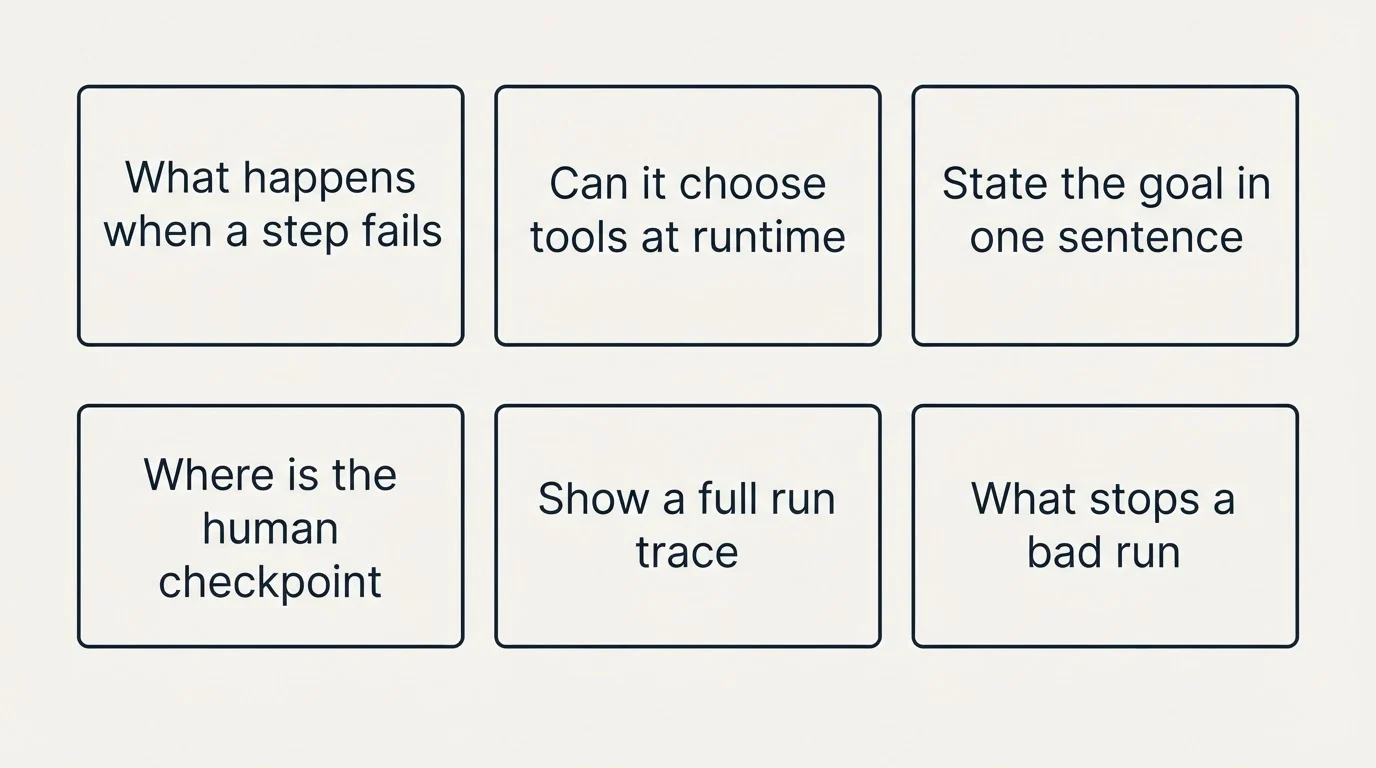
Six questions that separate a real agent from a renamed workflow:
- What does it do when a step fails? A re-plan is agency. An error log is automation.
- Can it choose between two tools for the same job at runtime, or is the path fixed?
- What is the goal it is given, in one sentence? If you cannot state a goal, you bought a sequence.
- Where is the human checkpoint, and can I move it up or down the ladder?
- Show me a run trace: every decision, every tool call, every input.
- What stops a bad run at scale, and how fast does the stop take effect?
Vendors that answer all six concretely are usually selling something real. Vendors that answer with output volume are selling the demo.
How to deploy one without regretting it
Give the agent a bounded job with a checkable output. "Research these 400 accounts and return a structured brief with sources" is checkable in an afternoon. "Own outbound" is not.
Start at level two, sample twenty items, and only move up the ladder when the sample is clean twice running. Keep an approval gate on anything a prospect will read until the failure rate is a number you can quote. Put the volume ceiling in the system rather than in a policy document, because the failure mode is speed.
And keep a person accountable for the goal. Someone owns the outcome the agent was pointed at, which is precisely the job we describe in what a GTM engineer actually is and why the role emerged as the successor to the traditional SDR function.
Where this leaves buying decisions
If you are evaluating packaged products in this space, the shopping guide sits in our companion page on what an AI SDR replaces and what it costs. If you are deciding what to build rather than buy, start from the jobs list above: automate the six, staff the four, and be honest about which one your current tooling is quietly doing badly.
Frequently Asked Questions
What is the difference between an AI sales agent and an AI copilot?
A copilot suggests and a human decides every step. An agent is given a goal and decides its own next actions, calling tools and re-planning when something fails. Both are useful. Copilots fail by going unused, and agents fail by being confidently wrong at volume.
Can an AI sales agent run discovery calls?
No, not in any way a serious buyer would accept. Discovery depends on unscripted follow-ups chosen from what the previous answer revealed. Agents ask the questions they were given and miss the sentence that should have changed the direction of the conversation.
What is agent washing?
Gartner's term for vendors rebranding assistants, chatbots and rule-based automation as agents without the underlying autonomy. The practical test is what happens when a step fails: a real agent re-plans, while a renamed workflow logs an error and stops.
What autonomy level should I start at?
Level two, where the system drafts and a human approves each item. Sample twenty outputs, and only move to level three, where the system executes and a human spot-checks, after two clean samples in a row. Anything a prospect will read stays gated until you can quote a failure rate.
We build AI-native pipeline systems and you pay per qualified meeting, not a retainer. If you would rather have the engine operated than assembled, see if you qualify.
Frequently asked questions.
Frequently asked questions- What is the difference between an AI sales agent and an AI copilot?
- A copilot suggests and a human decides every step, so it fails by going unused. An agent receives a goal and decides its own next actions, calling tools and re-planning when something breaks, so it fails by being confidently wrong at volume. Both are useful for different jobs, and buying agent autonomy for fully specified work wastes money.
- Can an AI sales agent run a discovery call?
- No. Discovery is a chain of unscripted follow-ups where each question is chosen from what the previous answer revealed. An agent asks the questions it was given and misses the sentence that should have redirected the conversation. Objection handling fails for the same reason, because real objections are political rather than informational.
- What is agent washing?
- Gartner's term for vendors rebranding assistants, chatbots and rule-based automation as agents without the autonomy that word implies. The quickest test is asking what happens when a step fails. A genuine agent re-plans and tries another route, while a renamed workflow logs an error and stops until a person intervenes.
- What autonomy level should a team start at?
- Level two, where the system drafts and a human approves each item. Sample twenty outputs and move to level three, execution with human spot-checks, only after two consecutive clean samples. Anything a prospect will read should stay behind an approval gate until you can quote an actual failure rate rather than an impression.
- Which sales jobs should stay with people?
- Discovery, objection handling with an economic buyer, multi-threading a live account, and the decision not to act. The last one costs the most when it is automated, because a person who senses a bad list stops after fifty emails while a system sends ten thousand and reports a completed run.
About the author.

Tim Carden is CMO / CTO at RevenueFlow, which builds and operates outbound revenue engines for B2B companies. Studied at McGill University.
Tim Carden · CMO / CTO
Connect on LinkedIn →Explore more.
Ready to scale your outreach?
We build GTM engines that book real meetings. See the receipts.
Related articles.
Claude Code Is the Best GTM Tool of 2026
Your GTM stack is fine. The problem is that you are the integration layer holding it together. Here is what changes when an agent with API access takes that job instead.
AI SDR: What It Replaces, What It Doesn't and What It Costs
AI SDRs handle research, list building, sending and reply triage well. Discovery, objections and relationships do not transfer. Capability matrix and real pricing.
Claude Code for RevOps: 5 Workflows to Run From the Terminal
Five recurring RevOps jobs run from the terminal with Claude Code: pipeline hygiene, forecasting, deal intelligence, lead routing and attribution, and the team setup.
AI Appointment Setters vs Human Setters: Cost per Meeting
2026 pricing for voice AI setters, AI SDR platforms, human setters and agencies, with a cost-per-meeting table that adds back oversight and no-shows.
Chat App or Engineer: 5 B2B Marketing Workflows
Competitor teardowns, campaign reports, a versioned brand voice file, SEO refresh, and ABM briefs. Five workflows that read real files, run real scripts, and write finished artifacts to disk.
5 Marketing Workflows You Can Run Entirely From the Terminal
Personalised outbound, content repurposing, competitive intelligence, SEO gap analysis, and creative testing. Five jobs that span four tools each, run by one agent instead of a person switching tabs.