5 RevOps Workflows You Can Run Entirely From the Terminal
Pipeline hygiene, forecasting, deal intelligence, lead routing, and attribution. Five recurring RevOps jobs, run by one agent with API access instead of six dashboards and a spreadsheet.
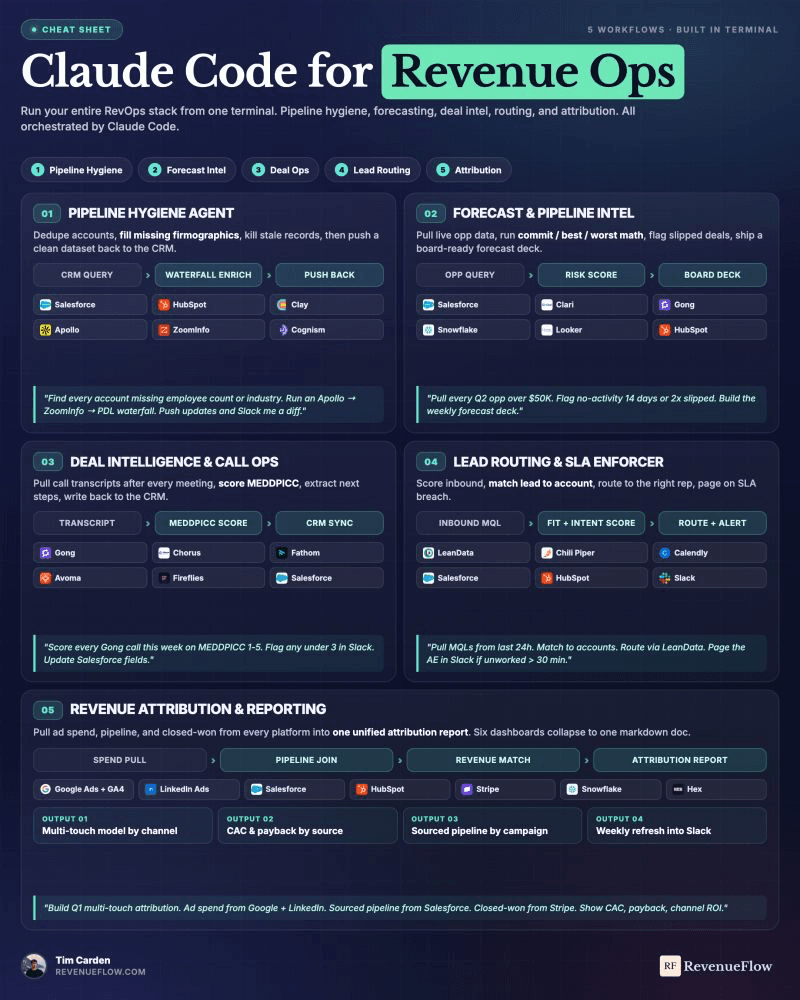
Five core RevOps workflows (pipeline hygiene, forecasting, deal intelligence, lead routing, and attribution) can run autonomously through API connections instead of manual dashboard work. Agents pull data from CRMs, enrichment tools, call intelligence platforms, and billing systems, apply logic, and write updates back or surface reports. This shifts recurring tasks from weekly analyst work to scheduled automation, though each workflow requires human-defined rules, proper credential scoping, and initial read-only testing before live deployment.
Key takeaways
- Gartner estimates the average annual cost of poor data quality at $12.9 million per organisation, making pipeline hygiene the critical first workflow to automate.
- Deal intelligence automation solves CRM update gaps by extracting qualification data, next steps, and risks from call transcripts immediately after conversations end.
- Lead routing becomes reviewable plain-English logic instead of flowcharts, allowing policy owners to maintain rules that would otherwise go stale.
- The first automated workflow takes longer than manual execution, but the second reuses credentials and context to become faster, creating the economic crossover point.
- Pipeline hygiene should start in read-only mode to expose data quality issues and matching logic failures before any system writes to production.
Reviewed and updated September 5, 2026
5 RevOps Workflows You Can Run Entirely From the Terminal
Revenue operations is mostly the same five jobs, repeated on a schedule, across systems that do not talk to each other.
That is also the honest scope of AI for RevOps: five recurring jobs that each already expose an API, rather than a transformation programme.
Every one of those systems has an API. That is the part worth sitting with, because it means the jobs are chainable. What follows is how each one looks when an agent runs it instead of a person clicking between tabs.
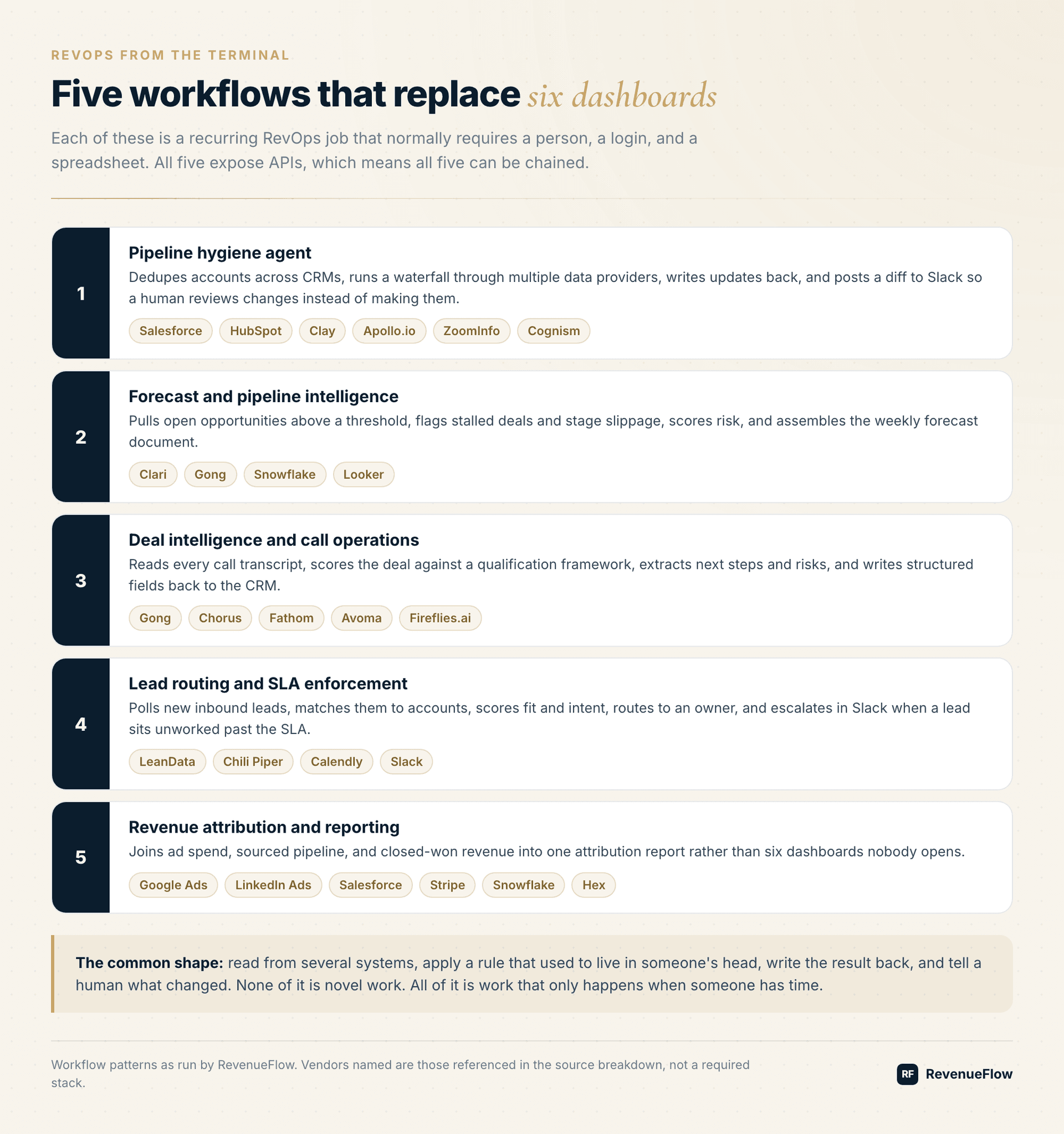
1. Pipeline Hygiene
The job: keep account and contact records accurate enough that everything built on top of them works.
The workflow reads accounts from Salesforce and HubSpot, identifies duplicates, runs a waterfall enrichment through Apollo.io, ZoomInfo, and People Data Labs via Clay, then writes updates back and posts a diff to Slack.
The diff matters more than the update. You want a human to see what changed before it becomes canonical, especially in the first few weeks when the matching logic is still wrong in ways you have not discovered yet. Cognism is the usual swap for better EU coverage.
Gartner's widely cited estimate puts the average annual cost of poor data quality at $12.9 million per organisation. Whatever the exact figure is for your business, the cost is real and it compounds through every layer above it.
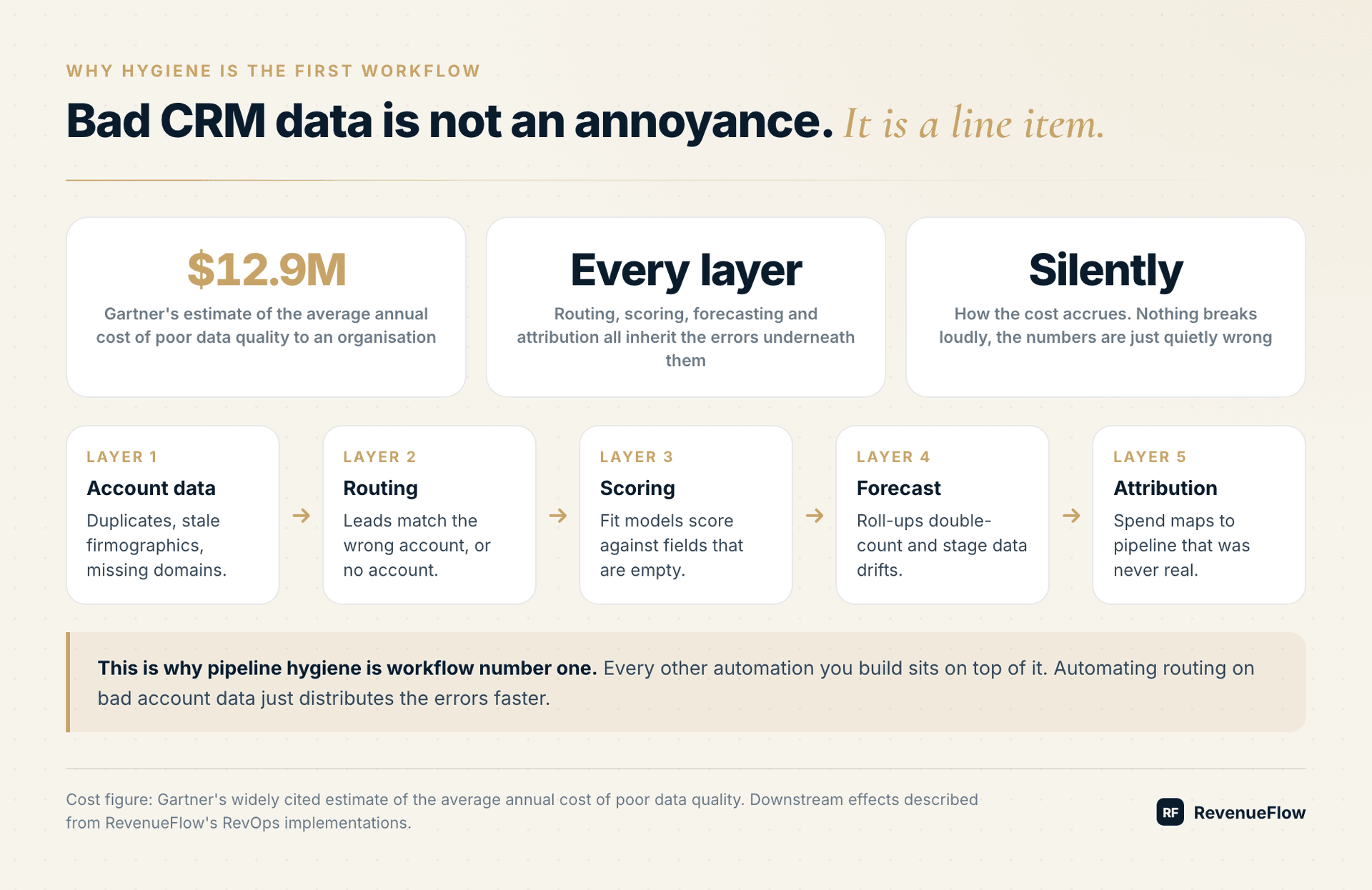
This is why hygiene is workflow one rather than workflow five. Automating lead routing on top of bad account data just distributes the errors faster.
2. Forecast And Pipeline Intelligence
The job: produce a defensible weekly view of what is going to close.
Pull every open opportunity above a threshold. Flag anything with no activity in 14 days. Flag stage slippage against the previous snapshot. Score risk. Assemble the result into a document a revenue leader can actually take into a board meeting.
Clari, Gong, Snowflake, and Looker all expose export APIs. The forecast deck that currently takes an analyst most of a Monday is a query across four of them plus a template.
Those products sit in different rows of the same stack, and nine RevOps products sorted by job separate forecasting from routing, data supply and wiring.
The honest caveat: the model that scores risk is only as good as the historical data you feed it. Early on, treat the score as a prompt for a conversation rather than a verdict.
3. Deal Intelligence And Call Operations
The job: get what was said on a call into the CRM.
After every call, pull the transcript from Gong, Chorus, Fathom, Avoma, or Fireflies. Score the deal against your qualification framework. Extract next steps, risks, and stated timelines. Write structured fields back to Salesforce.
This is the workflow with the clearest before and after, because "the rep did not update the CRM" is a problem every sales org has and no amount of process has ever solved. Reps do not skip CRM updates out of laziness. They skip them because the update happens after the call, when the next call has already started.
Moving the work to a system that was listening anyway removes the conflict entirely.
4. Lead Routing And SLA Enforcement
The job: get inbound leads to the right person fast enough to matter.
Poll for new MQLs every ten minutes. Match each lead to an existing account. Score fit and intent. Route through LeanData, Chili Piper, or Calendly. Page the owner in Slack if a lead sits unworked past 30 minutes.
Automating that routing assumes somebody already owns the lead definition, and who owns which revenue decision is the question scope language never answers.
The interesting change here is not the speed. It is that the routing logic becomes plain English rather than a flowchart in a tool nobody wants to open. Rules like "if the account already has an open opportunity, route to that owner regardless of territory" are one sentence, not fifteen clicks.
That makes the logic reviewable by the person who actually owns the policy, which is usually the reason routing rules go stale in the first place.
5. Revenue Attribution
The job: connect spend to pipeline to revenue without three weeks of reconciliation.
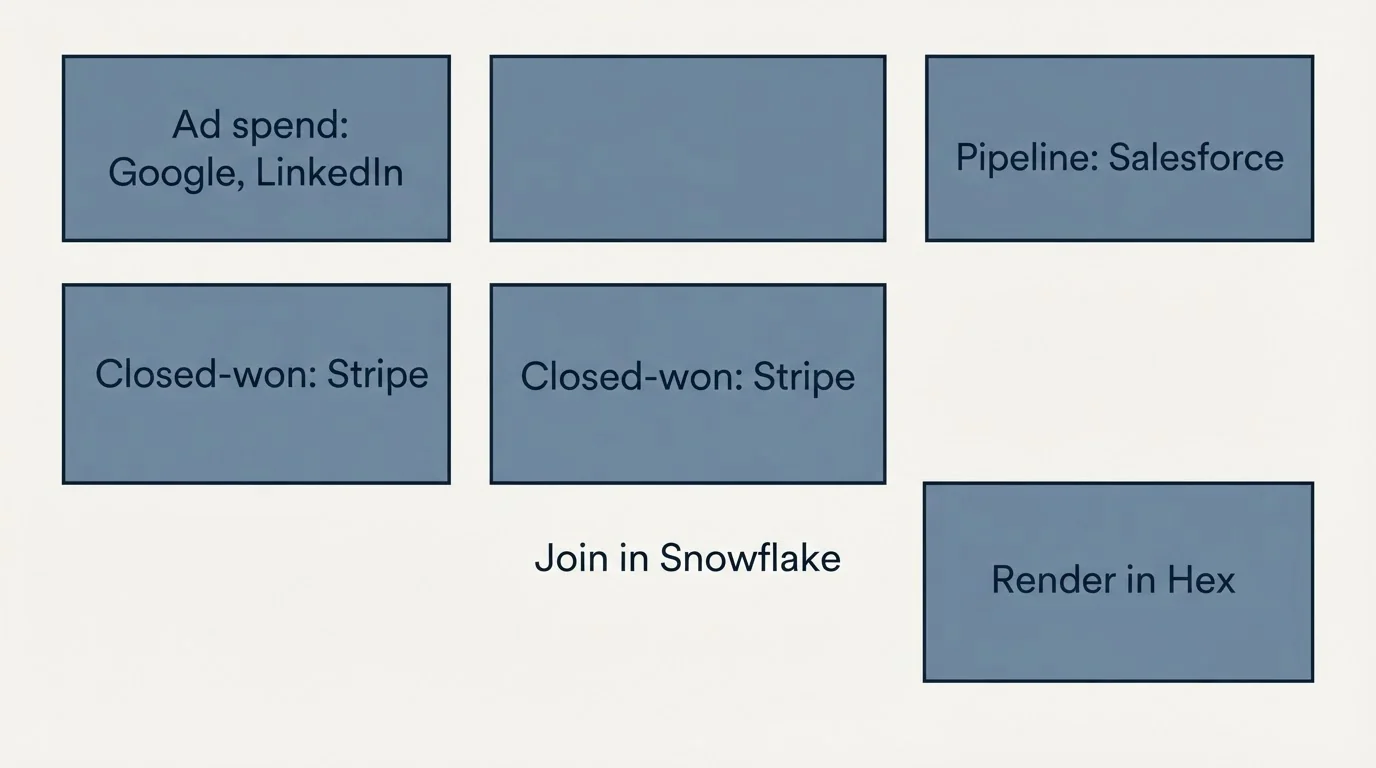
Pull ad spend from Google and LinkedIn. Sourced pipeline from Salesforce. Closed-won from Stripe. Join in Snowflake. Render in Hex.
Six dashboards collapse into one report. Not because the dashboards were bad, but because nobody was ever going to open all six and hold the joins in their head.
Attribution stays genuinely hard. Multi-touch models involve judgment calls that automation does not resolve. What automation removes is the data assembly, which is the part that made the report monthly instead of weekly.
What This Is Not
It is not a replacement for a RevOps person. Every workflow above needs someone who understands the commercial context to define the rules, review the output, and notice when a result is wrong in a way the system cannot detect.
It is also production infrastructure. An agent with write access to your CRM, your data warehouse, and your billing system needs scoped credentials, a log of what ran, and a clear answer to what happens when a job fails halfway through. Treat it accordingly.
And it takes real setup time. The first workflow is slower than doing the task by hand. The second is faster, because it reuses the credentials and the context. That crossover is the whole economic case.
Where To Start
- Step 1Start with pipeline hygiene, in read-only mode
producing a report rather than writing changes
- Step 2You will learn two things quickly
how bad your data actually is, and where your matching logic breaks.
- Step 3Once the diffs are consistently correct, let it write.
- Step 4Then add the next workflow.
Start with pipeline hygiene, in read-only mode, producing a report rather than writing changes.
You will learn two things quickly: how bad your data actually is, and where your matching logic breaks. Both of those need to be understood before anything writes to a live system.
Once the diffs are consistently correct, let it write. Then add the next workflow.
At RevenueFlow we run hygiene, deal intelligence, and attribution this way. The shift is not that the work got faster. It is that the work now happens on a schedule instead of when someone finds an afternoon.
Build Order And Risk
| Workflow | Build effort | Risk if wrong | Start in read-only? |
|---|---|---|---|
| Pipeline hygiene | Medium | High, it writes to core records | Yes, always |
| Forecast intelligence | Low | Low, output is a document | Not required |
| Deal intelligence | Medium | Medium, writes CRM fields | Yes |
| Lead routing | High | High, affects live SLAs | Yes, shadow mode first |
| Attribution | Medium | Low, reporting only | Not required |
Frequently Asked Questions
Does this replace a RevOps hire?
No. Every workflow above needs someone who understands the commercial context to define the rules, review the output, and notice when a result is wrong in a way the system cannot detect. What it replaces is the portion of that person's week spent assembling data rather than interpreting it.
What is the most common failure?
Silent failure. An enrichment step starts returning nulls, the job keeps running, and nothing looks broken until the month closes short. Build the alert that fires when a step returns an unexpected volume before you build the next workflow.
Which workflow should I build first?
Pipeline hygiene, in read-only mode, producing a report rather than writing changes. You will learn how bad your data actually is and where your matching logic breaks, and both need to be understood before anything writes to a live system.
How do I handle permissions safely?
Scope credentials per workflow rather than issuing one key with full access. A forecasting job needs read access to opportunities and nothing else. Treat it like production infrastructure, because a system with write access to your CRM is exactly that.
Can this work with a non-standard CRM setup?
Usually better than an off-the-shelf integration can, because the logic is written against your actual field names and quirks rather than against a vendor's assumption of how you configured things. Heavy customisation is where pre-built connectors tend to fail and where this approach has the advantage.
Related Reading
- 5 Marketing Workflows You Can Run Entirely From the Terminal
- Claude Code Is the Best GTM Tool of 2026 (Because It Operates the Whole Stack)
- The Gap Between a Chat App and an Engineer: 5 B2B Marketing Workflows
We build AI-native pipeline systems and you pay per qualified meeting, not a retainer. No paying for activity. You only pay when we book you a qualified sales meeting. See if you qualify.
Frequently asked questions.
Frequently asked questions- Why should pipeline hygiene be the first RevOps workflow to automate?
- Bad account data propagates through every downstream system: routing, scoring, forecasting, and attribution all inherit the errors. Automating lead routing on top of inaccurate data simply distributes mistakes faster. Pipeline hygiene must run accurately before other workflows can be trusted, which is why it should be implemented first, in read-only mode, until the matching logic and enrichment waterfall produce consistently correct results.
- How does automating deal intelligence solve the CRM update problem?
- Sales reps skip CRM updates not from laziness but because updates happen after calls when the next call has already started. Automated deal intelligence pulls transcripts from platforms like Gong or Chorus immediately after each call, scores deals against qualification frameworks, extracts next steps and risks, then writes structured data back to Salesforce. This removes the timing conflict entirely by handling updates while the rep moves forward.
- What risks come with running RevOps workflows through terminal agents?
- An agent with write access to your CRM, data warehouse, and billing system is production infrastructure requiring scoped credentials, complete job logs, and clear failure handling procedures. Each workflow needs a human who understands commercial context to define rules, review output, and catch errors the system cannot detect. Start every workflow in read-only mode to identify data quality issues and logic failures before allowing any writes to live systems.
- Does automating attribution workflows solve multi-touch modeling challenges?
- No. Multi-touch attribution models still involve judgment calls that automation does not resolve: deciding which touchpoints deserve credit remains genuinely hard. What automation removes is the data assembly work: pulling ad spend from Google and LinkedIn, sourced pipeline from Salesforce, and closed-won from Stripe, then joining in a warehouse and rendering one report. This shifts attribution from a monthly reconciliation project to a weekly process.
- When does the time investment in automation pay off?
- The first automated workflow is slower than doing the task manually because you are building credentials, context, and integration logic. The second workflow becomes faster because it reuses that foundation. This crossover point is the entire economic case. The shift is not speed but consistency: work happens on a schedule instead of when someone finds an afternoon, and tasks that took an analyst most of a Monday become automated queries.
About the author.

Tim Carden is CMO / CTO at RevenueFlow, which builds and operates outbound revenue engines for B2B companies. Studied at McGill University.
Tim Carden · CMO / CTO
Connect on LinkedIn →Explore more.
Ready to scale your outreach?
We build GTM engines that book real meetings. See the receipts.
Related articles.
Claude Code Is the Best GTM Tool of 2026
Your GTM stack is fine. The problem is that you are the integration layer holding it together. Here is what changes when an agent with API access takes that job instead.
AI Sales Agents: 6 Jobs They Do Well and 4 They Fail At
Agents plan and act, copilots suggest, workflows follow a fixed path. Here are the six sales jobs agents handle today, the four they fail, and the buying test.
AI SDR: What It Replaces, What It Doesn't and What It Costs
AI SDRs handle research, list building, sending and reply triage well. Discovery, objections and relationships do not transfer. Capability matrix and real pricing.
Chat App or Engineer: 5 B2B Marketing Workflows
Competitor teardowns, campaign reports, a versioned brand voice file, SEO refresh, and ABM briefs. Five workflows that read real files, run real scripts, and write finished artifacts to disk.
5 Marketing Workflows You Can Run Entirely From the Terminal
Personalised outbound, content repurposing, competitive intelligence, SEO gap analysis, and creative testing. Five jobs that span four tools each, run by one agent instead of a person switching tabs.
Outbound Teams Hold Their Stack With 3 Ops People or 22 APIs
Five categories of tooling, all API-addressable, run from one terminal. Here is the full stack, what MCP actually changes, and the honest version of what replaces the ops headcount.