Chat App or Engineer: 5 B2B Marketing Workflows
Competitor teardowns, campaign reports, a versioned brand voice file, SEO refresh, and ABM briefs. Five workflows that read real files, run real scripts, and write finished artifacts to disk.
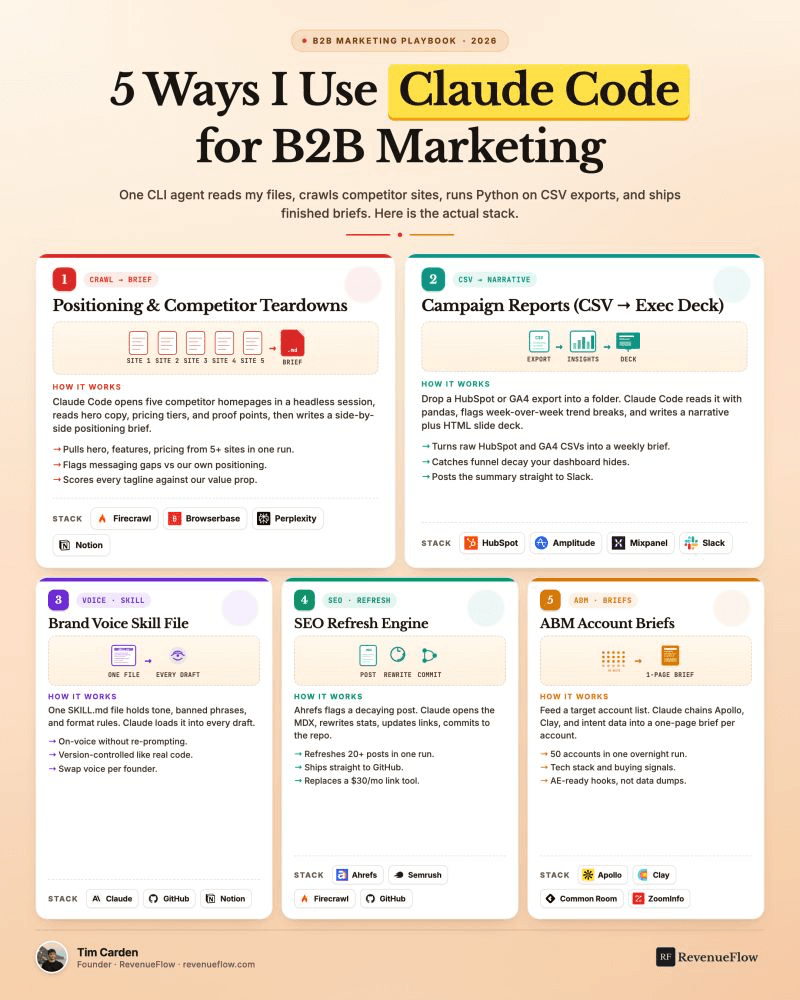
Five production marketing workflows (competitor teardowns, campaign report generation, brand voice enforcement, SEO refresh automation, and ABM account briefs) bridge the gap between chat AI and actual work completion by reading real files, executing code, and writing finished artifacts to disk. The critical distinction is not answer quality but whether output exists as a file in your workflow rather than text in a chat window that requires manual transfer.
Key takeaways
- AI agents that execute pandas code for CSV analysis avoid arithmetic errors inherent in models reading large tables within context windows.
- Automated competitor research changes frequency from annual positioning exercises to weekly checks that catch pricing page changes in real time.
- Brand voice files under version control transform aspirational guidelines into enforced standards loaded automatically into every draft.
- ABM account briefs synthesizing data from Apollo, Clay, Common Room, ZoomInfo, and BuiltWith replace roughly one week of analyst time per 50 accounts.
- SEO refresh workflows should open pull requests rather than commit directly because wrong statistics published are worse than stale ones.
Reviewed and updated September 5, 2026
The Gap Between a Chat App and an Engineer
One CLI agent reads my repository, crawls competitor sites, runs Python on CSV exports, and ships finished briefs to disk.
That last part is the whole distinction. Not answer quality. Whether the output is a paragraph you copy out of a chat window, or a file committed to your repository.
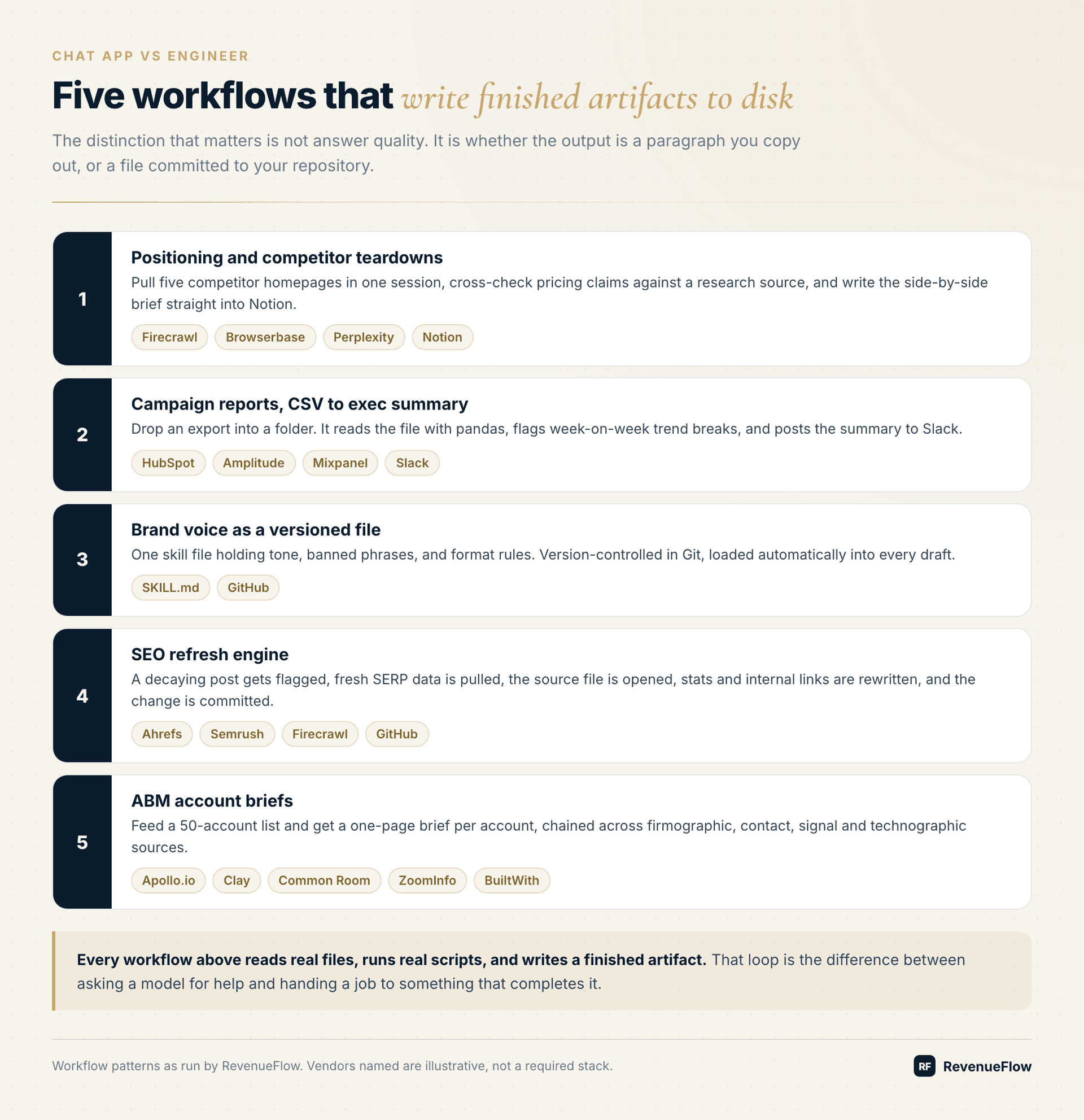
1. Positioning And Competitor Teardowns
Firecrawl and Browserbase pull five competitor homepages in a single session. Perplexity cross-checks pricing claims against public sources. The side-by-side brief gets written into Notion.
Competitive research decays fast, which is why most teams do it once during a positioning exercise and then never again. Making it a repeatable script changes the frequency from annually to weekly, and the weekly version is the one that catches a competitor quietly changing their pricing page.
The cross-check step is doing real work here. Crawled pricing pages are frequently misread, especially when a vendor uses "starting at" language or hides enterprise tiers. Verifying against a second source cuts the error rate substantially.
2. Campaign Reports, CSV To Exec Summary
Drop a HubSpot, Amplitude, or Mixpanel export into a watched folder. The agent reads it with pandas, flags week-on-week trend breaks, and posts the summary to Slack.
Reading a CSV with actual code rather than pasting it into a prompt matters more than it seems. A model reading a large table in context will make arithmetic errors and miss rows. A model writing pandas and executing it will not, because the computation happens in the runtime rather than in the token stream.
If you take one implementation detail from this list, take that one.
3. Brand Voice As A Versioned File
One skill file containing tone, banned phrases, and format rules. GitHub versions it. Every draft loads it automatically.
Brand guidelines normally live in a slide deck that nobody opens after onboarding. Putting them in a file that gets loaded into every generation makes them enforced rather than aspirational.
The version control part is not incidental. When the voice changes, you can see who changed it, when, and why. That is a better system than most marketing teams have for their guidelines regardless of whether AI is involved.
4. SEO Refresh Engine
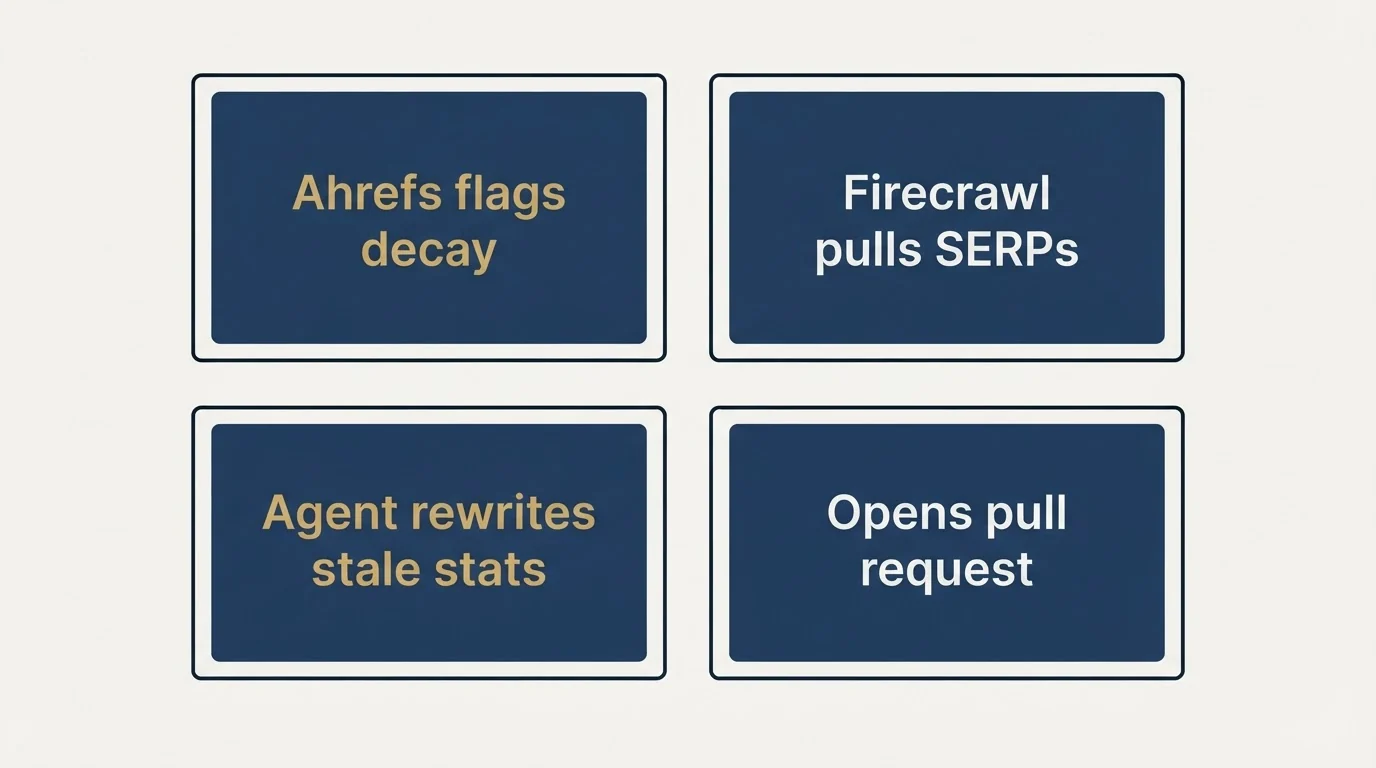
Ahrefs or Semrush flags a decaying post. Firecrawl pulls fresh SERP data. The agent opens the source file, rewrites stale statistics, updates internal links, and commits the change.
Content decay is the most reliably ignored problem in B2B marketing. Everyone knows old posts lose rankings. Nobody has a standing process to fix them, because the work is unglamorous and the impact is invisible until it is large.
A caution: let this open pull requests rather than committing directly. Statistics get rewritten confidently and occasionally incorrectly, and a wrong number in a published article is worse than a stale one.
5. ABM Account Briefs
Feed a 50-account list. The agent chains Apollo.io, Clay, Common Room, ZoomInfo, and BuiltWith into a one-page brief per account.
This is the workflow that most obviously replaces a task no one was doing. Proper account briefs for 50 targets is roughly a week of analyst time, which means in practice most ABM programmes run on a spreadsheet with a company name and a guess.
The Pattern
Every workflow above reads real files, runs real scripts, and writes finished artifacts to disk.
That loop is what separates a tool you consult from a tool that completes a job. A chat interface can tell you what your competitor's pricing looks like. Something with file access and a shell can produce the comparison document, put it where your team will find it, and do it again next Tuesday without being asked.
What It Costs To Run
Setup time is real. Each of these took a session to get right, and the first version of each was wrong in some way that only became obvious after running it against real data.
Review is non-negotiable on anything customer-facing. The failure mode is not gibberish, it is confident plausible output built on a misread source. That is harder to catch than obvious nonsense.
And it is a dependency. If your SEO refresh runs on a schedule and you stop watching it, you will eventually publish something you did not read.
- Yes: Setup time is real. Each of these took a session to get right
- Yes: Review is non-negotiable on anything customer-facing.
- Yes: it is a dependency. If your SEO refresh runs on a schedule and you stop watching it, you will eventually publish something you did not read.
Where To Start
Pick the workflow where the output is internal and the cost of an error is low. Campaign reports are ideal for this. If the summary is wrong, someone notices in Slack and nothing is published.
Once you trust the loop, move up to things that touch the outside world.
Save this if you run B2B marketing with a lean team. The advantage is not that any single task gets faster. It is that work which previously required a headcount decision now requires a file.
Teams that still assume this kind of orchestration requires an engineer will find how AI lowered technical barriers useful for understanding why one person can now own an entire workflow.
Frequently Asked Questions
What is the actual difference between this and using a chat interface?
File access and a shell. A chat interface can describe your competitor's pricing. Something that can read files, run scripts, and write output produces the comparison document, saves it where your team will find it, and repeats it next week without being asked.
Why does reading a CSV with code matter?
A model reading a large table inside its context window will make arithmetic errors and skip rows. A model writing pandas and executing it will not, because the computation happens in the runtime rather than in the token stream. If you take one implementation detail from this article, take that one.
Should the SEO refresh workflow commit directly?
No. Have it open pull requests. Statistics get rewritten confidently and occasionally incorrectly, and a wrong number in a published article is worse than a stale one. Anything that reaches the public should pass through a human.
How is a skill file different from a good prompt?
It lives in the repository, gets versioned alongside the code, and works identically for everyone on the team. A prompt lives in one person's history. When your brand voice changes, a skill file shows who changed it, when, and why.
What should I automate first?
Whatever produces internal output where a mistake is cheap. Campaign reports are close to ideal: if the summary is wrong, someone notices in Slack and nothing was published. Move to customer-facing workflows only after you trust the loop.
Related Reading
- 5 Marketing Workflows You Can Run Entirely From the Terminal
- Claude Code Is the Best GTM Tool of 2026 (Because It Operates the Whole Stack)
- Claude Code Has 50+ Features Most People Never Discover
We build AI-native pipeline systems and you pay per qualified meeting, not a retainer. No paying for activity. You only pay when we book you a qualified sales meeting. See if you qualify.
Frequently asked questions.
Frequently asked questions- Why does it matter whether a CSV is read with code versus pasted into a prompt?
- Models reading large tables in context windows make arithmetic errors and miss rows because computation happens in the token stream. Models writing pandas code that executes separately perform accurate calculations because the runtime handles the math, not the language model. This is the single most important implementation detail: delegate computation to actual code execution rather than asking the model to calculate within its context.
- Should automated SEO refresh workflows publish changes directly?
- No. Configure them to open pull requests instead of committing directly. Statistics get rewritten confidently and occasionally incorrectly, and publishing a wrong number is worse than leaving a stale one. Any workflow touching customer-facing content requires human review. The failure mode is not obvious gibberish but confident, plausible output built on misread sources, which is harder to catch than nonsense.
- Which workflow should I start with?
- Begin with campaign reports where output is internal and error cost is low. Drop HubSpot, Amplitude, or Mixpanel CSV exports into a watched folder and have the agent post summaries to Slack. If the summary is wrong, someone notices immediately and nothing is published. Once you trust the loop with internal work, move to workflows that touch external audiences. Start where mistakes are visible but not costly.
- How much does it cost to set up and maintain these workflows?
- Each workflow takes one session to build correctly, and first versions are always wrong in ways that only surface against real data. Review is non-negotiable for customer-facing output. The failure mode is confident plausible text built on misread sources, which is harder to catch than gibberish. Scheduled workflows become dependencies: if your SEO refresh runs automatically and you stop watching it, you will eventually publish something you have not read.
About the author.

Tim Carden is CMO / CTO at RevenueFlow, which builds and operates outbound revenue engines for B2B companies. Studied at McGill University.
Tim Carden · CMO / CTO
Connect on LinkedIn →Explore more.
Ready to scale your outreach?
We build GTM engines that book real meetings. See the receipts.
Related articles.
5 Marketing Workflows You Can Run Entirely From the Terminal
Personalised outbound, content repurposing, competitive intelligence, SEO gap analysis, and creative testing. Five jobs that span four tools each, run by one agent instead of a person switching tabs.
Claude Code Is the Best GTM Tool of 2026
Your GTM stack is fine. The problem is that you are the integration layer holding it together. Here is what changes when an agent with API access takes that job instead.
5 RevOps Workflows You Can Run Entirely From the Terminal
Pipeline hygiene, forecasting, deal intelligence, lead routing, and attribution. Five recurring RevOps jobs, run by one agent with API access instead of six dashboards and a spreadsheet.
Claude Code Has 50+ Features Most People Never Discover
The commands, configuration layers, and one workflow habit that changes everything. Written for people using it 8 hours a day who suspect they are using 10% of it.
Anthropic Ran Its Entire Growth Marketing With One Person
Paid search, paid social, app stores, email, and SEO for a company valued in the hundreds of billions. One non-technical marketer, four systems, and a memory layer that made each cycle better than the last.
AI Sales Agents: 6 Jobs They Do Well and 4 They Fail At
Agents plan and act, copilots suggest, workflows follow a fixed path. Here are the six sales jobs agents handle today, the four they fail, and the buying test.