Anthropic Ran Its Entire Growth Marketing With One Person
Paid search, paid social, app stores, email, and SEO for a company valued in the hundreds of billions. One non-technical marketer, four systems, and a memory layer that made each cycle better than the last.
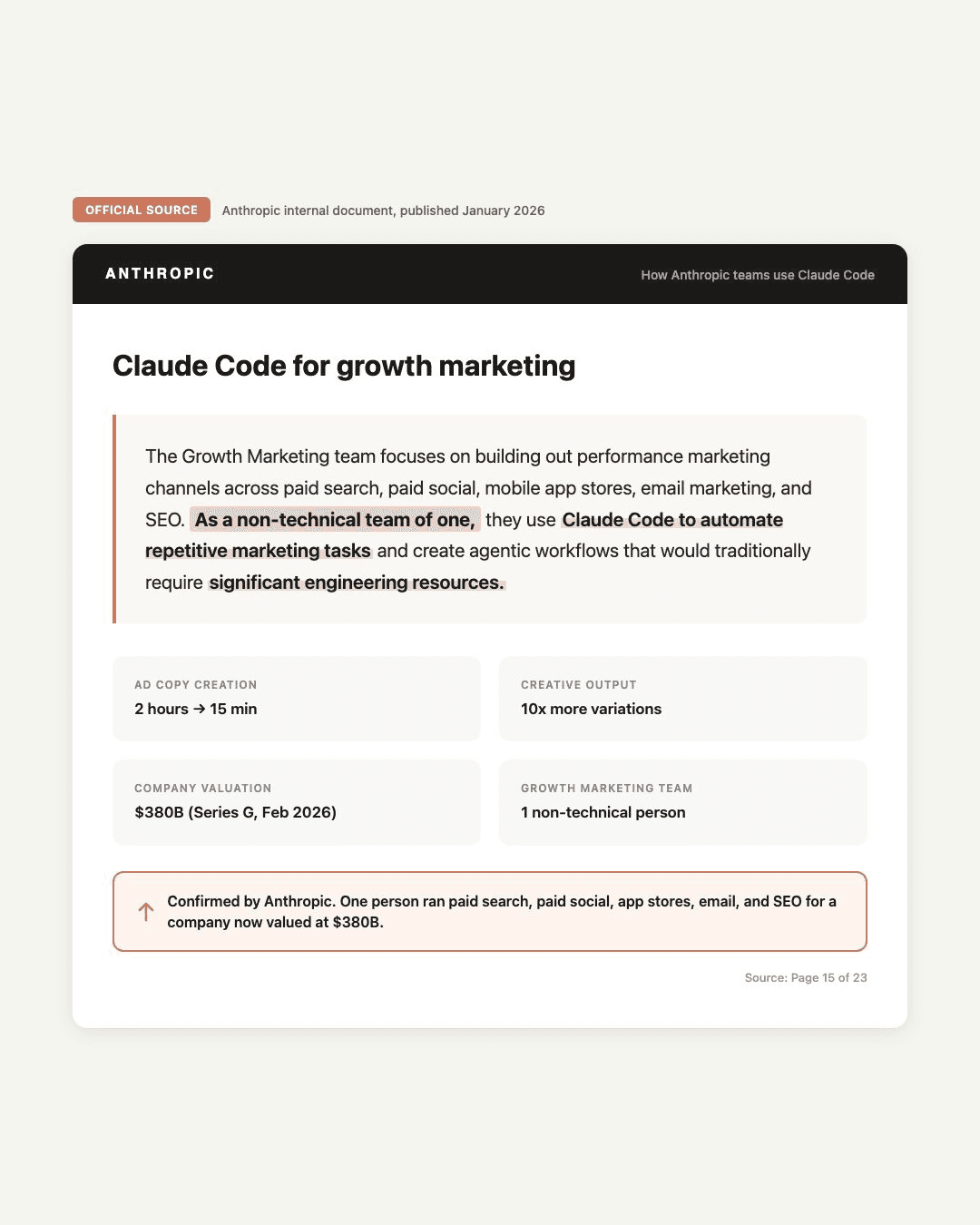
Anthropic's growth marketer automated paid search, paid social, and creative production using four systems: specialised agents for Google Ads copy generation (split by character limits), a Figma plugin producing 100 creatives in seconds, an MCP integration for conversational Meta Ads analysis, and a memory layer logging every experiment result. The memory system mattered most, compounding learnings across campaigns where human teams typically lose institutional knowledge.
Key takeaways
- Anthropic reduced ad copy creation time from 2 hours to 15 minutes while producing 10x more creative variations with a single non-technical marketer.
- Splitting ad copy generation into separate agents (one for 30-character headlines, one for 90-character descriptions) prevents headlines from reading like truncated descriptions.
- The memory layer that logged every hypothesis and experiment result created compounding advantages that larger teams rarely achieve due to poor institutional knowledge retention.
- Automating creative assembly rather than just copy generation removed the bottleneck that typically limits paid social testing to twenty copy variations against three creatives.
- The MCP integration enabled conversational analysis where follow-up questions surface insights that pre-configured dashboards miss.
Reviewed and updated September 5, 2026
Anthropic Ran Growth Marketing With One Person
Anthropic confirmed this in its own documentation. Their entire growth marketing operation was run by one person.
Not a team of ten. Not even three. One non-technical marketer covering paid search, paid social, app stores, email marketing, and SEO.
Here is what they built, and the part of it that actually explains the result.
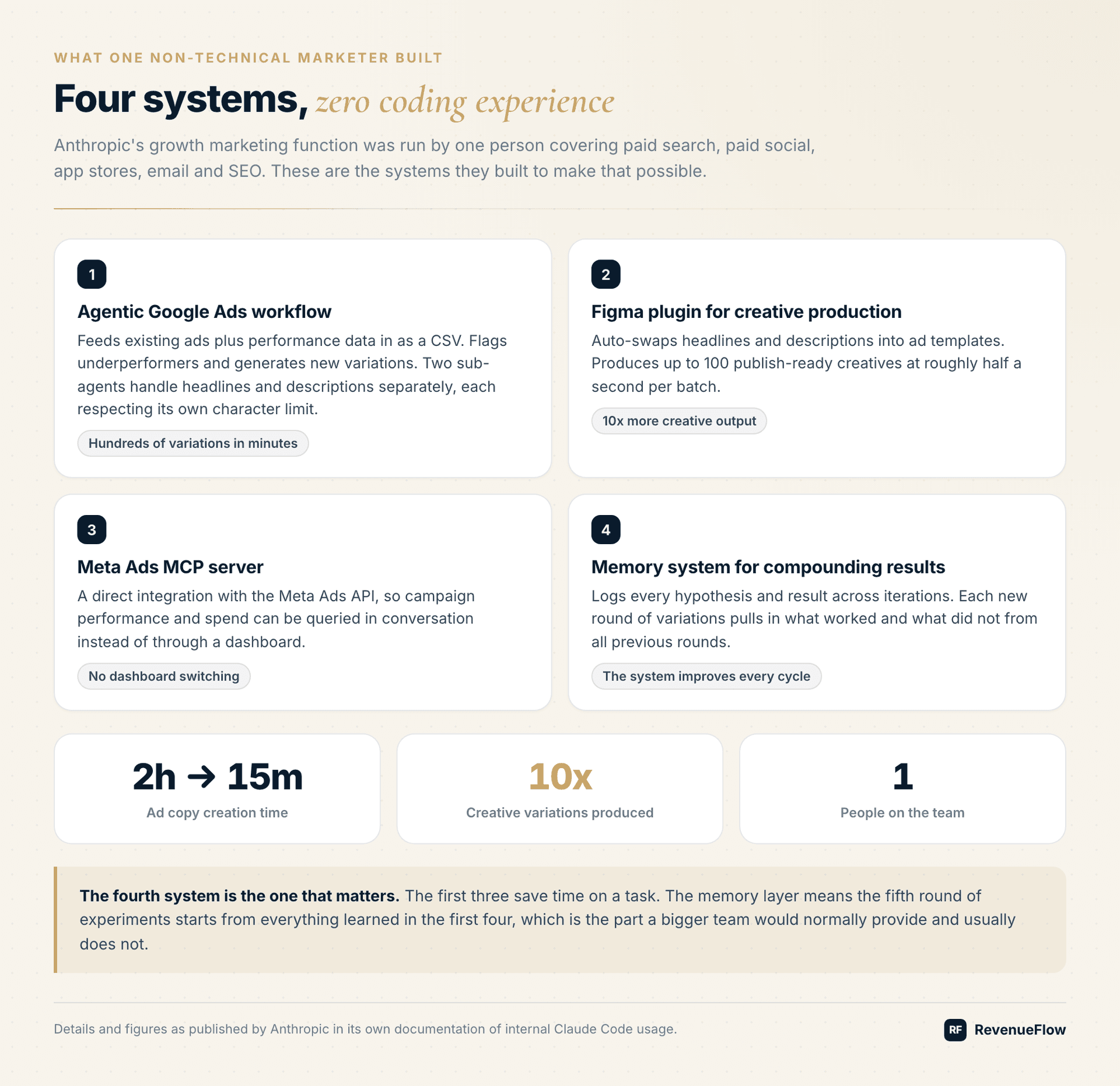
1. Agentic Google Ads Workflow
Feed a CSV of existing ads plus performance data into Claude Code. It flags underperformers and generates new variations.
The detail worth copying: two specialised sub-agents handle the work separately. One writes headlines against a 30-character cap. One writes descriptions against a 90-character cap.
Splitting the task matters more than it sounds. A single agent asked to produce both tends to produce headlines that read like truncated descriptions. Giving each format its own constraints and its own agent produces output that respects the medium.
Result: hundreds of new ad variations in minutes.
2. Figma Plugin For Creative Production
They built a Figma plugin that auto-swaps headlines and descriptions into existing ad templates. Up to 100 ready-to-publish creatives at roughly half a second per batch.
This is the step that usually kills volume in paid social. Copy is cheap to generate and creative is expensive to produce, so teams end up testing twenty variations of copy against three creatives. Automating the assembly removes the bottleneck.
Result: 10x more creative output.
3. Meta Ads MCP Server
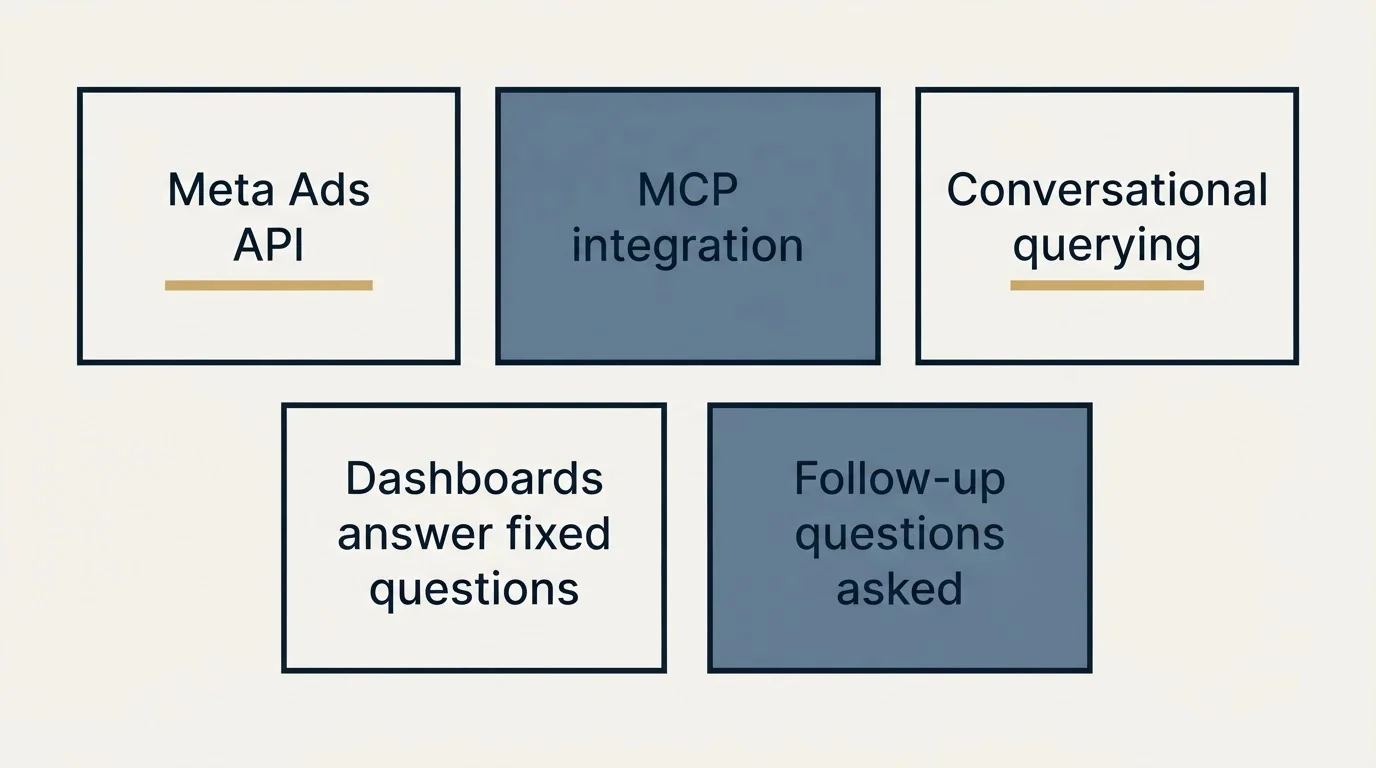
An MCP integration with the Meta Ads API, so campaign performance, spend, and effectiveness can be queried directly in conversation rather than through a dashboard.
The value here is not saving clicks. It is that analysis becomes conversational, which means follow-up questions get asked. Dashboards answer the question you configured them to answer. Most useful analysis is the third question you did not know to ask.
4. Memory System For Compounding Results
A memory layer that logs every hypothesis and experiment result across ad iterations. Each new round of variations pulls in what worked and what did not from all previous rounds.
This is the one that matters.
The first three systems save time on a task. The memory layer means round five starts from everything learned in rounds one through four. That accumulated context is normally what a larger team provides, through people who remember what was tried last quarter.
Except larger teams usually do not provide it either. Institutional memory in marketing is famously bad. People leave, documents go stale, and the same failed test gets run every eighteen months.
A logged, queryable record of every experiment is a genuine advantage over a bigger team, not just a substitute for one.
The Numbers From The Official Documentation
- Ad copy creation: 2 hours down to 15 minutes
- Creative output: 10x more variations
- Team size: 1
What This Story Does And Does Not Prove
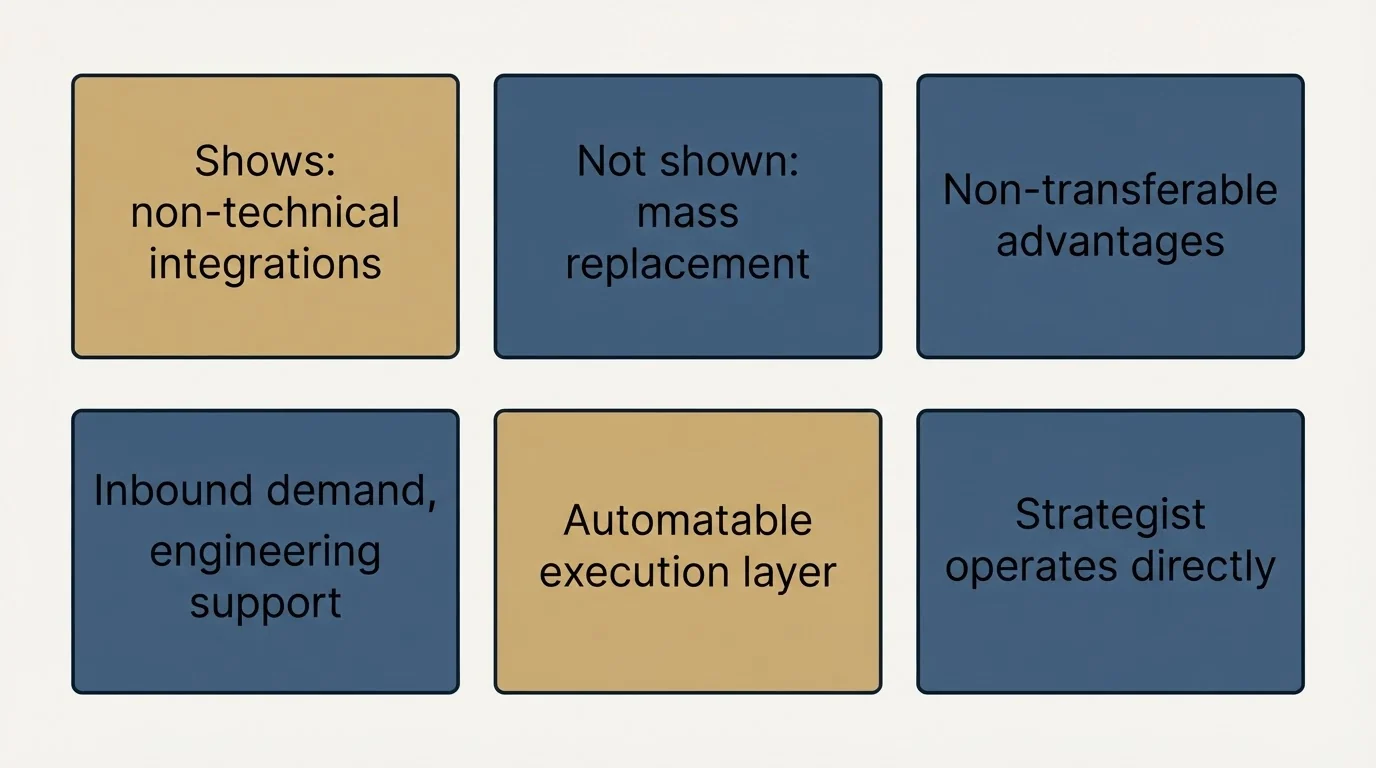
It is worth being careful here, because this example gets over-extrapolated.
- a non-technical person can build real integrations and automation when the tooling meets them where they are.
- Nothing in that list required knowing how to code before starting.
- that one marketer can do the job of ten at any company.
- Anthropic has advantages that do not transfer. Enormous inbound demand. A product that markets itself.
What it shows: a non-technical person can build real integrations and automation when the tooling meets them where they are. Nothing in that list required knowing how to code before starting.
What it does not show: that one marketer can do the job of ten at any company. Anthropic has advantages that do not transfer. Enormous inbound demand. A product that markets itself. Internal access to the tools being used. And, presumably, considerable support from an engineering-heavy organisation.
The honest read is narrower and still useful: the execution layer of growth marketing became automatable, and the person who understands the strategy can now operate it directly rather than briefing someone else to.
What Transfers To Your Team
Three things, in order of how easily they port.
- Yes: Split tasks by format constraint. If you generate content against different specifications, give each specification its own agent and its own rules.
- Yes: Automate assembly, not just generation. The bottleneck is rarely producing copy. It is turning copy into finished assets.
- Yes: Build the memory layer first. It is the least exciting of the four systems and the only one that compounds.
Split tasks by format constraint. If you generate content against different specifications, give each specification its own agent and its own rules. This is a small change with a disproportionate quality effect.
Automate assembly, not just generation. The bottleneck is rarely producing copy. It is turning copy into finished assets. Whatever your equivalent of the Figma plugin is, that is where the volume unlock lives.
Build the memory layer first. It is the least exciting of the four systems and the only one that compounds. Every experiment you run without logging it is one you will run again.
The Actual Conclusion
This is not evidence that AI replaces marketers. It is evidence that it gives one marketer the output of a team on the execution layer, while leaving strategy, judgment, and taste exactly where they were.
Which is a much more useful thing to know, because it tells you what to hire for.
Frequently Asked Questions
Can one marketer really replace a team of ten?
At Anthropic, with enormous inbound demand, a product that markets itself, and an engineering-heavy organisation around them, one person covered the function. Those advantages do not transfer. The narrower and more defensible claim is that the execution layer of growth marketing became automatable, so the person who understands the strategy can now operate it directly.
Which of the four systems should I build first?
The memory layer, even though it is the least exciting. It is the only one that compounds. Every experiment you run without logging it is one you will eventually run again, and institutional memory in marketing is famously bad with or without AI.
Why split headlines and descriptions into separate agents?
Different format constraints. A single agent asked to produce both tends to write headlines that read like truncated descriptions. Giving each format its own agent and its own character limit produces output that respects the medium, and the quality difference is larger than the change suggests.
Do I need engineering support to build a Figma plugin or an MCP server?
The Anthropic marketer was non-technical and built both. What that requires is willingness to iterate rather than prior coding knowledge. The realistic expectation is that the first version will be wrong in a way that only becomes obvious once you run it on real data.
What does this mean for marketing hiring?
Hire for strategy, judgment, and taste rather than for execution throughput. The bottleneck moved. A marketer who knows exactly what should be tested and why is now considerably more valuable than one who can produce volume, because volume is the part that got cheap.
Related Reading
- 5 Marketing Workflows You Can Run Entirely From the Terminal
- The Gap Between a Chat App and an Engineer: 5 B2B Marketing Workflows
- Claude Code Is the Best GTM Tool of 2026 (Because It Operates the Whole Stack)
We build AI-native pipeline systems and you pay per qualified meeting, not a retainer. No paying for activity. You only pay when we book you a qualified sales meeting. See if you qualify.
Figures and system descriptions as published by Anthropic in its own documentation of internal Claude Code usage.
Frequently asked questions.
Frequently asked questions- Which of the four systems should I build first?
- Build the memory layer first, even though it is the least exciting. It is the only system that compounds results over time. Every experiment you run without logging it is one you will eventually run again. Institutional memory in marketing is famously bad with or without AI, and a logged, queryable record of experiments provides a genuine advantage.
- Why split headlines and descriptions into separate agents?
- Different format constraints require different approaches. A single agent asked to produce both 30-character headlines and 90-character descriptions tends to write headlines that read like truncated descriptions. Giving each format its own agent with its own constraints produces output that respects the medium and reads naturally within each format.
- How did the Figma plugin increase creative output?
- The plugin auto-swapped headlines and descriptions into existing ad templates, producing up to 100 ready-to-publish creatives at roughly half a second per batch. This removed the bottleneck that usually kills volume in paid social, where teams end up testing twenty copy variations against only three creatives because creative production is expensive and time-consuming.
- What advantage does conversational ad analysis provide over dashboards?
- Dashboards answer only the questions you configured them to answer. The MCP integration with Meta Ads API enabled conversational queries, which means follow-up questions get asked naturally. Most useful analysis comes from the third question you did not know to ask initially, and conversational interfaces make that exploration frictionless.
About the author.

Ben Carden is CRO at RevenueFlow, which builds and operates outbound revenue engines for B2B companies. Previously at Gartner Enterprise. Studied at London School of Economics.
Ben Carden · CRO
Connect on LinkedIn →Explore more.
Ready to scale your outreach?
We build GTM engines that book real meetings. See the receipts.
Related articles.
5 Marketing Workflows You Can Run Entirely From the Terminal
Personalised outbound, content repurposing, competitive intelligence, SEO gap analysis, and creative testing. Five jobs that span four tools each, run by one agent instead of a person switching tabs.
Claude Code Is the Best GTM Tool of 2026
Your GTM stack is fine. The problem is that you are the integration layer holding it together. Here is what changes when an agent with API access takes that job instead.
Chat App or Engineer: 5 B2B Marketing Workflows
Competitor teardowns, campaign reports, a versioned brand voice file, SEO refresh, and ABM briefs. Five workflows that read real files, run real scripts, and write finished artifacts to disk.
5 RevOps Workflows You Can Run Entirely From the Terminal
Pipeline hygiene, forecasting, deal intelligence, lead routing, and attribution. Five recurring RevOps jobs, run by one agent with API access instead of six dashboards and a spreadsheet.
Claude Code Has 50+ Features Most People Never Discover
The commands, configuration layers, and one workflow habit that changes everything. Written for people using it 8 hours a day who suspect they are using 10% of it.
AI Sales Agents: 6 Jobs They Do Well and 4 They Fail At
Agents plan and act, copilots suggest, workflows follow a fixed path. Here are the six sales jobs agents handle today, the four they fail, and the buying test.