Outbound Teams Hold Their Stack With 3 Ops People or 22 APIs
Five categories of tooling, all API-addressable, run from one terminal. Here is the full stack, what MCP actually changes, and the honest version of what replaces the ops headcount.
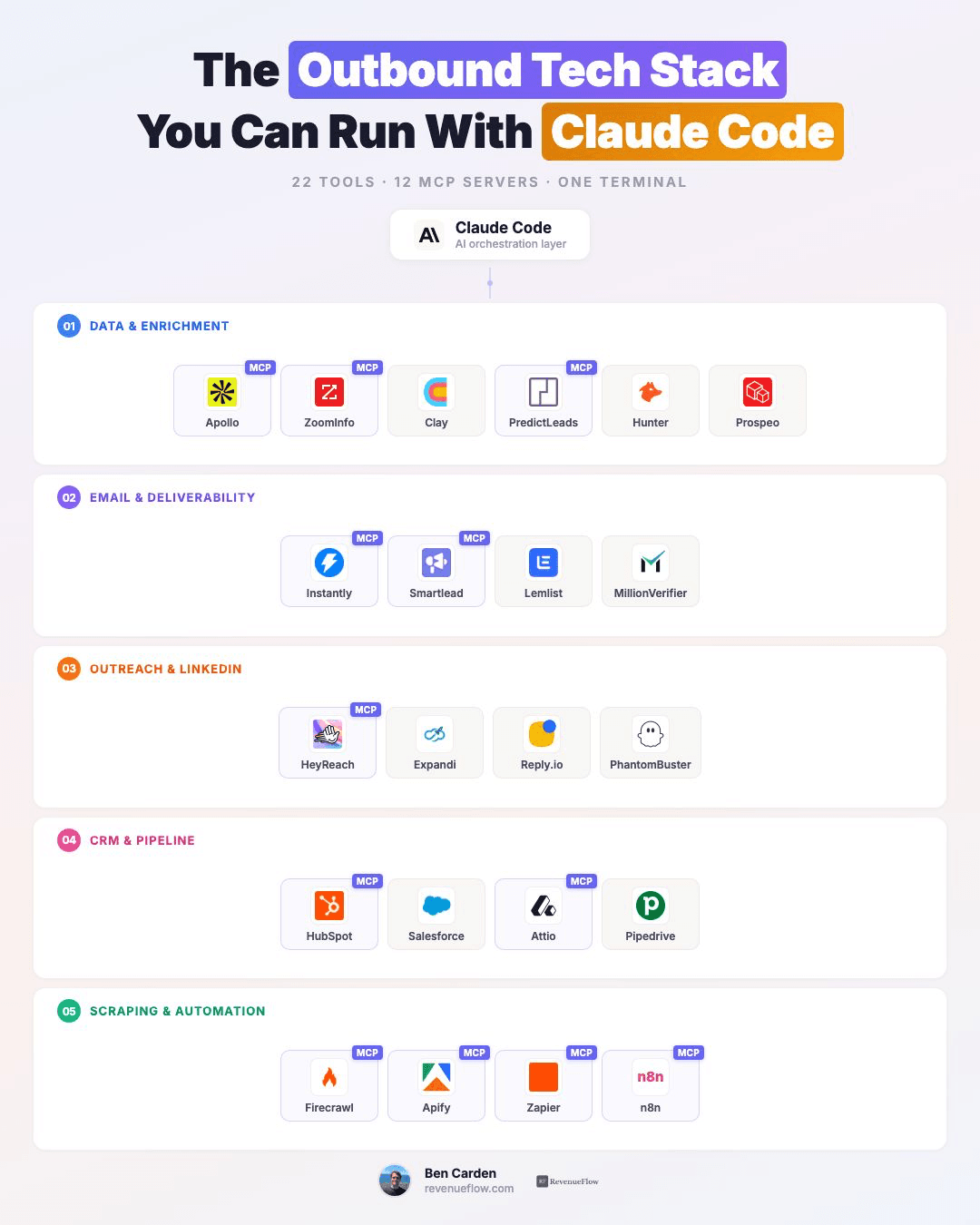
Modern outbound teams can replace three ops people with API-driven automation across 22 tools spanning data enrichment, email deliverability, outreach, CRM, and scraping. The Model Context Protocol (MCP) reduces maintenance overhead by allowing agents to connect directly to vendor APIs without custom integrations. The work shifts from managing undocumented Zapier graphs to maintaining inspectable, agent-generated code that one person can repair with prompts when endpoints change.
Key takeaways
- MCP servers eliminate the ongoing maintenance cost of API integrations by enabling direct agent connections, though MCP availability varies by vendor and changes frequently.
- Automated workflows require monitoring for silent failures, specifically alerts when a step returns unexpected volume since enrichment calls often quietly return nulls while downstream processes continue running.
- LinkedIn automation carries real account risk due to platform terms that restrict it and inconsistent but genuine enforcement, requiring careful rate limiting unlike email campaigns.
- The practical shift is from three people maintaining an undocumented automation graph to one person maintaining inspectable, versioned code that agents can rewrite when vendors change endpoints.
- Most teams should start with either enrichment-to-sender or reply-to-CRM integration as these typically require the most manual intervention.
Reviewed and updated September 5, 2026
Most Outbound Teams Need 3 Ops People to Hold Their Stack Together
The outbound stack used to require three ops people and a duct-taped Zapier setup.
Here is the full stack you can run from a terminal instead.
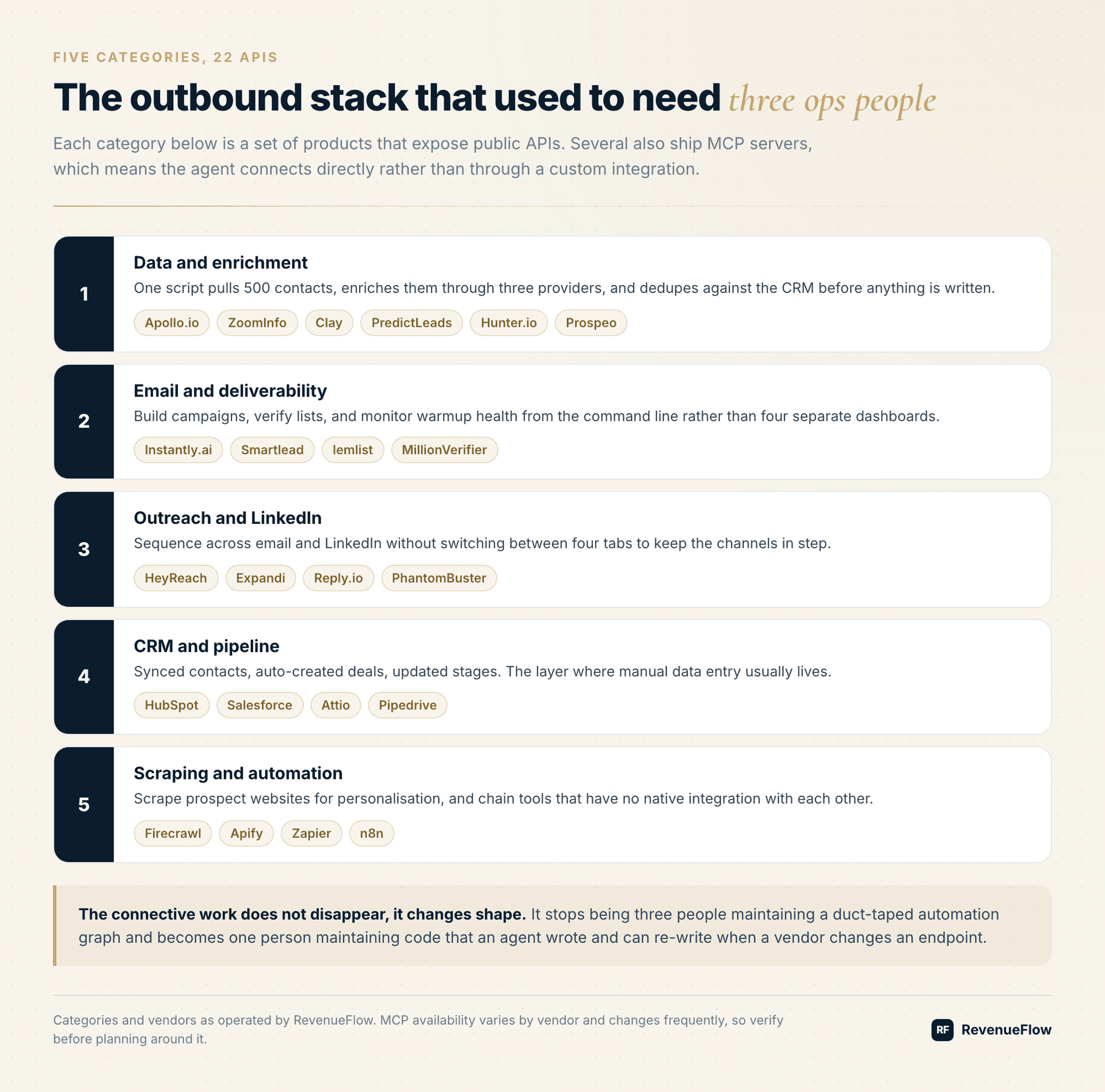
1. Data And Enrichment
Apollo.io, ZoomInfo, Clay, PredictLeads, Hunter.io, Prospeo.
One script pulls 500 contacts, enriches them through three providers, and dedupes against your CRM before anything is written.
The dedupe step is the part that normally requires a person. Every data provider will happily sell you contacts you already have, and nothing in the purchase flow tells you which ones.
2. Email And Deliverability
Instantly.ai, Smartlead, lemlist, MillionVerifier.
Build campaigns, verify lists, and monitor warmup. All from the command line.
Warmup monitoring is the highest-value item here. It is a task that requires checking a dashboard daily and doing nothing 95% of the time, which is precisely the kind of work humans are bad at and scripts are good at.
3. Outreach And LinkedIn
HeyReach, Expandi, Reply.io, PhantomBuster.
Sequence across email and LinkedIn without switching between four tabs to keep the two channels coordinated.
Worth a warning: LinkedIn automation carries real account risk. The platform's terms restrict it and enforcement is inconsistent but genuine. Rate limits matter here in a way they do not for email.
4. CRM And Pipeline
HubSpot, Salesforce, Attio, Pipedrive.
Synced contacts, auto-created deals, updated stages, zero manual data entry.
5. Scraping And Automation
Firecrawl, Apify, Zapier, n8n.
Scrape prospect websites for personalisation. Chain tools that do not natively talk to each other.
What MCP Actually Changes
Several of these products ship MCP servers. That means the agent connects to them directly rather than through an integration someone has to write and maintain.
The practical difference is the maintenance burden rather than the initial build. Writing an API integration is a couple of hours. Keeping it working through vendor changes, auth rotations, and schema updates is the ongoing cost, and that cost is what actually consumed the ops headcount.
Two caveats worth knowing. MCP availability varies by vendor and changes frequently, so do not plan a stack around a server that does not exist yet. And where there is no MCP server, the agent writes against the raw API, which works fine but puts the maintenance back on you.
The Honest Version Of The Headcount Claim

"Three ops people, now one terminal" is a good line and an incomplete description.
The connective work does not disappear. It changes shape. Instead of three people maintaining a graph of Zapier automations that nobody fully understands, you have one person maintaining code that an agent wrote and can re-write when an endpoint changes.
That is a genuine improvement for three reasons, none of which is that the work vanished.
The logic is inspectable. A Zapier graph built over two years by four people is effectively undocumented. Code is readable, and an agent can explain what it does.
Fixes are faster than rebuilds. When a vendor changes an endpoint, the repair is a prompt rather than an archaeology project.
Knowledge persists. The workflows survive the person who built them, which is not true of most ops setups.
- Yes: The logic is inspectable. A Zapier graph built over two years by four people is effectively undocumented.
- Yes: Fixes are faster than rebuilds. When a vendor changes an endpoint, the repair is a prompt rather than an archaeology project.
- Yes: Knowledge persists. The workflows survive the person who built them, which is not true of most ops setups.
What you still need is someone who notices when a silent failure has been running for a fortnight. Automated pipelines do not raise their hand. Build monitoring alongside the workflows, not after them.
Where To Start
Pick the single integration that currently requires the most manual intervention. For most teams that is either enrichment-to-sender or reply-to-CRM.
Build that one properly, including the error handling and the alert when it fails. Then use the same credentials and the same patterns for the next one.
The outbound stack used to need three ops people. Now it needs one terminal and someone paying attention.
Frequently Asked Questions
What does MCP actually change?
It removes the integration you would otherwise write and maintain. Building an API integration takes a couple of hours; keeping it working through vendor changes, auth rotations, and schema updates is the ongoing cost, and that cost is what consumed the ops headcount in the first place.
Does this genuinely replace three ops people?
It changes the shape of the work rather than removing it. Instead of three people maintaining an automation graph nobody fully understands, you have one person maintaining code that is inspectable, versioned, and repairable with a prompt when an endpoint changes.
What is the risk of automating LinkedIn outreach?
Real account risk. LinkedIn's terms restrict automation and enforcement is inconsistent but genuine. Rate limits matter far more here than they do for email, and an aggressive configuration can cost you the account rather than just the campaign.
How do I catch silent failures?
Build monitoring alongside each workflow rather than after. The specific check that catches most problems is an alert when a step returns an unexpected volume, since the common failure is an enrichment call quietly returning nulls while everything else keeps running.
Where should I start?
The single integration that currently requires the most manual intervention, which for most teams is either enrichment-to-sender or reply-to-CRM. Build that one properly, including error handling and a failure alert, then reuse the same credentials and patterns for the next.
Related Reading
- I Tested 40+ APIs With Claude Code. These 18 Actually Help You Sign Clients.
- Claude Code Has 50+ Features Most People Never Discover
- Claude Code Is the Best GTM Tool of 2026 (Because It Operates the Whole Stack)
We build AI-native pipeline systems and you pay per qualified meeting, not a retainer. No paying for activity. You only pay when we book you a qualified sales meeting. See if you qualify.
Frequently asked questions.
Frequently asked questions- Does automating outbound with APIs actually replace three ops people?
- It changes the work rather than eliminating it. Instead of three people maintaining an undocumented Zapier automation graph, one person maintains inspectable code that an agent wrote and can rewrite when endpoints change. The improvement comes from readable logic, faster fixes through prompts instead of rebuilds, and workflows that survive staff turnover. You still need someone monitoring for silent failures that can run undetected for weeks.
- What does the Model Context Protocol actually change for outbound teams?
- MCP removes the integration maintenance burden by allowing agents to connect directly to vendor APIs. Writing an API integration takes a couple of hours, but keeping it working through vendor changes, authentication rotations, and schema updates is the ongoing cost that consumed ops headcount. Where no MCP server exists, agents write against raw APIs, which works but returns the maintenance burden to you. MCP availability varies by vendor and changes frequently.
- How dangerous is automating LinkedIn outreach?
- LinkedIn automation carries real account risk. The platform's terms restrict it and enforcement is inconsistent but genuine. Rate limits matter significantly more than for email, and aggressive configurations can cost you the account rather than just the campaign. Unlike email deliverability issues that affect campaign performance, LinkedIn violations can result in permanent account loss.
- How do I catch failures in automated outbound workflows before they cause damage?
- Build monitoring alongside each workflow rather than after deployment. The most effective check is an alert when a step returns unexpected volume, since the common failure mode is enrichment calls quietly returning null values while everything downstream continues running. Automated pipelines do not self-report failures, so volume-based alerts catch most silent problems before they compound.
- Where should I start when building an API-driven outbound stack?
- Start with the single integration requiring the most manual intervention, which for most teams is either enrichment-to-sender or reply-to-CRM. Build that one properly including error handling and failure alerts, then reuse the same credentials and patterns for subsequent integrations. Starting with your highest-friction workflow demonstrates immediate value and establishes reusable infrastructure patterns.
About the author.

Ben Carden is CRO at RevenueFlow, which builds and operates outbound revenue engines for B2B companies. Previously at Gartner Enterprise. Studied at London School of Economics.
Ben Carden · CRO
Connect on LinkedIn →Explore more.
Ready to scale your outreach?
We build GTM engines that book real meetings. See the receipts.
Related articles.
Claude Code Is the Best GTM Tool of 2026
Your GTM stack is fine. The problem is that you are the integration layer holding it together. Here is what changes when an agent with API access takes that job instead.
18 of 40+ APIs Tested With Claude Code Help You Sign Clients
The filter that removed 22 of them: an API earns its place if a script can call it and get back something the next step uses without a human in between.
AI SDR: What It Replaces, What It Doesn't and What It Costs
AI SDRs handle research, list building, sending and reply triage well. Discovery, objections and relationships do not transfer. Capability matrix and real pricing.
AI Appointment Setters vs Human Setters: Cost per Meeting
2026 pricing for voice AI setters, AI SDR platforms, human setters and agencies, with a cost-per-meeting table that adds back oversight and no-shows.
5 RevOps Workflows You Can Run Entirely From the Terminal
Pipeline hygiene, forecasting, deal intelligence, lead routing, and attribution. Five recurring RevOps jobs, run by one agent with API access instead of six dashboards and a spreadsheet.
Claude Code Has 50+ Features Most People Never Discover
The commands, configuration layers, and one workflow habit that changes everything. Written for people using it 8 hours a day who suspect they are using 10% of it.