18 of 40+ APIs Tested With Claude Code Help You Sign Clients
The filter that removed 22 of them: an API earns its place if a script can call it and get back something the next step uses without a human in between.
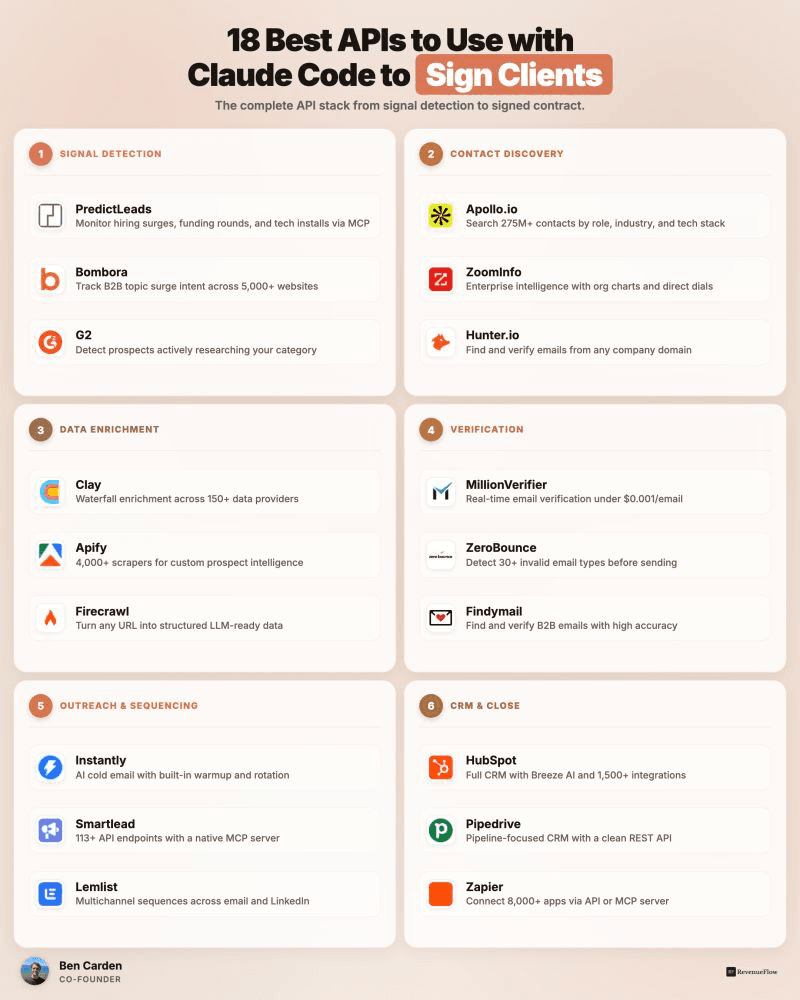
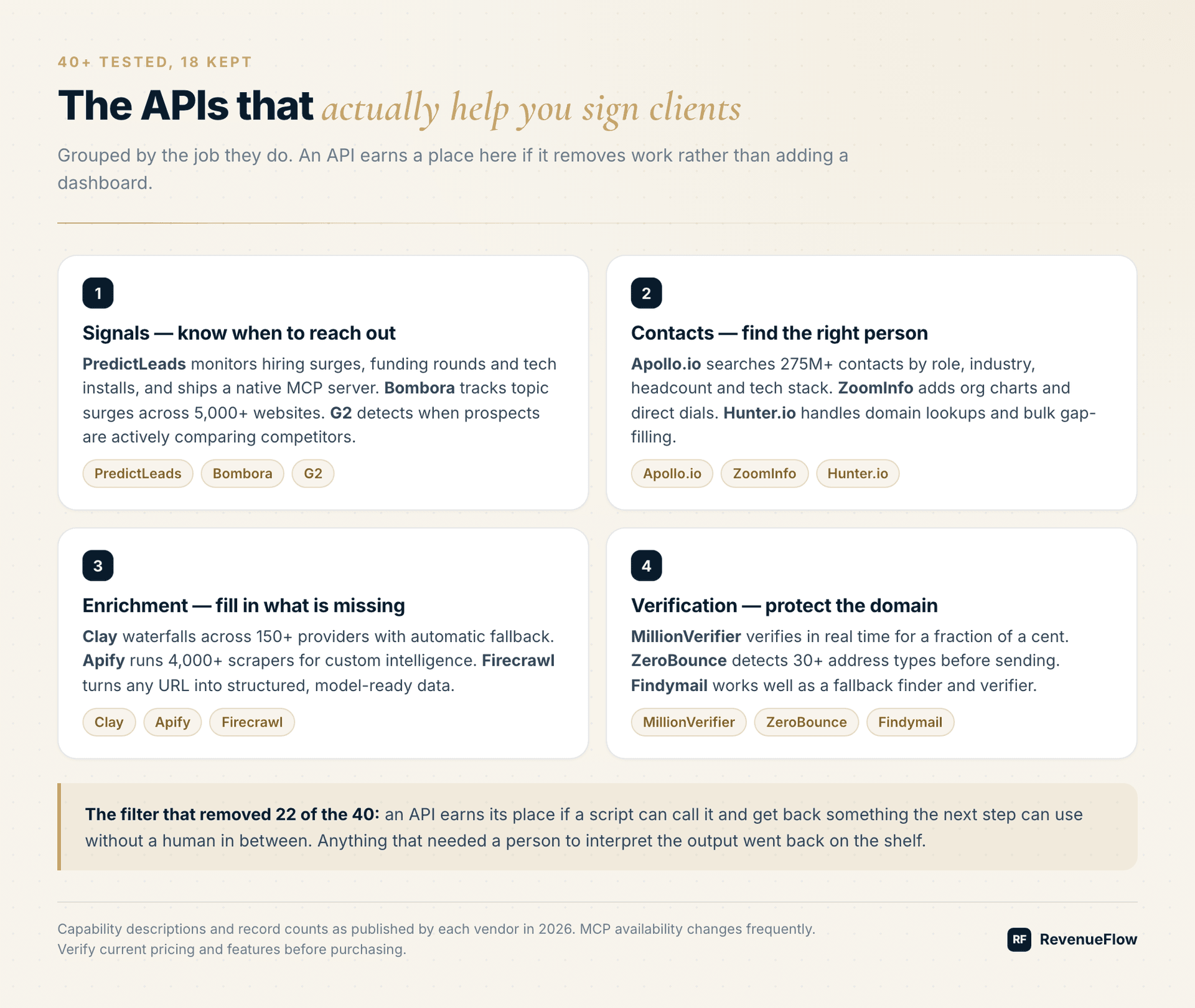
Of 40+ APIs tested with Claude Code, 18 survived a filter requiring each to return data the next step can use without human intervention. The survivors span signals (PredictLeads, Bombora, G2), contacts (Apollo, ZoomInfo, Hunter), enrichment (Clay, Apify, Firecrawl), verification (MillionVerifier, ZeroBounce, Findymail), and sending (Instantly.ai). The 22 eliminated were dashboard-first products, APIs with prohibitively low rate limits, or tools requiring expensive paid upgrades for API access.
Key takeaways
- The filter removed 22 APIs across three categories: dashboard-first products requiring human interpretation, APIs with rate limits too low for bulk operations, and products where API access costs several times the base licence.
- G2's category-level intent data is unusually high quality because prospects comparing vendors on review sites are already inside a buying process.
- Apollo.io provides access to 240M+ contacts searchable by role, industry, headcount, and tech stack, while ZoomInfo differentiates with org chart data for multi-threading large deals.
- Clay offers waterfall enrichment across 150+ providers with automatic fallback when one source returns no data.
- Rate limits are the single most common reason a working prototype fails at production volume and must be checked in documentation before committing to an API.
Reviewed and updated September 5, 2026
I Tested 40+ APIs With Claude Code
These 18 survived. The filter was simple: a script has to be able to call it and get back something the next step can use without a person in the middle.
That test removed 22 tools, most of them good products whose value happened to live in a dashboard.
Signals: Knowing When To Reach Out
1. PredictLeads. Monitors signals on target accounts including hiring surges, funding rounds, and tech installs. Ships a native MCP server, which means an agent connects to it without a custom integration.
2. Bombora. Tracks which companies are surging on topics relevant to your solution across 5,000+ websites.
3. G2. Detects when prospects are actively researching your category or comparing competitors in real time. Category-level intent from a review site is unusually high quality, because someone comparing two vendors is already in a buying process.
Contacts: Finding The Right Person
4. Apollo.io. Search 240M+ contacts by role, industry, headcount, and tech stack.
5. ZoomInfo. Enterprise intelligence with org charts, direct dials, and technographic data. The org chart data is the differentiator if you multi-thread large deals.
6. Hunter.io. Find and verify addresses from any company domain. Bulk lookups fill gaps in an existing list cheaply.
Enrichment: Filling In What Is Missing
7. Clay. Waterfall enrichment across 150+ providers with automatic fallback when one misses.
8. Apify. Runs 4,000+ web scrapers for custom prospect intelligence. This is the tool for data that exists on the web but in no database.
9. Firecrawl. Turns any URL into structured, model-ready data. Feed company websites straight into an agent for research.
Verification: Protecting The Domain
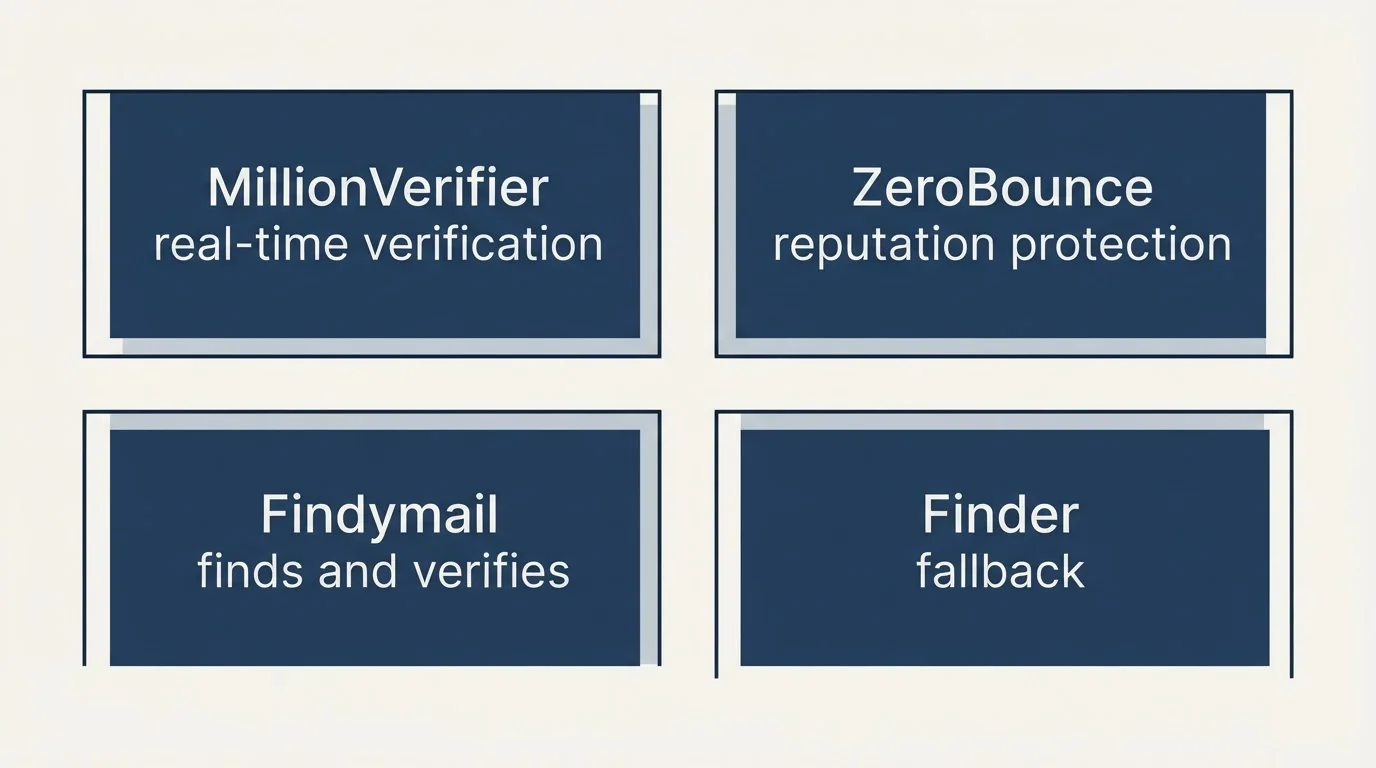
10. MillionVerifier. Verifies emails in real time for well under a cent each. Catches invalid, disposable, and catch-all addresses.
11. ZeroBounce. Detects 30+ address types before sending. Protects sender reputation and keeps bounce rates low.
12. Findymail. Finds and verifies B2B addresses with good accuracy. Works well as a fallback to a primary finder.
Sending And The Rest
13. Instantly.ai. AI cold email campaigns with built-in warmup, inbox rotation, and deliverability optimisation.
The remaining entries cover sending infrastructure, LinkedIn outreach, CRM writes, and scheduling. Those are covered in more depth in our 7-layer GTM AI stack and 22-API outbound stack breakdowns.
What The Filter Actually Removed
The 22 that did not make it fell into three groups, and the pattern is instructive.
- Genuinely useful tools whose value is in a human looking at a visualisation.
- They just cannot be a step in an automated chain.
- Several products expose an API technically, at a rate that makes bulk operations impossible.
- An enrichment endpoint capped at a few requests per minute is a demo, not infrastructure.
- Common with enterprise vendors.
- If API access costs several times the base licence, the arithmetic often stops working.
Dashboard-first products. Genuinely useful tools whose value is in a human looking at a visualisation. Nothing wrong with them. They just cannot be a step in an automated chain.
APIs with unusable rate limits. Several products expose an API technically, at a rate that makes bulk operations impossible. An enrichment endpoint capped at a few requests per minute is a demo, not infrastructure.
Products where the API is a paid upgrade. Common with enterprise vendors. If API access costs several times the base licence, the arithmetic often stops working.
Two Things To Check Before You Build On Any API
Rate limits, in the documentation, before you commit. This is the single most common reason a working prototype fails at production volume, and it is knowable in advance.
Whether an MCP server exists. Where one does, integration effort drops substantially. Where it does not, you write against the raw API, which works but puts maintenance on you. Availability changes frequently, so check rather than assume.
The Underlying Point
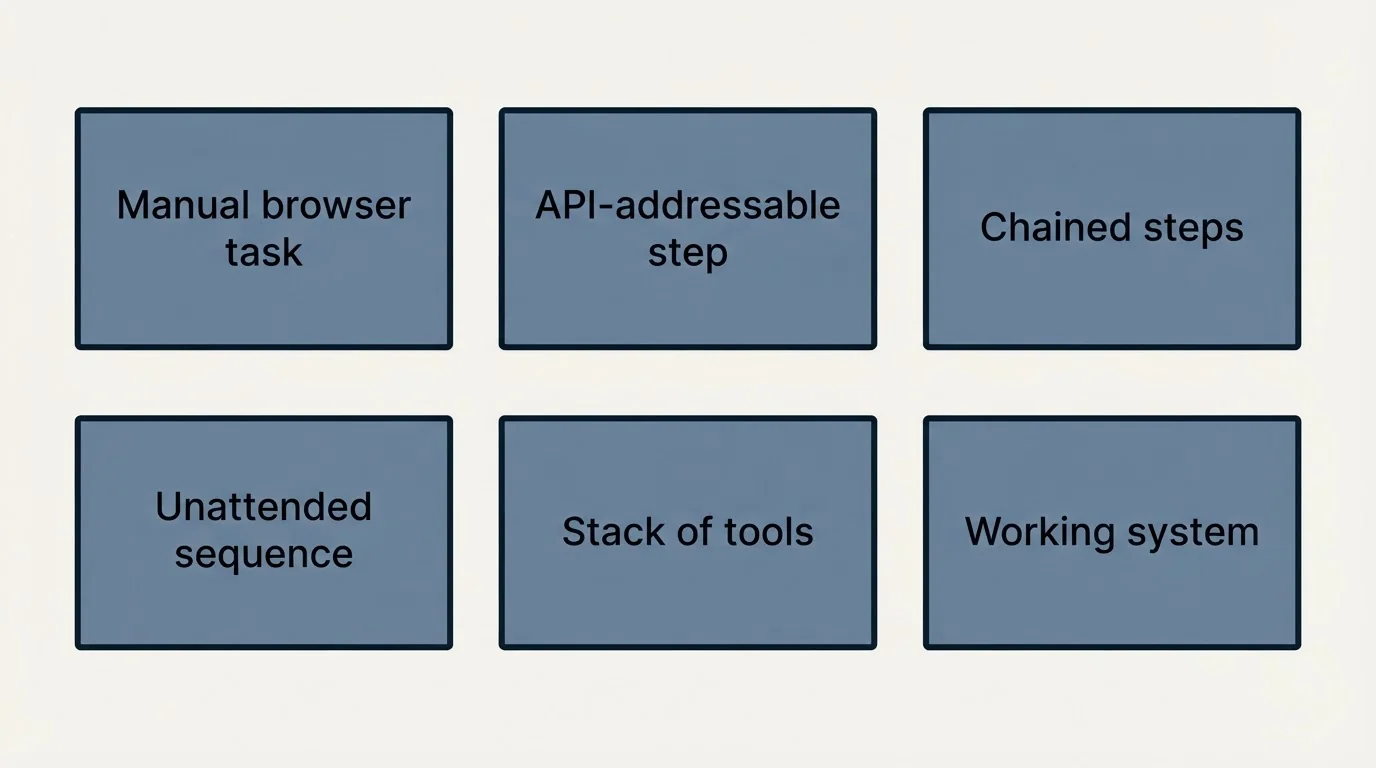
Every API on this list replaces a task that a person used to do by opening a tab.
The value is not in any individual one. It is that once a step is API-addressable, it can be chained to the step before and after it, and the whole sequence runs without anyone remembering to start it.
Teams wondering why non-engineers can now assemble these chains themselves will find how AI reshaped technical work explains the shift from specialized execution to cross-functional orchestration.
That is the difference between a stack of tools and a system.
The 18, By Job
| Job | APIs | What to check first |
|---|---|---|
| Signals | PredictLeads, Bombora, G2 | Whether the signal actually precedes a purchase in your market |
| Contacts | Apollo.io, ZoomInfo, Hunter.io | Coverage on your specific geography and company-size band |
| Enrichment | Clay, Apify, Firecrawl | Rate limits at your intended volume |
| Verification | MillionVerifier, ZeroBounce, Findymail | Cost per address and catch-all handling |
| Sending | Instantly.ai and the sending layer | Warmup and rotation behaviour |
Frequently Asked Questions
Why did 22 of the 40 not make the list?
Three reasons. Dashboard-first products whose value requires a human looking at a visualisation. APIs with rate limits too low for bulk operations. And products where API access is a paid upgrade costing several times the base licence.
What should I check before building on any API?
Rate limits, in the documentation, before committing. It is the most common reason a working prototype fails at production volume and it is entirely knowable in advance. After that, check whether an MCP server exists, since that substantially changes integration effort.
Which of these has the best signal quality?
G2 is unusually strong, because someone comparing two vendors on a review site is already inside a buying process. PredictLeads is the most operationally useful, because hiring surges and funding rounds are unambiguous events with clear timing.
Do I need both MillionVerifier and ZeroBounce?
Not usually. One verifier is enough for most teams. They are both listed because they behave differently on catch-all domains, and if a large share of your market uses catch-all configurations it is worth testing which one handles yours better.
What makes an API worth adding to a stack?
That a script can call it and get back something the next step uses without a person in between. That single test is what separates infrastructure from a product you log into.
Related Reading
We build AI-native pipeline systems and you pay per qualified meeting, not a retainer. No paying for activity. You only pay when we book you a qualified sales meeting. See if you qualify.
Capability descriptions and record counts as published by each vendor in 2026. Verify current pricing, rate limits and features before building on any API.
Frequently asked questions.
Frequently asked questions- Why did 22 of the 40 APIs tested not make the final list?
- Three reasons removed them. Dashboard-first products whose value requires a human looking at visualisations cannot automate. APIs with rate limits too low for bulk operations (such as enrichment endpoints capped at a few requests per minute) function as demos rather than infrastructure. Products where API access is a paid upgrade costing several times the base licence make the arithmetic unworkable.
- What should I check before building on any API?
- Check rate limits in the documentation before committing, because this is the single most common reason a working prototype fails at production volume and it is entirely knowable in advance. After that, check whether an MCP server exists, since that substantially reduces integration effort and puts less maintenance burden on your team.
- Which API has the best signal quality for identifying prospects?
- G2 delivers unusually strong signal quality because someone comparing two vendors on a review site is already inside a buying process. PredictLeads is the most operationally useful because hiring surges and funding rounds are unambiguous events with clear timing, making them reliable triggers for outreach.
- Do I need both MillionVerifier and ZeroBounce for email verification?
- Not usually: one verifier is enough for most teams. Both are listed because they behave differently on catch-all domains. If a large share of your target market uses catch-all configurations, it is worth testing which verifier handles them better for your specific use case.
About the author.

Ben Carden is CRO at RevenueFlow, which builds and operates outbound revenue engines for B2B companies. Previously at Gartner Enterprise. Studied at London School of Economics.
Ben Carden · CRO
Connect on LinkedIn →Explore more.
Ready to scale your outreach?
We build GTM engines that book real meetings. See the receipts.
Related articles.
Outbound Teams Hold Their Stack With 3 Ops People or 22 APIs
Five categories of tooling, all API-addressable, run from one terminal. Here is the full stack, what MCP actually changes, and the honest version of what replaces the ops headcount.
Claude Code Has 50+ Features Most People Never Discover
The commands, configuration layers, and one workflow habit that changes everything. Written for people using it 8 hours a day who suspect they are using 10% of it.
Claude Code Is the Best GTM Tool of 2026
Your GTM stack is fine. The problem is that you are the integration layer holding it together. Here is what changes when an agent with API access takes that job instead.
AI Sales Agents: 6 Jobs They Do Well and 4 They Fail At
Agents plan and act, copilots suggest, workflows follow a fixed path. Here are the six sales jobs agents handle today, the four they fail, and the buying test.
AI SDR: What It Replaces, What It Doesn't and What It Costs
AI SDRs handle research, list building, sending and reply triage well. Discovery, objections and relationships do not transfer. Capability matrix and real pricing.
Chat App or Engineer: 5 B2B Marketing Workflows
Competitor teardowns, campaign reports, a versioned brand voice file, SEO refresh, and ABM briefs. Five workflows that read real files, run real scripts, and write finished artifacts to disk.