AI Appointment Setters vs Human Setters: Cost per Meeting
2026 pricing for voice AI setters, AI SDR platforms, human setters and agencies, with a cost-per-meeting table that adds back oversight and no-shows.
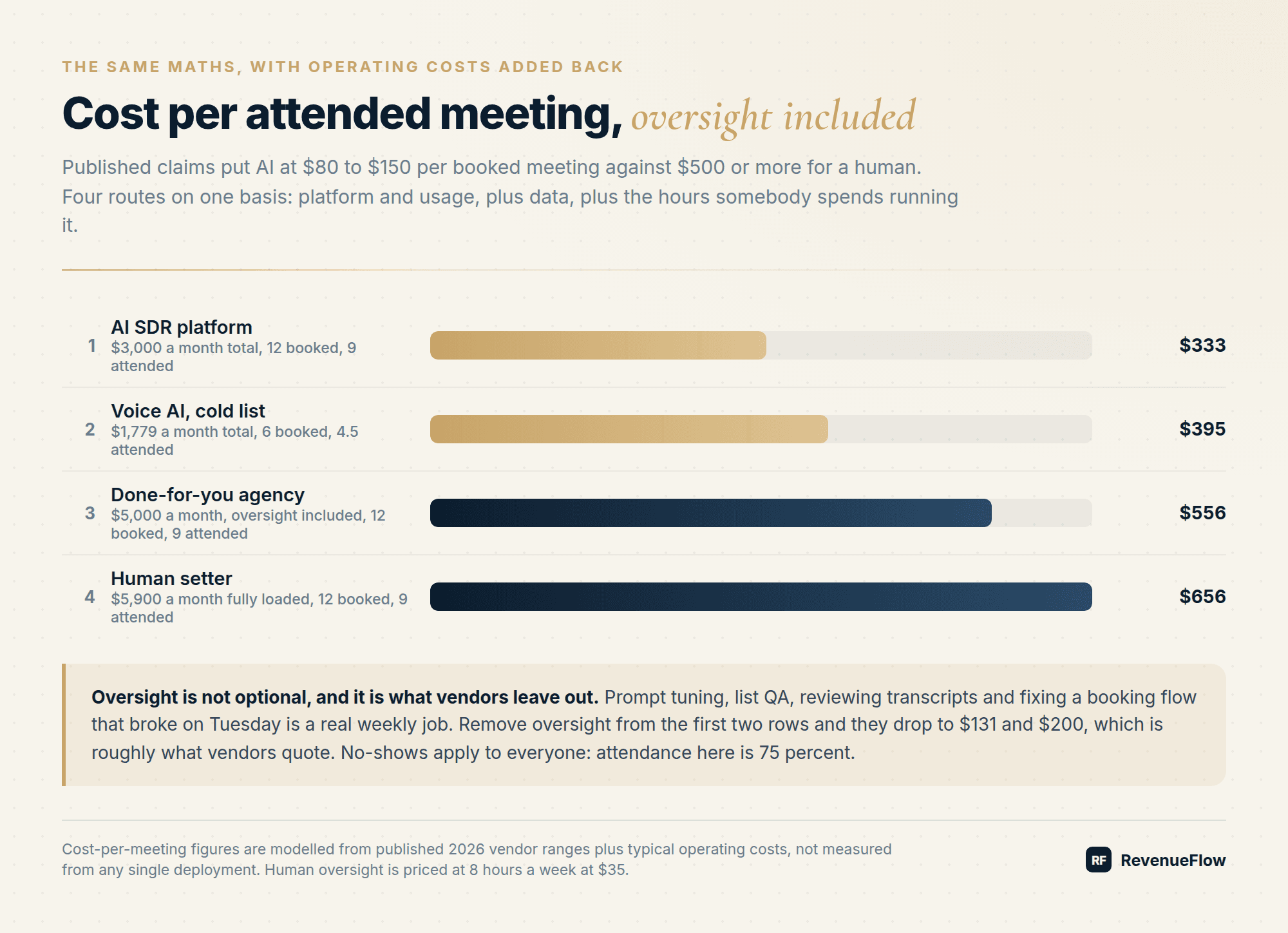
AI appointment setters cost $29 to $500 per month for SMB tools, or $0.07 to $0.14 per minute for voice agents plus platform fees. Once list costs and human oversight are included, realistic cost per attended meeting lands near $330 to $400, against roughly $650 for a human setter and $550 for a done-for-you agency.
Key takeaways
- Voice AI setters bill $0.07 to $0.14 per minute, with Bland adding a $299 to $499 monthly fee and Retell charging no platform fee.
- AI SDR platforms run $250 to $5,000 per month, with AiSDR Solo published at $250, Regie.ai at $180 to $499 per user, and 11x reported near $3,750 to $5,000.
- A human appointment setter costs $3,700 to $6,500 per month fully loaded, against a base wage near $15 per hour and a $35,000 to $55,000 salary.
- Vendor claims of $80 to $150 per meeting exclude list costs and human oversight, which add roughly $1,400 monthly and push realistic cost per attended meeting to $330 to $400.
- Connect rate decides voice economics: cold B2B dials connect in the low single digits, while inbound and warm lists connect roughly ten times more often.
- No-show rates of 20 to 30 percent mean any comparison quoted on booked meetings overstates every option by about a quarter.
Reviewed and updated September 5, 2026
AI Appointment Setters vs Human Setters vs Agencies: Cost per Meeting Compared
Vendors in this category publish cost-per-meeting figures that differ by a factor of ten. The spread is real, but most of it comes from what each vendor leaves out of the denominator rather than from genuine efficiency.
This page prices the three routes on the same basis, shows where the published numbers quietly exclude costs, and names the conditions under which each one is the right buy.
First, two different products share the name
"AI appointment setter" is used for two things that behave nothing alike.
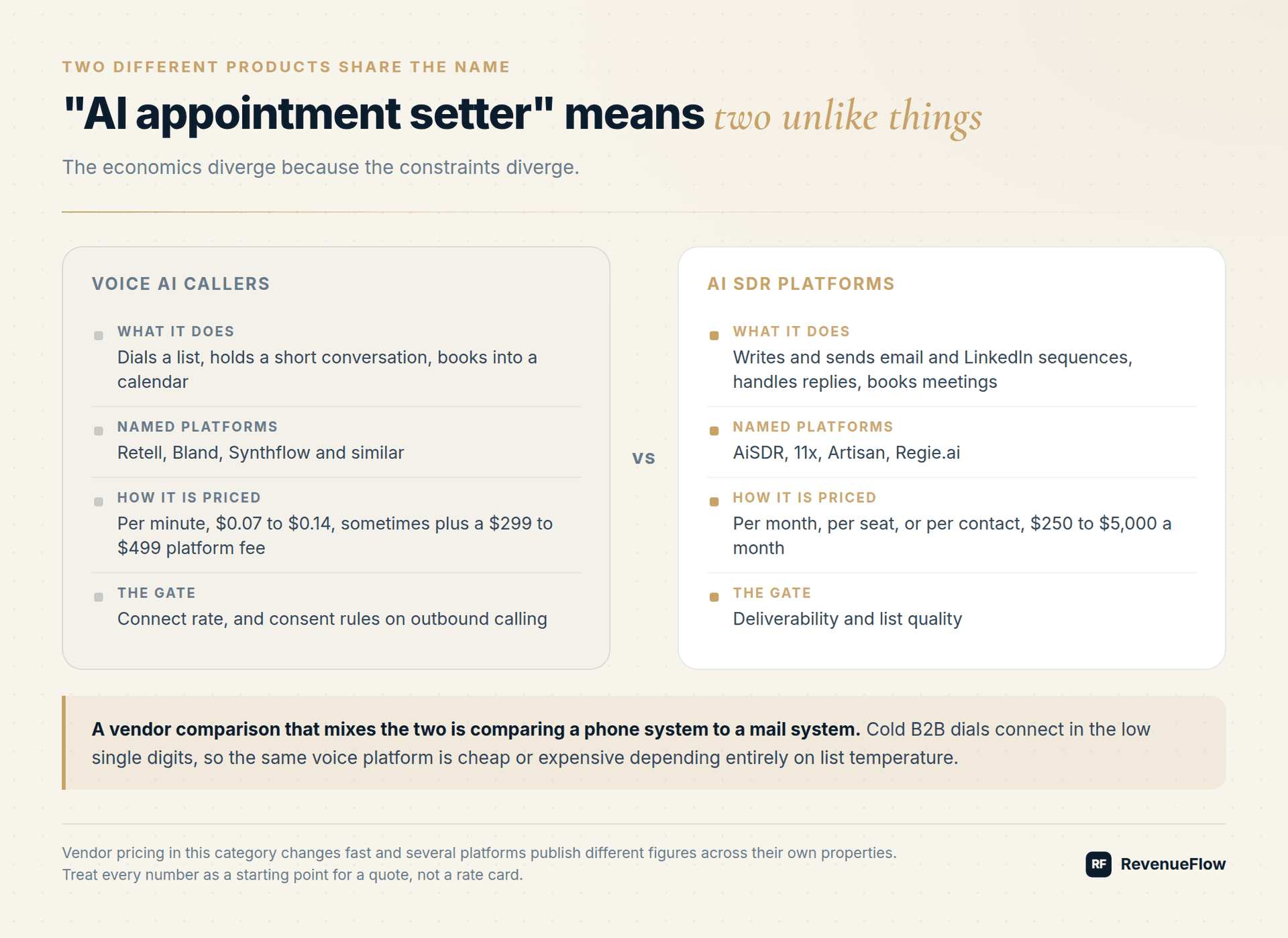
Voice AI callers dial a list, hold a short conversation, and book into a calendar. Retell, Bland, Synthflow and similar platforms sit here. Priced per minute, sometimes plus a platform fee.
AI SDR platforms write and send email and LinkedIn sequences, handle replies, and book meetings. AiSDR, 11x, Artisan and Regie.ai sit here. Priced per month, per seat, or per contact.
The economics diverge because the constraints diverge. Voice is gated by connect rate and by consent rules on outbound calling. Email is gated by deliverability and list quality. A vendor comparison that mixes the two is comparing a phone system to a mail system.
What each route costs in 2026
| Route | Platform cost | Usage cost | Notes |
|---|---|---|---|
| Voice AI, pay as you go | $0 to $499/mo | $0.07 to $0.14 per minute | Retell runs $0.07 to $0.12 with no platform fee, Bland $0.11 to $0.14 plus $299 to $499 monthly, Synthflow from about $0.08 |
| Voice AI, packaged | $99 to $500/mo | Included minute bundles | SMB-oriented tiers, published range $29 to $500 monthly |
| Voice AI, enterprise | $500 to $3,000/mo | $0.08 to $0.25 per minute plus SMS | Adds integrations, routing, compliance controls |
| AI SDR platform | $250 to $5,000/mo | Often per contact or per seat | AiSDR Solo publishes $250 monthly, Regie.ai $180 to $499 per user, Artisan contracts land near $1,500 to $2,000 monthly, 11x is reported around $3,750 to $5,000 |
| Human setter | $3,700 to $6,500/mo fully loaded | Included | Base wage near $15 an hour, $35,000 to $55,000 salary before loading |
| Agency | $2,500 to $8,000/mo retainer | Or $300 to $900 per booked appointment | Includes list, copy, infrastructure and reply handling |
Vendor pricing in this category changes fast and several platforms publish different figures across their own properties. Treat every number as a starting point for a quote, not a rate card.
The cost-per-meeting comparison
Published claims put AI at $80 to $150 per booked meeting against $500 or more for a human. Here is the same calculation with the operating costs added back.
| Voice AI, cold list | AI SDR platform | Human setter | Done-for-you agency | |
|---|---|---|---|---|
| Monthly platform and usage | $379 (1,000 dials, $299 fee) | $1,500 | $5,000 fully loaded | $5,000 |
| Data and list | $200 | $300 | $300 | Included |
| Human oversight | $1,200 (8 hrs/wk at $35) | $1,200 | $600 (management) | Included |
| Total monthly | $1,779 | $3,000 | $5,900 | $5,000 |
| Meetings booked | 6 | 12 | 12 | 12 |
| Attended at 75% | 4.5 | 9 | 9 | 9 |
| Cost per attended meeting | $395 | $333 | $656 | $556 |
Three assumptions carry that table, and they are where the vendor claims and the real invoices separate.
- Yes: Prompt tuning, list QA, reviewing transcripts, and fixing a booking flow that broke on Tuesday is a real weekly job.
- Yes: Cold B2B dials connect in the low single digits.
- Yes: Cold-sourced meetings no-show at 20 to 30 percent.
Oversight is not optional. Prompt tuning, list QA, reviewing transcripts, and fixing a booking flow that broke on Tuesday is a real weekly job. Published per-meeting figures almost never include it. Remove oversight from the first two columns and the numbers drop to $131 and $200, which is roughly what vendors quote.
Connect rate governs voice economics. Cold B2B dials connect in the low single digits. A voice agent working an inbound form fill or a webinar list connects at ten times that rate, and its cost per meeting falls accordingly. The same platform is cheap or expensive depending entirely on list temperature, which is why speed to lead on a warm reply is where voice AI currently pays for itself.
No-shows apply to everyone. Cold-sourced meetings no-show at 20 to 30 percent. Any comparison quoted on booked meetings overstates every column by about a quarter.
What AI setters do well
- Instant response on inbound. Answering a form fill in 60 seconds at any hour is a genuine structural advantage over a team working 40 hours a week.
- Coverage at volume. Unlimited concurrent conversations, no shift gaps, no vacation.
- Consistency. The qualification script does not degrade at 4pm on a Friday.
- Cheap experimentation. Testing five openers costs prompt edits rather than retraining a person.
What AI setters do badly
- Complex or consultative qualification. Anything requiring a judgment call about whether a prospect is actually a fit still fails, and a booked meeting with a bad fit costs more than no meeting.
- Objections that need a human. Price pushback, competitor comparisons, and internal politics are where transcripts get uncomfortable.
- Cold outbound calling compliance. Outbound dialling sits under consent and do-not-call rules that vary by jurisdiction. Get the legal answer before the pricing answer.
- Brand risk at scale. A bad human setter annoys 40 prospects a day. A misconfigured agent can annoy 4,000.
- List quality. No agent recovers from a bad list. The constraint moves upstream, it does not disappear.
The routing rule
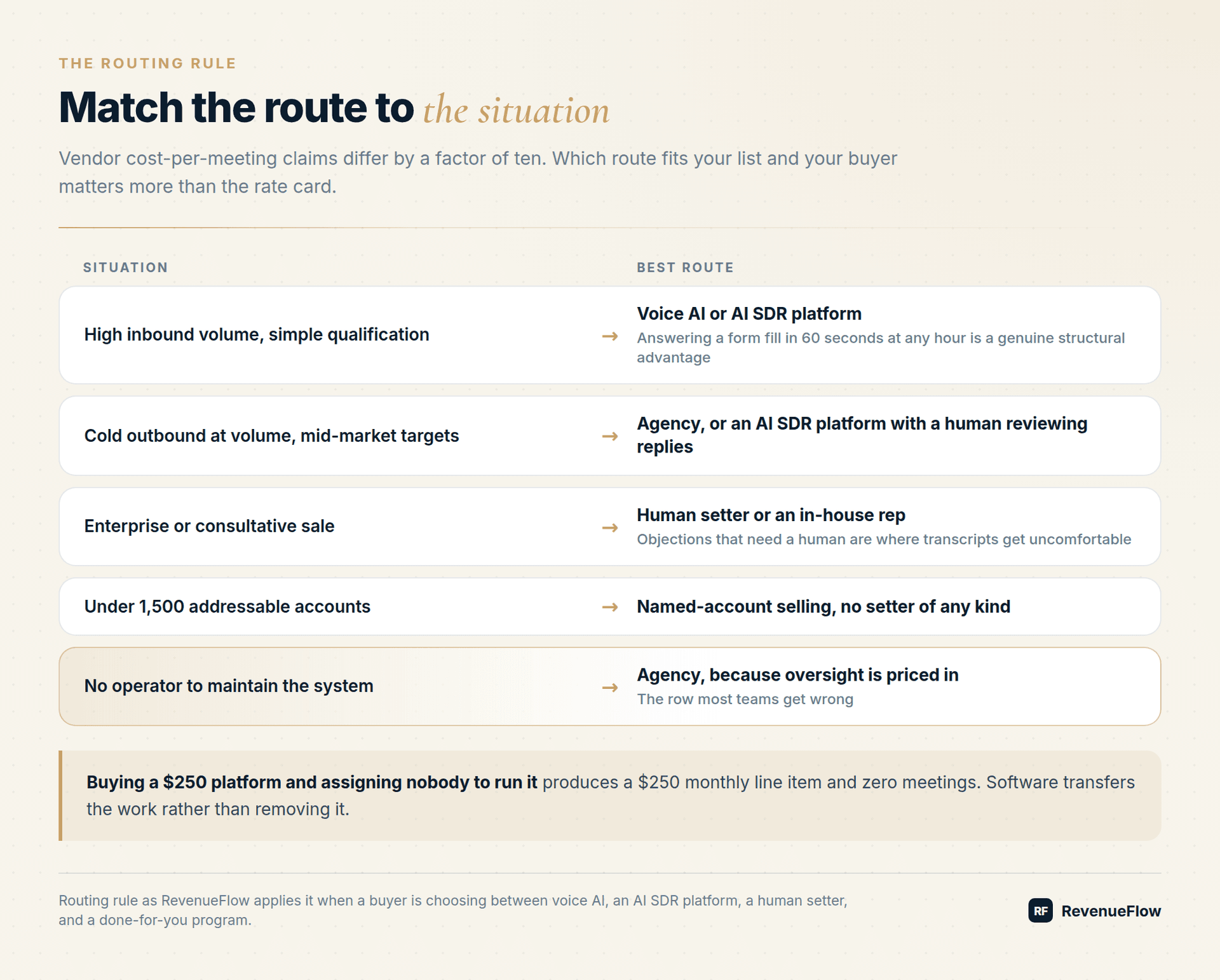
| Situation | Best route |
|---|---|
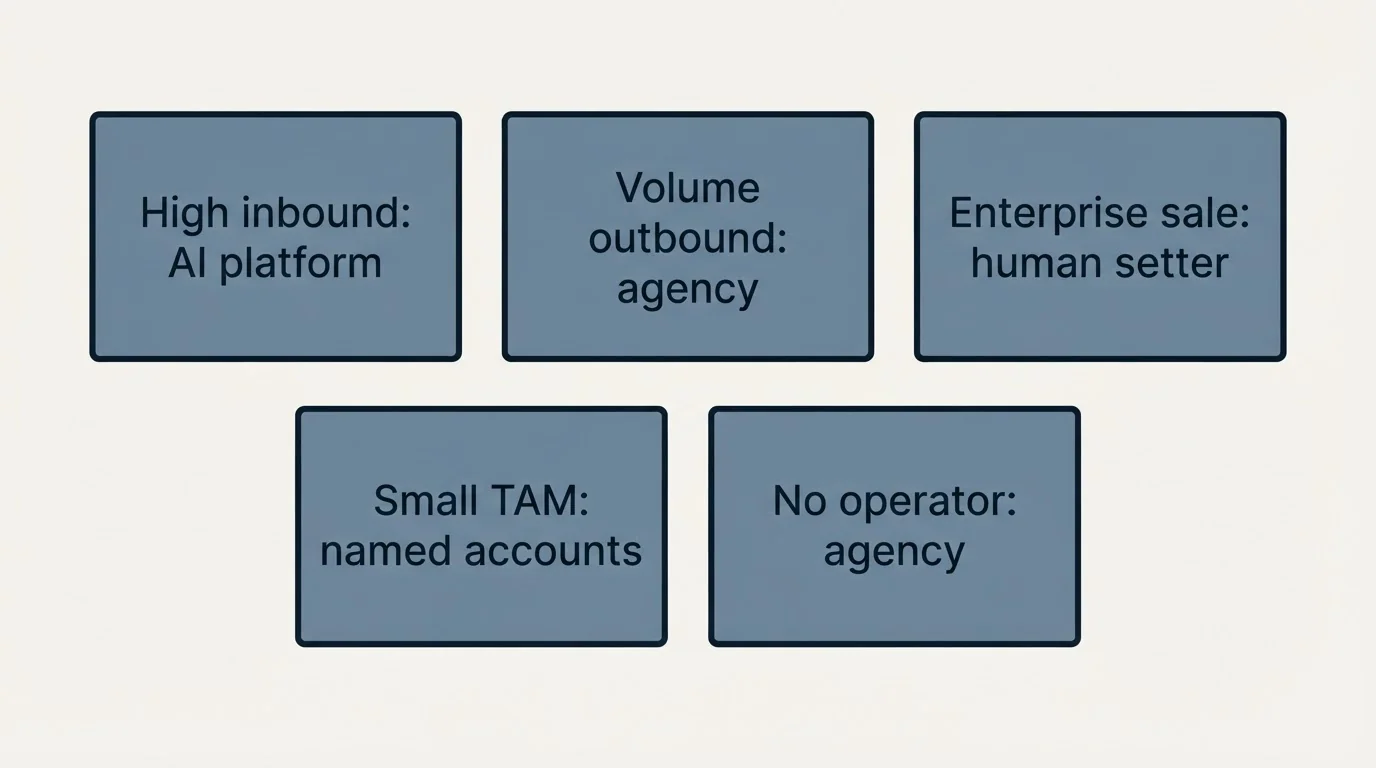
| High inbound volume, simple qualification | Voice AI or AI SDR platform |
| Cold outbound at volume, mid-market targets | Agency or AI SDR platform with a human reviewing replies |
| Enterprise or consultative sale | Human setter or an in-house rep |
| Under 1,500 addressable accounts | Named-account selling, no setter of any kind |
| No operator to maintain the system | Agency, because oversight is priced in |
That last row is the one most teams get wrong. Buying a $250 platform and assigning nobody to run it produces a $250 monthly line item and zero meetings. Software transfers the work rather than removing it, which is the theme running through the five SDR tasks that can be automated and the seven-layer GTM AI stack.
The hidden costs on the AI side
- Phone number and domain reputation. Voice agents burn caller ID reputation, email agents burn domains. Both need rotation and monitoring.
- Integration work. Calendar, CRM, and routing. Budget days, not hours, and budget for the week they silently stop syncing.
- Prompt drift. A script that worked in March books worse meetings in July because the market moved. Somebody has to notice.
- Escalation paths. Every agent needs a defined handoff for the conversations it should not be having.
- Attribution honesty. Agents that call inbound leads book meetings that would partly have happened anyway. Compare against a holdout before you credit the tool with the whole lift.
For the wider picture on which agent workflows survive contact with production, the eight agent workflows that matter and sales automation for B2B teams are the practical versions. If you are writing the setter script yourself, appointment setting email templates covers the message side.
When an agency like us is the wrong choice
We run done-for-you cold email and LinkedIn outbound and charge only for qualified meetings that are attended. Do not hire us when:
- your volume is inbound rather than outbound, in which case a voice agent or a fast human on speed-to-lead beats an outbound program;
- you have an operator who enjoys running systems, since an AI SDR platform plus that person is genuinely cheaper than any agency;
- your addressable market is under roughly 1,500 accounts;
- your average contract value is under roughly $3,000 with no expansion path;
- your buyers sit in consent-only or heavily regulated channels.
The full build-versus-buy arithmetic on people is in outsourced SDR vs in-house, and the service-pricing view is in cold email agency pricing and what a B2B lead generation agency costs.
How to run the comparison yourself
Take one month of your own data. Count attended meetings, not bookings. Divide total spend including the hours a human spent supervising the system. Then run the same number for the alternative you are considering, with the same honesty about oversight. Most of the ten-fold spread in published claims disappears at that point, and what remains is a real answer about which route fits your list, your buyer, and your team.
If the answer is outbound run by someone else, we charge only for qualified meetings that are actually attended. See if you qualify for a free campaign.
Vendor pricing reflects published 2026 rates and moves frequently. Cost-per-meeting figures are modelled from those published ranges plus typical operating costs, not measured from any single deployment.
Frequently asked questions.
Frequently asked questions- How much does an AI appointment setter cost?
- SMB-oriented tools publish $29 to $500 per month, with most buyers landing at $99 to $299. Voice agents charge $0.07 to $0.14 per minute, sometimes with a $299 to $499 platform fee. Enterprise deployments run $500 to $3,000 monthly plus usage. AI SDR email platforms range from $250 to $5,000 per month.
- Are AI appointment setters better than human setters?
- They are cheaper per meeting and available around the clock, which wins on high-volume inbound with simple qualification. Humans still win on consultative qualification, price objections, and anything requiring judgment about fit. A booked meeting with a poorly qualified prospect costs more than no meeting at all.
- What is the real cost per meeting for an AI setter?
- Vendors publish $80 to $150 per booked meeting. Adding list costs and eight hours a week of human oversight, and adjusting for 20 to 30 percent no-shows, realistic cost per attended meeting lands nearer $330 to $400. That still compares well against roughly $650 for a human setter and $550 for a full-service agency.
- Do AI appointment setters work for cold outbound?
- Voice agents struggle on cold lists because B2B cold dials connect in the low single digits, and outbound calling sits under consent and do-not-call rules that vary by jurisdiction. AI SDR platforms handling email and LinkedIn work better for cold outbound, provided a human reviews replies and the list is properly built and verified.
- What do AI setters still need a human for?
- Prompt tuning, list quality control, transcript review, integration fixes, and escalation of conversations the agent should not be having. Budget around eight hours a week. Teams that buy a platform and assign nobody to run it get a monthly line item and very few meetings, because software moves the work rather than removing it.
About the author.

Tim Carden is CMO / CTO at RevenueFlow, which builds and operates outbound revenue engines for B2B companies. Studied at McGill University.
Tim Carden · CMO / CTO
Connect on LinkedIn →Explore more.
Ready to scale your outreach?
We build GTM engines that book real meetings. See the receipts.
Related articles.
AI SDR: What It Replaces, What It Doesn't and What It Costs
AI SDRs handle research, list building, sending and reply triage well. Discovery, objections and relationships do not transfer. Capability matrix and real pricing.
Claude Code Is the Best GTM Tool of 2026
Your GTM stack is fine. The problem is that you are the integration layer holding it together. Here is what changes when an agent with API access takes that job instead.
Outbound Teams Hold Their Stack With 3 Ops People or 22 APIs
Five categories of tooling, all API-addressable, run from one terminal. Here is the full stack, what MCP actually changes, and the honest version of what replaces the ops headcount.
Appointment Setting for Manufacturers: Who a Setter May Call
For the manufacturer hiring a setter: the ranked titles to hand over, the rep and distributor map that decides which accounts may be called, and the meeting types.
AI Sales Agents: 6 Jobs They Do Well and 4 They Fail At
Agents plan and act, copilots suggest, workflows follow a fixed path. Here are the six sales jobs agents handle today, the four they fail, and the buying test.
Claude Code for RevOps: 5 Workflows to Run From the Terminal
Five recurring RevOps jobs run from the terminal with Claude Code: pipeline hygiene, forecasting, deal intelligence, lead routing and attribution, and the team setup.