Appointment Setting for Manufacturers: Who a Setter May Call
For the manufacturer hiring a setter: the ranked titles to hand over, the rep and distributor map that decides which accounts may be called, and the meeting types.
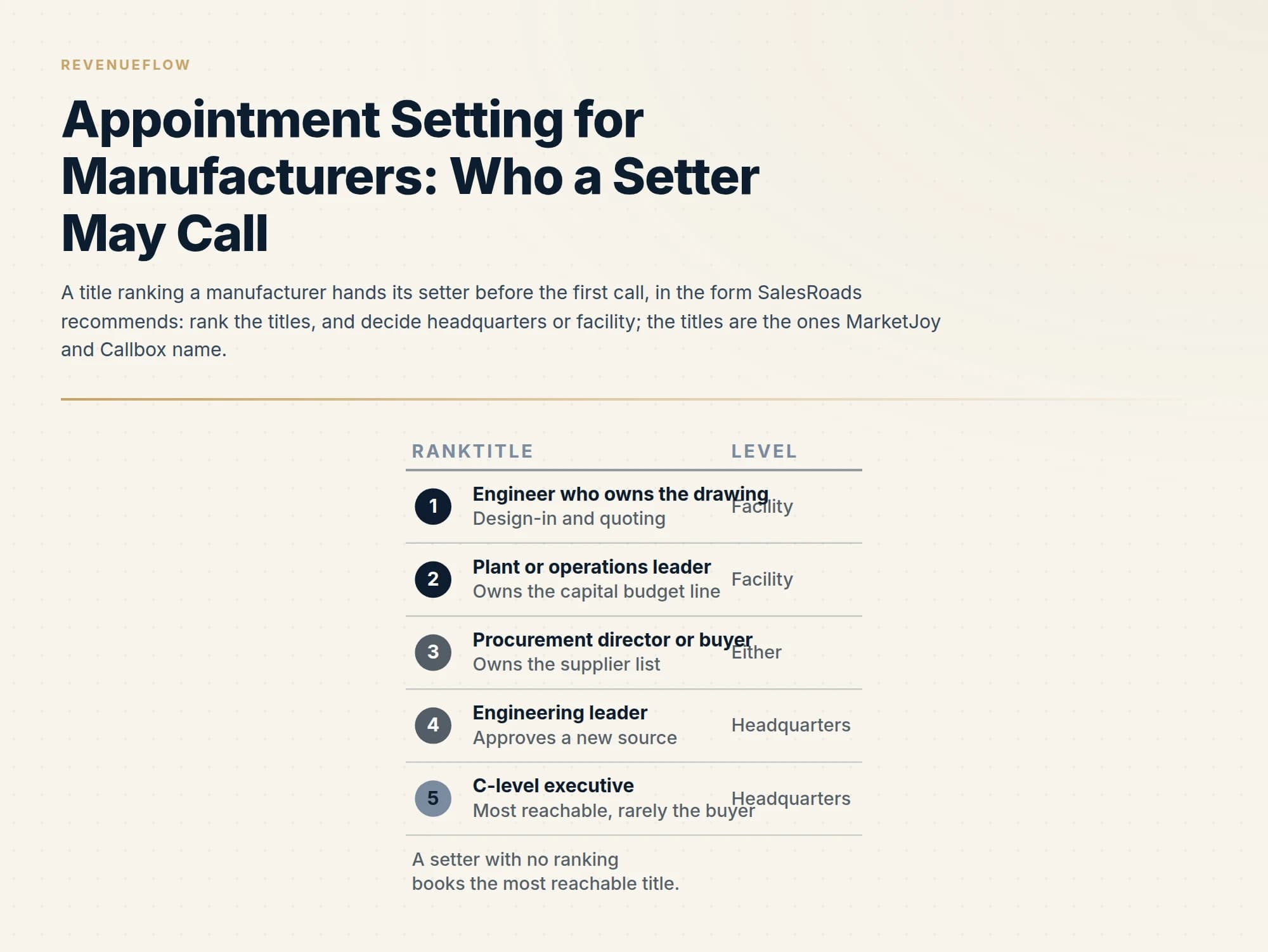
A manufacturer buying appointments hands the setter a ranked title list, a map of accounts that reps and distributors already own, and a qualification bar for each meeting type. Design-in and replacement meetings are worth different amounts, the setter never answers a technical question, and the manufacturer reads every message before it goes out in its name.
Key takeaways
- MarketJoy and Callbox name the titles a setter calls, and SalesRoads gives the useful instruction: rank the preferred titles and decide whether the engagement belongs at headquarters or the facility, because an unranked setter books the most reachable title.
- MANA describes itself as connecting independent sales reps with manufacturers since 1947; a setter that books an account a rep already covers creates a commission dispute or a rep who drops the line, so the account map comes before the list.
- A design-in meeting with an engineer specifying a component and a replacement meeting with a buyer re-sourcing a live part number sit at different points in a cycle SalesRoads describes as often running twelve to eighteen months.
- The FTC's guides state that most business-to-business calls are exempt from the Telemarketing Sales Rule and that CAN-SPAM makes no exception for business email, so the manufacturer reads the setter's messages before they are sent.
Reviewed and updated September 19, 2026
Search for appointment setting for manufacturers and the ten results, read on 18 September 2026, split three ways. Three pages sell appointment setting to the manufacturer as the client: MarketJoy's service page, Factur's manufacturing-only service page and Callbox's list of five agencies for manufacturers. Two sell the opposite thing, booking meetings with manufacturing decision-makers for a vendor selling into plants: SalesRoads' tactics page and IndustrySelect's post. The other five are generic directories and listicles in which the word manufacturing appears once or not at all. This page takes the first reading. It is written for the manufacturer, a contract manufacturer, a machine shop, a fabricator, a component maker or an OEM, deciding whether to pay someone else to book its first meetings with buyers, and what has to be true for that to work. If you sell to manufacturers and want to reach plant managers, the manufacturing lead generation guide covers that direction, including why the senior title is often the wrong first contact.
The generic questions, what a good meeting costs, what a setter's scope ladder includes at each price and how the purchase differs from buying leads, are answered in B2B appointment setting, appointment setting services and appointment setting vs lead generation, and are not repeated here. What is specific to a manufacturer is below: who the setter is calling for you, the rep and distributor problem that decides which accounts it may call at all, why a design-in meeting and a replacement meeting are worth different amounts, the rules a third-party caller and sender inherits, the objections manufacturers' own vendors report hearing, and when the money is better spent elsewhere.
Who a setter calls on your behalf
MarketJoy's guide, published 20 August 2026 under the byline of Curtis Bendt, defines manufacturing appointment setting as generating "qualified meetings with purchasing managers, procurement specialists, plant managers, operations directors, engineering leaders, and C-level executives", and says "procurement teams expect personalized solutions before agreeing to a sales conversation". Callbox's list, published 27 August 2026 and updated 31 August under Rebecca Matias's byline, names "plant managers, procurement directors, and chief technology officers", and says "Industrial decision-makers manage strict capital allocation budgets". SalesRoads, writing for the other side of the table, gives the most useful instruction: "create a score list and rank the preferred titles for outreach", and decide first "whether the engagement should be at the corporate headquarters level or the facility level". For a manufacturer hiring a setter, that ranking is the first thing to hand over, because a setter with no ranking will book the most reachable title rather than the right one.
Which title is right depends on what you make. A contract manufacturer or machine shop quoting on drawings needs the engineer who owns the drawing and the buyer who owns the supplier list, at the facility. A capital-equipment maker needs the plant or operations leader who owns the budget line and, per Callbox, the capital allocation cycle that line sits in. A component maker selling into an OEM's bill of materials needs the design engineer during design-in and the commodity buyer afterwards, and those are two different people at two different times.
The rep and distributor problem decides which accounts a setter may call
A manufacturer usually already has a sales channel, and it was not built by the manufacturer. The Manufacturers' Agents National Association's site, read on 18 September 2026, describes the association as "Connecting Independent Sales Reps with Manufacturers since 1947" and offers manufacturers a RepFinder directory of independent reps who, in its words, "already know your market, territory, and customers". Factur, the one agency in the results that works only with manufacturers, lists among its resources a post titled "Are Manufacturing Reps Holding Back Your Growth Potential?"; the title is the argument.
For a setter this is the first constraint, before any script. An independent rep is paid commission on a territory or a line; a distributor owns its accounts. A setter who books a meeting with an account that a rep already covers has created either a commission dispute or a rep who stops carrying your line. So before the list is built, the manufacturer draws the map: accounts covered by reps, accounts owned by distributors, house accounts the factory sells direct, and the open territory or segment where nobody is calling. The setter calls the last group. If the open group is small, the outsourced programme is small, whatever the agency proposes, and the manufacturing lead generation guide's treatment of channel conflict as a targeting constraint applies from the manufacturer's own side of the desk.
A design-in meeting and a replacement meeting are worth different amounts
SalesRoads' page states that "in the manufacturing sector, this cycle can extend significantly, often ranging from 12 to 18 months", and attributes the length to product complexity, multiple stakeholders, budget, the physical nature of the goods, deal size and internal procedure. It does not say how many deals were measured, so treat it as the agency's experience rather than a benchmark. The point for a manufacturer buying meetings is that not every meeting sits at the same place in that cycle. A meeting with a design engineer who is choosing a component for a product that will ship for years is a design-in meeting; it may not produce a purchase order for a year, and then produces them for a decade. A meeting with a buyer whose current supplier has just missed deliveries is a replacement meeting; it can produce a quote request the same week and a second source thereafter. A setter paid per meeting has no reason to tell these apart. The manufacturer does, because the price it should be willing to pay for each is different, and because the qualification bar for each is different: for a design-in meeting, that a new product is in design and the engineer is the one specifying; for a replacement meeting, that there is a live part number and a reason to re-source it.
The calendar helps. The largest shows in the manufacturer's own trade put the buyers in one building with a published exhibitor list weeks ahead: IMTS's site says "IMTS 2026 will be held September 14-19, 2026 at McCormick Place, Chicago"; PACK EXPO International runs 18 to 21 October 2026 in Chicago, with its site promising "INNOVATIONS FROM 2,600 Exhibitors" as of 18 September; FABTECH's site lists 21 to 23 October 2026 at the Las Vegas Convention Center. The setter's most useful pre-show job is not the booth invitation but the meeting on the floor with a ranked title from the exhibitor and attendee lists, booked in the fortnight before the doors open.
| Show | Dates and place | Setter's job |
|---|---|---|
| IMTS | 14 to 19 September 2026, McCormick Place, Chicago | Floor meetings with ranked titles from the exhibitor list |
| PACK EXPO International | 18 to 21 October 2026, Chicago | Packaging-line buyers by vertical, booked the fortnight before |
| FABTECH | 21 to 23 October 2026, Las Vegas Convention Center | Fabricators and job shops, booked from the exhibitor directory |
The rules a third-party caller and sender inherits from you
Two federal rules touch a setter working for a manufacturer, and both are stated here from the regulator's pages read on 18 September 2026; neither is legal advice, and a setter that describes itself as compliant is making a claim only its own counsel can support.
The Federal Trade Commission's guide to complying with the Telemarketing Sales Rule states that "Most phone calls between a telemarketer and a business are exempt from the TSR", with two carve-outs: business-to-business calls to induce the retail sale of nondurable office or cleaning supplies, and calls to business lines that solicit individual employees to buy for their own use, which the guide says "are not business-to-business solicitations and are not exempt from the TSR". The same guide states that the rule's provisions on assisting and facilitating reach companies that provide substantial assistance to sellers or telemarketers. A manufacturer's setter calling procurement about tooling or components sits inside the exemption; a setter that drifts into consumables, or into calling employees about something for themselves, does not.
The Commission's CAN-SPAM guide states that the law covers any commercial message, makes no exception for business-to-business email, and makes clear that "even if you hire another company to handle your email marketing, you can't contract away your legal responsibility to comply with the law", so that both the company whose product is promoted and the company that sends the message may be held responsible. The guide's requirements, a valid physical postal address, a clear opt-out honoured within ten business days, no deceptive subject lines, apply to every email a setter sends in the manufacturer's name. The practical consequence is that the manufacturer reads the setter's messages before they go out, not after.
What manufacturers say against it, as their own vendors report it
The objections are in the vendors' pages because the vendors meet them on every call. IndustrySelect, writing on 2 May 2026 for the seller into manufacturing, reports that buyers "are constantly shielded by gatekeepers and flooded with vendor outreach", and that "Cold calling remains highly effective in manufacturing because decision-makers often prefer direct, professional communication over digital noise". SalesRoads reports that "decision-makers often spend time on the production floor and away from their desks", which is why a phone-first setter's connect rate falls in this sector. Factur's own FAQ answers the volume question honestly: "Appointment volume depends on your market, goals, and ideal customer profile", and its focus is quality over quantity. And IndustrySelect's in-house-versus-outsourced comparison gives the objection a manufacturer's engineer will raise first: "In-house teams offer deeper product knowledge and cultural alignment", while outsourced teams bring speed and a ready-made process.
That last one is the real objection, and it is right. A setter cannot answer a buyer's question about tolerance, material certification or lead time, and a buyer who asks one and gets a scripted deferral has learned something about the manufacturer. The answer is to design the meeting so the setter never has to: the setter books, the manufacturer's own engineer or sales lead takes the call, and the setter's script says who will be on it.
- Works the open segment only
- Calls the ranked titles, facility first
- Names the engineer who will attend
- Confirms the qualification bar before booking
- Tolerances, certifications, lead times
- Quoting on a drawing
- Any account a rep or distributor owns
- Any consumables call under the telemarketing rule
When appointment setting is the wrong play for a manufacturer
Four cases. Your whole market is covered by reps and distributors and the open segment above is empty; the money belongs in the channel, not around it. Your product is bought from a catalogue or by specification, through distribution, so the buyer never takes a meeting about it. Your shop is at capacity and cannot quote new work this quarter; a booked meeting with a buyer you then decline costs the relationship you wanted. And your need is not buyers but capability, suppliers or process, in which case the Manufacturing Extension Partnership, which the National Institute of Standards and Technology's page describes as "nearly 1,400 trusted manufacturing advisors and experts at more than 450 MEP service locations" serving small and medium manufacturers across the United States and Puerto Rico, is the channel, and it is not a sales channel.
Three openers, each on a fetched fact
One message has to carry the campaign, so it needs a reason that belongs to the reader. Three illustrative openers follow, each built on a page read on 18 September 2026; each is one message, sent once, to one person, with no follow-up bump, on email and LinkedIn rather than the phone, and each names who will be in the meeting. They name no real recipient, make no claim about results, and the manufacturer that speaks in each is invented.
The first illustrative opener is for a purchasing manager at an OEM exhibiting at the Las Vegas fabrication show, and it rests on FABTECH's own dates, 21 to 23 October 2026 at the Las Vegas Convention Center.
You are on the exhibitor list for the fabrication show in Las Vegas on 21 to 23 October. We are a forty-person precision fabricator in Ohio with a second source already qualified for two of your competitors' enclosure programmes. If your current sheet-metal supplier's lead times are in the way of a launch, would a thirty-minute meeting on the floor on the Wednesday work? Our engineering manager will be there with sample parts and the certifications.
The second illustrative opener is for an operations director after a facility expansion announcement, and it rests on nothing but that public announcement, which is the kind of trigger a setter's list is built around.
Your expansion of the Greenville plant was announced this month. We build the conveying and packaging line integrations for three plants of that size in the Southeast. If the line layout is not yet fixed, would twenty minutes with our applications engineer, who has laid out two lines on the same footprint, be worth your time before the equipment list is set?
The third illustrative opener is for a design engineer at a packaging-machinery builder, and it rests on PACK EXPO International's own dates, 18 to 21 October 2026 in Chicago.
You are showing a new filler at the packaging show in Chicago on 18 to 21 October. We machine the stainless valve bodies for two of the fillers that will be on the same floor, to the same wash-down specification. If the valve source for the new machine is still open, our engineer can bring drawings and a sample to your stand for a twenty-minute review at a time you choose.
What to agree in writing before the first call
The account map, with the rep and distributor exclusions listed by name. The ranked titles and whether each lives at headquarters or the facility. The qualification bar for each meeting type, design-in or replacement, and which of your engineers attends. A sight of every message before it is sent, because the responsibility for it is yours. And a one-message rule per campaign, with no bumps: a buyer who has a live need answers, and one who does not is not persuaded by a fourth email. The per-meeting price and the scope ladder belong in the generic guides linked above. A manufacturer that would rather see the shape run against its own open segment before signing anything can start with a free campaign and count what comes back.
Frequently asked questions.
Frequently asked questions- Who should an outsourced setter call on a manufacturer's behalf?
- A ranked list the manufacturer writes before the first call. A contract manufacturer or machine shop quoting on drawings needs the engineer who owns the drawing and the buyer who owns the supplier list, at the facility. A capital-equipment maker needs the plant or operations leader who owns the budget line. A component maker needs the design engineer during design-in and the commodity buyer afterwards. The C-level executive is the most reachable title and rarely the buyer.
- How do independent reps and distributors limit what a setter may do?
- An independent rep is paid commission on a territory or a line and a distributor owns its accounts, so a meeting a setter books with a covered account creates a commission dispute or a rep who drops the line. Before the list is built the manufacturer draws the map: rep territories, distributor accounts, house accounts and the open segment where nobody is calling. The setter works only the open segment, and if it is small the programme is small.
- What is the difference between a design-in meeting and a replacement meeting?
- A design-in meeting is with an engineer choosing a component for a product that will ship for years; it may not produce a purchase order for a year and then produces them for a decade. A replacement meeting is with a buyer whose supplier has just missed deliveries; it can produce a quote request the same week. A setter paid per meeting cannot tell them apart, so the manufacturer sets a separate bar and price for each.
- When is appointment setting the wrong play for a manufacturer?
- When the whole market is covered by reps and distributors and the open segment is empty, because the money belongs in the channel. When the product is bought from a catalogue or by specification through distribution, so no buyer takes a meeting about it. When the shop is at capacity and cannot quote new work this quarter. And when the need is capability rather than buyers, where the Manufacturing Extension Partnership that NIST describes is the channel.
About the author.

B2B cold email experts helping companies generate qualified leads through done-for-you outreach campaigns.
RevenueFlow Team
Explore more.
Ready to scale your outreach?
We build GTM engines that book real meetings. See the receipts.
Related articles.
SDR Outsourcing for Solar Companies: The Commercial Layer
For the solar company weighing an outside setter: which segment a setter fits, the four sentences it must be able to say, and the consumer rules it inherits.
SDR Outsourcing for Fintech Companies: Assessability Test
For the fintech weighing an outside setter: the three assessability sentences, the promotion rules that bind every message, the sponsor test and which model fits.
LinkedIn Outreach for Ecommerce Companies: Who Is Reachable
LinkedIn outreach to ecommerce brands: why the storefront address reaches support, what Shopify's partner agreement says about contacting merchants, and who is reachable.
Outbound Sales for Ecommerce Companies: The Business Buyers
For the brand or merchant building business accounts: the business buyers, the show calendar, the proof a store already holds, and the domain rule that protects checkout.
Outbound Sales for Web Development Companies: A Guide
Outbound for a web shop starts from the prospect's own public site: what it runs on, how it performs and whether a dated accessibility duty applies.
Appointment Setting for Material Handling Companies
Appointment setting in material handling starts with whose appointment it is: dealer territories, the ProMat and MODEX calendar, and OSHA's dated duties.