Appointment Setting vs Lead Generation: Two Purchases
Lead generation stops at interest. Appointment setting absorbs the reply handling and delivers attended meetings. How to compare the two quotes properly.
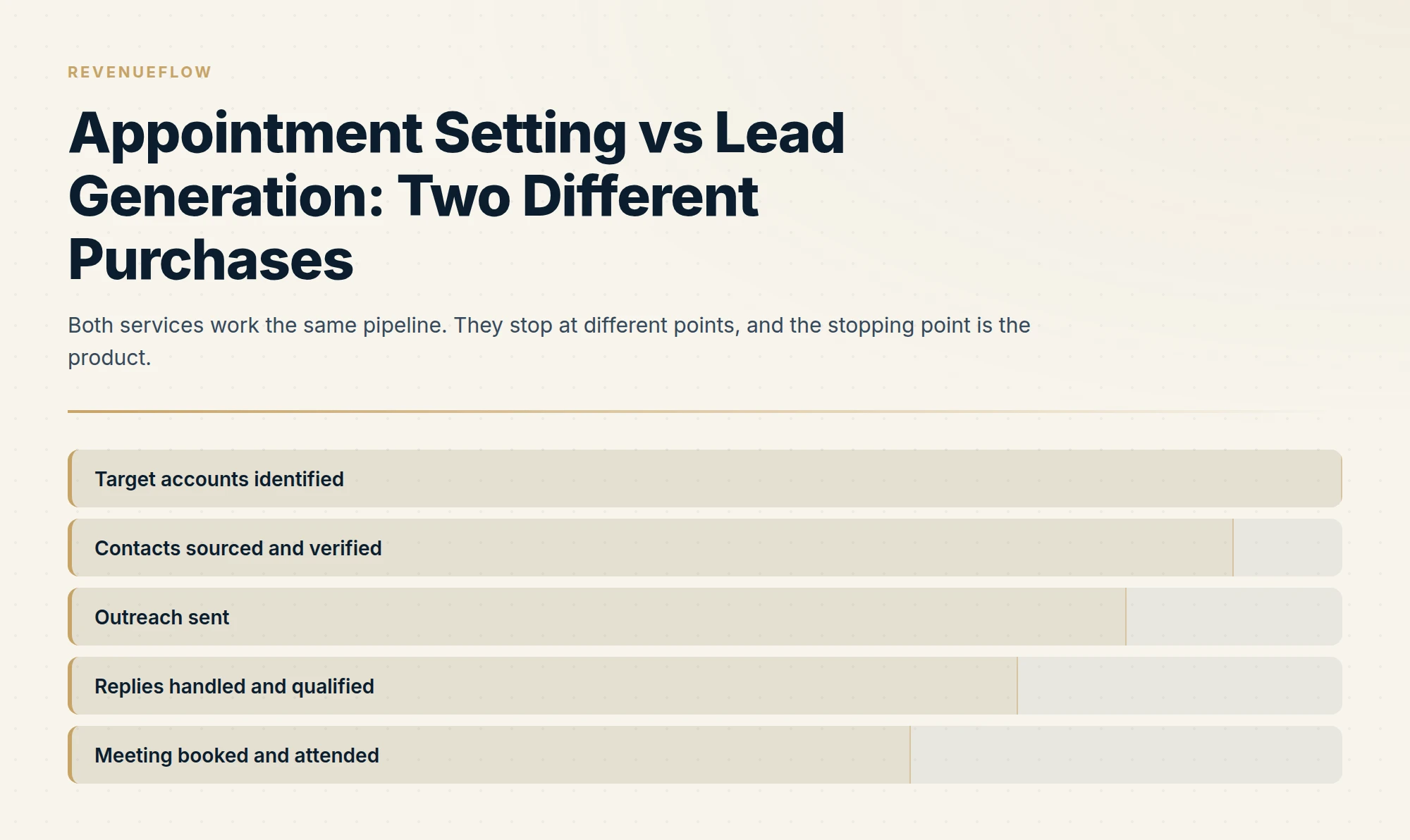
Lead generation delivers contacts and interest signals, stopping at the point of interest. Appointment setting delivers attended meetings and absorbs the reply handling, scheduling and no-show chasing in between. Compare both by cost per attended meeting, which requires knowing what share of supplied leads your team currently converts.
Key takeaways
- The dividing line is reply handling: converting a positive reply into an attended meeting is most of the labour and nearly all of the skill.
- To compare quotes, convert both to cost per attended meeting. A lead generation quote is unpriceable until you know your own lead-to-meeting conversion rate.
- Requiring budget confirmation before a meeting counts as billable is a trap that limits the vendor to people already in a buying cycle.
- A dispute window of a stated number of business days, with reasons that map to written criteria, resolves nearly every argument before it starts.
Reviewed and updated September 2, 2026
Two vendors quote you. One says lead generation, one says appointment setting, and the monthly numbers are close enough to compare directly. They are not comparable. One is selling you names and interest signals, the other is selling you time on a calendar, and the gap between those two things is where most of the disappointment in outsourced pipeline comes from.
The distinction is not academic. It determines what arrives, who does the work after it arrives, and what you are entitled to complain about when the quarter ends badly.
The two purchases
- Deliverable is a list, an MQL, or a form fill
- Qualification depth varies enormously by vendor
- Your team does the outreach and the booking
- Volume is the headline metric
- Cheaper per unit, more units required
- Deliverable is a booked, attended conversation
- Qualification happens before the booking
- Vendor does the outreach, the reply handling, and the scheduling
- Meeting count is the headline metric
- More expensive per unit, fewer units required
The operational difference is the reply handling. Lead generation stops at the point of interest. Appointment setting continues through the messy part: someone answers with a question, or asks to be contacted in March, or replies from a different address, or says yes and then does not show. Handling that is most of the labour and nearly all of the skill.
Where the handoff happens
Buyers asking how a qualified meeting differs from a regular lead are asking where the supplier stops, and the funnel above is the answer: a lead is an interest signal and a meeting is an attended conversation, with the reply handling between them.
The clearest way to see what you are buying is to draw the pipeline and mark the point where the vendor stops.
Drawing that pipeline against a consumer style funnel is instructive, because only two of ClickFunnels' five published stages transfer to a business sale decided by a committee.
Both models cover this.
Both models cover this. Lead generation often stops here.
Appointment setting always covers this. Lead generation sometimes does.
The dividing line. This is where appointment setting earns its premium.
Appointment setting only.
Read that middle row carefully, because it is where vendors blur the categories. Plenty of lead generation vendors do send outreach and then pass you the positive replies. That is a real service and it can be good value. It is still not appointment setting, because converting a positive reply into an attended meeting involves scheduling friction, no-show chasing, and judgment calls about which interested people are worth a slot.
Why the pricing looks similar and is not
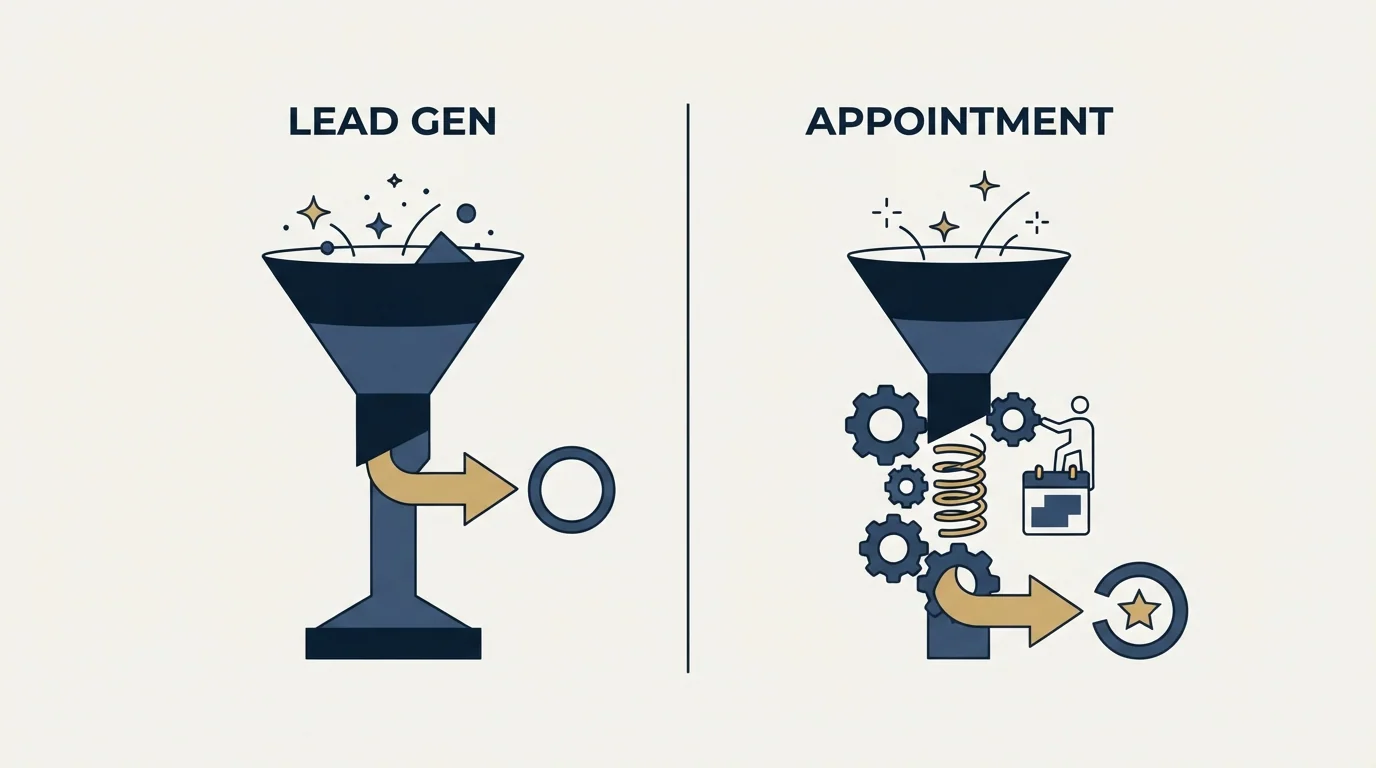
Per-unit pricing makes the two look comparable when the units are different sizes. A lead and a meeting are not interchangeable, and the conversion rate between them is the entire question.
The honest way to compare is to convert both quotes to cost per attended meeting. For an appointment setting quote, that is the quoted price. For a lead generation quote, it is the price per lead divided by the share of leads your team converts into held meetings, plus the cost of your team's time doing that conversion.
That second calculation is the one buyers skip, and it usually moves the comparison substantially, because the denominator is a number most teams have never measured. If you do not know what share of supplied leads your team turns into held meetings, you cannot evaluate a lead generation quote at all. You are comparing a known price to an unknown one.
The definition problem
Appointment setting concentrates risk on a single word, and the word is "qualified." A vendor paid per meeting has an obvious incentive to book meetings. Whether those meetings are worth attending depends entirely on criteria agreed before anything sends.
A workable definition is written down, specific, and testable by someone who was not on the call.
- Yes: The company matches agreed firmographic criteria, written as ranges not adjectives
- Yes: The attendee has responsibility for or influence over the relevant area
- Yes: The prospect agreed to a business conversation, not a favour
- Yes: The prospect actually attended
- Yes: Excluded accounts were named in advance, including existing customers
- No: Budget confirmed before the meeting
- Depends: A defined window for the client to dispute a meeting
Two rows there deserve comment.
Budget confirmation as a billing condition sounds prudent and is a trap. A first conversation is where budget gets discovered, so requiring it beforehand means the vendor can only book people already in a buying cycle, which is a fraction of the market and not the fraction outbound is good at reaching. Requiring it converts an outbound programme into a very expensive way to find people who were already shopping.
The dispute window is marked "maybe" because it is genuinely optional, but the engagements that go badly are almost always the ones without it. A stated number of business days for you to flag a meeting that missed the definition, with a reason that maps to the written criteria, resolves nearly every argument before it becomes one. Subjective complaints about how a call felt are not valid rejections against a written standard, and that cuts both ways: it protects the vendor from unfalsifiable criticism and protects you from meetings that technically qualified and obviously should not have.
Which one to buy
Buy lead generation when you have SDR capacity sitting idle, when your team already converts supplied leads well and you have measured that rate, when you want control over messaging and reply handling, or when your sales cycle needs a specific internal voice early in the conversation.
Buy appointment setting when your closers are the constraint and prospecting is stealing their selling time, when you have no SDR function and do not want to build one yet, when you want cost to track output rather than activity, or when you can write down clearly what a good meeting looks like.
Because deciding between these purchases often hinges on which internal function is actually the bottleneck, structuring a demand generation team can clarify where that constraint truly sits.
The strongest signal is where the bottleneck sits. If your sellers have gaps in the calendar, buy meetings. If your sellers have full calendars and your problem is that nobody upstream is generating names, buy leads or fix sourcing.
Merging inbound and outbound signals explains how combining the two channels into one motion still demands a written rule for triggers and a separate rule for attributing credit.
If neither is true and the actual issue is that meetings are happening but not converting, neither purchase helps. That is a positioning or a sales-execution problem, and adding volume to it makes it more expensive rather than better.
What the vendor needs from you

Both models fail in the same way when the client treats the engagement as fully outsourced. Neither can work without inputs only you hold, and the vendors who ask for these on the kickoff call are the ones who have done this before.
A suppression list. Existing customers, live opportunities, current vendors, partners, and anyone your team is already working. This has to be loaded before launch, not applied as a review step afterwards, because a review step means the message already went. Getting a CRM export in the first week is the single highest-value thing a client does.
Named exclusions beyond the CRM. Competitors, companies in litigation with you, an account a board member sits on. These are rarely in a system and are usually known by three people.
Access to someone who can answer market questions. Not weekly meetings, just a route to a person who can settle "would this title actually own this decision" inside a day. Guessing wrong on buyer titles is a common cause of a slow start, and it is cheap to prevent.
A decision on what happens to referrals. Prospects frequently reply saying the right person is a colleague. Who chases that, and does the resulting meeting count? Settle it before it happens rather than during the first invoice dispute.
What the first ninety days actually look like
Both models have a ramp, and both are routinely sold as though they do not.
- Weeks 1 to 2Setup and definition
Criteria agreed, suppression list loaded, sending infrastructure prepared. Nothing sends.
- Weeks 3 to 4First sends at low volume
Deliberately small. Volume here buys nothing and risks the domain.
- Weeks 5 to 8Volume ramps, first replies
Early meetings appear. Copy and targeting adjust on what replies say.
- Weeks 9 to 12Steady state
The first period where output is a fair measure of the engagement.
Buyers usually want the time from first connection to a qualified sales meeting stated up front, and the ramp above is the honest shape of it: the first weeks buy the build rather than meetings, and compressing them is the most reliable way to produce a disappointing first quarter.
Judging an engagement on month one measures the setup, not the programme. Judging it on month three is fair. Any vendor promising meaningful volume in the first fortnight is either skipping infrastructure preparation, which damages your domain, or drawing from a pre-existing list that was not built for your criteria.
The build alternative
Both models compete with hiring. The relevant comparison is fully loaded cost, which includes salary, tooling, management time, and the ramp period before a new hire produces anything. We worked through that comparison in outsourced SDR versus in-house, and the broader agency cost structure sits in the lead generation agency cost guide.
Worth noting where outsourcing genuinely beats hiring: sending infrastructure. Domains, mailbox warming, deliverability monitoring and blocklist recovery are specialised, unglamorous, and expensive to learn on your own domain. An established vendor has that infrastructure already running. If you want a sense of the surface area involved, the cold email deliverability guide covers what has to be maintained continuously rather than set up once.
Questions that separate the vendors
Who writes the meeting definition? If the vendor hands you theirs and will not amend it, the definition is designed around what they can reliably book rather than what you can reliably sell to.
Verifying the vendor behind that definition is its own exercise, and a supplier whose own pages stopped resolving is the case for reading three of a vendor's pages rather than one.
What happens to a no-show? Ask whether it is rebooked, credited, or billed. All three are defensible. Not having an answer is not.
Who owns the reply inbox? Some appointment setting engagements route replies to you and only handle scheduling. That is closer to lead generation, priced like appointment setting.
What is excluded? Existing customers, active opportunities, and current vendors should be excluded before launch by loading your suppression list, not caught afterwards by review.
What happens to the data when we stop? Ask who owns the contact records, the reply history, and the sending domains at the end of the engagement. Domains in particular are worth settling early: if the vendor bought and warmed them, walking away can mean losing the warmed infrastructure your results were built on, and starting again elsewhere from cold.
The short version
Lead generation sells you contacts and stops at interest. Appointment setting sells you attended conversations and absorbs the reply handling in between. Compare both by cost per attended meeting, which means measuring what share of supplied leads your team currently converts, because without that number the lead generation quote is unpriceable. And if you buy meetings, spend the effort on the written definition rather than on the rate, because the definition is what you are actually purchasing.
At RevenueFlow the meeting definition is agreed in writing before launch and we are paid on attended meetings that meet it. If that is the shape of the problem, you can see what a campaign would look like for your market.
Frequently asked questions.
Frequently asked questions- What is the difference between appointment setting and lead generation?
- Lead generation delivers contacts and interest signals and stops there, leaving your team to run outreach and booking. Appointment setting continues through reply handling, qualification and scheduling, and delivers an attended meeting. The stopping point in the pipeline is the product you are buying.
- Which is cheaper, appointment setting or lead generation?
- Lead generation is cheaper per unit and requires far more units. The honest comparison is cost per attended meeting: for appointment setting that is the quoted price, and for lead generation it is price per lead divided by your lead-to-meeting conversion rate, plus your team's time.
- What makes a meeting qualified?
- A workable definition specifies the company matching agreed firmographic ranges, an attendee with responsibility for the relevant area, agreement to a business conversation, actual attendance, and named exclusions such as existing customers. Budget, timing and authority should not be billing conditions.
- Should I buy leads or meetings?
- Look at where the bottleneck sits. If closers have calendar gaps, buy meetings. If closers are busy and nobody upstream is generating names, buy leads or fix sourcing. If meetings happen but do not convert, neither purchase helps and adding volume makes it more expensive.
About the author.

Ben Carden is CRO at RevenueFlow, which builds and operates outbound revenue engines for B2B companies. Previously at Gartner Enterprise. Studied at London School of Economics.
Ben Carden · CRO
Connect on LinkedIn →Explore more.
Ready to scale your outreach?
We build GTM engines that book real meetings. See the receipts.
Related articles.
Last Outbound Agency Did Not Deliver: Locating the Failure
The leads were bad names a symptom and no stage. Four places an outbound engagement fails, the counts that separate them, and what to change in the next purchase.
B2B Lead Generation Companies by Pricing Model: 15 Vendors
Nine of fifteen B2B lead generation vendors publish a dollar figure and six publish none. The five pricing models behind the numbers, each figure cited to its page.
Lead Generation as a Service: What the Service Part Changes
Most vendors selling lead generation as a service have productised the scope and kept the price bespoke. What that trade buys you, and how to tell which half is fixed.
Lead Verification: What Each Check Actually Proves
Lead verification covers two different jobs. One asks whether a mailbox will accept mail, the other asks whether the person behind the row is real and lawful to contact.
5 ABM Campaign Examples and How Each One Is Built
Five worked account-based campaign examples, each built on the same five fields: account set, tier, plays in order, owner and handoff, and the exit condition.
Two Agencies, One Target List: Who Owns Which Accounts
Two outbound suppliers on one market will contact the same companies unless the buyer splits it first. How to cut the list, run the exclusion feed and check the overlap.