Allbound: Merging Inbound and Outbound
Allbound runs inbound and outbound as one motion. Merging them creates two decisions: what a signal may trigger, and who is credited when both touched the deal.

Allbound describes running inbound and outbound as a single motion rather than two separate programmes, with buying signals directing outbound effort. Merging the channels removes none of the decisions that kept them apart. It creates two: a written rule for what a signal may trigger, and an attribution rule reporting origination and influence separately.
Key takeaways
- The routing rule has to be keyed on whether the person has been contacted before, because a signal on a live silence is a different case from a signal on a stranger.
- A re-approach triggered by a signal is a new campaign with its own premise, not a reminder of a message the prospect already declined.
- The same person becomes an inbound record and an outbound record, so origination and influence need defining in writing and reporting as two lines.
- Merging the motions does not change their different speeds: the inbound half still compounds slowly while outbound answers within weeks.
Reviewed and updated October 1, 2026
A prospect ignores a cold email in March. In June they read a comparison page, download a case study and get added to a nurture list. In July they book a demo through the website. The marketing team counts an inbound conversion. The outbound team points at the March message. Both are describing the same person, and the company now has to decide something it never wrote down.
Allbound is the name currently attached to running inbound and outbound as one motion rather than two. The word is doing real work, because the thing it describes is genuinely different from doing both separately. What the word tends to hide is that merging the two channels does not remove any of the decisions that kept them separate; it just moves all of them into the same week.
If the two motions themselves are new ground, inbound vs outbound sales sets them side by side first.
What the word names
Unify's essay on the term, by Austin Hughes and updated 16 June 2026, describes allbound as a synchronised approach that blends inbound and outbound into one growth engine, and frames the older debate as a false choice: relying only on inbound constrains you to whoever happens to discover you, while outbound alone ignores the opportunities already arriving. Its summary of the intent is that allbound captures existing demand and creates new demand in the same system.
Salesloft's guide, Allbound Is the Future of Prospecting, published 21 August 2024, makes a structural claim rather than a philosophical one, and it is the more useful of the two to argue with. It describes allbound as rebuilding the go-to-market motion by merging previously separate inbound and outbound teams, with the sales and business development representatives working alongside account executives rather than in a preceding stage. In that structure the development rep's job changes: instead of working large unqualified lists in the hope of finding an active buyer, they work from a list of target and inbound accounts, prioritised by buying signals.
Both descriptions are recognisable and neither is controversial. The interesting part is what has to be true operationally for either of them to hold.
The loop is a routing problem before it is a strategy

Every account of allbound describes a virtuous circle: content draws attention, outbound converts attention into conversations, and the engagement data sharpens both. Unify's own worked example is a webinar, after which the sales team runs plays at attendees and at people who registered without attending, referencing the content in the approach.
That example is where the abstraction meets a decision, because a signal arriving on a person you have already contacted is not the same as a signal arriving on a stranger, and most descriptions of the loop do not distinguish them. There are three cases and they are not interchangeable.
- Ordinary first touch, with a premise the signal supplies
- Nothing to reconcile and no prior message to sit under
- The easiest case and the one every vendor example uses
- Route on the signal, write to the signal
- The tempting move is a reminder referencing the new behaviour
- A reminder is a follow-up whatever the trigger was
- Our position: no reminder is sent under the first message, whatever the trigger
- Belongs to whoever holds the conversation, not to an automation
- A parallel play here reads as two people from one company not talking
- Route to the owner as information, not as a new touch
- The most common way an allbound motion embarrasses itself
RevenueFlow runs cold email and LinkedIn, and our documented doctrine on both is one message per campaign, with no bumps and no thread replies. That constraint is usually read as a limitation and it is exactly the right shape for the middle column above. A person who ignored a generic proposition is not moved by a reminder of it. They may be moved by a different proposition, sent because something actually changed, and the discipline of making that a separate campaign with its own premise forces somebody to name what changed. The longer argument sits in our outbound playbook. On LinkedIn the constraint is stricter still, because a second message lands directly under the one that was ignored, so it reads as a bump whatever the campaign structure says.
The general form: an allbound motion needs a written rule about what a signal is allowed to trigger, and the rule has to be keyed on the prospect's state rather than on the signal's strength. Without it, the loop's characteristic failure is not silence, it is the same company arriving twice in one week wearing two different voices.
There is a second half to that rule which is easy to skip, and it concerns what counts as a signal at all. A page view and a pricing-page visit are treated identically by most routing logic, and they are not the same evidence. The practical test is whether the behaviour would be strange for somebody with no interest, because a signal that a disinterested person produces routinely is a scheduling instruction rather than a reason to write. Getting that wrong is expensive in a specific way: the resulting messages reference behaviour the recipient does not remember performing, which reads as surveillance rather than as relevance and damages the channel that would otherwise have worked.
The same person becomes two records
The second decision the loop forces is attribution, and it is the one that decides whether the motion keeps its budget.
Unify's essay names the case exactly: a cold prospect ignores an email, later searches for the company and downloads a case study, and flips into being an inbound lead. Its position is that the lead should not be treated differently because it originally came from outbound. That is sound as a handling instruction and it leaves the reporting question open, because two teams are still going to describe that person in two different reports.
The test that resolves it is not new and does not need a platform. Ask whether the opportunity would exist at all without the earlier contribution. If the answer is no, the earlier channel originated it. If the answer is yes but the deal would have been slower, smaller or riskier, the earlier channel influenced it. Our partner enablement page publishes that counterfactual for a structurally identical problem between companies, and the reason it is worth borrowing is that it can be applied by somebody who was not involved, which is the property that lets a number survive a finance review.
Two failure modes follow, and both are ordinary. Counting influence as origination produces a number finance stops believing, and once one number from a team is disbelieved the rest are discounted with it. Not counting influence at all produces the opposite distortion, in which the channel that warms a market looks worthless because the conversion is always recorded somewhere else. Reporting them as two lines is the whole fix, and the crediting rule is where the internal version of the same argument gets settled between roles rather than between channels.
What to measure, given that the whole point is the interaction

An allbound motion is difficult to measure for a specific reason: its claim is about an interaction between channels, and channel-level metrics are constructed to isolate channels from each other.
Unify's practical answer is shared goals, and it names the shape: measure pipeline generated rather than qualified leads on one side and call quotas on the other. That is the right direction, and it needs one addition to be operable, which is that the pipeline number has to be defined at the same point for both sides. Counting at the top or counting at acceptance is where that definition gets made, and a motion whose two halves count at different points has not been merged, it has been renamed.
- Yes: What a signal is allowed to trigger, keyed on whether the person has been contacted before
- Yes: Who owns a person already in an open conversation when a new signal arrives
- Yes: Sourced and influenced defined in writing, and reported as two lines
- Yes: One definition of pipeline, counted at the same point by both halves of the team
- Yes: Which shared list the target accounts come from, and who maintains it
- Yes: Whether a re-approach is a new campaign with its own premise or a reminder of the old one
- No: Merging the teams first and settling the attribution rule afterwards
What allbound does not fix
The motion is a coordination improvement and it is worth being clear about what it leaves untouched.
It does not enlarge the addressable market. The account list is still the account list, and if the definition of a good-fit company is wrong then better sequencing between two channels makes the same mistake faster. Building the profile with the sizing attached is upstream of all of this and is not improved by merging the teams that work it.
It does not change the relative speed of the two channels. Content compounds slowly and outbound produces a result in weeks, which is the reason sorting channels by how fast they answer is more useful than sorting them by ceiling. A quarter that needs pipeline now is not helped by a loop whose inbound half will not be warm for two more quarters, and describing that loop as one system does not shorten either half.
And it does not remove the need for a message. A signal tells you when to write and to whom. It does not tell you what would be worth reading, and a well-routed message with nothing to say performs like any other message with nothing to say.
If the immediate constraint is conversation supply rather than coordination, that is a different problem with a faster answer. RevenueFlow is paid on attended meetings that meet criteria agreed in writing before launch, so the cost of the supply side is priced in the same unit the plan is written in. See what a first campaign produces while the loop is being built.
The short version
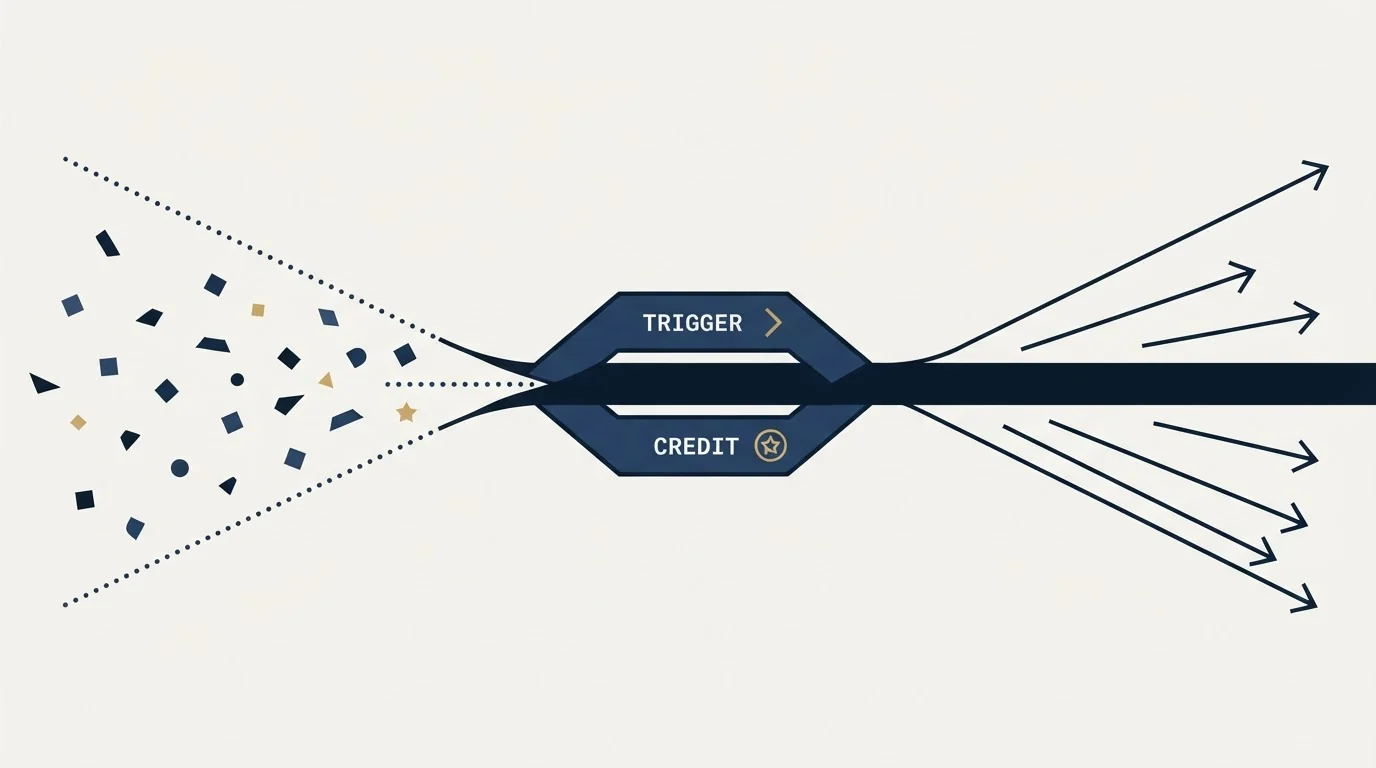
Allbound names inbound and outbound run as one motion, and both of the descriptions on the shelf are accurate about the intent. The work it creates is operational rather than strategic: a rule for what a signal may trigger, keyed on whether the person has already been contacted, and an attribution rule that reports origination and influence as separate lines.
Settle both before merging anything. Define pipeline once and count it at the same point on both sides. Treat a re-approach as a new campaign with a premise the signal actually supplies, rather than as a reminder of a message somebody already declined. And keep the two channels' different speeds in view, because a merged motion still has a slow half and a fast half, and only one of them answers this quarter.
Descriptions and definitions above are quoted from the two vendor pages linked in the text, fetched and verified 21 August 2026. Those pages also carry market statistics that are asserted without a primary citation, and none of them is repeated here.
Frequently asked questions.
Frequently asked questions- What is allbound marketing?
- An approach that runs inbound and outbound as one synchronised motion instead of two separate programmes, so content and campaigns generate signals that direct outbound effort, and outbound activity feeds people back into inbound channels. Vendor accounts of it usually also merge the teams, changing the development rep's job from list-working to signal-working.
- How is allbound different from multichannel outreach?
- Multichannel is about the number of channels one campaign uses to reach a person. Allbound is about the relationship between demand you captured and demand you created, so its distinguishing work is routing and attribution rather than channel selection. A team can run several channels and still keep inbound and outbound entirely separate.
- What should a buying signal be allowed to trigger?
- It depends on the prospect's state. On a never-contacted person the signal is an ordinary reason to write. On someone contacted with no reply, a reminder is a follow-up whatever triggered it, so the signal does not justify one. On someone already in a conversation, the signal is information for whoever holds that conversation.
- Who gets credit when both channels touched a deal?
- Decide it with a counterfactual rather than a timestamp. Ask whether the opportunity would exist at all without the earlier contribution: if not, that channel originated it, and if it would have existed but slower or smaller, that channel influenced it. Report the two as separate lines, because collapsing them is what breaks trust with finance.
About the author.

Ben Carden is CRO at RevenueFlow, which builds and operates outbound revenue engines for B2B companies. Previously at Gartner Enterprise. Studied at London School of Economics.
Ben Carden · CRO
Connect on LinkedIn →Explore more.
Ready to scale your outreach?
We build GTM engines that book real meetings. See the receipts.
Related articles.
5 ABM Campaign Examples and How Each One Is Built
Five worked account-based campaign examples, each built on the same five fields: account set, tier, plays in order, owner and handoff, and the exit condition.
Two Agencies, One Target List: Who Owns Which Accounts
Two outbound suppliers on one market will contact the same companies unless the buyer splits it first. How to cut the list, run the exclusion feed and check the overlap.
Define Content Syndication: Two Purchases Behind One Word
One budget line, two different purchases. Republication buys reach; lead syndication buys contact records produced by a download. The deliverable tells you which.
Last Outbound Agency Did Not Deliver: Locating the Failure
The leads were bad names a symptom and no stage. Four places an outbound engagement fails, the counts that separate them, and what to change in the next purchase.
HR Lead Generation: The Renewal Clock and Who Signs
An HR buyer who agrees with every word still cannot act outside their own renewal window. Which triggers are observable, and who signs.
When Outbound Stops Scaling: What Breaks First
Doubling the budget rarely doubles the meetings. The five constraints that bind in order, the signature each one leaves in the numbers, and what actually buys more.