Define Content Syndication: Two Purchases Behind One Word
One budget line, two different purchases. Republication buys reach; lead syndication buys contact records produced by a download. The deliverable tells you which.

Content syndication describes two purchases. Republication syndication places your article on a larger audience and buys reach. Lead syndication places a gated asset and delivers the contact records of people who downloaded it, priced per lead. If contact records are part of the deliverable, you are buying the second.
Key takeaways
- The deliverable separates the two senses. A placement and a link is republication; a spreadsheet of contacts against targeting filters is lead syndication, and the two carry different risks, different owners and different measures of success.
- Google's canonicalization documentation states that a canonical link element is not recommended for avoiding duplication by syndication partners, and that the most effective solution is for partners to block indexing. Most syndication advice says the opposite.
- A syndicated lead is a person who agreed to receive a document, not a person who asked to speak to anyone. Routing those records into a rep's call queue produces exactly the friction the record's own history predicts.
- Consent is inherited from the publisher's form, so the notice that person saw governs what you may do next. Settle the consent wording, exclusivity and duplicate handling before the first delivery rather than after the first complaint.
Reviewed and updated August 28, 2026
Two marketers approve a line item called content syndication in the same week. One of them gets their best guide republished on three industry sites with a link back. The other gets a spreadsheet of contacts who downloaded a whitepaper, and an invoice priced per contact.
Both are correctly named. Content syndication is one phrase covering two purchases that share almost nothing: what you buy, what arrives, who owns the result and what can go wrong are different in every case. Most of the confusion in budget meetings about this line traces to nobody asking which one is on the table.
The two definitions
Republication syndication. Your article, video or podcast is republished somewhere with a larger audience. You keep authorship, the partner keeps the traffic, and you are buying reach and attribution rather than contacts. The commercial form is a paid placement on a publisher; the free form is republishing to Medium, LinkedIn or a partner blog and asking for a link home.
Lead syndication. A publisher or lead vendor puts your gated asset in front of their audience, and the people who fill in the form become contact records they deliver to you. You are buying the records. The asset is the mechanism, and the pricing is usually per lead against targeting filters like industry, company size, geography and job title.
The word is the same because the mechanism looks the same from a distance: your content appears on somebody else's property. The deliverable is what separates them. If contact records are part of what you receive, you are in the second market. Both purchases sit under one heading in a digital marketing budget, which is where the confusion starts: content syndication in digital marketing means either of them depending on who is selling, and the deliverable stays the only reliable way to tell which one is on the table.
- Deliverable is a placement and usually a link
- Success is measured in referral traffic and authority
- The risk is search duplication, not consent
- Priced per placement or per campaign
- Your marketing team owns the outcome
- Deliverable is a list of contacts with fields
- Success is measured in what those records become
- The risk is consent, quality and duplication of spend
- Priced per lead against targeting filters
- Sales usually inherits the outcome
What republication actually costs you, and the guidance most articles get wrong
The standard worry about republishing is that Google will treat the copy as duplicate content and rank the partner instead of you. The standard advice, repeated across most syndication articles, is to have the partner add a canonical tag pointing at your original.
Google's own documentation says something different. Its canonicalization troubleshooting page states plainly that "the canonical link element is not recommended for those who want to avoid duplication by syndication partners, because the pages are often very different", and that "the most effective solution is for partners to block indexing of your content."
That is a meaningful difference in what you ask for in the deal. Asking a publisher to add a canonical tag is asking for something Google does not recommend for this case. Asking them to block indexing is a bigger ask commercially, because it removes the search value of the page for them, and it is the thing that actually protects you. A partner who agrees to neither is fine as long as you have decided that the audience is worth the search risk, which is a legitimate choice made deliberately rather than by default.
What arrives when you buy leads

A syndicated lead is a person who agreed to receive a document. That sentence is the whole thing, and holding it in mind prevents most of the disappointment.
They did not ask to speak to anyone. They did not compare you to an alternative. In many cases they wanted the specific artefact, and the form was the price. That is not a criticism of the channel, because a great many real buyers do start by reading something, and a document downloaded by the right person at the right company is genuine evidence of a topic being live. It is a caution about what happens next.
Teams that still treat every download as a ready buyer will find the funnel stage where content maps thin out a useful way to see why the middle stage resists a content schedule.
Three things follow, and each is a decision worth making before the first invoice.
A syndicated lead is not a meeting request, so do not route it like one. Handing these records straight to a rep's call queue produces exactly the friction you would expect, because the person on the other end has no memory of asking. The stage vocabulary that keeps this argument out of the monthly review is in MQL vs SQL, and the acceptance step it describes matters more here than anywhere else.
Fit and behaviour have to stay separate. A download is one behaviour signal of modest strength, and a scoring model that adds it to a fit score produces a number that cannot tell a good-fit company's intern from a poor-fit company's whole team. The full argument is in qualified lead marketing, and syndicated records are the population that breaks single-score models fastest, because the behaviour they carry is bought rather than volunteered.
Consent is inherited, not created. The permission that record carries came from the publisher's relationship with that person, under whatever notice their form displayed. What you may do with it afterwards is governed by that notice and by the law in the contact's jurisdiction, and the vendor is the only party who can tell you what it said. Ask for it in writing before the first delivery rather than after the first complaint.
- Yes: The exact consent language the person saw on the form
- Yes: Whether records are exclusive to you or resold to others in your category
- Yes: How duplicates against your existing database are handled and credited
- Yes: Which targeting filters are enforced at capture rather than at reporting
- Depends: The replacement policy for records that fail your own verification
- Depends: Whether any qualifying question was asked beyond the download
The premium tiers, and how to read them
Lead-syndication vendors rarely sell one product. Above the plain per-lead rate sit tiers with names like intent-qualified, content-consumption-qualified, or marketing-qualified, and each carries a higher price on the promise of a stronger signal. The names are not standardised across vendors, so the tier label tells you nothing on its own and the underlying mechanism tells you everything.
Ask what physically happened differently to produce a premium record. Sometimes the answer is real: the person answered qualifying questions on the form, or the vendor observed them reading several related pieces before they converted, or a human called to confirm a detail. Sometimes the answer is that the record was drawn from a narrower targeting filter, which is a fit improvement rather than an intent one and is worth paying for on different grounds. And sometimes the tier is a repackaging of the same capture with a longer field list attached.
The distinction is worth pressing because the two improvements behave differently once the records land. Better fit reduces the share you discard on arrival. Stronger intent, if it is genuine, shortens the distance to a conversation. A vendor who can describe which of the two they are selling is usually selling the thing they describe. What third-party intent signals actually predict, and what they do not, is set out in B2B intent data.
The number nobody can give you honestly

Cost per syndicated lead is the figure everyone wants and the one worth being careful about. The published ranges circulating on vendor and agency blogs disagree with each other by an order of magnitude, and none of them traces to a source that can be checked. No figure appears on this page for that reason.
What is worth doing instead is arithmetic on your own numbers, which is both more useful and actually available to you. Take the delivered cost of a batch, then the share of those records that survived your own fit criteria, then the share of the survivors that reached a real conversation. The third number is small and it is the only one that matters, because a cheap lead that never converts to a conversation is more expensive than an expensive one that does. The method for building that calculation properly is in cost per lead B2B.
The comparison that usually decides the budget is against the other ways of getting the same conversation. Buying records means paying for people who raised a hand for a document, and reaching a defined list means paying to contact people who fit whether or not they have raised a hand. The two produce different populations, and the second reaches accounts that will never appear in any syndication feed. Where each one sits in a broader plan is set out in outbound marketing tactics.
Where we sit
RevenueFlow does not sell syndicated leads and does not resell anybody's records. We run cold email and LinkedIn outbound against a list built to an agreed profile, and we are paid per qualified meeting against criteria written down before anything sends. That is our documented policy rather than a comparison claim, and it is stated here because the distinction is the practical one for a marketer choosing between the two lines in a budget.
The honest version of the trade is that syndication buys volume of records with modest evidence attached, and outbound buys a smaller number of conversations with people you chose. Both are legitimate. The failure mode is buying the first and measuring it as though it were the second, which is what produces the recurring argument about lead quality that neither side can win.
The short version
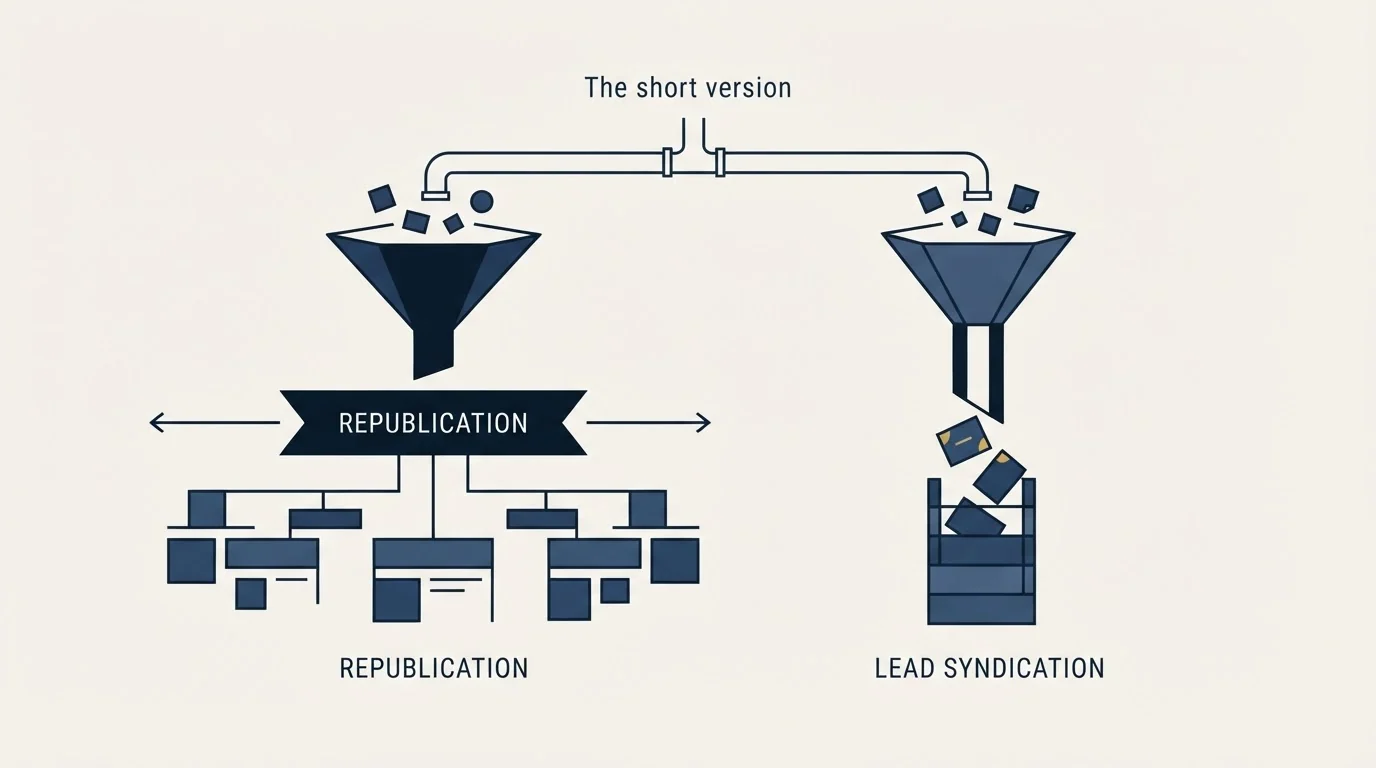
Content syndication means two different purchases. Republication buys reach, and its real risk is search duplication, where Google's own guidance is to have partners block indexing rather than to rely on a canonical tag. Lead syndication buys contact records produced by a download, and its real risks are consent, exclusivity and duplication of spend.
Ask which one is being sold, ask what the consent notice said, keep fit and behaviour as separate numbers, and do the cost arithmetic on your own delivered batch rather than on a published benchmark.
If the accounts you want are ones that will never fill in anybody's form, that is the other motion: we will build one campaign against your list and you can read the replies.
Google's syndication guidance quoted above is from its Search Central canonicalization troubleshooting documentation, fetched 22 August 2026. Confirm current guidance against Google's own page before relying on it.
Frequently asked questions.
Frequently asked questions- What is content syndication in B2B marketing?
- Two things. Republication syndication is your content appearing on a larger publisher with attribution and usually a link back, and you are buying reach. Lead syndication is a publisher putting your gated asset in front of their audience and delivering the contact records of people who filled in the form, priced per lead against targeting filters. Ask which is on the table.
- Does syndicated content hurt SEO?
- It creates a search duplication question you should decide deliberately. Google's canonicalization troubleshooting page states that the canonical link element is not recommended for avoiding duplication by syndication partners, because the pages are often very different, and that the most effective solution is for partners to block indexing of your content.
- What is a syndicated lead actually worth?
- It depends entirely on what you do with it, and no honest published benchmark exists. The circulating cost-per-lead ranges disagree by an order of magnitude and none traces to a checkable source. Do the arithmetic on your own delivered batch: cost, then the share surviving your fit criteria, then the share reaching a real conversation.
- How is content syndication different from outbound?
- Syndication buys records from people who raised a hand for a document, so the population is limited to people who converted on somebody's form. Outbound reaches a list you defined whether or not anyone raised a hand, which includes accounts that will never appear in a syndication feed. Both are legitimate, and each needs measuring on its own terms.
About the author.

Ben Carden is CRO at RevenueFlow, which builds and operates outbound revenue engines for B2B companies. Previously at Gartner Enterprise. Studied at London School of Economics.
Ben Carden · CRO
Connect on LinkedIn →Explore more.
Ready to scale your outreach?
We build GTM engines that book real meetings. See the receipts.
Related articles.
On-Demand Webinars: What Changes When You Take the Date Away
A live webinar earns most of its value from the date. Removing it keeps the topic signal and the address, and loses the deadline, the burst and the room.
Allbound: Merging Inbound and Outbound
Allbound runs inbound and outbound as one motion. Merging them creates two decisions: what a signal may trigger, and who is credited when both touched the deal.
eWebinar Pricing: Two Meters and a Level That Moves
eWebinar does not ask you to pick a plan. Published webinars set the level and registrants set the overage, and the two directions do not move on the same schedule.
BrightTALK Pricing: What the Vendor Does Not Publish
Six BrightTALK surfaces carry no price at all. The $500 figure filling that gap is a 2022 scrape on a listing the vendor says it does not manage.
Google Cloud Marketplace: What a Listing Changes
A Cloud Marketplace listing moves a purchase onto an agreement your buyer already holds. Google's own requirements explain what it will not do.
Deal Registration: Who Owns a Contested Deal
Deal registration lets a partner claim an opportunity before pursuing it. The policy is tested once, in public, on the first deal your direct team also wants.